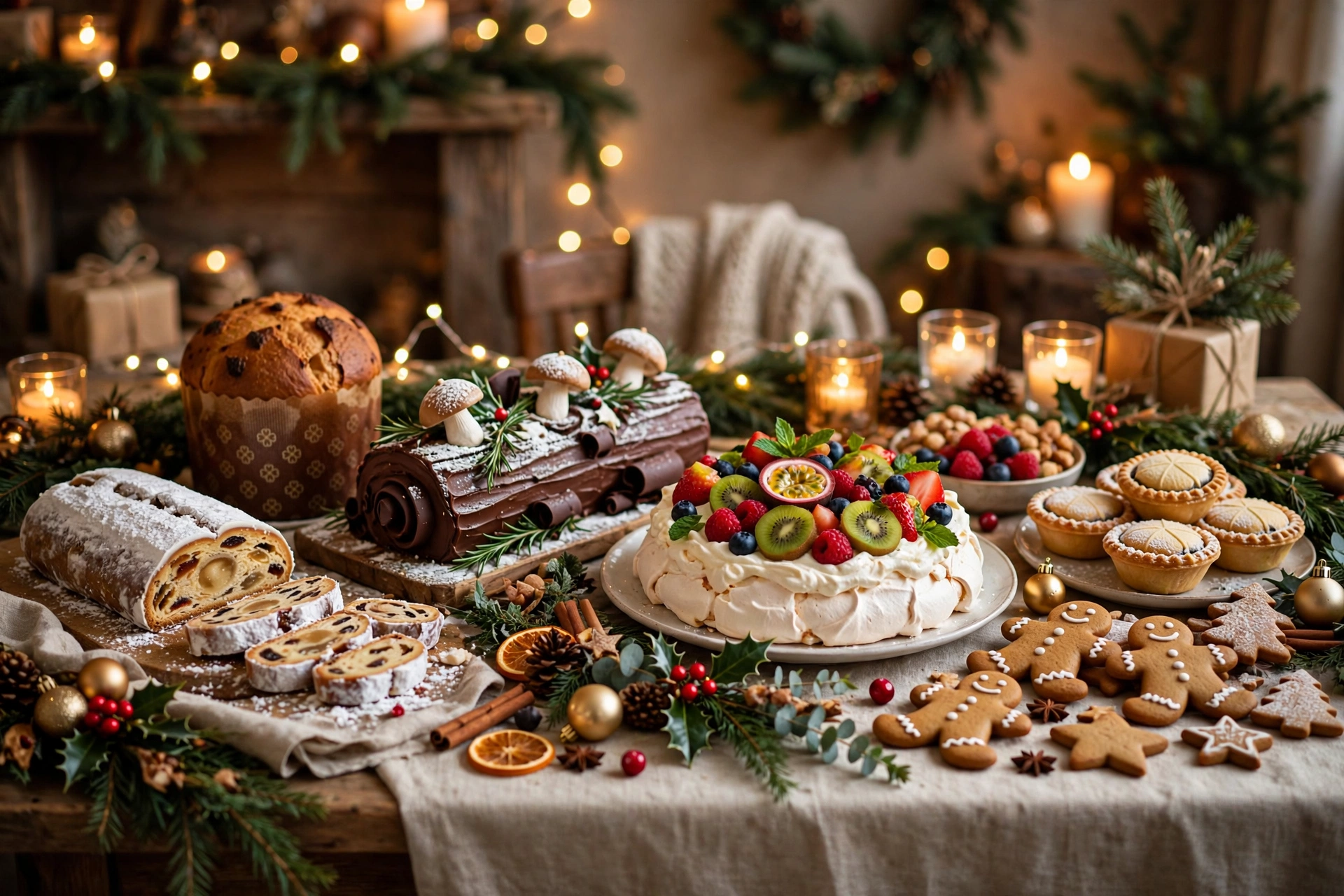
Every culture crowns its Christmas table with something sweet — and the world’s holiday desserts are as varied as they are delicious. This christmas desserts around the world roundup tours the globe’s most beloved festive sweets: Germany’s fruit-packed stollen, Italy’s towering panettone, France’s elegant bûche de Noël, Australia’s summer pavlova, and many more. Whether you are planning a multicultural dessert table, looking for a new baking project, or simply curious about what the rest of the world eats when the carols start, this guide is your passport to the sweetest side of Christmas.
Europe’s Classic Christmas Desserts
Stollen — Germany
The king of German Christmas baking: a dense, buttery loaf packed with dried fruit, candied citrus peel, and marzipan, dusted thickly with powdered sugar to resemble a snow-covered landscape. Dresdner Stollen — from Dresden, where the tradition is centuries old — is protected by a bakers’ association and stamped with an official seal. Stollen is baked weeks before Christmas and aged, wrapped tightly, so the flavors meld; a well-made stollen keeps for a month and improves with time. Serve in thin slices with coffee or glühwein. The marzipan center (Marzipanstollen) is the connoisseur’s choice.
Panettone — Italy
Milan’s gift to world Christmas: the tall, domed, impossibly light sweet bread studded with raisins and candied orange peel. True panettone is a feat of natural leavening — a three-day process with a living starter (lievito madre) that produces its characteristic airy crumb and tall rise. Artisanal panettoni bear no resemblance to dry mass-market versions; the best are fragrant, buttery, and feather-light. Italians serve panettone with mascarpone cream or a glass of spumante, and the great panettone-vs-pandoro debate (pandoro being Verona’s star-shaped, simpler rival) is a beloved holiday argument. For more Italian holiday traditions, see our sibling guide to the Feast of the Seven Fishes.
Bûche de Noël — France (and Belgium, Quebec, and beyond)
The Yule log: a chocolate (or chestnut, coffee, or praline) sponge rolled around buttercream, frosted to resemble bark, and decorated with meringue mushrooms, holly, and powdered-sugar snow. Born in 19th-century Parisian pâtisseries as an edible version of the traditional Yule log burned in the hearth, the bûche is now the definitive French Christmas dessert — and a fixture in Belgium, Quebec (where it anchors the French Canadian Christmas tourtière réveillon), and former French colonies. Modern pâtissiers turn it into high art each December; home bakers can achieve a beautiful classic with a jelly-roll sponge and chocolate ganache.
Christmas Pudding — England
The dark, dense, brandy-soaked steamed pudding — aged for weeks, flamed with brandy at the table, and served with hard sauce or brandy butter — is the great survivor of Victorian Christmas. Traditionally made on “Stir-up Sunday” (the last Sunday before Advent), with every family member stirring the batter and making a wish, the pudding is a ritual as much as a dessert. Love it or loathe it, no English Christmas is complete without the flaming entrance.
Mince Pies — England
Small, buttery pastry pies filled with mincemeat — a rich mixture of dried fruit, suet (or vegetarian substitute), spices, and brandy, with no meat despite the name. Eaten warm with clotted cream or brandy butter throughout December, mince pies are England’s definitive Christmas nibble — and leaving one out for Father Christmas on Christmas Eve is non-negotiable.
Vanillekipferl and Lebkuchen — Austria and Germany
Austria’s Christmas cookie culture is legendary: Vanillekipferl (vanilla crescents — delicate, nutty, rolled in vanilla sugar), Linzer cookies, and Lebkuchen (spiced honey gingerbread, often chocolate-coated) fill festive tins. In Nuremberg, Elisenlebkuchen — the flourless, nut-rich premium gingerbread — is protected by law. Austrian families bake dozens of varieties; the cookie platter is the season’s currency.
Melomakarona and Kourabiedes — Greece
Greece’s Christmas is a cookie war between two champions: melomakarona — honey-soaked, walnut-topped spiced cookies — and kourabiedes — buttery almond shortbreads buried in powdered sugar. Families declare allegiance; bakeries sell both by the kilo. Our Greek Christmas food traditions guide explores the full holiday table, including the christopsomo (Christ bread).
Pan de Pascua and Turrón — Spain and Latin America
Spain’s Christmas sweet table features turrón — the almond nougat of Alicante (hard) and Jijona (soft) — and polvorones, crumbly almond shortbreads that dissolve on the tongue. In Chile and much of Latin America, pan de Pascua — a dark, spiced fruit cake — is the Christmas cake. Our Spanish Christmas dinner traditions guide covers the full festive menu.
Christmas Desserts of the Americas
Bolo Rei — Portugal
The “king cake”: a crown-shaped sweet bread studded with candied fruit and nuts, hiding a dried fava bean and a small trinket — whoever finds them is “king” (and, traditionally, buys next year’s cake). Eaten from Christmas through Epiphany (Dia de Reis), when the three kings are celebrated. See our Portuguese Christmas dinner guide for the savory side.
Black Cake / Rum Cake — Jamaica and the Caribbean
The dark, magnificent fruit cake of the Caribbean: dried fruits soaked in rum and port for months, baked into a dense, moist, intensely flavored cake. Jamaica’s version — detailed in our Jamaican Christmas dinner guide — is the most famous, but Trinidad, Barbados, and the other islands all have their beloved variants. It is fruitcake’s glorious redemption.
Tres Leches and Flan — Latin America
Across Mexico, Central, and South America, Christmas dessert tables feature tres leches cake (sponge soaked in three milks), caramel flan, and buñuelos (crisp fritters drizzled with piloncillo syrup). In Mexico, the Rosca de Reyes (Three Kings bread) on January 6th extends the sweet season past Christmas itself.
Sugar Pie and Nanaimo Bars — Canada
French Canada contributes tarte au sucre (sugar pie — a caramel custard pie of maple or brown sugar) to the Christmas table, while English Canada’s Nanaimo bars (chocolate-coconut-graham layers with custard buttercream) and butter tarts appear on holiday trays nationwide. The French Canadian tourtière réveillon traditionally ends with bûche de Noël and sucre à la crème (maple fudge).
Summer Christmas Desserts: The Southern Hemisphere
Pavlova — Australia and New Zealand
The great Trans-Tasman rivalry in dessert form: the pavlova — a crisp meringue shell with a marshmallowy center, piled with whipped cream and summer fruit (passionfruit, kiwi, berries, mango) — is the definitive Australasian Christmas dessert. Light, cool, and spectacular, it is perfectly engineered for a hot December 25th. Both Australia and New Zealand claim its invention (the evidence favors New Zealand, but the debate is eternal and best conducted over a slice).
Trifle — Australia, New Zealand, South Africa, and Britain
The trifle — layers of sponge, jelly, custard, fruit, and cream in a glass bowl — is the Commonwealth’s great Christmas dessert: cool, make-ahead, endlessly adaptable, and designed to feed a crowd. South African Christmas tables feature it alongside malva pudding; Australian tables pair it with pavlova; English tables would not be without it. See our South African Christmas braai menu for the full summer-Christmas spread.
Malva Pudding — South Africa
South Africa’s most beloved dessert: a spongy apricot-jam pudding soaked in hot cream sauce, served warm with custard or ice cream. Rich, caramel-sweet, and deeply comforting, malva pudding closes the Christmas braai and appears at every South African celebration worth the name.
Mango Sticky Rice and Tropical Fruits — Southeast Asia
In the Philippines — which celebrates the world’s longest Christmas season, starting in September — the noche buena (Christmas Eve feast) dessert table features bibingka (rice cake), puto bumbong (purple rice cakes), and leche flan. Across tropical Asia, the Christmas sweet is often simply the season’s magnificent fruit: mangoes, mangosteens, rambutans, and durian for the brave.
Christmas Desserts of Eastern Europe and Beyond
Bejgli — Hungary
The elegant rolled pastry of Hungarian Christmas: sweet yeast dough wrapped around dense walnut (diós) or poppy seed (mákos) filling, sliced to reveal the spiral. A December ritual in every Hungarian household — and the sweet finale of the Hungarian Christmas Eve table.
Makowiec and Kutia Sweets — Poland and Ukraine
Poland’s makowiec (poppy seed roll) and piernik (gingerbread) anchor the Wigilia (Christmas Eve) sweet table, while Ukraine’s kutia — wheat berries with honey, poppy seeds, and walnuts — is both the sacred first dish of Sviata Vecheria and its sweet soul. Our Ukrainian Christmas Eve supper guide covers all twelve dishes.
Bebinca and Kuswar — Goa, India
Goa’s Christmas sweet table is one of the world’s great hidden treasures: bebinca (the 16-layer coconut-milk pudding), neuris (coconut pastries), kulkuls (sugar-dusted curls), dodol, and marzipan fruits — the kuswar platter. Our Indian Christmas sweets kuswar guide is the full tour.
Vasilopita — Greece (New Year)
Straddling Christmas and New Year: the vasilopita, a cake or pie baked with a hidden coin for St. Basil’s Day (January 1st) — whoever finds the coin gets luck for the year. Sweet, symbolic, and a lovely bridge between the holidays.
How to Build a Around-the-World Christmas Dessert Table
Inspired to go global? Here is how to assemble a showstopping international dessert spread:
- Pick 4–6 desserts from different regions — enough for variety without chaos. A classic lineup: stollen (Germany), panettone (Italy), bûche de Noël (France), pavlova (Australia), black cake (Jamaica), and bejgli (Hungary).
- Label everything: Small cards with each dessert’s name and country turn the table into a conversation piece — and help guests with allergies navigate.
- Balance textures: Mix light (pavlova, bûche) with rich (black cake, stollen), and include fresh fruit for palate relief.
- Make ahead strategically: Stollen, black cake, and bejgli improve with age — bake weeks ahead. Pavlova and trifle are best assembled near serving time.
- Add drinks: Coffee, glühwein, port (for the black cake and stollen), and champagne (for the panettone) complete the experience.
- Tell the stories: The pavlova rivalry, the stollen seal, the hidden coin — every dessert has a tale, and the tales are half the dessert.
For the savory side of global Christmas tables, our Christmas dinner ideas collection is the perfect companion.
Baking Project Picks: Start Here
New to global Christmas baking? These are the most rewarding starting points:
- Easiest: Pavlova — meringue, cream, fruit. Dramatic results, minimal technique.
- Most impressive for the effort: Bûche de Noël — a jelly-roll sponge is very achievable, and the decoration is pure theater.
- Best make-ahead: Stollen — bake in late November, age it, and look like a genius on Christmas Day.
- Most fun with kids: Decorating Lebkuchen or gingerbread — see our Christmas decoration ideas for edible décor inspiration.
- Most exotic: Bebinca — the layered Goan pudding is a genuine adventure and a guaranteed conversation piece.
Christmas Desserts of Scandinavia
Pepparkakor and Lussekatter — Sweden
Sweden’s Christmas is inseparable from pepparkakor — thin, crisp ginger snaps, often heart- or star-shaped — eaten with blue cheese and glögg (mulled wine) in a combination that surprises outsiders and delights Swedes. For St. Lucia’s Day (December 13th), lussekatter — saffron-yellow buns shaped like curled cats’ tails, studded with raisins — are served by candlelight processions. Saffron buns at Christmas are a Swedish luxury: saffron is precious, and the golden buns glow like the candles.
Joulutorttu — Finland
Finland’s joulutorttu — pinwheel-shaped puff pastries with prune jam centers — are the stars of the Finnish Christmas coffee table (joulupöytä). Crisp, buttery, and jewel-like, they are eaten throughout December with endless coffee. Our sibling guide to the Finnish joulupöytä Christmas table covers the full savory spread.
Risalamande — Denmark
Denmark’s beloved Christmas dessert: risalamande — cold rice pudding folded with whipped cream, chopped almonds, and vanilla, served with hot cherry sauce — with a game attached. A single whole almond is hidden in the bowl; whoever finds it wins a prize (traditionally a marzipan pig). The Danish Christmas dinner guide has the full story, from flæskesteg to this almond lottery.
Kransekake — Norway
Norway’s tower cake: kransekake — rings of almond-marzipan dough stacked into a cone, decorated with icing and flags — is the centerpiece of Norwegian celebrations, Christmas included. Pulling a ring from the tower is interactive dessert at its most architectural.
Christmas Sweets of the Middle East and Africa
Kahk and Ma’amoul — Egypt and the Levant
In Egypt, Christian families bake kahk — buttery shortbread cookies dusted with powdered sugar, sometimes filled with dates or nuts — for Christmas (and Eid). Across the Levant, ma’amoul — date-filled semolina cookies pressed in carved wooden molds — mark both Christmas and Easter. These ancient cookies, with their intricate patterns, are edible art.
Malva Pudding and Koeksisters — South Africa
Beyond the trifle, South Africa’s Christmas sweet table features koeksisters — syrup-soaked twisted pastries, crisp and sticky — and melktert (milk tart), the cinnamon-dusted custard tart that appears at every gathering. See our South African Christmas braai menu for the complete summer-Christmas feast.
Basbousa and Baklava — Across the Region
In Christian communities from Lebanon to Ethiopia, Christmas sweet tables feature the region’s great syrup-soaked pastries: baklava (layered filo with nuts and honey), basbousa (semolina cake soaked in syrup), and kataifi (shredded pastry with nuts). In Ethiopia, where Christmas (Genna) falls on January 7th, the feast includes tej (honey wine) and sweet breads.
Christmas Desserts of Asia
Japanese Christmas Cake
Japan’s Christmas is a fascinating import culture: the kurisumasu kêki — a light sponge layered with whipped cream and strawberries, decorated like a snowy winter scene — is the nation’s Christmas icon, sold by the millions each December. Paired, famously, with KFC (a marketing triumph of the 1970s that became genuine tradition), the strawberry shortcake is Christmas in Japan.
Bibingka and Puto Bumbong — Philippines
The Philippines’ simbang gabi (dawn Masses) are followed by street stalls selling bibingka (rice cakes baked in banana leaves with salted egg and cheese) and puto bumbong (purple sticky-rice cakes steamed in bamboo tubes, topped with coconut and muscovado sugar). These are Christmas morning in edible form — and the world’s longest Christmas season deserves exceptional sweets.
Plum Cake — India
India’s Christian communities — in Goa, Kerala, and beyond — bake dark, rum-soaked plum cakes every December, alongside the kuswar platter of neuris, kulkuls, and bebinca. Kerala’s bakeries are legendary for their Christmas cakes; our Indian Christmas sweets kuswar guide is the definitive tour.
Pairing Drinks with Christmas Desserts
- Port and stollen/black cake: A tawny port is the classic match for aged fruit cakes — the nutty wine echoes the dried fruit.
- Champagne and panettone: The Italian tradition — bubbles cut the buttery richness beautifully.
- Glühwein and gingerbread: Mulled wine with Lebkuchen, pepparkakor, or mince pies is December in a cup.
- Coffee and everything Scandinavian: The Nordic coffee table is a ritual — strong coffee with every cookie.
- Brandy and Christmas pudding: Both in the flaming and in the glass alongside.
- Hot chocolate and cougnou/churros: Thick drinking chocolate with sweet breads is the Belgian-Spanish axis of joy.
- Tea and trifle/pavlova: A proper pot of tea with the Commonwealth’s cool desserts.
The Stories Behind the Sweets
Christmas desserts carry legends as rich as their flavors:
- Stollen’s shape is said to represent the Christ child wrapped in swaddling clothes — the thick coat of powdered sugar is the swaddling.
- Panettone’s legend tells of a Milanese baker’s apprentice, Toni, who invented the tall bread to impress his beloved — pan de Toni, Toni’s bread.
- The bûche de Noël descends from the actual Yule log burned in medieval hearths; when fireplaces disappeared from Paris apartments, pâtissiers made the log edible.
- The pavlova was named for the Russian ballerina Anna Pavlova, whose 1920s tour of Australasia inspired chefs on both sides of the Tasman — hence the century-long argument.
- Mince pies were once oval, representing the manger, and filled with actual minced meat; the meat vanished over the centuries, but the name and the Christmas magic remained.
- The vasilopita coin honors St. Basil’s generosity — the hidden coin brings the finder a year of luck.
These stories are why Christmas desserts matter beyond flavor: each is a small, edible piece of cultural memory, passed down through generations of December kitchens. Bake one this year, learn its story, and you are keeping a tradition alive — which is, after all, what Christmas is for.
However you celebrate — with stollen or pavlova, black cake or bebinca — the world’s Christmas desserts share one ingredient no recipe lists: the joy of sharing something sweet with people you love. That is the true flavor of the season, in every country on earth.
In Pictures: Christmas Desserts Around the World
Every culture crowns its Christmas table with something sweet — from Germany's fruit-packed stollen to Australia's summer pavlova, the world's holiday desserts are a delicious geography lesson.
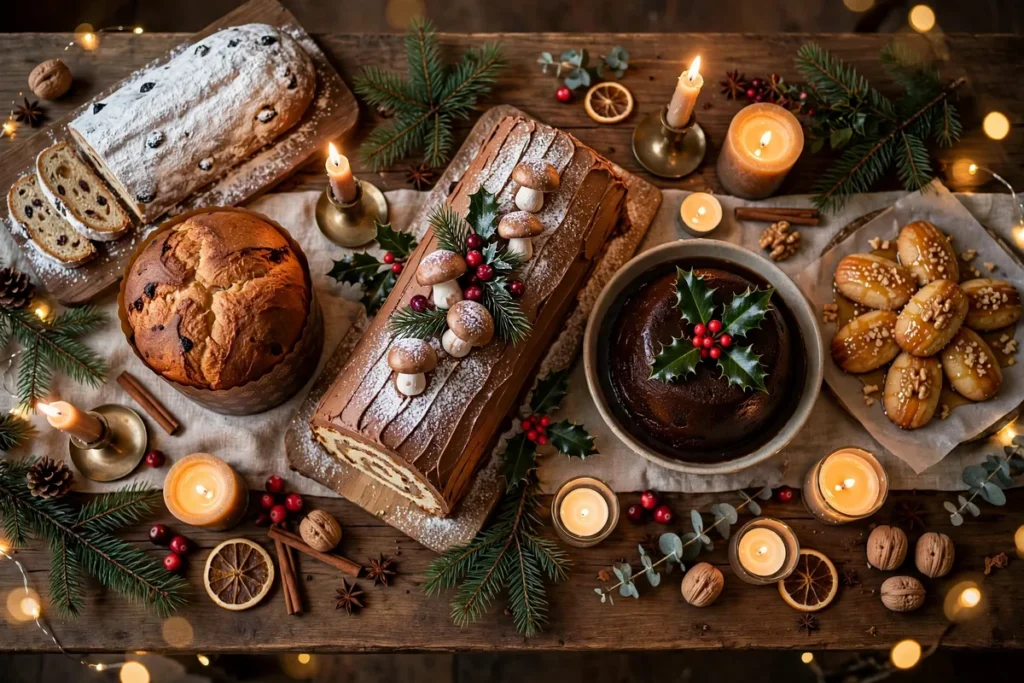
A world tour of Christmas desserts on one table: stollen, panettone, bûche de Noël, Christmas pudding, and melomakarona among the candles.
Watch: Christmas Desserts Around the World
Chef John of Food Wishes bakes five showstopping holiday desserts from around the world — yule log, panettone, Portuguese custard tarts, and more.
At a Glance: Christmas Desserts Around the World
The world's most beloved festive sweets, country by country.
| Dessert | Country | Key detail |
|---|---|---|
| Stollen | Germany | Dense, buttery loaf packed with dried fruit, candied peel, and marzipan, dusted with powdered sugar like snow; Dresdner Stollen is protected by a bakers' association seal |
| Panettone | Italy | Milan's tall, domed sweet bread — true panettone uses a three-day natural leavening with a living starter (lievito madre) |
| Bûche de Noël | France | The elegant yule log cake — chocolate sponge rolled with cream and decorated like a winter log |
| Christmas pudding | England | Dark, dense, brandy-soaked pudding of dried fruits and spices, traditionally aged for weeks and flamed at the table |
| Pavlova | Australia / New Zealand | Crisp meringue with whipped cream and fresh fruit — the summer Christmas dessert of the Southern Hemisphere |
| Melomakarona | Greece | Honey-soaked Christmas cookies with walnuts and orange — dipped in honey syrup while still warm |
| Lussekatter | Sweden | Saffron buns baked for St. Lucia's Day (13 December) — golden, S-shaped, and studded with raisins |
| Bibingka | Philippines | Coconut rice cake sold outside churches after Simbang Gabi dawn Masses through the Christmas season |
Frequently Asked Questions
What is the most popular Christmas dessert in the world?
There is no single winner, but the strongest contenders are panettone (Italy’s global export), stollen (Germany’s aged fruit loaf), bûche de Noël (France’s Yule log), Christmas pudding (England’s flamed classic), and pavlova (the Southern Hemisphere’s summer answer).
What is the difference between stollen and panettone?
Stollen is a dense, buttery German loaf packed with dried fruit and marzipan, dusted with powdered sugar and aged for weeks. Panettone is a tall, airy Italian sweet bread leavened over days with a natural starter, studded with raisins and candied peel. Both are Christmas icons; they share only the holiday.
What do Australians eat for Christmas dessert?
Pavlova — the meringue-and-fruit showpiece — is the definitive Australian (and New Zealand) Christmas dessert, suited to the Southern Hemisphere’s summer Christmas. Trifle is the other classic.
What is bûche de Noël made of?
A sponge cake rolled around flavored buttercream (chocolate, coffee, chestnut, or praline), frosted to resemble tree bark and decorated with meringue mushrooms and powdered-sugar “snow.” It represents the Yule log traditionally burned in the hearth.
What is Jamaican black cake?
Black cake (Jamaican Christmas or rum cake) is a dark, moist fruit cake made with dried fruits soaked in rum and port for weeks or months — rich, boozy, and completely unlike dry commercial fruitcake.
How far ahead can I make Christmas desserts?
Stollen and black cake: 3–4 weeks ahead (they improve with age). Bejgli and panettone: up to a week. Bûche de Noël: 1–2 days. Pavlova: bake the meringue a day ahead, assemble within hours of serving. Trifle: assemble the day before.