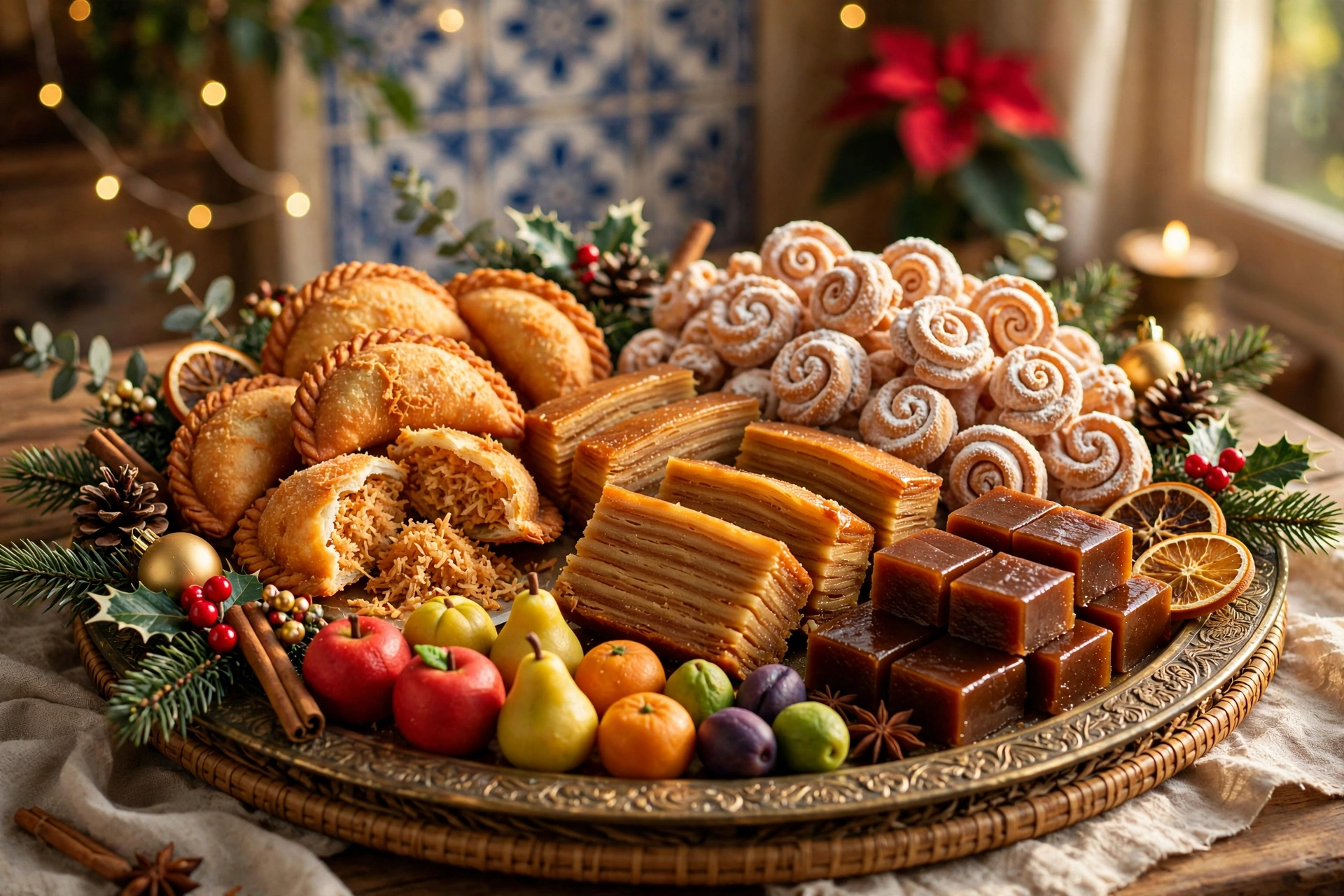
Christmas in India wears many delicious faces, but none is more delightful than the kuswar — the lavish platter of homemade sweets and savories that is the beating heart of Christmas in Goa and among Christian communities across India. The indian christmas sweets kuswar tradition turns December into a month-long festival of frying, baking, and sharing: kitchens fill with the scent of coconut, cardamom, and ghee, and no guest leaves a Goan home at Christmas without a box of kuswar pressed into their hands. This guide introduces the stars of the kuswar platter — from neuris and kulkuls to bebinca and dodol — explores the history of Christian Christmas in India, and shows you how to make these treats wherever you live.
What Is Kuswar?
Kuswar (also spelled kuswad) refers to the assortment of Christmas sweets and savories prepared in Goan Catholic homes — and increasingly in Christian households across Mumbai, Bangalore, Kerala, and the diaspora. The word covers dozens of individual treats, but the concept is singular: an abundant, beautiful platter that says “Christmas” more eloquently than any decoration. Traditionally, kuswar-making begins weeks before Christmas, often in the first week of December, and it is communal work — mothers, aunts, grandmothers, and neighbors gather to roll, shape, fry, and bake in marathon sessions, with children assigned to quality control.
The finished kuswar is distributed in decorative boxes and trays to family, friends, neighbors of all faiths, and colleagues — a gesture of goodwill that makes Christmas in Goa a shared celebration across religious lines. Receiving kuswar is one of the great pleasures of an Indian December. If you love discovering how the holiday table changes around the world, our Christmas desserts around the world roundup puts kuswar in festive global company.
Christmas in India: A Quick Portrait
Christianity has ancient roots in India — tradition holds that St. Thomas the Apostle arrived on the Kerala coast in 52 CE, and the Portuguese brought Catholicism to Goa in the 16th century. Today India’s Christian population, concentrated in Goa, Kerala, the Northeast states, and major cities, celebrates Christmas with enormous enthusiasm. Midnight Mass on Christmas Eve draws huge congregations; churches are decorated with lights and stars; and the crib (nativity scene) is a centerpiece of home décor.
Goan Christmas has its own distinctive flavor, shaped by 450 years of Portuguese influence layered over Konkani culture. The Christmas Eve Missa de Galo (midnight Mass), the sorpotel and vindaloo at the festive table, the bebinca for dessert — this is a Christmas unlike any other, tropical and joyful, where the season’s spirit is expressed through food as much as through worship. The kuswar platter is its sweetest ambassador.
The Stars of the Kuswar Platter: 12 Treats to Know
Every family’s kuswar is slightly different, but these twelve are the classics — the ones that define the platter:
1. Neuris (Nevris)
The queen of kuswar. Neuris are half-moon pastries — think Goan empanadas — with a crisp, flaky shell and a filling of grated coconut, jaggery (or sugar), cardamom, and sometimes poppy or sesame seeds. They are deep-fried until golden and keep for weeks in an airtight tin, which is why they are made in enormous batches. The crimped edge is the mark of an experienced hand; Goan grandmothers can pleat a neuri in seconds.
2. Kulkuls (Kidyo)
Tiny, crunchy, curl-shaped fritters — the most labor-intensive and most beloved of kuswar. A coconut-milk dough is rolled into small curls (traditionally shaped on a fork or a special kulkul mold), deep-fried, and tossed in powdered sugar or a light syrup glaze. Making kulkuls is a family assembly line: one person rolls, one shapes, one fries. Children are traditionally paid in kulkuls.
3. Bebinca
Goa’s most famous dessert and the crown jewel of the Christmas table. Bebinca is a rich, layered pudding made from coconut milk, sugar, egg yolks, flour, and ghee — built up one thin layer at a time, each grilled before the next is poured, until the cake stands seven, fourteen, or even sixteen layers tall. It is dense, caramel-sweet, and utterly unique: a legacy of Portuguese convent sweets adapted to tropical ingredients. Authentic bebinca takes hours and considerable skill; it is the ultimate Christmas flex.
4. Dodol
A dark, glossy, toffee-like sweet made by stirring coconut milk, jaggery, and rice flour for hours until it thickens into a dense, fudgy mass, often studded with cashews. Dodol is patience made edible — the stirring never stops, traditionally done by the men of the family taking turns at the pot. It is cut into diamond shapes and keeps for weeks.
5. Bolinhas (Coconut Cookies)
Delicate, crumbly coconut-semolina cookies, sometimes called bolinhas de coco, reflecting the Portuguese influence. Lightly spiced with cardamom, they melt in the mouth and are among the quicker kuswar items to make — a good entry point for beginners.
6. Perad (Guava Cheese)
Not cheese at all, but a firm, jewel-red guava paste — slow-cooked guava pulp and sugar set into slabs and cut into pieces. Perad glows like stained glass on the kuswar platter and its sweet-tart flavor cuts through the richer fried sweets. It is also a beloved Goan sweet year-round.
7. Marzipan Fruits
Goan marzipan — made from cashews rather than almonds — is sculpted and painted into astonishingly lifelike miniature fruits: mangoes, bananas, apples, and cashew apples. These jewel-like confections are the visual showpieces of the kuswar box, and making them is a genuine folk art passed down through families.
8. Milk Cream
Simple, nostalgic, and adored by children: milk cream is a fudge of milk, sugar, and cashews, often flavored with cardamom and shaped into small mounds or pressed into decorative molds. It is the first sweet to disappear from most kuswar tins.
9. Pinaca (Rice Fritters)
Crisp, lacy fritters of rice flour, coconut, and jaggery, deep-fried into golden nests. Less famous than neuris and kulkuls but deeply traditional — the kind of sweet that prompts Goans abroad to sigh with homesickness.
10. Baath (Coconut Semolina Cake)
A moist, rich cake of semolina, coconut, and ghee, sometimes called batica. It is the everyday celebration cake of Goa — served at christenings, weddings, and Christmas alike — and its tender crumb makes it a gentle counterpoint to the fried sweets.
11. Doce de Grão (Chana Doce)
A Portuguese-descended sweet of chickpeas (or split Bengal gram), coconut, and jaggery, slow-cooked into a dense, fudgy confection. It is less common in modern kuswar but prized by traditionalists as a taste of old Goa.
12. Savory Balance: Chaklis and Samosas
Kuswar is not all sweet. Savory fried snacks — crisp chaklis (spiral rice-flour crackers), shankarpali, cocktail samosas, and cutlets — provide the salty counterpoint that keeps the platter balanced. The sweet-savory rhythm is essential: a piece of perad, then a chakli, then a neuri.
How Kuswar Is Made: The December Kitchen
Understanding kuswar means understanding the labor behind it. In a traditional Goan household, kuswar-making is a production:
- Timing: Work typically begins in early December. Fried sweets (neuris, kulkuls, pinaca) are made first since they keep longest; cakes and marzipan come closer to Christmas.
- The workforce: It is communal. Neighbors and extended family gather for “kuswar days,” with stations for rolling, shaping, frying, and packing. Recipes are measured in kilos, not cups.
- The equipment: Huge kadhais (woks) of oil for frying, special molds for kulkuls and milk cream, and endless tins for storage. The bebinca requires a dedicated grill setup for layering.
- The economics: A full kuswar spread is a significant investment of ingredients — kilos of coconut, sugar, ghee, and cashews — which is why it is the centerpiece of Christmas generosity rather than everyday eating.
- The distribution: Finished kuswar is packed into boxes and trays and delivered across neighborhoods — to relatives, friends, Hindu and Muslim neighbors, coworkers, and the parish priest. The giving is as important as the eating.
For modern families short on time, many Goan bakeries and home-based businesses now sell ready-made kuswar — in Goa, Mumbai, and diaspora hubs like London, Toronto, and the Gulf states, December brings a thriving kuswar market. But the homemade platter remains the gold standard, and the day spent making it is part of the holiday itself.
Recipes to Try: Neuris and Kulkuls at Home
You do not need a Goan grandmother (though it helps) to start your own kuswar tradition. Here are simplified, reliable recipes for the two most iconic sweets.
Neuris (makes about 24)
Pastry: 2 cups flour, ½ teaspoon salt, 3 tablespoons ghee or oil, and just enough warm water to make a firm dough. Rest 30 minutes. Filling: 2 cups freshly grated coconut (or desiccated, moistened), 1 cup grated jaggery or brown sugar, ½ teaspoon cardamom, 2 tablespoons poppy seeds (optional), a pinch of salt. Cook the filling in a dry pan until the jaggery melts and the mixture comes together; cool. Roll the dough thin, cut 4-inch rounds, place a spoonful of filling on each, fold into half-moons, seal and crimp the edges with water. Deep-fry in medium-hot oil until golden, turning once. Drain on paper towels and cool completely before storing airtight — they keep 2–3 weeks.
Kulkuls (makes about 60 pieces)
Dough: 2 cups flour, ½ cup thick coconut milk, 2 tablespoons softened butter, 2 tablespoons sugar, ½ teaspoon cardamom, a pinch of salt. Knead to a smooth, firm dough; rest 30 minutes. Pinch off marble-sized pieces, flatten each on the back of a fork, and roll it up to form a curl. Deep-fry in batches in medium-hot oil until pale gold — they crisp as they cool. While still slightly warm, dust generously with powdered sugar. Store airtight; keeps 2–3 weeks. The shaping is the fun part — enlist the whole family.
Bebinca for the Ambitious
A simplified bebinca: whisk 1½ cups coconut milk, 1 cup sugar, 5 egg yolks, ½ cup flour, and a pinch of salt until smooth. Grease a 7-inch round pan. Pour in a thin layer (about ¼ cup), grill under a hot broiler until set and lightly golden, then repeat — layer after layer, about 10–12 layers — brushing each with melted ghee. Cool, unmold, and slice thin. It will not be a 16-layer Goan masterpiece, but it will be delicious.
The Christmas Table Beyond Kuswar
Kuswar is the sweet soul of Goan Christmas, but the savory table deserves its honor too. Christmas lunch in a Goan Catholic home is a magnificent affair:
- Sorpotel: The legendary pork curry of Goan Christmas — pork offal and meat slow-cooked with vinegar, spices, and sometimes blood, traditionally made days ahead and reheated (it improves with age). Served with sannas (steamed rice cakes).
- Vindaloo: Pork vindaloo, another vinegar-based curry, is a Christmas staple.
- Chicken cafreal or xacuti: Green-masala or roasted-spice chicken curries.
- Sannas: Fluffy steamed rice-and-coconut cakes, the essential accompaniment.
- Roast turkey or chicken: The Portuguese-British influence shows in the roast centerpiece many families serve.
- Plum cake: The dark, rum-soaked Christmas cake — aged for weeks, studded with dried fruit — is as essential as the kuswar itself.
Midnight Mass on Christmas Eve, the crib, the star lanterns (akash kandils in Maharashtra, similar stars in Goa), and carol singing complete the picture. Christmas in Goa is famously open-hearted: the beach shacks host parties, the churches glow, and the whole state seems to run on celebration through New Year’s. It is no wonder Goa ranks among the best places to spend Christmas for travelers seeking something beyond the ordinary.
Kuswar in the Diaspora
For Goans living abroad — in the Gulf states, the UK, Canada, Australia, and beyond — kuswar is homesickness management. December sees a flurry of couriered tins from home, community kuswar-making days at parish halls, and small businesses that spring up to supply the demand. Social media fills with photos of platters captioned with longing and pride. Making kuswar far from Goa is an act of cultural preservation: each neuri crimped in Toronto or Dubai keeps a thread to the ancestral kitchen intact. If you receive a box of kuswar this Christmas, know that you have been given something made with genuine love — and eat the kulkuls first, before anyone else gets to them.
The Plum Cake: Kuswar’s Dark, Boozy Cousin
No discussion of Indian Christmas sweets is complete without the plum cake — the dark, dense, rum-soaked fruit cake that is as essential to an Indian Christian Christmas as the kuswar itself. Unlike its lighter Western counterparts, the Indian Christmas plum cake is unapologetically rich: dried fruits (raisins, currants, candied peel, tutti frutti) are soaked in rum or brandy for weeks — sometimes months — before being folded into a dark, caramel-colored batter spiced with cinnamon, clove, and nutmeg.
The plum cake tradition arrived with the British and the Portuguese and was enthusiastically adopted and improved. In Kerala, the plum cake is a point of fierce bakery pride; legendary bakeries in cities like Kochi and Thiruvananthapuram sell thousands of cakes each December, and families guard their soaking jars like heirlooms. In Goa, the plum cake shares the table with bebinca, and in Anglo-Indian households it is the centerpiece of the Christmas tea table. A well-made plum cake, wrapped tightly, keeps for months and improves with age — many families cut the first slice on Christmas morning and the last at Easter.
Making one at home is a commitment worth making: soak 2 cups of mixed dried fruit in ¾ cup dark rum for at least two weeks (a month is better), then fold into a standard rich fruit-cake batter with burnt-sugar caramel for color. Bake low and slow, brush with rum while warm, and wrap tightly. Your December self will thank your November self.
Kuswar Etiquette: The Art of Giving and Receiving
The kuswar economy runs on generosity, and it has its own unwritten rules:
- Give abundantly: Kuswar is distributed widely — not just to close family but to neighbors of all faiths, colleagues, domestic helpers, and the parish community. The platter is an instrument of goodwill.
- Presentation matters: Kuswar is packed in decorative boxes, lined with festive paper, sometimes tied with ribbon. The box is part of the gift.
- Receive graciously: When given kuswar, accept it with both hands and genuine thanks. It represents days of someone’s labor.
- Reciprocate: The kuswar exchange is circular — families that receive give in return. December in Goa involves a constant, joyful circulation of sweet boxes.
- Share the story: If you are introducing kuswar to friends unfamiliar with it, explain what each sweet is. The stories — the bebinca’s sixteen layers, the kulkuls’ assembly line — are part of the flavor.
- Do not re-gift visibly: Passing along a kuswar box is normal in the circulation economy, but repackage it — and never return a box to the family that gave it to you.
This culture of edible generosity is one of the most beautiful aspects of Christmas in India, and it offers a lovely model for holiday giving anywhere: our best Christmas gifts guide celebrates the same spirit — the best gifts, edible or otherwise, are the ones made with care.
Sourcing Kuswar Ingredients Outside India
Making kuswar abroad requires a few specialty ingredients, but all are findable:
- Jaggery: Available at Indian grocery stores and online; dark brown sugar or palm sugar substitutes well.
- Fresh coconut: Frozen grated coconut (sold at Indian and Southeast Asian grocers) is far superior to sweetened desiccated coconut for neuris and kulkuls.
- Coconut milk: Use full-fat canned coconut milk for bebinca and dodol — light versions will not set properly.
- Ghee: Widely available at Indian grocers and many supermarkets; essential for authentic flavor.
- Cardamom and poppy seeds: Indian grocers sell them far more cheaply than mainstream spice aisles.
- Kulkul molds and jaggery: Indian stores stock the ridged wooden or plastic molds traditionally used for shaping kulkuls, though a fork works fine.
In cities with large Goan or Indian Christian communities — London, Toronto, Dubai, Sydney — December brings pop-up kuswar sales at churches and community centers, which is the easiest way to taste the real thing before attempting your own.
How to Eat a Kuswar Platter: A Tasting Order
Faced with a full kuswar box, restraint is difficult but strategy helps. Start with the delicate items — a marzipan fruit, a piece of milk cream — while your palate is fresh. Move to the fried classics: a neuri, then kulkuls, letting the coconut-cardamom flavors build. Take a savory break with a chakli or two to reset. Then the heavyweights: a thin slice of bebinca, a diamond of dodol, a piece of perad for its bright acidity. Finish with plum cake and a strong cup of chai or coffee. Pace yourself — the platter will still be there tomorrow, and that is entirely the point.
In Pictures: Indian Christmas Sweets and Kuswar
In Goa and Christian homes across India, Christmas means kuswar — a lavish platter of homemade sweets and savories, fried and baked in marathon December sessions and shared with neighbors of all faiths.
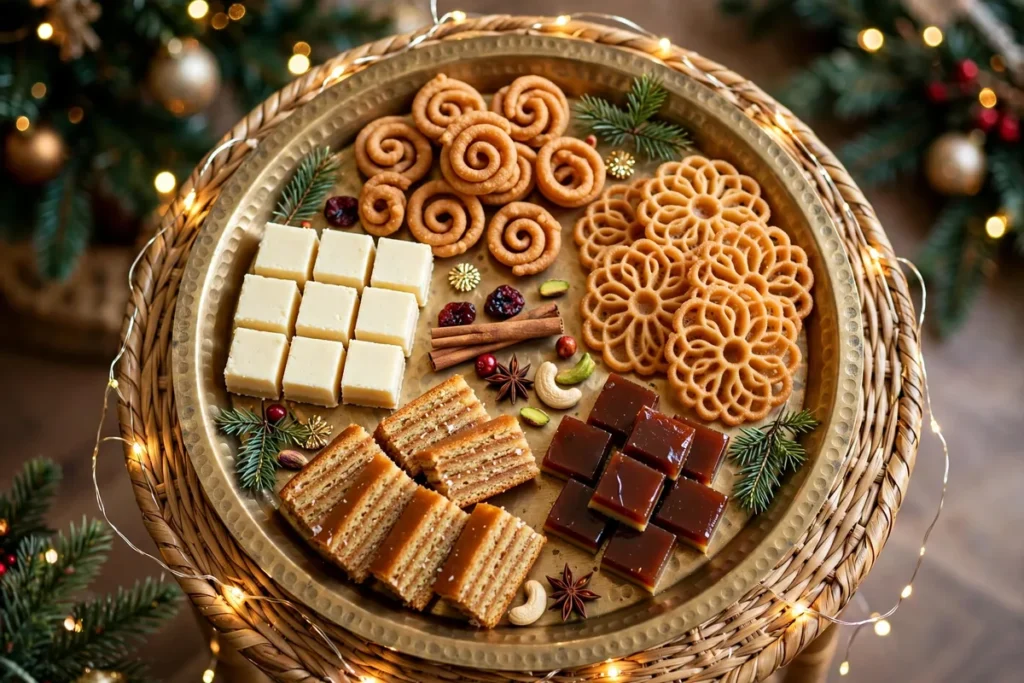
A kuswar platter in Goa: kulkuls, rose cookies, milk cream fudge, and bebinca arranged on a brass tray beneath the Christmas lights.
Watch: Indian Christmas Sweets and Kuswar
India Food Network's Joel makes kulkuls — the sweet fried curls at the heart of the Goan kuswar platter — step by step for Christmas.
At a Glance: Indian Christmas Sweets and Kuswar
The stars of the kuswar platter, from fried curls to the queen of Goan desserts.
| Sweet | What it is | Key detail |
|---|---|---|
| Kulkuls (kidyo) | Sweet fried curls | Dough of flour, ghee, and coconut milk shaped into curls and deep-fried; a Christmas staple in Goa and Mangalore |
| Rose cookies (kokkisan) | Lacy fried cookies | Made with a hot iron mould; rice flour and coconut milk batter fried into delicate rosettes |
| Nevri (neureos) | Sweet puffs | Crisp pastries stuffed with coconut and jaggery, fried golden for the Christmas tray |
| Bebinca | Layered cake | The queen of Goan desserts — many thin layers of coconut milk, egg, and ghee, baked one by one |
| Milk cream | Christmas fudge | Cashew and milk fudge, often shaped into festive forms; a kuswar essential |
| Dodol | Toffee-like sweet | Coconut, jaggery, and rice flour stirred for hours into a rich, dark confection |
| The sharing | The custom | Finished kuswar is boxed and distributed to family, friends, and neighbors of all faiths — Christmas in Goa is a shared celebration |
Frequently Asked Questions
What is kuswar?
Kuswar is the traditional assortment of Christmas sweets and savories made in Goan Catholic homes (and Christian households across India) — including neuris, kulkuls, bebinca, dodol, marzipan fruits, and more. It is prepared in December and shared generously with family, friends, and neighbors.
What are the most popular Indian Christmas sweets?
The icons are neuris (coconut half-moon pastries), kulkuls (sugar-dusted curls), bebinca (layered coconut-milk pudding), dodol (coconut-jaggery toffee), perad (guava cheese), marzipan fruits, milk cream, and rum-soaked plum cake.
How long does kuswar keep?
Fried sweets like neuris and kulkuls keep 2–3 weeks in airtight tins at room temperature. Bebinca and dodol keep about 2 weeks refrigerated. Marzipan fruits and milk cream keep 2–3 weeks refrigerated. Plum cake, properly stored, improves for weeks.
Is kuswar only a Goan tradition?
It originated in Goa’s Catholic community under Portuguese influence, but the tradition — or close variants — is now found among Christians across India, from Mumbai and Bangalore to Kerala and the Northeast, and throughout the Goan diaspora worldwide.
Can I buy kuswar instead of making it?
Yes. In December, Goan bakeries, home-based businesses, and online sellers in India and diaspora hubs (London, Toronto, Dubai, and others) sell ready-made kuswar assortments. Homemade remains the gold standard, but good commercial kuswar is widely available.
What is bebinca made of?
Bebinca is made from coconut milk, sugar, egg yolks, flour, and ghee, built up layer by layer — each thin layer grilled before the next is added — until the pudding stands 7 to 16 layers tall. It is dense, caramel-sweet, and uniquely Goan.