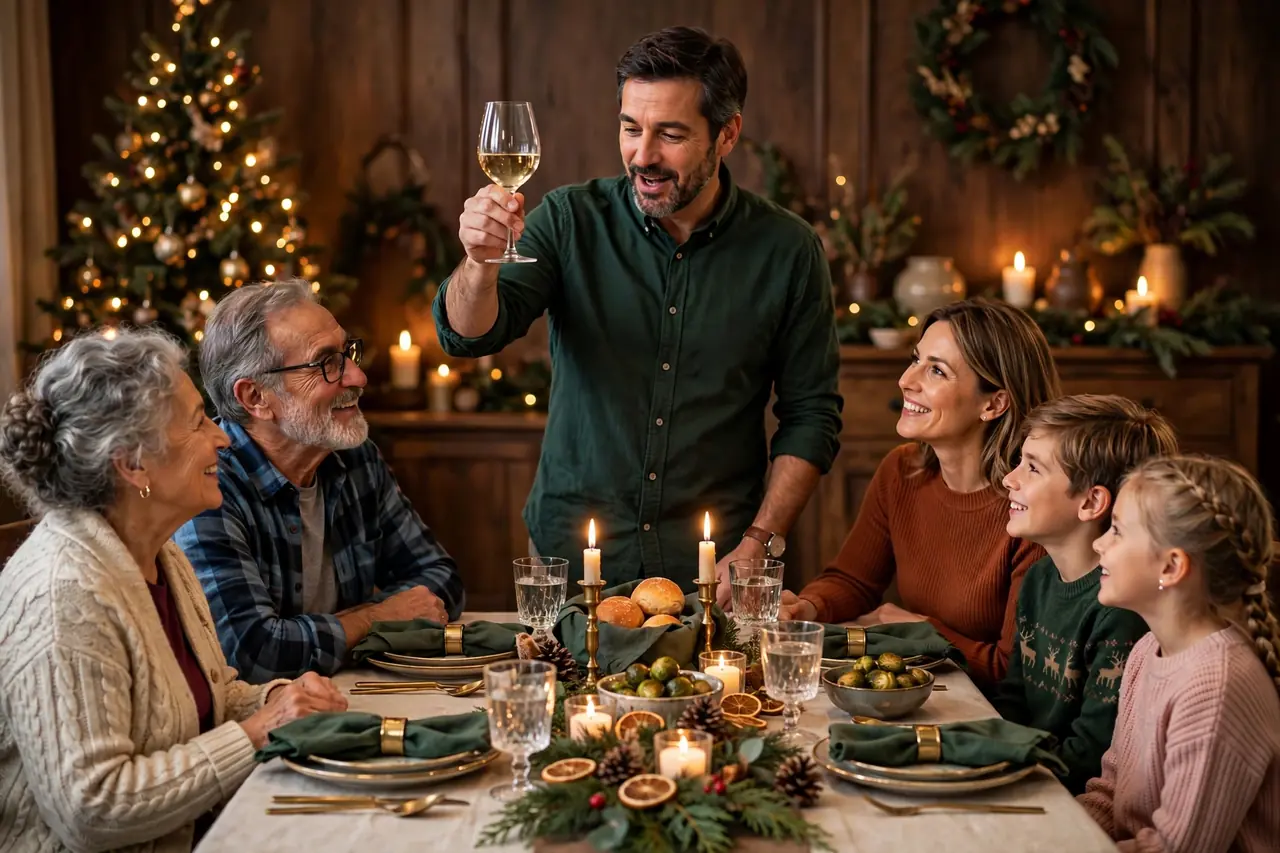
Every Christmas dinner has a moment when the plates are cleared, the candles are burning low, and someone, usually the host, usually with zero preparation, is expected to stand up and say something meaningful. It is one of the most human moments of the holiday: a room full of people who love each other, waiting to hear that love put into words. If the thought of being that person ties your stomach in knots, these Christmas dinner speech examples are here to untie it: fifteen complete, ready-to-deliver speeches for hosts, parents, grandparents, and guests, each one written to sound like a real person talking, not a greeting card reading itself aloud.
A Christmas dinner speech is not a wedding toast and not a eulogy. It is shorter than you fear and more forgiving than you imagine. Two to three minutes is the sweet spot: long enough to say something real, short enough that nobody’s dessert gets cold. The speeches that land best are not the most eloquent; they are the most specific. One true detail, the burnt rolls of 2019, Grandma’s laugh, the year everyone got the flu except the dog, does more work than a paragraph of beautiful generalities.
This guide gives you 15 complete Christmas dinner speech examples organized by speaker and tone: warm speeches for hosts, heartfelt words for parents and grandparents, funny speeches for the family’s comedian, short speeches for the reluctant speaker, and emotional speeches for meaningful years. You will also find the four-part structure behind every great holiday speech, a quick-picker table, delivery tips that turn nerves into charm, and answers to the questions every drafted speaker asks. Read one through twice, add your own detail, and stand up. You have got this.

The 4-Part Structure of a Great Christmas Speech
Every memorable Christmas dinner speech, from the two-minute impromptu to the prepared five-minute reflection, follows the same four-part arc. Internalize it and you will never be lost at a podium, a dinner table, or a wedding microphone again. Part one: the welcome. Thank everyone for coming, name the occasion, set the warmth. Thirty seconds, maximum. Part two: the reflection. One or two specific memories from the year, funny or touching, that only this family would understand. This is the heart of the speech; specificity is everything. Part three: the gratitude. Thank specific people for specific things: the cook, the traveler, the helper, the elder. Public gratitude is the most powerful tool in any speech. Part four: the close. One forward-looking sentence, a wish for the coming year, and a clear ending: “Merry Christmas, everyone.”
The examples below all follow this arc, so you can deliver them nearly word for word or use them as scaffolding for your own stories. Time yourself reading aloud; most of these run two to three minutes at a natural pace. If yours runs long, cut from the middle, never from the gratitude or the close. And remember the cardinal rule of holiday speaking: it is always better to be brief and heartfelt than long and impressive. Nobody has ever complained that a Christmas speech was too short.
Christmas Dinner Speeches for the Host (1–4)
The host’s speech sets the tone for the whole evening. It should be warm, inclusive, and grateful, the verbal equivalent of opening the front door wide. These four cover the classic hosting situations.
1. The classic host’s welcome. “Welcome, everyone, and Merry Christmas. Thank you for being here, for braving the traffic and the weather and the group chat logistics that got us all to this one table. This house has held a lot of Christmases, but having all of you in it tonight makes this one special. Before we dive into dessert, I want to say what I feel every year at this moment: I am the luckiest person in this room, because I get to look around and see every face I love in one place. This year gave us plenty of challenges, and it gave us each other, which turned out to be the same thing. Thank you for coming, thank you for being exactly who you are, and thank you for making this house a home tonight. Merry Christmas, everyone.”
2. The first-time host. “So this is my first time hosting Christmas dinner, and I have a confession: I have been nervous about this speech since October. But standing here now, looking at all of you, the nerves are gone, because this is what it was all for. Thank you for trusting me with your Christmas. Thank you for the recipes you shared, the advice you gave, and for pretending not to notice when I called Mom three times about the turkey. Hosting has taught me something: Christmas is not in the perfect table or the perfect meal. It is in the people who show up, year after year, and make an ordinary house feel like the center of the universe. You are those people. Merry Christmas, and thank you for being here.”
3. The big reunion host. “Look at this table. Really look. Some of you drove six hours. Some of you flew across the country. One of you, and you know who you are, took three buses and a ferry. And you are all here. Do you know how rare that is? How many families wish for exactly this and do not get it? We get it tonight, all of us, in one room, and I do not want to waste a second of it being casual about how miraculous that is. Thank you for making the journey, every mile of it. Thank you for choosing this table over every other place you could be. Let us make tonight worthy of the effort it took to get here. Merry Christmas, my wonderful, far-flung, finally-home family.”
4. The intimate gathering host. “Small table tonight, and I would not trade it for anything. There is something about a quiet Christmas, just us, the candles, the good food, that feels like the holiday distilled to its essence. Thank you for being the people I want to spend the stillest night of the year with. No performance, no crowd, just us and the tree lights and a meal we will remember. In a world that keeps getting louder, this quiet table is my favorite place in it. Merry Christmas.”
Speeches for Parents and Grandparents (5–7)
When the older generation speaks at Christmas dinner, the room listens differently. These speeches carry the weight of family history, and they are often the ones quoted back for years. If you are a parent or grandparent, speak from that authority; it is your superpower.
5. The parent’s reflection. “When you have kids, people tell you the years go fast, and you nod politely while thinking they have no idea what they are talking about. Then one Christmas you look up from carving the turkey and the babies are adults with their own babies, and you realize they knew exactly what they were talking about. So here is what I want to say while I have you all here: thank you for turning out so well. Not perfect, thank goodness, perfect would be boring, but kind, funny, and present. Every year I watch this table grow and change, and every year I think the same thing: this is the best thing I ever built. Not the career, not the house. This table. Merry Christmas, my loves.”
6. The grandparent’s blessing. “I have celebrated a lot of Christmases, more than I will admit to, and I want to tell you what I have learned. The presents fade. I cannot tell you what I got in 1987. But I can tell you who was at the table, who laughed the loudest, who fell asleep on the couch during the movie. People are the holiday. You are the holiday. So my Christmas wish for all of you is simple: keep showing up for each other. Keep this table full. Long after I am just a story you tell, keep telling it around a table like this one. That is all I ask, and it is everything. Merry Christmas, my darlings.”
7. The new grandparent. “This time last year, I did not know what it felt like to be a grandparent at Christmas, and now I do, and I have to tell you: it is the best plot twist of my life. Watching this little one experience the lights, the wrapping paper, which is frankly the main event, has reminded me what Christmas actually feels like before we adults complicate it. So thank you for giving me this gift, this new set of eyes to see the holiday through. And to the newest member of this table: welcome to the best family a kid could ask for. We have been saving you a seat. Merry Christmas.”
Funny Christmas Dinner Speeches (8–10)
Every family has a designated funny one, and Christmas dinner is their Super Bowl. The secret to a funny holiday speech is affection underneath the jokes: roast the traditions, never the people, and make sure the love is unmistakable. If your family’s history is part of the humor, our history of Christmas origins might give you an extra laugh about how the old traditions started.

8. The family comedian. “Thank you, thank you. I would like to thank the Academy, my agent, and the tryptophan. What a year it has been. We survived the group chat, which deserves its own medal. Dad learned to text with emojis, which deserves a moment of silence. Mom’s turkey has achieved, and I say this with love, a level of dryness previously thought impossible by science, and yet we keep coming back, because the gravy covers a multitude of sins. In all seriousness, though, look at us. We drive each other crazy 364 days a year, and on the 365th we sit here genuinely happy to be together, which either means we are a family or we are all slightly unwell. I choose family. Merry Christmas, you weird, wonderful people.”
9. The sibling roast, with love. “As the favorite child, I have been asked to say a few words. Kidding. Mostly. Growing up in this family meant Christmas mornings that started at 5 AM, thanks to certain siblings who shall remain nameless but are sitting right there. It meant Dad assembling toys with the instructions upside down, Mom wrapping presents in newspaper when she ran out of paper, and all of us pretending the lopsided tree was ‘rustic.’ And you know what? Those are my favorite memories. Not the perfect years, the chaotic ones. So here is to our beautiful chaos, to the burnt rolls and the tangled lights and the arguments about Monopoly that ended friendships for exactly one evening. We would not have it any other way. Merry Christmas.”
10. The self-deprecating guest. “I was asked to say a few words, which is brave of the host, because last year my contribution to Christmas dinner was bringing ice to a house with two freezers. But I have been thinking about what makes this night special, and I keep coming back to this: you people feed me, you laugh at my jokes even the bad ones, and you have never once made me feel like the extra plate at the table, even though I absolutely am the extra plate. Families like this do not happen by accident. They happen because someone, usually the person who cooked all this, decided years ago that everyone deserves a place. So thank you for my place. Merry Christmas.”
Short and Sweet Speeches (11–13)
Not everyone is a speech person, and that is fine. These ninety-second speeches prove that brevity is not shallowness; sometimes the shortest words carry the most weight. Memorize one and you are covered for life.
11. The reluctant speaker. “I am not a speech person, so I will keep this short. Thank you for being here. Thank you for the food, the laughter, and for pretending my jokes are funny all year. This table, these people, this night: it is my favorite thing in the world. Merry Christmas.” Forty-five seconds, honest, and over before the nerves can build. The admission of reluctance is charming, not weak; the room will be on your side instantly.
12. The toast-speech hybrid. “I will keep this brief because dessert is waiting and I respect dessert. This year, I am grateful for health, for home, and for every one of you. Whatever next year brings, I hope we face it together, around a table like this one. So raise your glasses: to family, to Christmas, and to the cook, who deserves a medal and a nap. Cheers, and Merry Christmas.” Part speech, part toast, all heart. The dessert line gets a laugh and buys you goodwill for the sincerity that follows.
13. The gratitude list. “Three things I am grateful for tonight. One: that we are all here, healthy and together, which is never guaranteed and always a gift. Two: this food, and the hands that made it, because I certainly did not. Three: that no matter how complicated the year gets, Christmas with you people always feels simple and right. That is it. That is the speech. Merry Christmas.” The numbered structure makes it easy to remember and gives it a satisfying rhythm. Audiences love lists; they feel complete.
Emotional and Meaningful Speeches (14–15)
Some Christmases carry extra weight: the first after a loss, a milestone year, a reunion long awaited. These speeches honor the depth of the moment. Speak slowly, let yourself feel it, and trust the room to hold the emotion with you.
14. The remembrance speech. “Before we go any further tonight, I want us to take a moment for someone who is not at this table. [Name] loved Christmas more than anyone I knew, the lights, the music, the terrible puns on the crackers. This is our first Christmas without them, and I know I am not the only one who keeps expecting to hear their laugh. So here is what I propose: let us make this Christmas worthy of them. Let us laugh loudly, eat too much, and love each other fiercely, because that is what they would have wanted, and that is how we keep them here. They are not at the table, but they are in everything the table stands for. Merry Christmas, [Name]. We miss you.”
15. The milestone Christmas. “I want to mark this moment, because years like this do not come often. This Christmas, we are celebrating [the milestone: fifty years of marriage, a new baby, a recovery, a homecoming]. When I think about everything it took to get here, the hard years, the prayers, the sheer stubborn love, I am overwhelmed. So let us not let this night pass like any other. Let us remember it. Years from now, when someone asks about the Christmas of [year], I want us all to say: I was there, it was beautiful, and I knew, in that moment, exactly how lucky I was. Thank you for giving me that moment tonight. Merry Christmas.”
Quick-Picker Table: Find Your Speech in Seconds
| You are… | Best speech style | Example numbers | Length |
|---|---|---|---|
| The host | Warm welcome | 1, 2, 3, 4 | 2 to 3 minutes |
| A parent | Reflection on the family | 5 | 2 to 3 minutes |
| A grandparent | Blessing and wisdom | 6, 7 | 2 to 4 minutes |
| The funny one | Comedic roast with heart | 8, 9, 10 | 2 to 3 minutes |
| Terrified of speaking | Short and sweet | 11, 12, 13 | Under 90 seconds |
| Marking a hard year | Emotional, remembrance | 14 | 2 to 3 minutes |
| Celebrating a milestone | Milestone tribute | 15 | 3 to 4 minutes |
| A guest, not family | Self-deprecating gratitude | 10 | 1 to 2 minutes |
Delivery Tips: From Nervous to Natural
The difference between a good speech and a great one is rarely the words; it is the delivery. First, read it aloud three times. Not in your head, aloud, standing up, at speaking volume. You will find the awkward phrases, fix the tongue-twisters, and learn the timing. The third read-through is usually when it starts to sound like you. Second, print it large. Notes on your phone mean squinting at a glowing screen in candlelight; a printed page in 16-point font means you can glance down and find your place instantly. Number your paragraphs so a lost place is found in seconds.
Third, slow down deliberately. Adrenaline makes everyone race, and racing makes even beautiful words blur together. Aim for a pace that feels almost too slow; to the audience, it sounds confident and gives emotional lines room to land. Pause after your funniest line and after your most serious one; the pause is where the audience reacts, and the reaction is the reward. Fourth, look up. Read a sentence, then look at the room for the next one. Eye contact transforms a recitation into a conversation, and seeing the faces of people who love you will calm your nerves more than any technique.
Finally, have an exit line and use it. The most common speech disaster is not a bad speech but a speech that does not end, trailing off into “so, yeah…” while the room waits. Your last line should be memorized cold: “Merry Christmas, everyone.” Say it clearly, raise your glass, sit down. A clean ending makes the whole speech feel polished, even if the middle wobbled. For more words that bring a table together, our Christmas morning traditions guide is full of rituals worth mentioning in your speech, and our New Year blessings will carry the evening’s warmth into January.
If You Only Remember Three Things
Speeches have a lot of advice attached to them, and nervous speakers forget most of it the moment they stand up. So here is the entire art reduced to three things that actually matter. One: be specific. A single true detail about your family outweighs five minutes of beautiful generalities. If you remember nothing else, remember to name a name, tell one tiny true story, and thank one specific person. Two: be brief. Two minutes of heartfelt words will be remembered and quoted; six minutes of rambling will be endured and forgotten. When you think you are done, you are done; stop there. Three: end clean. Memorize your last line word for word, deliver it clearly, raise your glass, and sit down. A decisive ending makes everything before it feel intentional, even the parts where your voice shook. Specific, brief, clean ending. That is the whole game, and you already know how to play it.
Watch: A Real Christmas Speech
Reading speeches is useful, but watching a real one delivered shows you the pacing, the pauses, and the warmth that make it work. This video captures a genuine Christmas speech moment to inspire your own.
FAQs About Christmas Dinner Speeches
How long should a Christmas dinner speech be?
Two to three minutes is ideal. Under ninety seconds is perfect for reluctant speakers. Beyond five minutes, even a wonderful speech starts competing with dessert, and dessert usually wins. When in doubt, cut; nobody has ever wished a Christmas speech were longer.
Do I have to give a speech if I am the host?
Tradition says yes, but tradition also forgives a thirty-second welcome in place of a speech. A brief, warm “thank you for coming, Merry Christmas” fulfills the host’s duty completely. The examples eleven through thirteen are designed for exactly this situation.
What if I cry during my speech?
Then you cry, and it will be the most memorable part. Audiences do not judge tears at Christmas; they honor them. Pause, breathe, smile, and continue. If you are worried, keep water nearby and have your closing line memorized so you can land the plane even through tears.
Is it okay to use a speech I found online?
Completely. Every example in this guide is meant to be borrowed. The trick is personalization: swap in one real detail, a name, a memory, an inside joke, and the borrowed structure becomes your speech. Structure is shareable; sincerity is personal.
Should a Christmas speech be funny or serious?
Match the room and the year. Joyful years welcome humor; heavy years need heart. The most beloved speeches blend both: open with warmth, include one laugh, land on something true. Avoid roasting individuals, controversial topics, and anything that would embarrass someone at the table.
When during dinner should the speech happen?
The classic moment is after the main course and before dessert, when everyone is satisfied, seated, and relaxed. At the very start works for a welcome, and at the very end works for a reflective close. Avoid the middle of eating; nobody wants to pause mid-bite for oratory.
Can I propose a toast instead of giving a speech?
Yes, and it is often the smarter choice. A thirty-second toast with genuine feeling accomplishes everything a nervous speaker needs, with a fraction of the pressure. Our wedding wishes collection shows how short, heartfelt lines can carry enormous emotion.
What is the biggest mistake people make in Christmas speeches?
Going too long and getting too general. “Family is important” moves no one; “Dad, thank you for teaching me to change a tire in the snow so I would never feel helpless” moves everyone. Specificity is the entire game. One true detail beats ten beautiful generalities.
Stand Up and Say It
Here is what nobody tells the nervous speaker: the room is not judging you. Every person at that table is silently grateful they are not the one standing, and silently hoping you say the thing they feel but cannot articulate. You are not performing; you are translating the room’s love into words, and the room will meet you more than halfway.
So pick one of these Christmas dinner speech examples, read it aloud three times, print it large, add your one true detail, and stand up when the moment comes. Speak slowly, look at the faces you love, and end clean. Then sit down to the applause and the clinking glasses and the best seat in the house: the one belonging to the person brave enough to say what everyone was feeling. Merry Christmas, speaker. You have got this.