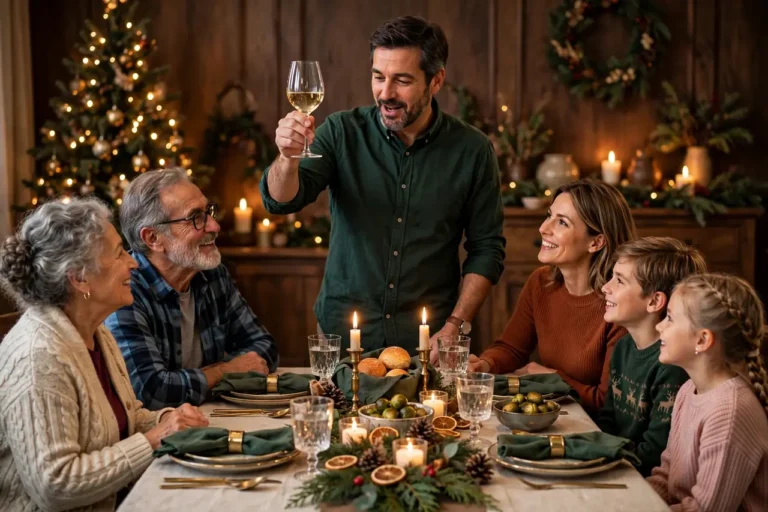
There comes a moment at every great Christmas gathering when someone stands up, raises a glass, and the whole room goes quiet with anticipation. Then they say something beautiful, or something hilarious, or something so heartfelt that half the table tears up, and the night is suddenly, officially, Christmas. That is the power of a toast. And if the thought of being that person makes your palms sweat, these Christmas toast examples are your secret weapon: twenty-five ready-to-raise lines for every kind of table, from the rowdy friends’ party to the reverent family dinner.
A toast is not a speech. That distinction matters, because speeches terrify people and toasts should not. A toast is thirty seconds, one clear sentiment, and a raised glass. It has a beginning, a middle, and a “cheers,” and then you sit down to applause. The best toasts in history were not the longest or the cleverest; they were the most sincere, delivered with a steady hand and a genuine smile. Anyone can do this, including you, including tonight, including with about five minutes of preparation.
This guide gives you 25 complete Christmas toast examples organized by tone and occasion: short and sweet one-liners, funny toasts that get the laugh, heartfelt toasts that get the tears, party toasts for friends, faith-centered blessings, and New Year crossover toasts for the week between the holidays. You will also find the anatomy of a perfect toast, a quick-picker table for last-minute selection, delivery tips that make even nervous speakers shine, and answers to the questions everyone asks about toasting. Pick your line, fill your glass, and stand up. The room is waiting.

The Anatomy of a Perfect Christmas Toast
Every great toast, from a wedding to a Christmas table, follows the same invisible three-part structure. Learn it once and you can improvise a toast for the rest of your life. Part one: the connection. One sentence that names why you are all together: “We are here because…” or “This year gave us…” This grounds the toast in shared reality. Part two: the sentiment. One or two sentences of genuine feeling: gratitude, love, pride, hope. This is the heart; keep it specific and keep it true. Part three: the raise. The closing line and the call to drink: “So raise your glasses to…” followed by “Cheers,” “Merry Christmas,” or “Salud.”
The whole thing should run thirty to sixty seconds. Shorter is almost always better; a toast that ends while the emotion is still rising is perfect, while a toast that explains itself afterward is ruined. Stand up, make eye contact with the room, speak slowly enough that the back of the table hears you, and end decisively. The examples below all follow this structure, so you can deliver them word for word or use them as templates with your own details swapped in.
One etiquette note that matters: the person being toasted does not drink to themselves, they smile and nod while everyone else drinks to them. And if you are toasting with something non-alcoholic, raise it with exactly the same ceremony. A toast is about the gesture, not the beverage. Our guide to toast drinks without alcohol has beautiful options for every non-drinker at the table, and if you are curious about the tradition itself, our piece on why we toast with champagne at midnight traces the ritual’s sparkling history.
Short and Sweet Christmas Toasts (1–6)
When the moment calls for brevity, when dinner is ready, when the kids are restless, when you have been volunteered with zero warning, these one-line Christmas toast examples do the job beautifully. Short, warm, and impossible to mess up.
1. The classic. “To good friends, good food, and the best season of the year. Merry Christmas, everyone. Cheers!” Clean, complete, and timeless. This is the toast equivalent of a perfectly tailored suit: appropriate everywhere, impressive nowhere it should not be, and always, always correct.
2. The gratitude snap. “We are together, we are healthy, and there is pie. What more could anyone ask? Merry Christmas. Cheers!” The humor is gentle, the gratitude is real, and naming the pie grounds it in the delicious present moment. Works at any table where people like each other, which is to say, most of them.
3. The warm minimal. “To the people in this room, who make every year better than the last. Merry Christmas. Cheers!” Direct eye contact on “the people in this room” is what sells this one. It is simple enough to memorize in ten seconds and sincere enough to mean something.
4. The present moment. “Right here, right now, with all of you: this is the gift. Merry Christmas. Cheers!” A toast about presence rather than presents, which lands especially well in years when the greatest luxury really is everyone being in the same room. Pause before “this is the gift” for maximum effect.
5. The cook’s honor. “To the hands that made this feast and the hearts that fill this home. Merry Christmas. Cheers!” Always toast the cook if you are not the cook. Public gratitude for the person who spent all day in the kitchen is one of the loveliest traditions a family can have, and this line delivers it perfectly.
6. The far-and-near. “To those at this table and those in our hearts, wherever they are tonight. Merry Christmas. Cheers!” For the years when someone is missing, through distance or loss, this toast holds them gently in the room. It acknowledges the empty chair without dimming the celebration.
Funny Christmas Toasts (7–11)
Laughter is the fastest way to bond a room, and a funny toast, done with warmth, is remembered longer than a serious one. The rule of funny toasting: punch up at the situation, never down at a person. Laugh with the room, not at anyone in it.
7. The honest priorities. “Let us raise our glasses to Christmas: the one day a year when eating cookies for breakfast is called tradition. Cheers!” Self-aware, joyful, and true. It gives the whole room permission to enjoy themselves without a shred of guilt, which is, frankly, the spirit of the holiday.
8. The diet’s farewell. “To the diet we abandoned on December 1st and will heroically resume on January 2nd. It served us well. Cheers!” The January date is doing heavy comedic lifting here; everyone knows it is a lie, and that shared knowledge is the joke. Best delivered with a completely straight face.
9. The gift exchange survival. “To surviving another year of Secret Santa without anyone crying, quitting the family, or regifting the same candle for the fourth time. Cheers!” Only use this if your gift exchange was actually harmonious, or if everyone involved will laugh. The specific detail, the candle, is what makes it feel real rather than generic.
10. The in-law diplomacy. “To family: the people who know exactly which buttons to push and love us anyway. Merry Christmas, you beautiful maniacs. Cheers!” The affectionate insult lands because the love is obvious. “Beautiful maniacs” is endearing, not mean, and every family recognizes itself in this toast.
11. The Santa logistics. “To Santa, who somehow visits two billion homes in one night without a single traffic ticket. May we all be that efficient in the new year. Cheers!” Whimsical, original, and guaranteed to get a laugh from the kids and the adults alike. It is the rare funny toast that works for literally every audience.
Heartfelt and Emotional Christmas Toasts (12–16)
Some years call for sincerity over sparkle: the first Christmas after a hard year, a reunion after too long apart, a milestone worth marking. These heartfelt Christmas toast examples are for those moments. Deliver them slowly, mean every word, and do not apologize for the tears; they are the point.

12. The year in review. “This year tested us in ways we did not expect, and yet here we are, together, laughing, eating too much, exactly where we belong. To resilience, to love, and to every one of you who carried someone else this year. Merry Christmas. Cheers!” This toast honors difficulty without dwelling in it, and the pivot from hardship to togetherness is what makes it powerful. Name the hard thing obliquely, celebrate the survival specifically.
13. The homecoming. “There were years when this table had an empty chair with your name on it, and tonight that chair is full. Welcome home. To family, finally all together. Cheers!” For the year the deployed service member returns, the kid comes home from college, the prodigal makes it for dinner. Personalize the empty-chair line to your story and watch the room melt.
14. The elders’ honor. “To Mom and Dad, Grandma and Grandpa: the ones who built every tradition we are enjoying tonight. The tree, the recipes, the ridiculous ornament fights, all of it started with you. We are your legacy, and we are grateful. Cheers!” Toasting the older generation publicly is a gift they will treasure. Be specific about one tradition they started; the detail proves you were paying attention.
15. The quiet gratitude. “I do not say this enough, so I will say it now, with a glass in my hand and all of you in front of me: thank you for being my people. For the calls, the casseroles, the showing up. You are the best part of my life. Merry Christmas. Cheers!” The “I do not say this enough” opening is disarming in its honesty. This toast works because it admits something true, that gratitude often goes unspoken, and then corrects it on the spot.
16. The new beginning. “To the newlyweds, the new parents, the new homeowners, to everyone at this table starting something beautiful: may your Christmas be the first of a thousand happy ones together. Cheers!” Perfect for years when the family has grown. Name the new beginnings specifically, the baby’s name, the couple, the new house, and the toast becomes a blessing they will remember.
Christmas Toasts for Friends and Parties (17–20)
Friends’ Christmas parties have their own energy: louder, looser, and fueled by chosen-family love. These toasts match that frequency, warm, celebratory, and just irreverent enough for the occasion.
17. The chosen family. “They say you cannot choose your family, but look around: we absolutely did, and we chose brilliantly. To the friends who became family. Merry Christmas. Cheers!” The gentle subversion of the old saying is what makes this sing. Deliver it looking around the room, making eye contact with as many people as you can.
18. The party gratitude. “To the host who deep-cleaned for three days so we could destroy it in three hours, we salute you. To friendship, to laughter, and to whoever brought that dip. Merry Christmas. Cheers!” Always honor the host, and the specific, funny acknowledgment of the cleaning-to-chaos ratio gets the biggest laugh of the night from the host themselves.
19. The year-end cheers. “We survived another year together: the group chats, the drama, the 2 AM phone calls, all of it. I would not trade a single one of you. Here is to us. Cheers!” This is the toast for the friend group with history. The litany of shared experiences, group chats to late-night calls, makes everyone feel seen, and the sincerity underneath the humor is real.
20. The dance-floor sendoff. “Glasses up, everyone. To good music, questionable dance moves, and friends who love you anyway. This night is ours. Cheers!” Short, high-energy, and designed to be shouted right before the music gets louder. It is less a toast and more a battle cry, and that is exactly right for the moment.
Faith-Centered Christmas Toasts (21–23)
For tables where Christmas is first and foremost the celebration of Christ’s birth, these toasts root the celebration in its sacred meaning. Reverent, warm, and brief.
21. The nativity toast. “On this night we celebrate the greatest gift ever given, wrapped not in paper but in swaddling clothes. To the Christ child, and to the love that brought Him to us. Merry Christmas. Cheers!” The contrast between paper wrapping and swaddling clothes is a beautiful image that refocuses the room on the season’s meaning in a single line.
22. The blessing toast. “May the God who gave us Christmas bless this food, this family, and every heart in this room. May His peace fill our home tonight and His joy follow us into the new year. Cheers!” Structured as a blessing rather than a cheer, which suits a reverent table. It covers the meal, the people, and the future in three graceful beats.
23. The light of the world. “In a season of lights, we remember the true Light, born in Bethlehem to shine in every darkness. To Jesus, the reason for our rejoicing. Merry Christmas. Cheers!” The lights imagery connects the decorations all around you to the deeper meaning, making the whole room part of the toast. Lovely to deliver with the tree glowing behind you.
New Year Crossover Toasts (24–25)
The week between Christmas and New Year has its own toasting occasions, and these bridge the two holidays, looking back with gratitude and forward with hope.
24. The backward glance. “To the year behind us: the lessons, the laughter, the people who carried us through. We are still standing, and we are together. To survival, to growth, and to all of you. Cheers!” Honest about the year’s difficulty without being bleak, and the “still standing” line resonates with everyone who had a complicated twelve months, which is everyone.
25. The forward look. “And to the year ahead: may it be kinder than the last, may our dreams be bigger than our fears, and may this table never have an empty chair. Happy New Year, my loves. Cheers!” Ending on the image of the full table ties the future to what matters most, the people. “My loves” is intimate and warm; adjust the endearment to your crowd.
Quick-Picker Table: Find Your Toast in Seconds
| Your situation | Best toast style | Example numbers | Tone |
|---|---|---|---|
| Big family dinner, mixed ages | Short and sweet | 1, 3, 5 | Warm, universal |
| Friends’ Christmas party | Party toasts | 17, 18, 20 | Celebratory, fun |
| First Christmas after a hard year | Heartfelt | 12, 15 | Sincere, emotional |
| Someone is missing this year | Far-and-near | 6, 24 | Tender, inclusive |
| Fun-loving, joke-cracking crowd | Funny | 7, 8, 11 | Playful |
| Faith-centered family | Faith-centered | 21, 22, 23 | Reverent |
| Honoring the host or cook | Cook’s honor, party gratitude | 5, 18 | Grateful |
| New Year’s Eve or the week between | Crossover | 24, 25 | Reflective, hopeful |
Toast Etiquette: The Unwritten Rules
Toasting has etiquette, and knowing it keeps you from the small social stumbles that haunt people for years. None of these rules are complicated, but violating one is memorable in the worst way, so learn them in the thirty seconds it takes to read this section.
Always stand, unless you cannot. The toaster stands; the toasted remain seated and smile graciously. Standing signals that something intentional is happening and gives your voice the projection it needs. The one exception is a very small, intimate table where standing would feel theatrical; use your judgment, but default to standing.
Never toast with an empty glass. It is considered bad luck in many traditions and bad manners in all of them. If your glass is empty, pour something, anything, even water, before you stand. The symbolism of the full glass, abundance, celebration, generosity, is the whole point of the gesture.
Do not clink with everyone individually. At a table of more than six, raising your glass toward the room is sufficient and correct. Working the table for individual clinks turns a toast into a receiving line and kills the moment’s momentum. One raise, one cheers, done.
Keep the glassware safe. When clinking does happen, bell to bell, not rim to rim: touch the sides of the glasses together gently rather than smashing the rims. Fine crystal chips easily, and nothing deflates a toast like the sound of breaking glass. Eye contact during the clink is the traditional sign of sincerity, and it is a lovely habit.
Do not hijack someone else’s toast. If the host is about to speak, do not jump in first. If someone is mid-toast, do not add your own commentary. And when the toast is to a specific person, keep the spotlight on them; this is not the moment for your anecdote. Your turn will come, and the room will be warmer for your patience.
How to Deliver a Toast Like You Mean It
The words are only half the toast; the delivery is the other half. Stand up fully, do not half-rise from your chair, because commitment reads as confidence. Hold your glass at chest height, not overhead like a trophy and not at your waist like an afterthought. Make eye contact with different people around the table as you speak; a toast is a conversation with the whole room, not a recitation to the chandelier.
Speak more slowly than feels natural. Nerves accelerate everyone, and a toast delivered at a measured pace sounds authoritative and gives each line room to land. Pause for one beat before the final line, the “cheers” moment, because anticipation is delicious. Smile genuinely; if you are nervous, smiling tricks your brain into calming down, and it signals warmth to the room. Keep it under a minute. The perfect toast ends while everyone is still leaning in, not after they have started checking the rolls.
And the golden rule of toasting mishaps: if you stumble, laugh, take a breath, and keep going. A recovered stumble makes you more charming, not less, because the room is rooting for you. Nobody remembers the flawless toast as fondly as the one where the speaker teared up, laughed at themselves, and finished strong. For more words worth raising a glass to, our wedding day wishes collection has the same heartfelt DNA in message form, and our Christmas drinks guide will make sure your glass is as festive as your words.
Watch: A Christmas and New Year Toast
Words on a page are one thing; hearing a real toast delivered with warmth is another. This short video captures a genuine Christmas and New Year toast moment, perfect for catching the tone and spirit before you raise your own glass.
FAQs About Christmas Toasts
What is the difference between a toast and a speech?
A toast is thirty to sixty seconds, one clear sentiment, ending with a raised glass and a “cheers.” A speech is several minutes with a structure and stories. If you are nervous about public speaking, volunteer for the toast, not the speech; it is shorter, simpler, and the bar for success is a warm moment, not a performance.
When should the Christmas toast happen?
The classic moment is just before the meal begins, right after grace or in its place. At parties, toasts happen when the host decides the night needs a moment, often when everyone has a full glass. Do not wait too late; toasts land best when the room is still relatively sober and attentive.
What do I say if I am asked to toast with no warning?
Use the anatomy: one sentence of connection, one of sentiment, then raise your glass. Memorize one universal line from this list, like example number one or three, as your emergency toast. Smile, speak slowly, end with “Merry Christmas, cheers,” and sit down. Nobody will know it was improvised.
Is it okay to toast with a non-alcoholic drink?
Absolutely, and anyone who suggests otherwise is wrong. A toast is about the gesture and the words, not the beverage. Raise your sparkling cider, eggnog, or water with full ceremony. Our alcohol-free toast drinks guide has festive options that look as celebratory as champagne.
Should the toast be funny or serious?
Read the room. A table that has laughed all evening wants a funny toast; a table marking a meaningful moment wants sincerity. When in doubt, choose warm over witty; a sincere toast never misfires, while a joke that lands wrong echoes. The best toasts often blend both: one laugh, then one true thing.
Can I read my toast or should I memorize it?
Reading is completely fine, especially for longer or more emotional toasts. Glance at a card or your phone, then look up for the key lines and the final “cheers.” Memorizing one short toast as a backup is smart, but nobody expects a toaster to perform from memory.
What should I avoid in a Christmas toast?
Avoid inside jokes most of the table will not understand, anything embarrassing about a specific person, controversial topics, and toasts that run longer than ninety seconds. Never toast to yourself, and never use the toast to make an announcement or air a grievance. Keep it about gratitude, love, and the season.
Who traditionally gives the Christmas toast?
The host, the eldest family member, or the guest of honor usually goes first, but anyone can propose a toast, and multiple toasts through the evening are welcome. If you are bursting with something to say, stand up and say it. The worst toast is the one that stays in your head.
Raise Your Glass
Here is the secret about toasts: the room wants you to succeed. Every person at that table is hoping you say something wonderful, because your wonderful moment becomes their wonderful memory. You are not performing for critics; you are speaking to people who love you, and they are already on your side before you stand up.
So pick one of these Christmas toast examples, fill your glass with something festive, and stand up tonight. Say it slowly, say it like you mean it, and end with a clear, joyful “Cheers.” Then sit down to the applause, the clinking glasses, and the best feeling of the evening: the knowledge that for thirty seconds, you held the whole room in the palm of your hand. Merry Christmas.