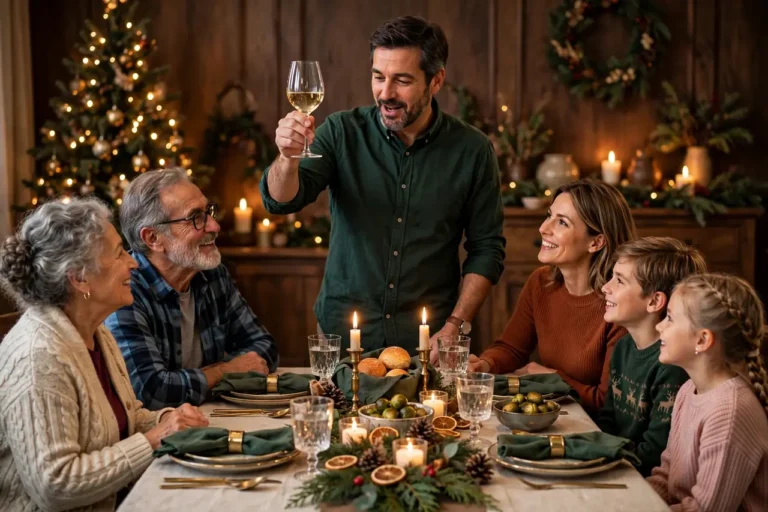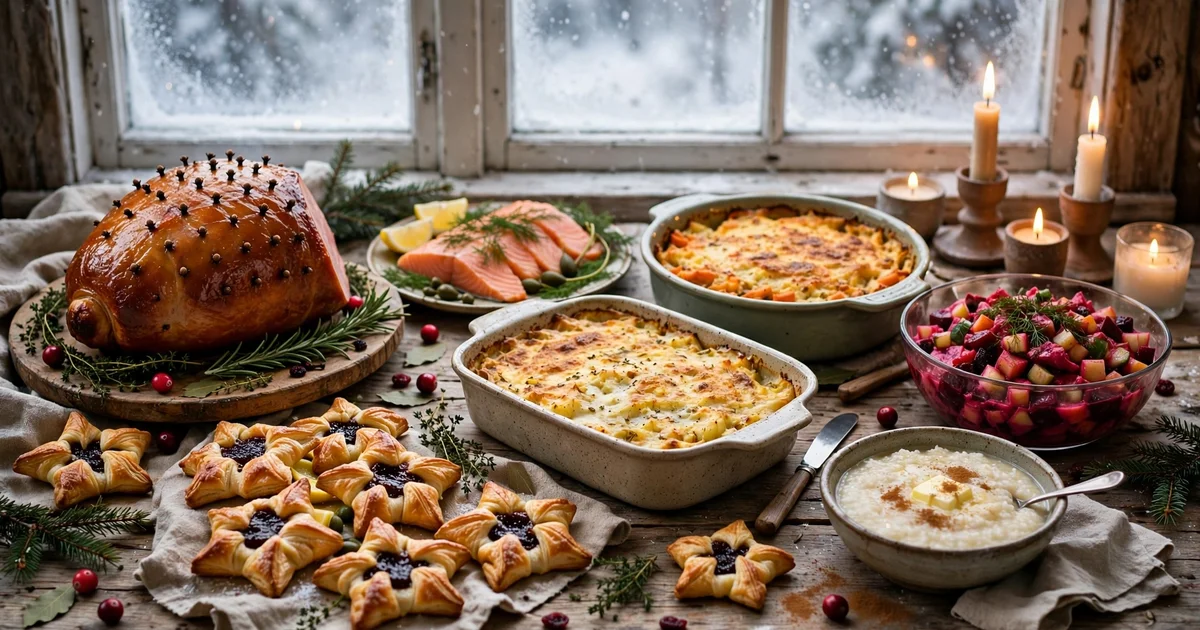
In Finland, Christmas dinner is not a plate but a landscape — and the Finnish joulupöytä Christmas table is Scandinavia’s most generous buffet. Joulupöytä means “Yule table,” and on Christmas Eve it groans under ham, cured and smoked fish, root-vegetable casseroles, beetroot salads, rye breads, and rice porridge with a hidden almond. Eaten in stages over hours, in the glow of candles against the blue Arctic dark, it is less a meal than a delicious expedition. This guide maps the entire joulupöytä zone by zone — the cold fish table, the hot casseroles, the ham, the sweets — plus the rhythms of the Finnish Christmas Eve that surround it, and how to build your own.
What Is the Joulupöytä?
The joulupöytä is Finland’s traditional Christmas Eve buffet, served on December 24 — the day Christmas is celebrated in Finland, as across the Nordic countries. Unlike a plated dinner, the joulupöytä is laid out all at once (or in two waves: cold dishes first, hot dishes revealed later), and diners help themselves in any order, returning as often as they like. The table is both the meal and the decoration: the pink of gravlax, the deep red of rosolli beet salad, the golden crust of casseroles, the star-shaped joulutorttu pastries — it is designed to be looked at before it is eaten.
The philosophy is abundance without formality. A proper joulupöytä feeds the extended family across the whole evening, with dishes served at room temperature or kept warm in their baking dishes — no synchronized courses, no host trapped at the stove. It evolved from practical roots: in the farming past, Christmas was the slaughter season and the midwinter feast had to showcase the year’s stores — the ham, the preserved fish, the cellared roots. The modern table keeps that logic: this is the meal where Finland eats its pantry at its proudest.
Scale varies enormously. A small family’s joulupöytä might feature eight dishes; a grandmother’s might hold twenty. But the architecture is constant: fish first, then ham and hot dishes, then porridge and sweets — with bread, butter, and mustard stationed permanently at the flank. Understanding the zones is the key to navigating (and building) the table.
The Rhythm of Christmas Eve: How the Day Unfolds
The joulupöytä sits inside a choreographed Christmas Eve with deep traditions:
- 12:00 noon — The Declaration of Christmas Peace: From the Old Great Square of Turku, Finland’s former capital, the Declaration of Christmas Peace (joulurauhan julistus) is read — a centuries-old proclamation urging peaceful conduct through the holidays, broadcast on television and radio. Many families pause to watch; it is the official emotional start of Christmas.
- Afternoon — The Christmas sauna: The joulusauna is sacred. Families sauna in the afternoon — often with a special Christmas sauna whisk and perhaps a beer — emerging clean, relaxed, and ravenous. It is arguably the most Finnish sentence ever written: Christmas begins with a sauna.
- Late afternoon — Rice porridge: Riisipuuro (creamy rice porridge with cinnamon, sugar, and cold milk) is traditionally eaten before the main table — sometimes as the actual lunch. One blanched almond is hidden in the pot; the finder is said to get married within the year (or simply wins bragging rights).
- Early evening — The joulupöytä: The main event, eaten in leisurely stages as the candles burn down.
- Evening — Joulupukki visits: Santa Claus — Joulupukki, the “Christmas Goat,” who Finns insist lives on Korvatunturi (Ear Fell) in Lapland — traditionally visits in person, knocking at the door with his sack. (In many families, a relative disappears suspiciously shortly before.)
- Night — Presents and quiet: Gifts are opened, the candles burn low, and Christmas Day itself is kept deliberately quiet — for rest, leftovers, and the second-day calm of Tapaninpäivä (St. Stephen’s Day, December 26).
Zone 1: The Cold Table — Fish, Beets, and Pickles
The joulupöytä traditionally opens with the cold dishes, and in Finland that means fish — prepared in every Nordic method known:
- Graavilohi (gravlax): salmon cured with salt, sugar, and dill — silky, fragrant, the essential first bite. Served with hovimestarinkastike (sweet mustard-dill sauce).
- Kylmäsavulohi: cold-smoked salmon, delicate and smoky — often the most expensive item on the table.
- Lämminsavulohi: hot-smoked salmon or whitefish, flaky and rich, sometimes still faintly warm.
- Silli: pickled herring in its many Finnish forms — mustard herring, onion herring, matjes — always with rye bread.
- Siika and muikku: whitefish and vendace, smoked or cured, for the connoisseurs.
- Skagen-style shrimp: hand-peeled shrimp with dill and lemon mayonnaise on dark bread — the luxury bite.
Alongside the fish come the salads that define the Finnish Christmas palette:
- Rosolli: the iconic beetroot salad — diced beets, apple, pickled cucumber, and potato in a whipped-cream dressing, its shocking pink-red color the visual signature of the joulupöytä. It tastes like Christmas looks: earthy, sweet, creamy, bright.
- Itu-salaatti and vihersalaatti: sprout and green salads for freshness against the richness.
- Sienisalaatti: mushroom salad with sour cream — woodsy and comforting.
- Pickles: pickled cucumbers, beets, and suolakurkku — the acidic counterpoints the rich table demands.
Cold meats appear too — smoked reindeer (poro) slices, cured ham — but the cold table belongs to the water: Finland’s thousand lakes and long coastline, preserved on a platter.
Zone 2: The Hot Center — Ham, Casseroles, and Lutefisk
When the cold plates are cleared (or alongside them, in hungry families), the hot heart of the joulupöytä is revealed:
Joulukinkku: The Christmas Ham
The joulukinkku is the undisputed king of the Finnish Christmas table — a large bone-in pork leg, traditionally ordered from the butcher, cooked low and slow for many hours until meltingly tender. The classic finish: the rind is scored in a diamond pattern, painted with strong sweet mustard, dusted with breadcrumbs, and browned until the crust is deep golden. Served at room temperature in thick slices with strong Finnish mustard (sinappi — the sweet-hot Turku style is traditional), it anchors the entire table. Many families cook the ham overnight, filling the house with its smell by morning — the definitive scent of Finnish Christmas Eve.
The Laatikkos: Finland’s Beloved Casseroles
The laatikko (box) casseroles are the soul food of the joulupöytä — sweet, creamy, baked-until-caramelized root vegetable gratins:
- Lanttulaatikko: rutabaga (swede) casserole — mashed rutabaga with cream, syrup, breadcrumbs, nutmeg and ginger, baked until the top is burnished. The most Christmas-specific of the three.
- Porkkanalaatikko: carrot casserole — sweet carrots with rice, cream, and syrup, the brightest-flavored of the trio.
- Perunalaatikko: potato casserole — the mildest, creamiest, the comfort anchor.
All three share a method: the vegetable is cooked and mashed, enriched with cream and dark syrup (siiras), spiced, topped with breadcrumbs dotted with butter, and baked until deeply golden. They are sweet-savory in the old Nordic way — and they are non-negotiable. A joulupöytä without lanttulaatikko is, to a Finn, simply not a joulupöytä.
Lipeäkala: The Lutefisk Question
Lipeäkala (lutefisk) — dried cod reconstituted in lye — divides Finland as it divides all of Scandinavia. Its lovers serve it with white sauce (valkokastike), allspice, and melted butter; its detractors… don’t serve it. It appears on perhaps half of Finnish Christmas tables, more common in the west and among older generations. Our advice: try it once, with an open mind and plenty of sauce — it is milder than its fearsome reputation suggests. For the full Nordic lutefisk debate, see our guide to Norwegian Christmas dinner, where lutefisk plays a similar controversial role.
Zone 3: Breads, Porridge, and the Sweet Finish
Bread is the joulupöytä’s constant companion, and Finland’s rye tradition shines:
- Joululimppu: the Christmas rye — a dark, malty, slightly sweet loaf flavored with orange peel, fennel, and syrup. Served thickly sliced with butter, it is the vehicle for gravlax, ham, and everything else.
- Saaristolaisleipä: archipelago bread — even darker, sweeter, studded with seeds; a southwestern specialty.
- Crispbreads and butter: always present, always being reached for.
The sweet finish belongs to two icons:
- Joulutorttu: star-shaped puff-pastry tarts with prune jam centers — the pinwheel shape (folded corners) is the visual shorthand for Finnish Christmas. Every bakery, every home, every December.
- Piparkakut: thin, crisp gingerbread — often heart- or star-shaped, decorated with icing. The classic Finnish pairing: piparkakku with blue cheese (aura cheese). It sounds bizarre; it is revelatory — the sweet spice against the salty funk is one of Nordic food’s great combinations.
And presiding over it all, the riisipuuro — the rice porridge that opens the day and often closes it too, with cinnamon, sugar, and a final hunt for the almond. For dessert lovers wanting the global picture, our Christmas desserts around the world tour places these Nordic sweets in international company.
The Casseroles Deep Dive: Mastering the Laatikkos
The laatikkos deserve their own masterclass — they are the dishes guests ask about and the ones most worth perfecting.
Lanttulaatikko (Rutabaga Casserole) — serves 8
- 1 kg rutabaga (swede), peeled and cubed; 2 dl (200ml) heavy cream; 3 tbsp dark syrup; 1 egg; 1 tsp salt; ½ tsp each ground nutmeg, ginger, white pepper; breadcrumbs and butter for topping
- Boil rutabaga until completely tender (30–40 min). Drain very well — water is the enemy of a set custard — and mash smooth.
- Whisk in cream, syrup, beaten egg, salt, and spices. The mixture should be thick but spoonable.
- Spread in a buttered baking dish, top with breadcrumbs, dot with butter.
- Bake at 175°C (350°F) for 60–90 minutes until deeply golden and set at the center. Rest 15 minutes before serving.
Porkkanalaatikko (Carrot Casserole) — serves 8
- 1 kg carrots; 1 dl cooked rice (or barley); 2 dl cream; 2 tbsp syrup; 1 egg; salt, white pepper, nutmeg
- Boil carrots tender, mash (leave some texture). Stir in the cooked rice — it gives the traditional body.
- Add cream, syrup, egg, seasonings. Bake as above, 60 minutes, until golden.
Keys to Success
- Drain thoroughly: watery mash makes watery casserole. Let the boiled vegetables steam-dry in the pot for a few minutes.
- Don’t skip the syrup: dark Finnish syrup (tumma siirappi) gives the signature caramel depth; molasses is the closest substitute.
- Bake dark: pale laatikko is underdone — the top should be deeply burnished, nearly mahogany at the edges.
- Make ahead: laatikkos reheat beautifully and are traditionally made a day or two before Christmas Eve.
What Finns Drink at Christmas: Glögi and Beyond
Glögi is Finland’s mulled wine — and, distinctively, it is as often non-alcoholic as alcoholic. Finnish glögi (traditionally made from blackcurrant or other berry juices, or from red wine) is served steaming hot with raisins and blanched almonds in the cup — you eat them with a spoon as you drink. Supermarkets sell excellent ready-made glögi concentrates in December; the ritual is to warm it gently (never boil, if wine-based) and serve with piparkakut.
With the joulupöytä itself, Finns drink beer (Christmas lagers appear in December), aquavit-style snaps with the herring course, and red wine with the ham. Kotikalja (a low-alcohol malt bread drink) is the traditional farmhouse pairing for the ham — malty, slightly sweet, utterly Finnish. Coffee, as everywhere in Finland (the world’s highest per-capita coffee consumers), flows continuously from the first porridge to the last joulutorttu.
How to Build Your Own Joulupöytä: The Countdown
- 1–2 weeks before: Order the ham from a butcher (or buy a smaller boneless joint). Make the laatikkos — they keep and reheat perfectly. Bake joululimppu or order from a Nordic bakery.
- 3–4 days before: Cure the gravlax (48–72 hours). Make rosolli (it melds beautifully). Prepare pickled herring if making from scratch.
- Christmas Eve morning: Put the ham in low and slow (or reheat if pre-cooked). Make the riisipuuro. Assemble cold platters. Bake joulutorttu (or buy — no shame; Finns buy them too).
- Afternoon: Sauna. Seriously — even a hot bath in the spirit of it. Lay the table: cold dishes out first, candles lit.
- Early evening: Serve the cold table. Reveal the hot dishes (ham carved, casseroles bubbling) for the second wave.
- After: Joulutorttu, piparkakut with blue cheese, glögi. Wait for Joulupukki’s knock.
The guiding principle: everything should be servable at leisure. Nothing on a joulupöytä demands split-second timing — that is the format’s genius, and why it works as beautifully for eight guests as for twenty. Compare this Scandinavian buffet philosophy with its Danish cousin in our guide to Danish Christmas dinner flæskesteg, or browse Christmas dinner ideas for more festive formats.
The Joulusauna: Christmas Begins in the Heat
Of all Finnish Christmas traditions, the joulusauna (Christmas sauna) is the most essentially Finnish — and the most non-negotiable. On Christmas Eve afternoon, before the joulupöytä and before Joulupukki’s visit, the family saunas. The Christmas sauna is special: it is cleaned meticulously beforehand, decorated with candles (electric, for safety), and scented with a fresh vihta (birch whisk). Many families sauna in a particular order — children first, then adults — and the session is unhurried, contemplative, the year’s stresses steamed away.
The tradition has deep roots: in old Finland, the sauna was the cleanest room in the house — births happened there, and the dead were washed there. The Christmas sauna was purification before the holy days, and the sauna elf (saunatonttu) was honored with quiet respect. Afterward, Finns emerge pink, relaxed, and ravenous — physiologically primed for the feast. Visitors invited to a Finnish Christmas should treat a sauna invitation as the honor it is: accept, follow the etiquette (shower first, no swimsuits in a family sauna unless told otherwise, respect the silence), and understand that you have just participated in the true start of Finnish Christmas.
And yes — many Finns follow the sauna with a roll in the snow or a plunge into an icy lake (avantouinti). It is bracing, euphoric, and the fastest appetite-builder known to science or folklore.
Tapaninpäivä and the Quiet Days: After the Feast
Christmas Day (joulupäivä) in Finland is deliberately, almost aggressively quiet. After the intensity of Christmas Eve — the Peace declaration, the sauna, the feast, Joulupukki — the 25th is for rest: leftovers eaten cold from the fridge, long walks in the snow, and the particular Finnish pleasure of doing nothing. Many churches hold early morning services (joulukirkko); otherwise, the day belongs to calm.
Tapaninpäivä (St. Stephen’s Day, December 26) is the Second Day of Christmas — traditionally the day for visiting friends, sleigh rides (rekiretket) in the old days, and festive gatherings. The joulupöytä’s survivors are repurposed: cold ham with mustard on rye, leftover laatikko reheated, the last of the rosolli. It is also the start of the social season — the quiet days between Christmas and New Year fill with visits, each demanding glögi and something from the cookie tin.
This rhythm — one intense day of feast, then days of delicious aftermath — is the joulupöytä’s final wisdom. The table is designed to feed the family for days, not hours. A Finnish Christmas is not a dinner; it is a season of eating well, and the leftovers are part of the plan.
Sourcing Finnish Christmas Foods Abroad
Building a joulupöytä outside Finland is entirely possible — the diaspora does it every year. Your allies:
- Nordic/IKEA stores: gravlax, pickled herring, crispbread, glögi concentrate, gingerbread, and often frozen joulutorttu — the expat lifeline.
- German and Polish delis: excellent rye breads, mustards (close to Finnish sinappi), pickled beets and cucumbers, and dark syrups.
- Fishmongers: order gravlax-grade salmon (sushi-quality) for home-curing, or buy pre-cured. Cold-smoked salmon is widely available.
- Online Nordic grocers: dark Finnish syrup (tumma siirappi — molasses works in a pinch), rye malt for joululimppu, and piparkakku spices.
- The ham: a bone-in fresh pork leg from a good butcher, or a smaller boneless roasting joint — the mustard-breadcrumb crust works on any size.
- Rutabaga: sold as swede (UK) or kålrot — available in most supermarkets through winter; that is your lanttulaatikko.
Start with the non-negotiables (ham, one laatikko, gravlax, rosolli, porridge, joulutorttu) and expand yearly. A first joulupöytä with six dishes, eaten by candlelight after a hot bath, is more Finnish than a stressed twenty-dish spread. The table’s spirit is generosity without performance — cook what you love, serve it with warmth, and let the candles do the rest. That is the whole philosophy of the joulupöytä in a single sentence. Generosity, candlelight, and good rye bread will carry any Christmas table further than perfectionism ever could.
In Pictures: Finnish Joulupöytä Christmas Table
Finland’s joulupöytä — the Yule table — is Christmas Eve’s grand spread: ham, casseroles, fish, and sweet finish.
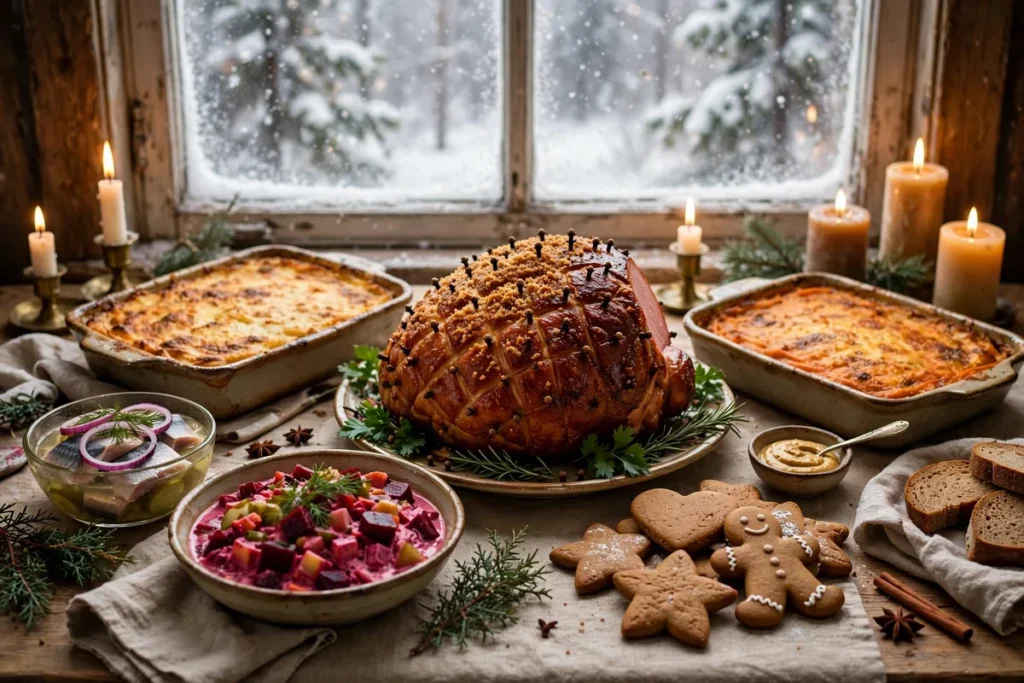
A Finnish joulupöytä: glazed Christmas ham, rutabaga and carrot casseroles, pickled herring, beetroot salad, gingerbread, snowy window.
Watch: Finnish Joulupöytä Christmas Table
No item is as iconic on the Finnish Christmas table as the Christmas ham — how to salt a fresh ham, ready for Christmas.
At a Glance: Finnish Joulupöytä Christmas Table
The zones of the Yule table.
| Dish | When | Key detail |
|---|---|---|
| Joulupöytä | 24 December | The “Yule table” — Christmas Eve’s grand spread, eaten in zones |
| Joulukinkku | 24 December | The glazed Christmas ham — 6–7 million kg sold each Christmas |
| Laatikot | 24 December | The casseroles — carrot, rutabaga, potato (and liver) gratins |
| Rosolli | 24 December | Beetroot and potato salad — with gravlax and pickled herring |
| Joulupuuro | 24 December | Rice porridge with a hidden almond — the finder gets luck |
| Joulutorttu | December | Star-shaped prune tarts — with piparkakku gingerbread |
| Glögi | December | Mulled wine with almonds and raisins — the Christmas drink |
Frequently Asked Questions
What is a joulupöytä?
The joulupöytä (“Yule table”) is Finland’s traditional Christmas Eve buffet: an abundant spread of cured and smoked fish, Christmas ham, root-vegetable casseroles (laatikkos), beetroot salad, rye breads, rice porridge, and Christmas pastries, eaten in leisurely stages on December 24.
What are the essential dishes of the Finnish Christmas table?
The non-negotiables: joulukinkku (Christmas ham with mustard), graavilohi (cured salmon), lanttulaatikko (rutabaga casserole), rosolli (beetroot salad), riisipuuro (rice porridge with hidden almond), joulutorttu (prune-jam stars), piparkakut (gingerbread), and joululimppu (Christmas rye).
When do Finns celebrate Christmas?
On Christmas Eve, December 24 — Jouluaatto. The day includes the Declaration of Christmas Peace from Turku at noon, the Christmas sauna, rice porridge, the joulupöytä in the early evening, a visit from Joulupukki (Santa), and presents. Christmas Day is kept quiet.
What is lipeäkala?
Lipeäkala is the Finnish name for lutefisk — dried cod treated with lye, then soaked and boiled. Served with white sauce and allspice, it divides opinion sharply; it appears on roughly half of Finnish Christmas tables, more often among older generations.
Why do Finns put blue cheese on gingerbread?
The pairing of piparkakut (gingerbread) with blue cheese (like Aura) is a beloved Finnish tradition — the sweet, spiced crisp against the salty, funky cheese is a classic Nordic sweet-savory contrast. Skeptics become converts within one bite.
What is glögi?
Glögi is Finnish mulled wine, often made non-alcoholic from berry juice. Served hot with raisins and almonds in the cup, it is the definitive Finnish Christmas drink, sold as concentrate in every supermarket through December.