In Denmark, Christmas dinner is the warm heart of the darkest season — and Danish Christmas dinner flæskesteg is its undisputed centerpiece. This is roast pork with shatteringly crisp crackling (svær), served with caramelized potatoes, sweet-sour red cabbage, and rich brown gravy, followed by the playful lottery of risalamande rice pudding with its hidden almond. Eaten on Juleaften (Christmas Eve, December 24) in candlelight, surrounded by dancing around the tree and the deep hygge coziness Denmark is famous for, it may be Scandinavia’s most beloved Christmas meal. This guide covers the traditions, the great duck-versus-pork debate, every side dish, step-by-step recipes, and the hygge philosophy that makes it all glow.
Juleaften: Why Danes Celebrate on Christmas Eve
In Denmark, Christmas happens on December 24 — Juleaften — not the 25th. The day builds gently: a church service in the afternoon (even for the not-particularly-religious — the Christmas service is a cultural institution), then the family gathers as darkness falls around 4 PM. Dinner is typically served around 6 PM, earlier than in southern Europe, because the evening has a full program.
After dinner comes one of Denmark’s most cherished rituals: the family joins hands and dances around the Christmas tree (dans om juletræet), singing carols as they circle. Only then are the presents — piled beneath the tree — opened. The evening glows with live candles on the tree (a tradition Danes maintain with characteristic calm) and the julehjerter, woven paper hearts, hanging from the branches. Christmas Day itself is quieter: leftovers, family visits, and the long, slow pleasure of hygge — which, as any Dane will tell you, is not a decoration style but a way of being together.
December also brings the julefrokost (Christmas lunch) season: long, boozy lunches with colleagues and friends featuring smørrebrød (open sandwiches) — pickled herring, liver pâté, roast pork with red cabbage — washed down with snaps (aquavit) and Christmas beer. A Dane may attend several julefrokoster before Juleaften even arrives; by Christmas Eve, they are well practiced in festivity.
Flæskesteg: The King of the Danish Christmas Table
Flæskesteg is roast pork loin or belly with the skin on, scored in a crosshatch, salted aggressively, and roasted until the skin bubbles into svær — crackling so crisp it shatters. It is, for most Danes, the taste of Christmas itself. The cut matters: a proper flæskesteg has an even layer of skin and a good balance of meat and fat. The butcher scores the rind (or you do it at home with a very sharp knife or scalpel — cuts about 1cm apart, through the skin but not into the meat).
The technique is a national obsession. Salt is rubbed into every cut, bay leaves are tucked into the scores, and the roast goes into a hot oven over a bed of sliced onions and carrots with water in the pan — the steam keeps the meat juicy while the dry heat attacks the skin. The roast is basted with its own drippings, and in the final blast of heat the rind transforms: it bubbles, crisps, and turns the deep golden-brown of a perfect svær. A flæskesteg with soft, chewy rind is a Christmas tragedy; Danish cooks will tell you the crackling is not a garnish but the point.
Carving is ceremonial: the crackling is cut into strips (one per guest, minimum — fights have started over less), and the meat sliced thick. The drippings become brun sovs, the brown gravy that ties the whole plate together. If you only cook one Danish dish in your life, food writers agree: make it this one. For a broader Scandinavian comparison, see how Norway handles its own pork-versus-tradition debate in our guide to Norwegian Christmas dinner: ribbe vs. pinnekjøtt.
Andesteg vs. Flæskesteg: Denmark’s Friendly Rivalry
Every Danish family has a position on the great Christmas question: duck or pork? Andesteg (roast duck) is flæskesteg’s noble rival — a whole duck stuffed with prunes and apples (or sometimes a prune-apple-pecan stuffing), roasted until the skin is lacquered and crisp, the rich meat perfumed with fruit. Its defenders call it the more elegant bird, the proper festive centerpiece; its detractors note the duck-to-guest math (one duck serves fewer, costs more, and demands more attention).
The Danish solution is characteristically pragmatic: serve both. A great many families roast a duck and a flæskesteg, letting guests choose — or take both. The sides are identical, the gravy works for either, and the table looks doubly abundant. Purists on each side maintain their allegiance (often inherited: “we are a duck family” is a genuine Danish identity statement), but the both-camp grows every year. If you are hosting your first Danish Christmas, the safest play is the Danish play: a modest flæskesteg plus a duck, and let the table decide.
A note on the duck: prick the skin all over, stuff the cavity generously with quartered apples and prunes, and roast on a rack so the considerable fat renders away. Save that fat — andefedt (duck fat) roasted potatoes are one of life’s great pleasures and a legitimate Christmas-week treat.
The Supporting Cast: What Comes With the Roast
A Danish Christmas plate is an architecture of sweet, sour, salty, and crisp. The sides are not optional — they are load-bearing:
- Rødkål (red cabbage): shredded red cabbage braised with vinegar, sugar, apple, and sometimes red currant juice until sweet-sour and jammy. Made days ahead — it improves with reheating.
- Brunede kartofler (caramelized potatoes): small boiled potatoes rolled in a caramel of sugar and butter until lacquered and golden. The trick is patience: the sugar must melt without burning, the potatoes must be dry, and the pan must not be crowded. They are Christmas candy disguised as a side dish.
- Hvide kartofler (plain boiled potatoes): for the traditionalists and the gravy-soakers.
- Brun sovs (brown gravy): made from the roast’s drippings, enriched with cream, darkened with kulør (caramel coloring) if needed. It must be abundant — a dry Danish Christmas plate is a sad one.
- Ribsgele (red currant jelly) or asier (pickled cucumber salad): the sharp, bright counterpoints that cut the richness.
- Waldorf-style touches: some families add a Waldorf salad or pickled beets — regional and family variations abound.
The plate composition matters: pork (or duck), a spoon of rødkål, three or four brunede kartofler glistening like jewels, white potatoes for the gravy, a strip of svær standing at attention, and gravy over everything. It is a brown-and-red masterpiece — the colors of a Danish December, and a plate no Dane would trade for any other Christmas dinner on earth, ever. This is the architecture of the perfect bite: crisp, sweet, sour, and rich in a single forkful.
Risalamande: The Dessert With a Hidden Almond
After the roast comes Denmark’s most playful tradition: risalamande (from riz à l’amande), a cold rice pudding folded with whipped cream, vanilla, and chopped almonds, served with hot cherry sauce (kirsebærsovs). It sounds simple; it is transcendent — cool, creamy, almond-flecked, with the hot-cold contrast of the cherry sauce.
The game is the point. One whole almond is hidden in the bowl, and whoever finds it wins the mandelgave (almond gift) — traditionally a marzipan pig (marsipangris), Denmark’s lucky symbol. The ritual comes with sanctioned cheating: the host may hide the almond in their own portion and “find” it with theatrical surprise, children are quietly favored, and at least one guest every year pretends not to have found it to prolong the suspense. The marzipan pig, incidentally, is worth fighting for — Danish marzipan is superb.
Classic Risalamande (serves 8)
- 200g short-grain rice pudding rice, 1L whole milk, pinch of salt — cook low and slow 40 minutes until thick; cool completely
- Fold in 500ml whipped cream, 100g chopped blanched almonds, seeds of 1 vanilla pod, 2–3 tbsp sugar
- Hide one whole blanched almond in the finished bowl
- Serve with warm cherry sauce (sour cherries simmered with sugar — jarred is fine, heated)
Make the rice pudding base the day before; fold in the cream on the day. Serve cold with the sauce hot — the temperature contrast is essential.
Hygge: The Invisible Ingredient
No guide to Danish Christmas dinner is complete without hygge — the Danish philosophy of coziness, warmth, and unhurried togetherness that peaks in December. Hygge is not a product or a décor scheme; it is an atmosphere, deliberately cultivated. At the Christmas table, hygge means: candles everywhere (Danes burn more candles per capita than any nation on earth), no phones at the table, no rushing between courses, and an active preference for the simple over the showy.
Practically, hygge shapes the meal. The lighting is low and warm — overhead lights are a hygge violation. The table is set with the good linen but without stiffness. Conversation is the main course; the food is the excuse. And crucially, everyone helps: Danish Christmas cooking is communal, with family members peeling, stirring, and taste-testing together through the afternoon. The julehygge (Christmas coziness) begins long before dinner, in the shared work of preparing it.
This philosophy is why Danish Christmas dinner travels so well as an idea even when the recipes stay home. You can serve flæskesteg in any country, but the hygge — the candles, the slowness, the togetherness — is what makes it Danish. Our Dutch neighbors understand this instinctively; compare with the communal tabletop cooking of Dutch Christmas dinner gourmetten, where the format itself manufactures togetherness.
Recipe: Classic Flæskesteg, Step by Step
What You Need (serves 6–8)
- 2–2.5 kg pork loin or rib roast with skin on, rind scored
- Coarse sea salt (plenty), whole black peppercorns
- A handful of bay leaves
- 2 onions and 2 carrots, thickly sliced (for the roasting pan)
- 500ml water for the pan
Method
- Score and salt (morning of, or night before): Ensure the rind is scored in 1cm strips through the skin but not into the meat. Rub coarse salt deep into every cut — be generous; much will fall away. Tuck bay leaves into the scores. If time allows, refrigerate uncovered overnight for drier skin.
- Prepare the pan: Scatter onions and carrots in a roasting pan, add the water, and set a rack (or the vegetables themselves) so the roast sits above the liquid. The steam keeps the meat juicy.
- Roast: Start at 200°C (400°F) for 30 minutes to kick-start the crackling, then reduce to 175°C (350°F). Roast until the internal temperature reaches 62–65°C (144–149°F) — roughly 1.5–2 hours total. Baste occasionally with pan juices.
- The crackling finish: If the svær is not fully crisped, blast at 230°C (450°F) for the final 10–15 minutes, watching like a hawk — it goes from perfect to burnt in minutes. Alternatively, lift the rind off, finish it separately under the broiler, and return it to the roast for serving.
- Rest: Rest 20–30 minutes tented loosely with foil (tight wrapping steams the crackling soft — the enemy).
- Serve: Cut the crackling into strips first, then slice the meat thickly. Pour over the brun sovs made from the pan drippings.
The Svær Commandments
- Dry skin crisps; wet skin steams. Pat the rind dry, salt it, and give it air time.
- Salt in the scores, not just on top — the cuts are where the magic happens.
- Never cover tightly while resting. Drape, don’t wrap.
- If disaster strikes (soft patches), the broiler is your rescue — 2 minutes, close watch.
Danish Christmas Drinks: Gløgg, Julebryg, and Snaps
The Danish Christmas table drinks as festively as it eats. Gløgg — Denmark’s mulled wine, studded with raisins and slivered almonds — is served through December, traditionally alongside æbleskiver (spherical pancake puffs dusted with powdered sugar and served with jam). The combination of hot spiced wine and fresh æbleskiver is the definitive Danish December afternoon, served at every Christmas market and family gathering.
Julebryg (Christmas beer) gets its own national holiday: J-dag, the first Friday of November, when the year’s Christmas brews are released at 8:59 PM and the country toasts simultaneously. It is a marketing invention that became a genuine tradition — very Danish. At the julefrokost table, beer is joined by snaps (aquavit, often caraway-flavored), drunk in small chilled glasses with the ritual toast of skål — and, by tradition, you must look your drinking companions in the eye. With dinner itself, red wine or a dark Christmas ale accompanies the roast; with dessert, port or coffee.
Hosting a Danish Christmas Dinner: The Timeline
- Days before: Make the rødkål (it improves with age). Prepare the risalamande rice base. Buy the marzipan pig for the mandelgave.
- Morning of Juleaften: Score and salt the flæskesteg; prep the duck if serving. Peel potatoes. Set the table with candles — many candles.
- Afternoon: Roast the pork (and duck). Caramelize the brunede kartofler — this needs attention, so time it for when the roast rests. Fold the risalamande and hide the almond.
- 6 PM: Dinner. Serve the roast with all the sides, gravy flowing.
- After dinner: Dance around the tree, sing carols, open presents.
- Evening: Risalamande, the almond hunt, coffee, and hygge into the night.
For more festive menu ideas from around the world, browse our Christmas dinner ideas collection.
The Julefrokost: Denmark’s Legendary Christmas Lunch Season
Before Juleaften even arrives, Denmark eats its way through December via the julefrokost — the Christmas lunch. These are not quiet sandwiches: a proper julefrokost is a hours-long, snaps-fueled feast held by workplaces, friend groups, and families throughout December, built on smørrebrød (open-faced sandwiches) in a ritual order:
- First: pickled herring (sild) three ways — curry, mustard, and plain — with raw onion and snaps. The herring course is sacred and never skipped.
- Second: leverpostej (liver pâté) warm with bacon and mushrooms, or frikadeller (meatballs) with red cabbage.
- Third: flæskesteg itself — cold roast pork with crackling, red cabbage, and prune — the Christmas Eve star making its lunch debut.
- Fourth: cheeses — Danish blue, danbo, aged gammel ost — with grapes and crackers.
- Throughout: snaps (aquavit) in small chilled glasses, Christmas beer (julebryg), and the endless skål — always with eye contact.
The julefrokost has its own etiquette: pace the snaps (veterans alternate with beer), never leave before the cheese, and expect singing — Danish lunch songs (selskabssange) with printed lyrics are standard issue. Many Danes attend three, four, five julefrokoster in a season; by Juleaften, the liver is pre-seasoned and the caroling voice is well warmed up. It is Denmark’s delicious answer to the question of how to survive the dark: together, at a long table, with herring.
Nisser: The Elves in the Rafters
No Danish Christmas is complete without the nisser — the Christmas elves of Danish folklore. The nisse (plural nisser) is a small, bearded, red-capped farm guardian who protects the household — provided he is treated well. The traditional offering: a bowl of risengrød (hot rice porridge with butter, cinnamon, and sugar) left in the attic or barn on Christmas Eve. Forget the porridge, folklore warns, and the nisse’s pranks turn spiteful.
Modern Danish homes are full of decorative nisser — ceramic, wooden, knitted — perched on shelves and windowsills through December. And the porridge tradition survives: many families still eat risengrød on Lillejuleaften (December 23, Little Christmas Eve), the warm, simple prelude to the next day’s feast. The nisse is Denmark’s reminder that Christmas has old, pagan roots beneath the candles — and that even elves appreciate good porridge.
Leftover Magic: December 25–26
A Danish Christmas is designed to feed the family twice — the leftovers are a tradition in their own right. Christmas Day (juledag) is quiet: cold flæskesteg sliced thin on rye bread with rødkål and a smear of strong mustard is the definitive Danish Christmas sandwich, and many Danes insist it rivals the hot dinner. Leftover duck becomes andesteg sandwiches with prune jam; leftover brunede kartofler are eaten cold, like candy, straight from the fridge (no judgment).
Anden juledag (December 26, Second Christmas Day) is for family visiting and the great leftover lunch: the remaining roast reheated gently, the rødkål (better than ever), fresh white potatoes, and a new batch of gravy. The risalamande, if any survived, is breakfast. Nothing is wasted — the flæskesteg bones become soup, the duck carcass becomes stock, and the svær… there is never leftover svær. There is never, ever leftover svær.
In Pictures: Danish Christmas Dinner — Flæskesteg
Denmark’s Juleaften runs on flæskesteg — roast pork with glass-crisp crackling, caramelized potatoes, and risalamande.
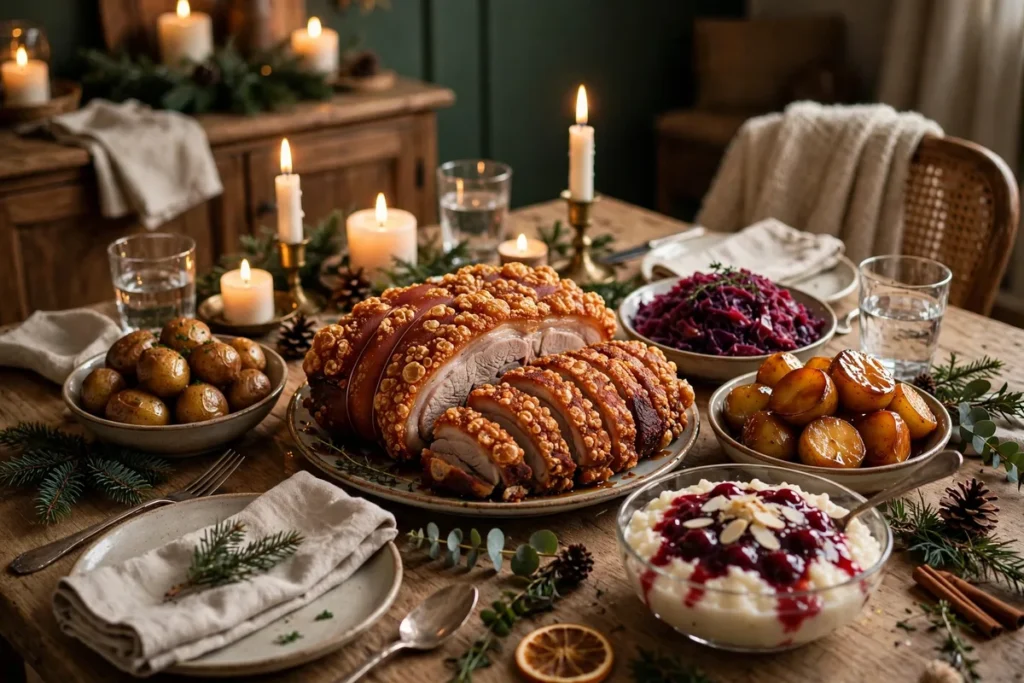
A Danish Christmas dinner: crispy flæskesteg, caramelized potatoes, red cabbage, risalamande, candles in a cozy hygge room.
Watch: Danish Christmas Dinner — Flæskesteg
How to make the whole Danish Christmas dinner — flæskesteg with everything: crackling, caramel potatoes, red cabbage and gravy.
At a Glance: Danish Christmas Dinner — Flæskesteg
The Danish Christmas Eve table.
| Tradition | Date | Key detail |
|---|---|---|
| Juleaften | 24 December | Christmas Eve is the main celebration — dinner, tree dance, then gifts |
| Flæskesteg | 24 December | Roast pork with shattering crispy crackling — the table’s king |
| Andesteg | 24 December | Roast duck — the friendly rival; goose has fallen out of favor |
| Brunede kartofler | 24 December | Caramelized potatoes in toffee — with rødkål (pickled red cabbage) |
| Risalamande | 24 December | Rice pudding with almonds and cherry sauce — a hidden whole almond wins the mandelgave |
| Gløgg & julebryg | December | Mulled wine and the Christmas brew — with snaps for toasting |
| Æbleskiver | December | Apple-filled pancake balls — the Christmas Eve afternoon treat |
Frequently Asked Questions
What is flæskesteg?
Flæskesteg is the traditional Danish Christmas roast pork: a loin or rib roast with the skin on, scored, salted, and roasted until the rind becomes shatteringly crisp crackling (svær). It is served on Juleaften (December 24) with caramelized potatoes, red cabbage, brown gravy, and red currant jelly.
Do Danes eat duck or pork for Christmas?
Both — Denmark’s great Christmas debate is andesteg (roast duck with prune-apple stuffing) versus flæskesteg (roast pork with crackling). Many families serve both and let guests choose; allegiance to one or the other is often a cherished family identity.
What is risalamande?
Risalamande is the classic Danish Christmas dessert: cold rice pudding folded with whipped cream, vanilla, and chopped almonds, served with hot cherry sauce. One whole almond is hidden inside; whoever finds it wins the mandelgave (almond gift), traditionally a marzipan pig.
Why do Danes celebrate Christmas on December 24?
Like much of Scandinavia and German-speaking Europe, Denmark’s main Christmas celebration is Juleaften (Christmas Eve, December 24), with dinner around 6 PM followed by dancing around the tree, carols, and presents. Christmas Day is quieter, for leftovers and family visits.
What is hygge?
Hygge is the Danish concept of cozy, unhurried togetherness — candles, good food, close company, no rushing. It peaks at Christmas, when the dark days make warmth and light precious. It is considered an active practice, not just a mood: Danes deliberately create hygge.
What are brunede kartofler?
Brunede kartofler are Denmark’s caramelized Christmas potatoes: small boiled potatoes rolled in a butter-sugar caramel until lacquered and golden. Sweet, glossy, and dangerously good, they are an essential part of the Juleaften plate.