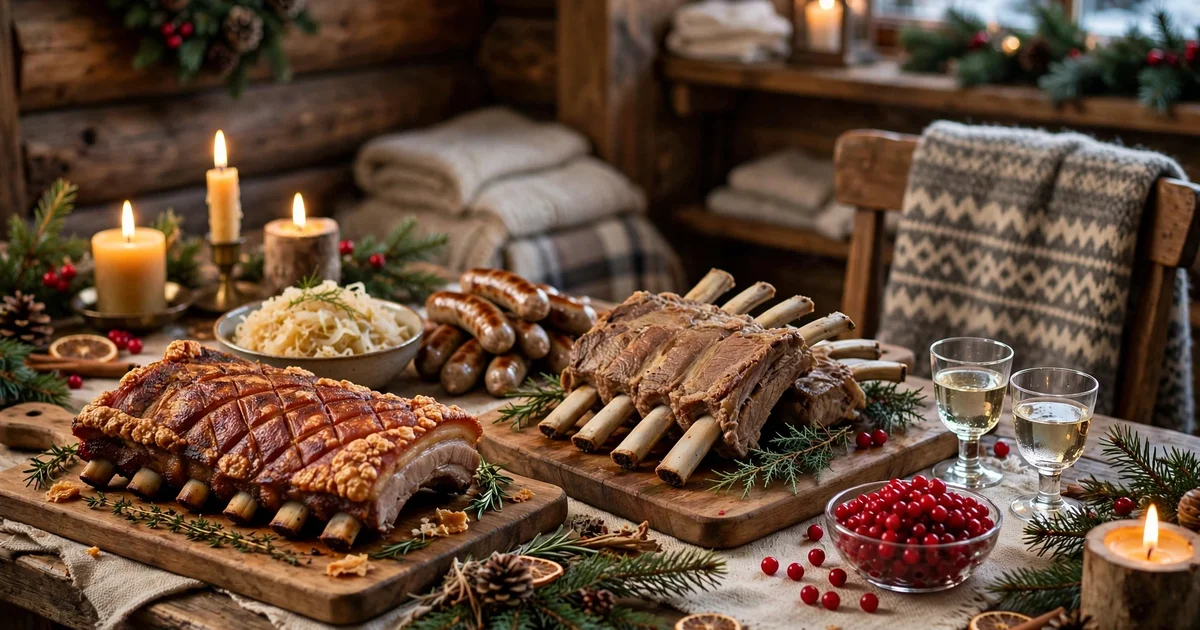
Norway does not have a Christmas dinner — it has a Christmas argument, served with crackling. The Norwegian Christmas dinner ribbe pinnekjøtt rivalry is the country’s great culinary divide: in the east, families swear by ribbe (roast pork ribs with shattering crackling); in the west, they pledge allegiance to pinnekjøtt (salted, dried lamb ribs steamed over birch sticks). Ask a Norwegian which is the “real” Christmas dinner and you will get an answer with the force of regional identity behind it. Add lutefisk — Scandinavia’s most controversial fish — plus rice cream with a hidden almond, aquavit, and the cozy rituals of lille julaften, and you have one of Europe’s most characterful Christmas tables. This guide referees the great debate, maps the regions, and gives you the full Norwegian Christmas playbook.
The Great Debate: Ribbe vs. Pinnekjøtt
Every December, Norway splits into two delicious camps. Polls consistently show the country divided — ribbe commanding the east (including Oslo), pinnekjøtt ruling the west and much of the north — with families defending their choice like a football allegiance. Mixed marriages negotiate truces (serve both, alternate years, or the diplomatic “ribbe on Christmas Eve, pinnekjøtt on Christmas Day”). To understand Norway’s Christmas, you must understand both contenders.
In the Red Corner: Ribbe
Ribbe is pork belly — the rib section — roasted with its rind on until the skin becomes svor, crackling of legendary crispness. The preparation is a ritual: the rind is scored in a diamond or strip pattern, rubbed with coarse salt and black pepper, and the roast goes into the oven over water (steam for juiciness below, dry heat for crackling above). As it roasts, it is basted; near the end, the heat is blasted to bubble the svor into golden armor.
Ribbe’s stronghold is Eastern Norway — Oslo, the inland valleys, the southeast — where it is the undisputed Christmas Eve centerpiece. Its appeal is primal: rich, fatty pork, salty-crisp skin, the deep satisfaction of crackling that shatters audibly. It is served with surkål (sauerkraut) or rødkål (red cabbage), boiled potatoes, pork meatballs (medisterkaker), Christmas sausage (julepølse), and a rich gravy — plus tyttebær (lingonberry jam) for the essential sweet-sour cut through the fat.
The ribbe cook’s nightmare is soft svor — a Christmas tragedy discussed in hushed tones. The rescue techniques are passed down like heirlooms: dry the rind overnight salted in the fridge, never let water touch the skin, finish under screaming heat, and rest the roast uncovered. A perfect ribbe’s crackling should be audible across the room.
In the Green Corner: Pinnekjøtt
Pinnekjøtt (“stick meat”) is one of the world’s great preserved-meat traditions: lamb or mutton ribs, salted and dried (sometimes lightly smoked), then transformed by a two-day process. First the ribs are soaked in cold water for 24–36 hours (changed once or twice) to draw out the salt; then they are steamed — not boiled — arranged over a bed of birch sticks (pinner, hence the name) in a pot with a little water below, the lid on, for about three hours, until the meat surrenders from the bone.
The result is unlike anything else: deeply savory, concentrated lamb flavor, meat that falls apart at a glance, with a texture somewhere between confit and jerky made tender. It is served with kålrabistappe (mashed rutabaga/swede — the essential partner), boiled potatoes, and sometimes a rich lamb stock gravy. Its stronghold is Western Norway — Bergen, the fjords, the coast — where Christmas without pinnekjøtt is unthinkable, plus much of the north.
Pinnekjøtt’s magic is its history: this is Viking preservation logic — salt, dry, store — turned into celebration food. The birch sticks are not theater; they keep the meat above the water so it steams rather than boils, and they perfume it faintly. Modern cooks use a steamer rack, but traditionalists insist on real birch. Either way, the soaking is non-negotiable: under-soaked pinnekjøtt is a salt lick; properly soaked, it is sublime.
Head-to-Head: Ribbe vs. Pinnekjøtt
| Round | Ribbe | Pinnekjøtt |
|---|---|---|
| Meat | Pork belly/ribs, fresh | Lamb/mutton ribs, salted & dried |
| Method | Oven-roasted over water | Soaked 24–36 hrs, then steamed over birch sticks |
| Signature texture | Shattering crisp crackling (svor) | Fall-off-the-bone tenderness |
| Flavor | Rich, salty, porky indulgence | Concentrated, savory, almost gamey lamb depth |
| Stronghold | Eastern Norway, Oslo, the southeast | Western Norway, the fjords, much of the north |
| Prep stress | High (the svor gamble) | Medium (the soaking discipline) |
| Essential partner | Surkål & medisterkaker | Kålrabistappe (mashed rutabaga) |
| Best for | Crackling devotees, pork lovers | Adventurous eaters, preservation-food romantics |
The referee’s verdict: there isn’t one — and that’s the point. The rivalry is the tradition. Norway’s Christmas identity is big enough for both, and the annual debate is itself a form of togetherness. Newcomers should try both (many restaurants and julebord Christmas parties serve them side by side through December) and then — this is important — pick a side loudly. Neutrality is not respected. Ask any Norwegian expat what they miss most in December and the answer comes without hesitation: not the snow, not the darkness, but the smell of their side’s champion roasting or steaming in their mother’s kitchen. That aroma is the true meaning of a Norwegian Christmas — edible homesickness, served with gravy.
The Supporting Cast: What Else Is on the Table
Whichever champion you back, the supporting dishes are largely shared across Norway:
- Medisterkaker: savory pork meatballs, fried golden — the ribbe table’s essential companion, also served with pinnekjøtt in many homes.
- Julepølse: Christmas sausage — coarse, juicy pork sausage, a must on the side.
- Surkål: sauerkraut, often cooked with caraway and a little sugar — the acidic counterpoint to rich pork.
- Rødkål: sweet-sour red cabbage with apple — the Danish influence, beloved in the south and east.
- Kålrabistappe: mashed rutabaga with cream and nutmeg — pinnekjøtt’s soulmate, glorious with either meat.
- Tyttebær: lingonberry jam or stirred lingonberries — the bright, tart foil for all that fat.
- Poteter: plain boiled potatoes — the neutral canvas for gravy.
- Sjy/saus: rich brown gravy from the roast’s drippings — non-negotiable.
And for dessert, Norway shares Scandinavia’s loveliest lottery: riskrem — cold rice cream with chopped almonds and vanilla, served with warm red berry sauce (rød saus). One whole almond is hidden inside; the finder wins a prize (often a marzipan pig, the Nordic lucky symbol). It is the Norwegian twin of Denmark’s risalamande — compare the two in our guide to Danish Christmas dinner flæskesteg.
Lutefisk: Norway’s Most Controversial Christmas Dish
Lutefisk — dried cod treated with lye, then soaked and cooked — is the dish Norwegians love to argue about almost as much as ribbe versus pinnekjøtt. Its texture (gelatinous, delicate) and its preparation (involving lye) make it infamous far beyond Norway, but properly made lutefisk is mild, tender, and genuinely delicious — a blank canvas for bacon, mustard, peas, and browned butter.
In Norway, lutefisk’s Christmas role has shifted: it was once a Christmas Eve dish, but today it stars in the lutefisk season of November and December — dedicated lutefisk dinners with friends, often at restaurants or as lutefisklag (lutefisk parties) — while Christmas Eve itself belongs to ribbe or pinnekjøtt. It remains the ultimate litmus test: serve lutefisk at a gathering and watch the room divide into devotees and the horrified. Finland fights the same battle under another name — see the Finnish joulupöytä for the lipeäkala perspective.
Regional Map: What Norway Eats Where
- Eastern Norway (Østlandet) — Ribbe country: Oslo and the inland valleys are the heartland of roast pork ribs with svor, surkål, and medisterkaker. The capital’s Christmas is a ribbe Christmas.
- Western Norway (Vestlandet) — Pinnekjøtt country: Bergen and the fjord districts steam their salted lamb ribs over birch, with kålrabistappe. The most fiercely loyal pinnekjøtt territory.
- Trøndelag (central) — The swing region: Trondheim’s tables are famously split — ribbe and pinnekjøtt coexist, and many families serve both.
- Northern Norway (Nord-Norge) — Mixed with fish: Pinnekjøtt is strong, but the north’s fishing heritage puts lutefisk, boknafisk (dried cod), and fresh cod dishes on many Christmas tables alongside or instead of the meats.
- Southern Norway (Sørlandet) — Ribbe with Danish notes: Pork ribs dominate, with rødkål and a generally Danish-leaning table.
The regional map is not just culinary trivia — it is identity. A Westerner served ribbe on Christmas Eve will eat it politely and tell you, at length, what they should be eating. This is Norway’s delicious, good-natured tribalism at its finest.
Lille Julaften and the Norwegian Christmas Calendar
The great dinner sits inside a full season of rituals:
- December 13 — St. Lucia Day: borrowed from Sweden, with lussekatter (saffron buns) and candle-crowned processions, especially in kindergartens.
- Throughout December — Julebord: the Christmas-table party season. Workplaces, clubs, and friend groups book restaurants for long evenings of ribbe, pinnekjøtt, lutefisk, aquavit, and singing. A Norwegian may attend half a dozen julebord before Christmas Eve.
- December 23 — Lille julaften (Little Christmas Eve): the tree is decorated, the house is finished, and the family eats risengrynsgrøt (hot rice porridge with cinnamon, sugar, and butter) — often with a hidden almond, a preview of the riskrem lottery. It is the calm before the feast.
- December 24 — Julaften: church in the afternoon, dinner around 5–6 PM, then gang rundt juletreet (walking around the Christmas tree singing carols), and presents — traditionally brought by Julenissen (the Christmas gnome/elf).
- December 25–26: first and second Christmas Day — quiet, for leftovers, skiing, and family. The ribbe sandwiches (cold ribbe with surkål on bread) are a Boxing Day treasure.
What Norwegians Drink: Aquavit and Juleøl
Akevitt (aquavit) is Norway’s Christmas spirit — caraway- and dill-flavored, and at Christmas, the aged juleakevitt versions. The most famous, Linie, is aged in sherry casks that cross the equator twice by ship — a tradition born when a 19th-century shipment returned unsold and tasted better for the voyage. It is drunk in small glasses with the Christmas dinner, with the obligatory skål and eye contact.
Juleøl (Christmas beer) — dark, malty, spiced — is the dinner companion, with every brewery releasing its own. The aquavit ritual deserves a final note: the skål is never rushed. Glasses are raised, eyes are met around the entire table, and only then does anyone drink — a small ceremony of attention that turns a sip of caraway spirit into an act of togetherness. At a Norwegian Christmas table, even the drinking has choreography, and it is beautiful. And gløgg (mulled wine with raisins and almonds) warms the December afternoons. With lutefisk, tradition demands aquavit; with ribbe, beer; with the whole long evening, both. For more festive drinking and dining ideas, browse our Christmas dinner ideas collection.
The Perfect Svor: Ribbe Masterclass
The difference between good ribbe and legendary ribbe is entirely in the svor — the crackling. Here is the method Norwegian butchers and grandmothers agree on:
Choosing the Cut
Ask for tynnribbe (thin ribs, belly section) or familieribbe — with an even, unbroken layer of rind. The rind should already be scored; if not, score it yourself with a razor-sharp knife or scalpel in 1cm strips, cutting through skin and fat but not into the meat. Uneven scoring means uneven crackling.
The Method
- Salt early: Rub coarse sea salt and cracked black pepper deep into every score. Refrigerate uncovered overnight — the dry air is your ally; moisture is the enemy of crispness.
- Low and slow: Place the ribbe rind-up on a rack over water (with a halved onion in the water for the gravy). Roast at 150°C (300°F) for 2–3 hours until the meat is tender.
- The blast: Raise to 230°C (450°F) for the final 20–30 minutes, watching constantly. The rind will bubble and blister into golden svor. This is the high-wire act — perfect crackling to burnt in minutes.
- Rest uncovered: Rest 20–30 minutes tented loosely — tight foil steams the svor soft, the unforgivable sin.
Emergency Repairs
- Patchy soft spots: Cut the rind off, finish it separately under the broiler, return for serving.
- Meat done, skin not: The classic dilemma — remove the meat, blast the skin alone. Serve together; no one will know.
- Total svor failure: It happens to everyone once. Serve with extra medisterkaker, pour more aquavit, and try again next year — Norwegian Christmas forgives.
Pinnekjøtt Masterclass: From Soak to Steam
Pinnekjøtt rewards patience, not skill — the method is simple, but the timing is sacred:
Buying
Choose smoked or unsmoked according to family tradition (the west is split; smoked is more assertive). Look for well-dried ribs with good meat coverage — overly fatty pieces steam greasy. Plan 400–500g per person (bone-in).
The Soak (36 hours before serving)
- Rinse the ribs and submerge in plenty of cold water. Refrigerate.
- Change the water after 12 hours, and again after 24. Total soak: 24–36 hours depending on thickness and saltiness.
- Taste-test a small piece: it should taste seasoned and savory, not aggressively salty. When in doubt, soak longer — you cannot easily fix over-salted pinnekjøtt, but you can always add salt at the table.
The Steam (3 hours before serving)
- Line a large pot with birch sticks (pinner) — or a steamer rack — and add water below the sticks. The meat must steam, never boil.
- Arrange the ribs over the sticks, lid on, and steam gently for 2.5–3 hours, until the meat pulls from the bone with no resistance.
- Rest 15 minutes. Serve with kålrabistappe, boiled potatoes, and the rich steaming liquor as a light gravy.
The birch question: traditionalists insist real birch sticks perfume the meat; modernists use metal racks. Both work — but if you can get birch, use birch. It is the difference between pinnekjøtt and real pinnekjøtt, or so the west claims.
Norway’s Seven Sorts: The Christmas Cookie Canon
Norwegian Christmas baking follows the old rule of seven sorts (sju slag) — a proper Christmas requires seven kinds of cookies. The classic lineup:
- Pepperkaker: thin, crisp gingerbread — often heart- or pig-shaped, decorated with icing. The undisputed number one.
- Krumkaker: delicate cone-rolled waffle cookies, made on a special iron, sometimes filled with whipped cream.
- Sandkaker (sandnøtter): crumbly almond tartlets baked in fluted tins.
- Berlinerkranser: wreath-shaped butter cookies with pearl sugar.
- Kokosmakroner: coconut macaroons, chewy and golden.
- Serinakaker: buttery cookies topped with pearl sugar and chopped almonds.
- Goro: thin, crisp cardamom-flavored flat cookies from the traditional iron.
The seven-sorts rule is honored as much in the breach as the observance — modern families bake what they love — but the tin of mixed julekaker remains the essential Christmas offering, refilled all December. For the global cookie perspective, see our Christmas desserts around the world.
Julebord Etiquette: Surviving Norway’s Party Season
The julebord (Christmas table party) season is where many Norwegians eat their first ribbe or pinnekjøtt of December — and where outsiders need a briefing. The rules:
- Dress the part: julebord is dressy — this is not the night for casual. Dark suits, cocktail dresses, the works.
- Pace the aquavit: the skål comes often. Alternate every snaps with water or beer; the veterans do.
- Eye contact on the toast: look each person in the eye when you skål. It matters.
- Eat before you drink: the buffet opens before the speeches — strategic.
- Sing along: someone will start a drinking song (drikkevise); printed lyrics may appear. Join in, badly is fine.
- The taxi rule: book your ride home before the party. December taxis in Norwegian cities are a competitive sport.
Workplace julebord parties are legendary for next-day stories — the Norwegian phrase “hva skjedde på julebordet” (what happened at the Christmas party) carries entire novels of implication. Eat well, drink wisely, and you’ll have your own. And remember the host’s perspective too: if you’re organizing a julebord, book the restaurant in October (December dates vanish fast), confirm the ribbe-vs-pinnekjøtt split in advance, and order the aquavit selection with the same care as the menu — your guests will judge both, loudly and lovingly. One more survival tip from the Norwegian trenches: the julebord speech. Someone — usually the boss, usually after the second aquavit — will give a speech. Applaud warmly, laugh at the jokes you’ve heard three years running, and remember that your own turn to give the toast may come sooner than you think. Preparation beats improvisation, especially in December.
In Pictures: Norwegian Christmas Dinner — Ribbe vs Pinnekjøtt
Norway’s great Christmas debate: ribbe, the crispy pork roast, against pinnekjøtt, the steamed lamb ribs of the west.
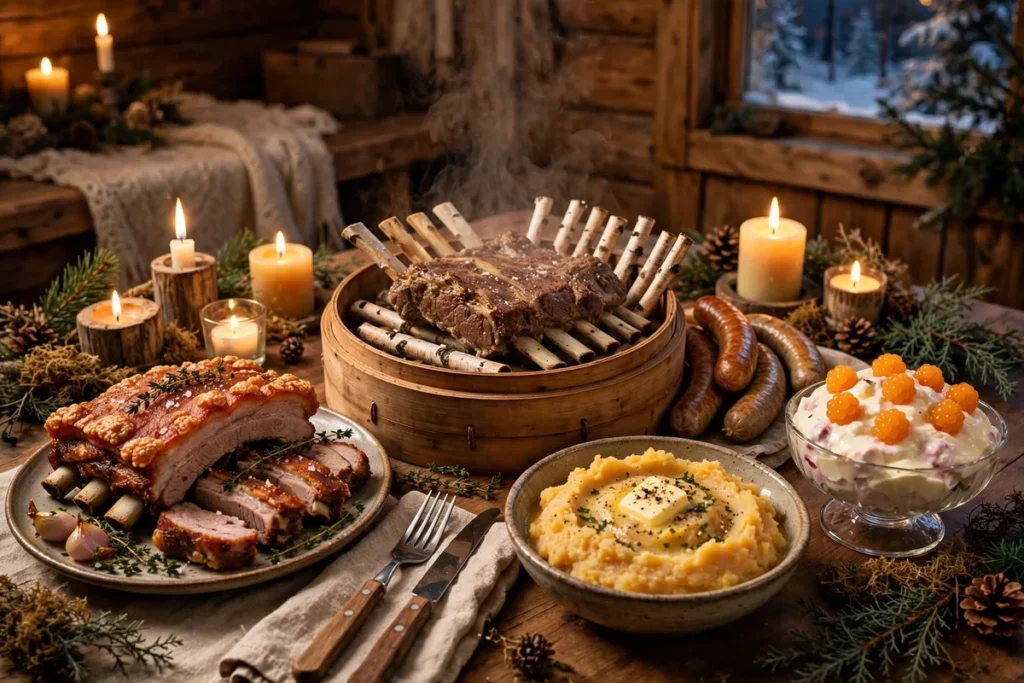
A Norwegian Christmas dinner: crispy ribbe and pinnekjøtt lamb ribs, sausages, mashed rutabaga, in a candlelit wooden cabin.
Watch: Norwegian Christmas Dinner — Ribbe vs Pinnekjøtt
How to make the traditional Norwegian Christmas pork ribs — step by step, with roots back to the 1800s.
At a Glance: Norwegian Christmas Dinner — Ribbe vs Pinnekjøtt
The great debate and the supporting cast.
| Dish | When | Key detail |
|---|---|---|
| Ribbe | 24 December | Crispy pork rib roast — the choice of about half of Norway, especially the east |
| Pinnekjøtt | 24 December | “Stick meat” — salted lamb ribs steamed over birch sticks; western Norway’s favorite |
| Kålrabistappe | 24 December | Mashed swede — the classic accompaniment to both |
| Medisterkaker | 24 December | Pork meatballs and julepølse sausage — the supporting cast |
| Lutefisk | December | Lye-treated dried fish — Norway’s most controversial Christmas dish |
| Lille julaften | 23 December | “Little Christmas Eve” — preparations and porridge |
| Julebord | December | The Christmas buffet parties — through the whole season |
Frequently Asked Questions
What is the difference between ribbe and pinnekjøtt?
Ribbe is fresh pork belly/ribs oven-roasted with crackling (svor), dominant in eastern Norway. Pinnekjøtt is salted, dried lamb ribs, soaked for 24–36 hours then steamed over birch sticks until fall-apart tender, dominant in western Norway. They are the two rival centerpieces of the Norwegian Christmas dinner.
Which is more popular in Norway — ribbe or pinnekjøtt?
The country is famously split: ribbe leads in the east (including Oslo) and pinnekjøtt in the west and north, with central regions divided. Many families serve both or alternate years. The rivalry itself is a beloved national tradition.
What is lutefisk?
Lutefisk is dried cod treated with lye, then soaked and gently cooked until gelatinous-tender. Served with bacon, peas, mustard, and browned butter, it is Scandinavia’s most controversial dish — once a Christmas Eve staple in Norway, now more common at dedicated lutefisk parties in November and December.
What do Norwegians eat for dessert at Christmas?
Riskrem — cold rice cream with vanilla and chopped almonds, served with warm red berry sauce. A whole almond is hidden inside; whoever finds it wins a prize, traditionally a marzipan pig. It is the Norwegian cousin of Danish risalamande.
What is lille julaften?
Lille julaften (“Little Christmas Eve”) is December 23, when Norwegians decorate the Christmas tree, finish preparations, and eat risengrynsgrøt (hot rice porridge with cinnamon and butter) — the calm, cozy prelude to the Christmas Eve feast.
What is julebord?
Julebord (“Christmas table”) is Norway’s December party season: festive dinners hosted by workplaces, clubs, and friend groups, featuring ribbe, pinnekjøtt, lutefisk, aquavit, and singing. Most Norwegians attend several julebord each year before Christmas Eve arrives.