On Christmas Eve, as the first star appears in the winter sky, Ukrainian families gather around a table laden with twelve meatless dishes — one for each of the twelve apostles. The ukrainian christmas eve supper 12 dishes tradition, known as Sviata Vecheria (the Holy Supper), is one of Europe’s most beautiful and spiritually rich Christmas rituals: a meatless, dairy-free feast of grains, mushrooms, fish, and honey that honors both the nativity and the agricultural year. This guide walks you through all twelve traditional dishes — from the sacred kutia to the warming uzvar — explains the rituals that surround the meal, and shows how this ancient supper is kept alive by Ukrainians around the world today.
What Is Sviata Vecheria?
Sviata Vecheria — literally “Holy Evening” — is the traditional Ukrainian Christmas Eve supper, held on the evening before Christmas Day. For centuries, Ukrainian Christmas followed the Julian calendar, placing the Holy Supper on January 6th; in recent years, following the Orthodox Church of Ukraine’s move to the Revised Julian calendar, many Ukrainians now celebrate Christmas on December 25th, with Sviata Vecheria on December 24th — though some families and communities continue to observe the January dates. Either way, the supper itself is unchanged: twelve dishes, no meat, no dairy, no eggs, eaten in a spirit of solemn joy after a day of fasting.
The meal is deeply symbolic. The number twelve honors the apostles; the absence of animal products reflects the fasting tradition and the humility of the nativity; and many dishes carry pre-Christian agricultural symbolism — wheat for prosperity, honey for sweetness in the new year, mushrooms for the forest’s bounty. The supper begins when the first star appears, recalling the Star of Bethlehem, and in many families the youngest child is sent to watch the sky and announce it. If you are fascinated by how different cultures structure their holiday tables, our Christmas dinner ideas offers more festive inspiration from around the world.
The Rituals of the Holy Supper
Before a single bite is taken, Sviata Vecheria unfolds through rituals that make it far more than a meal:
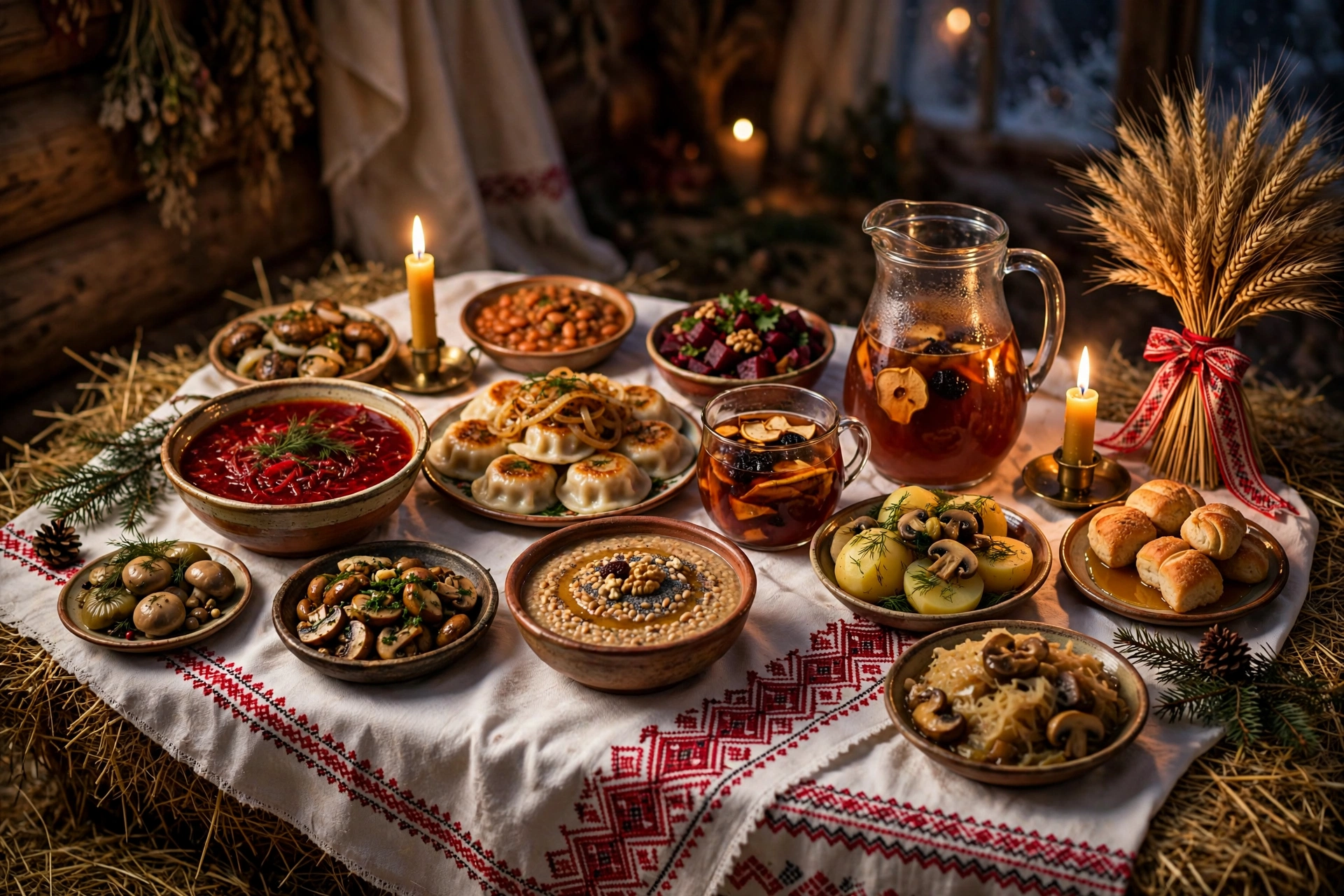
- The didukh: A sheaf of wheat — the didukh, or “grandfather spirit” — stands in the corner of the room, symbolizing the ancestors and the harvest. It is brought in ceremoniously before the supper.
- Hay under the tablecloth: A thin layer of hay is spread on the table beneath a white embroidered cloth (rushnyk), recalling the manger. Some families place straws of hay under plates for luck.
- The first star: The family waits for the first star of the evening — children are often dispatched to watch — before sitting down.
- The empty place: An extra place is set for absent family members or for the souls of the departed, who are believed to join the feast in spirit.
- Kutia first: The meal opens with kutia, the sacred wheat-and-honey dish. The head of the household raises the first spoonful, offering a toast to health and remembrance, and each person takes a spoonful.
- Carols after supper: Once the twelve dishes are eaten, the family sings koliadky (carols) — including the world-famous “Shchedryk,” known in English as “Carol of the Bells” — and children may go caroling door to door.
- Midnight service: Many families attend the Christmas liturgy after the supper, returning home in the early hours to rest before Christmas Day’s (non-fasting) celebrations.
The Twelve Dishes of Ukrainian Christmas Eve
While the exact lineup varies by region and family, these are the twelve canonical dishes of Sviata Vecheria. Each carries its own symbolism and its own place in the meal’s rhythm.
1. Kutia — the sacred first dish
Kutia is the soul of the supper: cooked wheat berries (or barley) mixed with honey, ground poppy seeds, and chopped walnuts, sometimes with raisins. It is the first dish tasted and the most symbolically loaded — wheat for eternal life and prosperity, honey for the sweetness of paradise, poppy seeds for abundance and remembrance of the dead. Every family has its ratio; every grandmother insists hers is correct. Kutia is also served at memorial services, linking Christmas joy to the remembrance of ancestors in a single bowl.
2. Uzvar — the dried-fruit compote
The traditional Christmas drink: a compote of dried fruits — apples, pears, plums, cherries, sometimes apricots — slowly simmered with honey into a fragrant, lightly sweet beverage served warm or at room temperature. Uzvar is one of the oldest dishes on the table, predating Christianity in the region, and its deep amber color and orchard aroma are the taste of a Ukrainian winter.
3. Borscht with vushka — the mushroom broth
Christmas borscht is distinct from the everyday beet soup: it is a clear, meatless mushroom broth, its ruby color coming from beet kvass or beet juice rather than chunky beets, served with vushka (“little ears”) — tiny dumplings filled with minced mushrooms and onion. The combination of earthy broth and delicate dumplings is refined and deeply comforting.
4. Varenyky — the festive dumplings
No Ukrainian celebration is complete without varenyky, and Christmas Eve demands them in meatless form: filled with potato and fried onion, with sauerkraut and mushrooms, or with sweet cabbage. They are boiled, then often tossed with caramelized onions, and served with a reverence that approaches the religious. Making varenyky is communal work — the pinching of each dumpling is a skill passed down through generations.
5. Holubtsi — cabbage rolls
For Christmas Eve, holubtsi are made without meat: tender cabbage leaves wrapped around rice, buckwheat, or millet with mushrooms, carrots, and onion, baked in a light tomato or mushroom sauce. They are humble, hearty, and profoundly satisfying — proof that fasting food need not feel like deprivation.
6. Baked or fried fish
Fish is permitted during the fast and provides the supper’s protein: carp, pike, or herring, baked whole, fried in batter, or served as jellied fish (kholodets made with fish stock). In western Ukraine, fried carp echoes the Central European Christmas fish tradition — compare the Czech Christmas carp tradition for a fascinating parallel.
7. Mushroom gravy (pidlyva)
Dried forest mushrooms — porcini-like bili hryby gathered in autumn — are rehydrated and simmered into a rich, dark gravy thickened with flour, served over varenyky, holubtsi, or mashed potatoes. The intense, woodsy flavor of real forest mushrooms is irreplaceable; this is the taste of the Ukrainian woods on a winter night.
8. Sauerkraut and pickled vegetables
Homemade sauerkraut, pickled cucumbers, pickled mushrooms, and marinated beets provide the bright, acidic counterpoint the rich meal needs. Fermentation is central to Ukrainian food culture, and the Christmas table shows off the autumn’s preserving work at its best.
9. Mashed potatoes or buckwheat kasha
Simple, buttery (with oil, not butter, for the fast) mashed potatoes or nutty buckwheat kasha serve as the foundation starch — the quiet base that lets the mushroom gravy and pickles shine. Buckwheat, in particular, is ancient Ukrainian soul food.
10. Beans or peas
Slow-cooked white beans or yellow peas with caramelized onion and garlic — humble, protein-rich, and traditional. In some regions this dish is sweetened slightly with honey; in others it stays firmly savory.
11. Pampushky — garlic bread rolls
Soft, golden dinner rolls brushed with garlic oil and sprinkled with herbs — the bread of the Christmas table, perfect for sopping up borscht and mushroom gravy. Sweet versions filled with poppy seed or cherry may also appear among the desserts.
12. Honey cake (medivnyk) and dried-fruit desserts
The sweet close: medivnyk, a spiced honey layer cake, or makivnyk (poppy seed roll), plus stewed dried fruit and nuts. Christmas Eve desserts are honey-based rather than chocolate-based, keeping the meal’s ancient flavor profile to the very end. For more global sweet traditions, see our Christmas desserts around the world.
Regional Variations Across Ukraine
Ukraine is a large country, and Sviata Vecheria wears regional accents:
- Western Ukraine (Galicia, Volhynia): The most elaborate observance — strict fasting, the full twelve dishes, strong emphasis on mushroom dishes and the didukh tradition. Borscht with vushka is canonical here.
- Central Ukraine: Similar structure with more emphasis on varenyky varieties and fish dishes; kutia may include more dried fruit.
- Eastern and Southern Ukraine: The supper may be slightly simplified, with more Russian-influenced dishes, but the twelve-dish framework and kutia remain.
- Carpathian regions: Mountain influences — more mushrooms, more buckwheat, cornmeal dishes like banosh in adapted fasting form, and distinctive local carols.
- Crimean and coastal areas: More fish and seafood in the lineup, reflecting the Black Sea and Sea of Azov.
Diaspora communities — in Canada, the US, Poland, and beyond — preserve these traditions with fierce devotion, often hewing to the western Ukrainian form as the “classic” version. Ukrainian Christmas Eve suppers in cities like Toronto, Chicago, and Warsaw draw hundreds to parish halls each year.
Cooking Sviata Vecheria: A Practical Guide
Preparing all twelve dishes is a truly joyful labor of love that rewards careful planning — and the work itself, done together with family over two days of chopping, pinching, and stirring, becomes part of the holiday memory. Here is how experienced hosts manage it:
- Start with what keeps: Kutia, uzvar, pickles, and sauerkraut can be made days ahead — kutia actually improves after a day as the flavors meld.
- Soak and prep: Dried mushrooms need overnight soaking; wheat berries for kutia need long cooking; beans need soaking. Begin two days out.
- Enlist the family: Varenyky-pinching is a group activity; assign dishes to relatives potluck-style.
- Mind the fast: Traditional Sviata Vecheria uses oil, not butter; no meat, dairy, or eggs. Check every recipe — modern adaptations sometimes sneak in butter.
- Sequence the cooking: Christmas Eve day: morning — borscht broth and mushroom gravy; midday — varenyky, holubtsi, fish; afternoon — pampushky, mashed potatoes, beans; evening — reheat gently and assemble.
- Set the table with meaning: White cloth, hay beneath, the didukh in the corner, candles, and the extra place. The ritual setting is half the experience.
- Wait for the star: Build the anticipation — it is the most magical part for children.
Sviata Vecheria in the Modern World
In recent years, the Ukrainian Christmas Eve supper has gained international attention as a symbol of cultural resilience. Ukrainian restaurants worldwide feature Sviata Vecheria menus in December and January; food writers celebrate the twelve-dish tradition as one of Europe’s great festive meals; and Ukrainian families — including those displaced by war — have kept the supper as an anchor of identity and continuity. The meal’s structure makes it naturally welcoming: it is entirely plant-and-fish based, easily adapted for vegans, and its symbolism of remembrance, hope, and shared abundance resonates far beyond Ukraine.
For non-Ukrainians, hosting a Sviata Vecheria-inspired supper is a beautiful way to experience a different Christmas — one built on patience, symbolism, and the quiet magic of a meatless feast eaten by candlelight while waiting for the first star. Pair the evening with carols — “Carol of the Bells” is, after all, Ukrainian — and our best Christmas movies for after the dishes are cleared.
Kutia Recipe: The Heart of the Table
Ingredients: 1 cup wheat berries (or pearl barley); 3 cups water; pinch of salt; ½ cup poppy seeds; ½ cup honey (or to taste); ½ cup chopped walnuts, lightly toasted; ¼ cup raisins or chopped dried apricots (optional).
Method: Rinse the wheat berries and simmer in salted water for 60–90 minutes until tender but still chewy; drain and cool. Pour boiling water over the poppy seeds, soak 30 minutes, drain well, and grind (a spice grinder or mortar works). Combine the wheat, ground poppy seeds, honey, walnuts, and dried fruit; mix gently. Taste — it should be distinctly sweet, nutty, and fragrant. Serve at room temperature as the first dish of the supper, with the traditional toast to health and memory. Kutia keeps 3–4 days refrigerated and is eaten for breakfast through the Christmas season.
Christmas Day: When the Fast Breaks
If Christmas Eve is solemn and meatless, Christmas Day is exuberant and abundant. After the midnight liturgy and a few hours of sleep, Ukrainian families wake to a table transformed: the fasting dishes give way to the full glory of the holiday kitchen. Christmas Day features roast meats — pork roast, baked ham, roast goose or duck in wealthier households — alongside kovbasa (homemade sausage), salo (cured pork fat, served thinly sliced with rye bread and garlic), holubtsi now made with meat, and rich desserts like paska-style sweet breads, honey cakes, and poppy seed rolls.
The day is for visiting: godparents visit godchildren, families visit elders, and every visit involves food. Children recite poems or sing carols and receive treats and small gifts in return. The celebration traditionally extends through the twelve days of Christmas to Epiphany (Vodokhreshche), with New Year’s (and the Old New Year on January 13th–14th for those on the Julian calendar) bringing its own feasts of kutia-like shchedryk dishes and the famous carol-singing of Shchedryi Vechir. Christmas in Ukraine is not a day but a season, and the Holy Supper is its sacred opening chord.
Koliadky: The Caroling Tradition
Ukrainian Christmas carols — koliadky — are among the richest in Europe, and they are inseparable from the season’s food traditions, because caroling was historically rewarded with food. Groups of carolers, often led by a star-bearer carrying a large illuminated star (zvazda), go door to door singing koliadky and shchedrivky (New Year carols). Hosts reward them with kutia, pampushky, nuts, and sweets — and in modern times, money.
The most famous Ukrainian carol needs no introduction: “Shchedryk,” composed by Mykola Leontovych in the early 20th century, became “Carol of the Bells” in English and is now sung worldwide — often by people with no idea of its Ukrainian origins. Other beloved koliadky include “Dobryi Vechir Tobi” (“Good Evening to You”) and “Nova Radist Stala” (“A New Joy Has Come”). After the Sviata Vecheria dishes are cleared, the family’s own carol singing is the evening’s crown — and a lovely way to end any Christmas gathering. Our Christmas activities for families includes caroling ideas that work for any tradition.
Symbols and Décor of Ukrainian Christmas
The Sviata Vecheria table is dressed with symbolic objects that make the meal a visual ritual:
- Didukh: The wheat sheaf, tied decoratively and placed in the corner of honor, representing ancestors, the harvest, and continuity. Modern families unable to source a full sheaf use small decorative bundles.
- Rushnyk: The embroidered ritual cloth — white linen with red-and-black geometric or floral embroidery — laid as the tablecloth or draped over the didukh. Each region has its own embroidery patterns.
- Straw and hay: Scattered on the table under the cloth, recalling the manger; children love finding the hidden straws.
- Candles: The supper is eaten by candlelight in many families, adding to the solemn, magical atmosphere.
- The Christmas tree (yalynka): Decorated with traditional ornaments — straw stars, painted wooden figures, glass baubles — and topped with a star.
- Spider ornaments (pavuchky): A charming Ukrainian legend holds that a poor family’s Christmas tree was decorated by spiders’ webs turned to silver overnight — so spider ornaments bring good luck.
These symbols turn the dining room into a sacred space for the evening, and they photograph beautifully — the didukh and rushnyk are among the most distinctive Christmas décor traditions in Europe. For more festive decorating inspiration, browse our Christmas decoration ideas.
Experiencing Sviata Vecheria as a Guest
You do not need Ukrainian heritage to experience the Holy Supper. Ukrainian churches and cultural centers in cities with large diaspora communities — Toronto, Chicago, New York, London, Warsaw, and many others — host public Sviata Vecheria dinners in December and January, often as fundraisers, where anyone can taste all twelve dishes and witness the rituals. Ukrainian restaurants increasingly offer Christmas Eve tasting menus built around the tradition. And Ukrainian cookbooks and food blogs provide reliable recipes for every dish, from kutia to vushka. Attending as a respectful guest is a wonderful way to understand the tradition — come hungry, stay for the carols, and leave with a deeper appreciation of what a Christmas table can mean.
In Pictures: Ukrainian Christmas Eve Supper
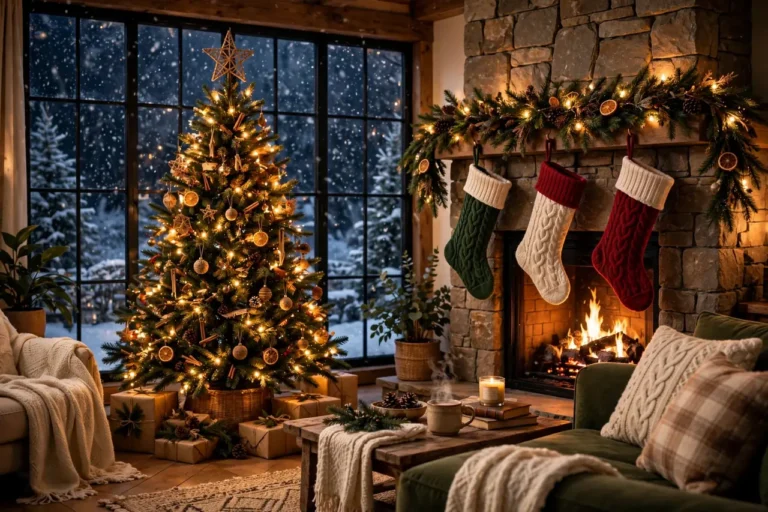
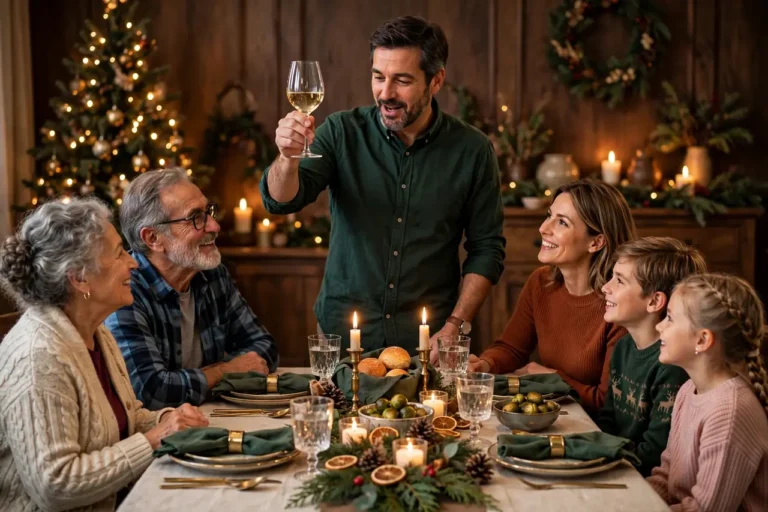
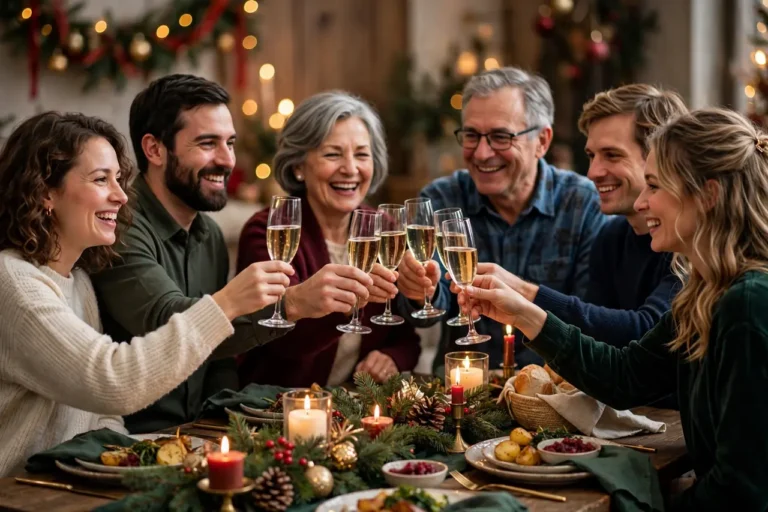
When the first star appears, Ukrainian families gather for Sviata Vecheria — twelve meatless dishes, one for each apostle, served in solemn joy after a day of fasting.
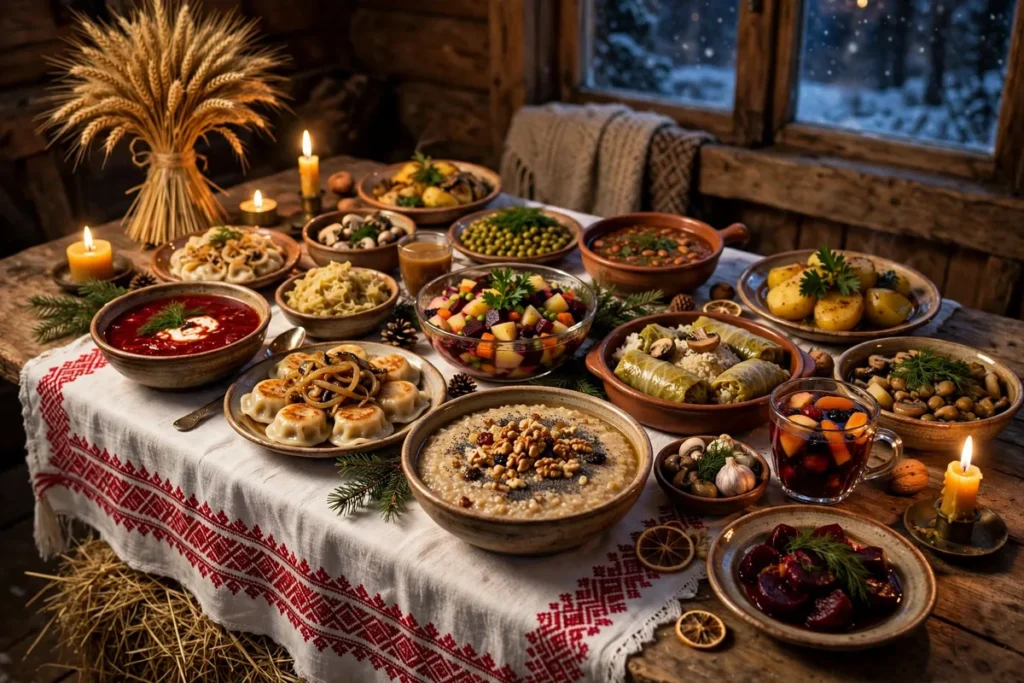
A Sviata Vecheria table: twelve meatless dishes with kutia at the center, hay beneath the embroidered cloth, and the didukh wheat sheaf standing watch.
Watch: Ukrainian Christmas Eve Supper
Life of Julia spends Christmas in the Carpathian Mountains, preparing kutia, varenyky, and all twelve Lenten dishes — with hay under the tablecloth and the didukh brought in.
At a Glance: Ukrainian Christmas Eve Supper
The dishes and rituals of Sviata Vecheria, Ukraine's Holy Supper.
| Element | What it is | Key detail |
|---|---|---|
| Kutia | The sacred first dish | Wheat berries with honey, poppy seeds, and nuts; eaten first — wheat symbolizes prosperity, honey sweetness in the new year |
| Uzvar | The drink | A compote of dried fruits — apples, pears, prunes — simmered into a warming Christmas beverage |
| Borscht with vushka | The soup | Beet borscht served with tiny mushroom dumplings (vushka), entirely meatless |
| Varenyky | The dumplings | Filled with potato, cabbage, or mushrooms; a staple of the twelve-dish table |
| Holubtsi | The cabbage rolls | Stuffed cabbage rolls made without meat for the Holy Supper |
| Didukh | The wheat sheaf | Brought into the home to honor ancestors and invite prosperity — a pre-Christian symbol woven into Christmas |
| Hay under the tablecloth | The ritual | A handful of hay recalls the manger of the nativity, spread beneath the festive cloth |
| The first star | The signal | The supper begins only when the first star appears, recalling the Star of Bethlehem; often the youngest child watches the sky |
Frequently Asked Questions
Why are there 12 dishes at the Ukrainian Christmas Eve supper?
The twelve meatless dishes of Sviata Vecheria honor the twelve apostles. The number is fixed by tradition, though the exact dishes vary by region and family — kutia, uzvar, borscht, varenyky, and fish are nearly universal.
When is Ukrainian Christmas Eve?
Traditionally January 6th (Julian calendar), with Christmas on January 7th. Since the Orthodox Church of Ukraine adopted the Revised Julian calendar, many Ukrainians now celebrate Christmas Eve on December 24th and Christmas on December 25th; some families and parishes continue to observe the January dates.
Why is the Ukrainian Christmas Eve supper meatless?
Christmas Eve is the culmination of the Nativity Fast (a period of abstinence before Christmas), so the supper contains no meat, dairy, or eggs — only grains, vegetables, mushrooms, fish, fruit, honey, and oil. The fasting makes the Christmas Day feast, which includes meat, all the more celebratory.
What is kutia?
Kutia is the sacred first dish of Sviata Vecheria: cooked wheat berries mixed with honey, ground poppy seeds, and walnuts. It symbolizes prosperity, eternal life, and remembrance of ancestors, and is tasted first, with a toast, before the rest of the meal.
What is uzvar?
Uzvar is the traditional Christmas beverage: dried fruits (apples, pears, plums, cherries) simmered with honey into a fragrant compote, served warm or at room temperature. It is one of the oldest dishes on the Ukrainian Christmas table.
Can I make a simplified Sviata Vecheria?
Absolutely. Many families — especially in the diaspora — prepare a representative selection rather than all twelve from scratch: kutia, uzvar, borscht, varenyky, a fish dish, pickles, and a honey dessert capture the supper’s spirit. The rituals (first star, kutia toast, carols) matter as much as the full count.