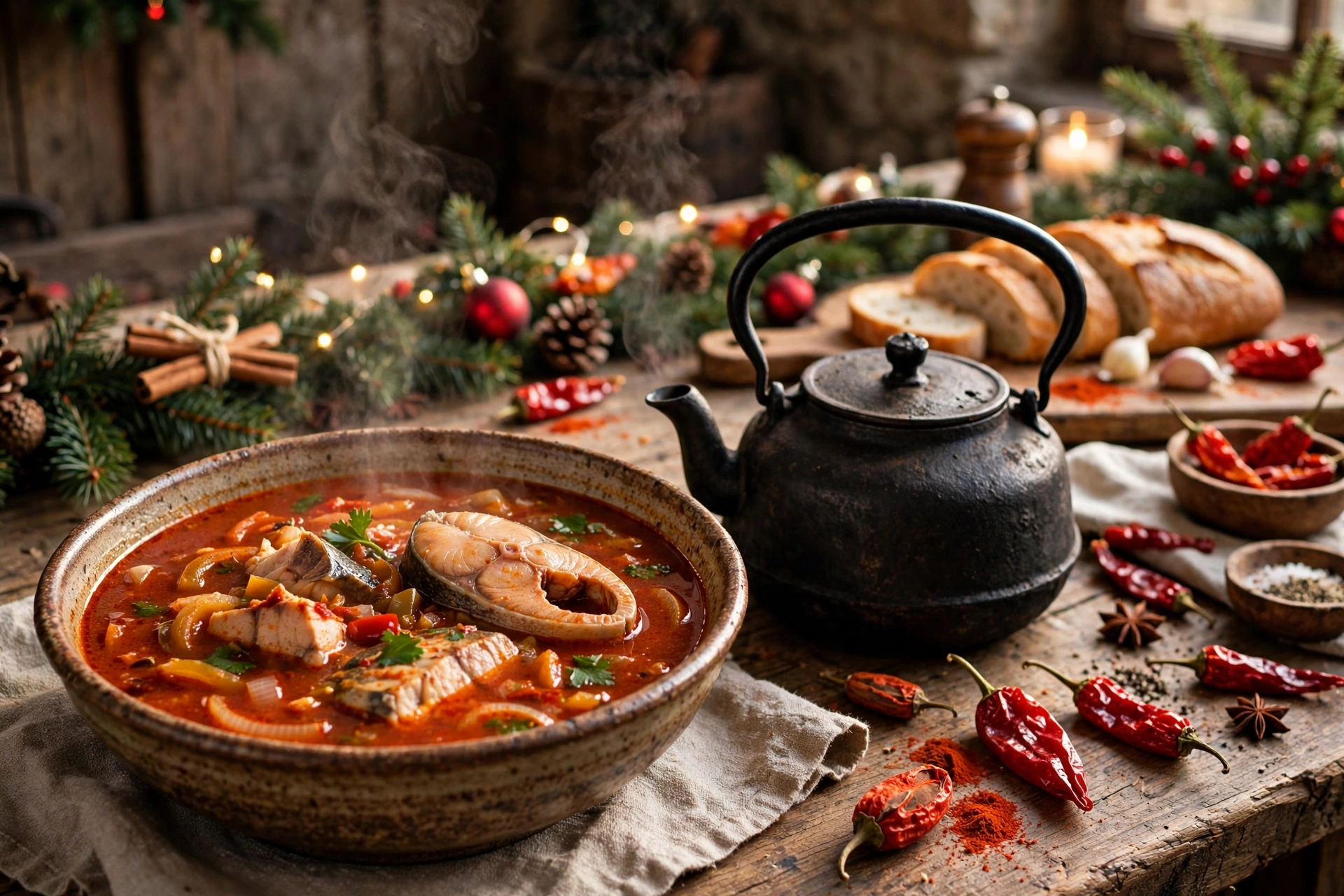
On Christmas Eve in Hungary, the holiday table glows paprika-red. The hungarian christmas fish soup halászlé — the fiery fisherman’s soup that is Hungary’s most iconic dish — opens the Christmas Eve dinner in countless households, its rich broth carrying the flavor of river fish, sweet paprika, and tradition. Alongside it come stuffed cabbage (töltött káposzta), fried fish, and the beloved walnut-and-poppy-seed rolls called bejgli. This guide explores the complete Hungarian Christmas table: the history of halászlé, how to make an authentic pot, the regional rivalries (Szeged vs. Baja — passions run high), and everything else that makes a Hungarian Christmas Eve unforgettable.
What Is Halászlé?
Halászlé (pronounced roughly “HAH-lahss-lay”) means “fisherman’s soup,” and it began exactly that way: a soup cooked by fishermen on the banks of the Danube and Tisza rivers, in a cast-iron kettle (bogrács) over an open fire, from the day’s catch, river water, onion, and paprika. The classic version is brilliantly simple and intensely flavored: freshwater fish — traditionally carp, catfish, and pike — simmered with generous amounts of Hungarian sweet paprika until the broth turns a deep, glowing red.
What elevates halászlé from simple to sublime is the paprika. Hungarian paprika — especially the renowned varieties from Szeged and Kalocsa — is not the dusty background spice of other cuisines; it is a fresh, fruity, deeply flavorful ingredient, and halászlé uses it by the tablespoon. The soup’s character comes from the quality of the paprika and the fish, not from complexity: onion, fish, paprika, salt, water, and time. Like the Czech Christmas carp tradition, it reflects Central Europe’s deep relationship with freshwater fish — but where the Czechs fry, the Hungarians simmer.
Why Fish Soup on Christmas Eve?
The Hungarian Christmas Eve dinner (szenteste) follows the old Catholic fasting tradition: Christmas Eve was a meatless day, and fish — not counted as meat under fasting rules — became the festive centerpiece. Halászlé was the natural choice in a land of great rivers: it was celebratory yet compliant, rich yet fasting-legal. Over generations, what began as religious observance became pure tradition — even Hungarians who no longer fast eat halászlé on Christmas Eve, because Christmas Eve without it would not feel like Christmas.
The Christmas Eve table traditionally unfolds in courses: halászlé first, then fried or baked fish (often carp or catfish) with potato salad or rice, then stuffed cabbage, and finally the great sweet finale of bejgli and other pastries. The meal is eaten after the evening’s church service or family gift-giving, in a leisurely, candlelit progression. For more festive menu inspiration from around the world, browse our Christmas dinner ideas.
The Great Halászlé Rivalry: Szeged vs. Baja
Hungary’s most delicious argument is about halászlé, and it has two main camps:
- Szeged-style (Tisza halászlé): From the city of Szeged on the Tisza River — the paprika capital of Hungary. This version starts by making a rich fish stock: fish heads, bones, and trimmings are simmered with onion and paprika, then strained, and the strained broth is used to poach the choice fish pieces. The result is clear, refined, and intensely flavored — often served with gyufatészta, thin “matchstick” noodles. Purists consider this the true halászlé.
- Baja-style (Danube halászlé): From the Danube town of Baja. Here everything — fish pieces, onion, paprika — goes into the pot together and cooks as one, producing a thicker, heartier, more rustic soup, traditionally served with bread rather than noodles. Baja hosts an annual fish-soup cooking festival where hundreds of kettles steam simultaneously.
Both styles inspire fierce loyalty, annual competitions, and endless debate. There are also regional variants — the Balaton version with the lake’s pike-perch (fogas), Transylvanian versions, and family recipes guarded like state secrets. The only universal rules: use freshwater fish, use real Hungarian paprika generously, and never, ever rush it.
How to Make Authentic Hungarian Christmas Halászlé
This recipe follows the Szeged method — the strained-broth version considered the classic for Christmas Eve — scaled for 6 servings as a first course. The key ingredient is good Hungarian sweet paprika; seek out Szeged or Kalocsa paprika from a Hungarian or Eastern European grocer.
Ingredients
- 3 lb (1.4 kg) mixed freshwater fish: carp steaks, catfish fillets, and pike if available (ask the fishmonger for heads and bones too — they make the stock)
- 3 large yellow onions, finely chopped
- 4–5 tablespoons Hungarian sweet paprika (plus 1 teaspoon hot paprika, optional, for heat)
- 2 tablespoons tomato paste (optional; some families swear by it, others consider it heresy)
- 1 green bell pepper or Hungarian wax pepper, chopped (optional)
- 1 fresh tomato, chopped (optional)
- Salt to taste
- 8 cups cold water
- To serve: thin egg noodles (gyufatészta) or crusty bread
Step 1: Build the stock
Place the fish heads, bones, trimmings, and any less-choice pieces in a large pot with the cold water. Bring to a gentle simmer — never a hard boil, which clouds the broth — skimming any foam. Add half the chopped onion and simmer 45–60 minutes, until the stock is flavorful. Strain through a fine sieve, pressing the solids to extract every drop; discard the solids. You should have a rich, golden fish stock.
Step 2: Bloom the paprika
In a clean large pot or Dutch oven, soften the remaining onion in a little oil or lard over medium heat until translucent — about 8 minutes. Remove from the heat (this is critical: paprika scorches in seconds and turns bitter) and stir in the sweet paprika (and hot paprika if using), coating the onion in a fragrant red paste. Immediately pour in the hot fish stock, stirring to dissolve.
Step 3: Simmer the soup
Return to medium heat, add the tomato paste, pepper, and tomato if using, and season with salt. Bring to a gentle simmer and cook 15 minutes to marry the flavors. Taste — the broth should be vividly paprika-forward, savory, and just salty enough.
Step 4: Poach the fish
Lay the choice fish pieces (carp steaks, catfish fillets) gently into the simmering broth. Poach 10–15 minutes, until the fish is just cooked through and flakes easily. Do not stir aggressively — you want the pieces intact for serving. Adjust salt and paprika to taste; the soup should glow deep red.
Step 5: Serve
Ladle the broth into wide bowls, place a piece of fish in each, and serve with matchstick noodles cooked separately or with thick slices of crusty bread for sopping. In Hungary, halászlé is often cooked and served in the bogrács (kettle) at the table for maximum theater — a Christmas Eve kettle of glowing red soup is unforgettable.
Pro tips
- Paprika quality is everything: Buy Hungarian paprika from Szeged or Kalocsa, and check the date — paprika loses its punch within months. The soup needs tablespoons, not teaspoons.
- Never boil paprika: Add it off the heat to bloomed onion; scorched paprika ruins the pot.
- Fish freshness: Freshwater fish should smell clean and sweet. Carp is traditional; catfish adds richness; pike adds delicacy.
- Make it ahead: The stock can be made a day ahead; the finished soup reheats gently (do not boil the fish).
- Heat level: Traditional halászlé is flavorful rather than fiery, but a spoonful of Erős Pista (Hungarian hot pepper paste) at the table lets heat-lovers customize.
The Rest of the Hungarian Christmas Table
Halászlé opens the meal, but the Hungarian Christmas Eve table is a multi-act production:
Töltött káposzta — stuffed cabbage
The great Hungarian comfort dish: cabbage leaves stuffed with a mixture of ground pork and rice (on Christmas Eve, some families make a meatless version with mushrooms and rice to honor the fast; others serve the classic pork version as the meal’s hearty center), simmered in a paprika-tomato sauce with smoked sausage. It is the dish Hungarians abroad miss most, and a fixture of every holiday table.
Fried and baked fish
Alongside the soup, Christmas Eve often features breaded fried carp or catfish fillets, or whole baked fish with lemon and herbs — echoing the Central European Christmas fish tradition shared with the Czechs and Poles.
Bejgli — the walnut and poppy seed rolls
The crown of Hungarian Christmas baking: bejgli are long, elegant rolled pastries — a sweet yeast dough wrapped around a dense filling of ground walnuts (diós bejgli) or poppy seeds (mákos bejgli), sometimes chestnut. Sliced to reveal the beautiful spiral, bejgli is served throughout the holidays with coffee. Making it is a December ritual; buying it from a good bakery is a completely respectable alternative.
Other sweets
- Zserbó: Layered walnut-apricot-chocolate slices — rich, complex, and beloved.
- Mézeskalács: Hungarian honey gingerbread, often elaborately decorated.
- Kifli: Crescent cookies, vanilla or walnut, dusted with powdered sugar.
- Szaloncukor: The iconic Hungarian Christmas tree candy — foil-wrapped fondant or chocolate pralines hung on the tree as edible ornaments, then eaten (or mysteriously vanished) through the season.
For more holiday sweets from every corner of the globe, see our Christmas desserts around the world.
Hungarian Christmas Customs
The Hungarian Christmas table sits within lovely traditions:
- Szenteste (Holy Evening): December 24th is the main celebration — the tree is decorated (traditionally on the 24th, often in secret while children wait in another room), gifts are exchanged in the evening, brought by Jézuska (Baby Jesus) or an angel.
- Szaloncukor on the tree: The foil-wrapped candies dangling from the branches are Hungary’s most distinctive tree decoration — and its most pilfered.
- Midnight Mass: Éjféli mise on Christmas Eve is widely attended, with the halászlé often served after the family returns.
- Betlehemezés: Traditional nativity plays performed by costumed groups going door to door — a folk custom still alive in villages.
- Christmas Day and Stephen’s Day: December 25th and 26th are for visiting family, eating leftovers (the stuffed cabbage improves overnight), and resting.
- New Year’s: Lentil soup on New Year’s Day for prosperity, and the great Budapest street celebrations on Szilveszter (New Year’s Eve).
Halászlé Beyond Christmas
While Christmas Eve is halászlé’s most sacred stage, the soup is a year-round Hungarian passion. Summer brings fish-soup festivals along the Danube and Tisza — Baja’s famous halfőzőfesztivál draws competitors cooking hundreds of kettles simultaneously. Hungarian restaurants serve it year-round, and every family has its champion kettle-cooker. For Hungarians abroad, a Christmas Eve pot of halászlé — paprika ordered from home, fish sourced with effort — is homesickness medicine. The soup’s glow on a winter night, its steam carrying paprika and river-fish memory, is Hungary in a bowl. If your Christmas table leans toward other fish traditions, compare notes with the Ukrainian Christmas Eve supper, where fish also honors the fasting table.
Paprika: Hungary’s Red Gold
To understand halászlé, you must understand Hungarian paprika — which is not a single spice but a whole culture. Paprika arrived in Hungary with the Turks in the 16th–17th centuries, and the Great Hungarian Plain proved ideal for growing it. By the 19th century, the towns of Szeged and Kalocsa had become paprika capitals, and Hungarian chemists and breeders had developed the sweet, mild varieties that define the cuisine.
Hungarian paprika is graded into several classes, from különleges (special — the finest, sweetest, brightest red) through édesnemes (sweet) down to erős (hot). For halászlé, cooks reach for édesnemes or különleges — sweet, fruity, vividly red — sometimes with a spoonful of hot paprika for backbone. The spice is perishable: ground paprika loses its aroma within months, which is why Hungarian cooks buy it fresh each autumn after the harvest and why the Christmas halászlé — made with the new paprika — tastes so vivid.
Paprika’s role in Hungarian cooking goes far beyond color. It is the base flavor of goulash, pörkölt, chicken paprikash, and stuffed peppers — an entire cuisine built on a single spice, the way other cuisines are built on wine or olive oil. When you taste halászlé, you are tasting the Hungarian Plain itself: sun, soil, and four centuries of mastery.
The Bogrács: Cooking Halászlé Over Fire
The traditional vessel for halászlé is the bogrács — a cast-iron kettle hung from a tripod over an open wood fire. Cooking halászlé in a bogrács is not just theater; the wood smoke adds a subtle dimension, the wide kettle allows rapid simmering, and the communal fire turns cooking into a social event. At summer fish-soup festivals, rows of bogrács steam over fires while crowds watch, argue, and taste.
For Christmas Eve, most families cook indoors in a large pot — but the bogrács ideal persists, and some families with gardens or fireplaces keep the tradition alive even in December. If you ever get the chance to eat halászlé from a kettle over a fire, on a riverbank, take it: it is one of the great outdoor eating experiences of Europe. For home cooks, a heavy Dutch oven or stockpot reproduces the result faithfully — the paprika and the fish do the real work.
A Hungarian Christmas Eve Timeline
How does the day unfold? Here is the traditional rhythm of szenteste:
- Morning: Final preparations — the bejgli is sliced, the fish is prepped, the tree is decorated (often in secret, with children banished from the room).
- Afternoon: The halászlé stock simmers; the stuffed cabbage warms; the house fills with the smell of paprika and pine. Families may visit the cemetery to light candles for the departed — a common Central European custom.
- Early evening: The tree is revealed, gifts are exchanged (brought by Jézuska or the angel), and carols are sung.
- Dinner: Served in courses — halászlé first, then fish and stuffed cabbage, then the great sweet spread of bejgli, zserbó, and gingerbread. The meal stretches for hours.
- Midnight: Many families attend the éjféli mise (midnight Mass), returning home to a quiet house, a glowing tree, and the last slices of bejgli.
The whole day has an unhurried, candlelit quality — a reminder that Christmas Eve, not Christmas Day, is the emotional heart of the Hungarian holiday. Planning your own festive evening? Our best Christmas movies make a perfect after-dinner wind-down.
Sourcing Hungarian Ingredients Abroad
Making authentic halászlé outside Hungary takes a little sourcing, but it is entirely doable:
- Paprika: Order Szeged or Kalocsa sweet paprika from Hungarian or Eastern European grocers, or reputable online spice merchants. Check harvest dates — fresh paprika is everything.
- Freshwater fish: Carp is sold at Asian markets and Eastern European fishmongers; catfish is widely available in the US; pike and walleye work beautifully. Ask for heads and bones for the stock.
- Erős Pista: The ubiquitous Hungarian hot pepper paste — sold in tubes at European delis — for the table.
- Bejgli: Hungarian bakeries in diaspora hubs (and good online bakeries) ship bejgli in December; or bake your own — the spiral is worth the effort.
- Szaloncukor: Imported Hungarian tree candies appear at European delis each December — buy extra, because they vanish from the tree.
How to Eat Halászlé Like a Hungarian
There is an etiquette to the soup, and Hungarians notice. First: the fish pieces are eaten with care — freshwater fish have bones, and picking them delicately is part of the ritual. Second: the broth is the point — sop it with bread until the bowl is clean, or twirl the matchstick noodles through it. Third: do not ask for a spoonful of sour cream — halászlé takes none, unlike some other Hungarian soups. Fourth: a glass of dry white wine (a Hungarian Furmint or Olaszrizling) or a cold lager is the correct accompaniment. And finally: compliment the cook’s paprika, not just the soup. In Hungary, praising the paprika is praising the family’s judgment, and it will earn you a second helping and a friend for life.
The Day After: Leftovers and the Long Holiday
Like all great Christmas cooking, halászlé makes superb leftovers — the broth deepens overnight, and gently reheated (never boiled) it is arguably better on December 25th than on the 24th. The stuffed cabbage, too, improves with a day’s rest. Christmas Day in Hungary is for visiting relatives, walking in the winter air, and grazing on the remains of the feast. And the paprika does not rest long: New Year’s Eve brings its own cooking — lentil soup for prosperity, roast pork, and stuffed cabbage’s return — before the decorations come down and the bogrács is cleaned for another year.
One last tip from Hungarian grandmothers: always make more halászlé than you need. An unexpected guest at Christmas is a blessing, and a pot that can stretch is the sign of a well-run holiday kitchen. There is no better compliment than an empty kettle.
In Pictures: Hungarian Christmas Fish Soup
On Christmas Eve in Hungary, the table glows paprika-red — halászlé, the fiery fisherman's soup, opens the holiday dinner, followed by stuffed cabbage and bejgli rolls.
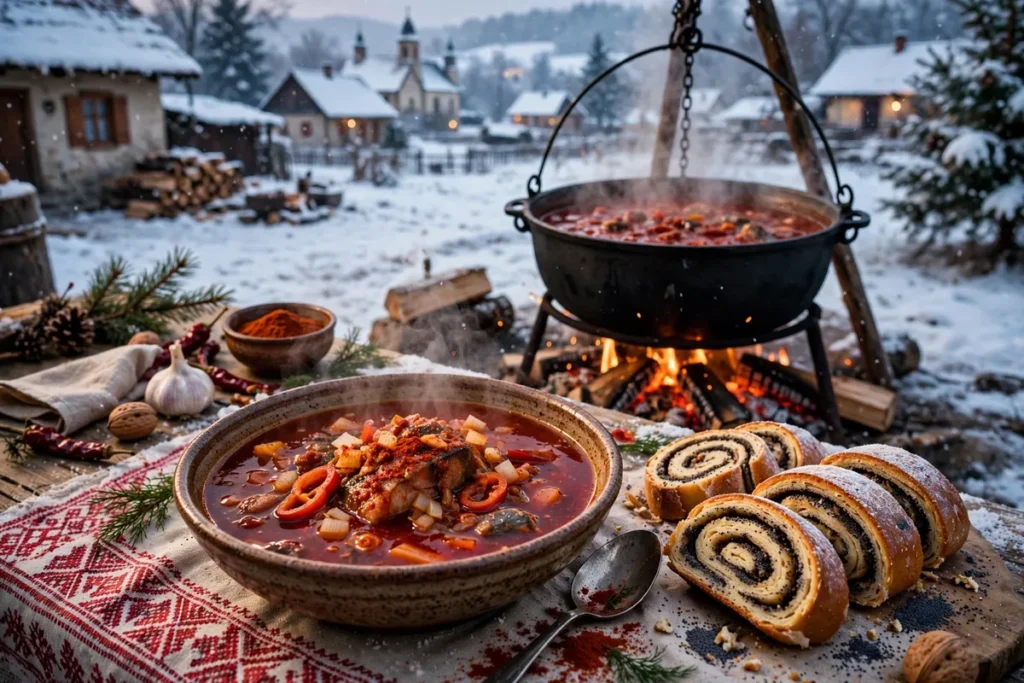
Halászlé simmering in a bogrács cauldron over an open fire: the deep-red paprika broth of Hungary's Christmas Eve table.
Watch: Hungarian Christmas Fish Soup
Stuffed Cabbage Adventures asks his dad about halászlé — the history of Hungary's fisherman's soup, its regional styles, and how it became the Christmas dish.
At a Glance: Hungarian Christmas Fish Soup
The soup, its soul, and the traditions around Hungary's paprika-red Christmas Eve.
| Element | What it is | Key detail |
|---|---|---|
| Halászlé | The soup | “Fisherman's soup” — freshwater fish (carp, catfish, pike) simmered with generous Hungarian sweet paprika until the broth glows deep red |
| The paprika | The soul | Hungarian paprika — especially from Szeged and Kalocsa — is fresh, fruity, and deeply flavorful, not a background spice |
| Szeged vs. Baja | The rivalry | Two great regional styles of halászlé; Hungarians hold passionate views on which is the true original |
| Bogrács | The vessel | The cast-iron kettle in which fishermen cooked the soup over open fire on the banks of the Danube and Tisza |
| Töltött káposzta | The companion | Stuffed cabbage served alongside the soup on the Hungarian Christmas table |
| Bejgli | The dessert | Walnut- and poppy-seed rolls — the beloved sweet that closes the Hungarian Christmas Eve meal |
| The opener | The role | Halászlé opens the Christmas Eve dinner in countless Hungarian households |
Frequently Asked Questions
What is Hungarian Christmas fish soup halászlé?
Halászlé (“fisherman’s soup”) is Hungary’s iconic paprika-based fish soup, made from freshwater fish (carp, catfish, pike), onion, and generous amounts of Hungarian sweet paprika. It is the traditional first course of the Hungarian Christmas Eve dinner.
What is the difference between Szeged and Baja halászlé?
Szeged-style strains a rich fish stock and poaches the fish pieces in it, yielding a clear, refined soup served with matchstick noodles. Baja-style cooks everything together in one pot for a thicker, heartier soup served with bread. Both inspire fierce regional loyalty.
What else do Hungarians eat on Christmas Eve?
After halászlé: fried or baked fish, stuffed cabbage (töltött káposzta), and for dessert bejgli (walnut and poppy seed rolls), zserbó slices, and honey gingerbread. Szaloncukor candies decorate — and get eaten from — the tree.
What kind of paprika is best for halászlé?
Fresh Hungarian sweet paprika from Szeged or Kalocsa — it should be vibrantly red and fragrant, not brown and dusty. The soup uses tablespoons of it, so quality and freshness are essential.
Is halászlé spicy?
Traditionally it is richly paprika-flavored rather than fiery, though hot paprika or Erős Pista (hot pepper paste) can add heat. The dominant flavor is sweet paprika and fish, not chili burn.
Can I make halászlé with saltwater fish?
Traditionalists insist on freshwater fish — carp, catfish, pike, pike-perch — for authentic flavor. In a pinch, firm saltwater fish works, but the soul of halászlé is the river.