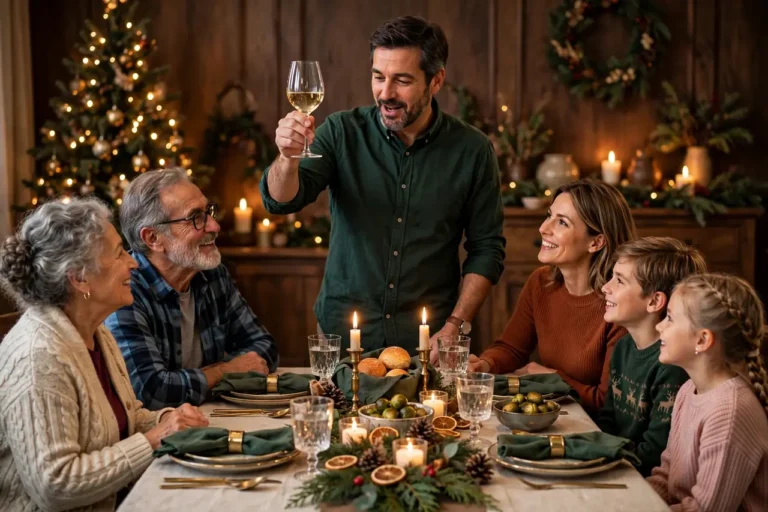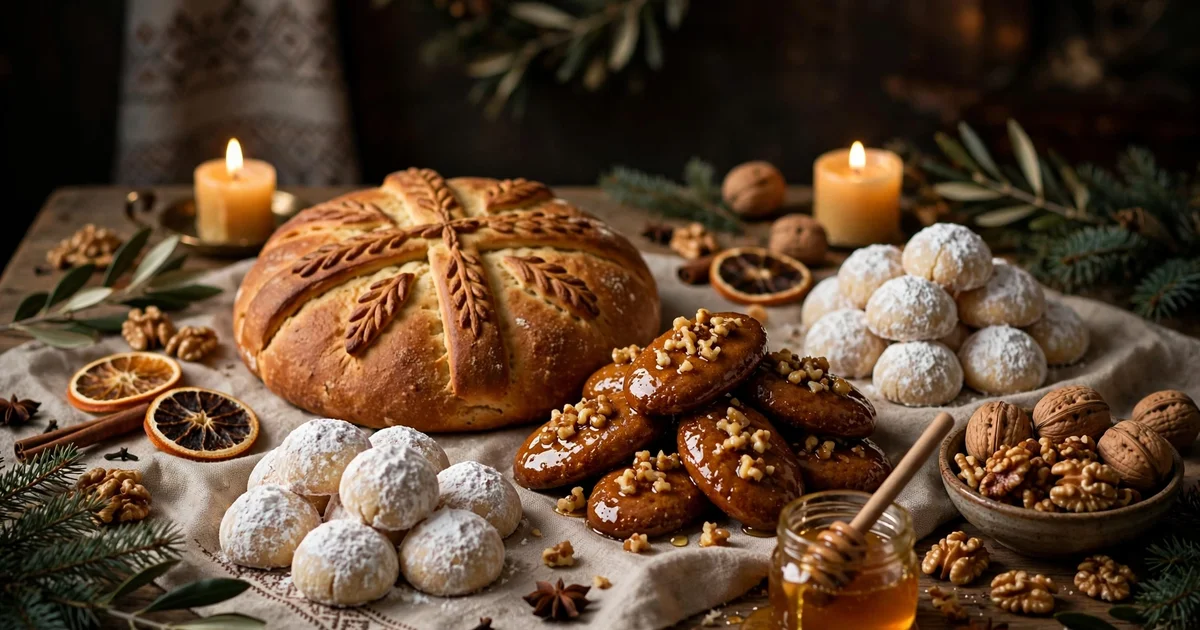
Greek Christmas is a feast that begins with fasting and ends with honey — and Greek Christmas food traditions are among the most spiritually layered in Europe. For forty days before December 25, many observant Greeks keep the Nativity Fast, abstaining from meat and dairy. When Christmas finally arrives, the table erupts: the decorated Christopsomo bread, trays of honey-soaked melomakarona and snow-dusted kourabiedes, roast pork and stuffed turkey, and on New Year’s Day, the vasilopita cake with its hidden lucky coin. This guide follows the Greek Christmas food calendar from the first day of the fast to Epiphany’s blessing of the waters, explaining what is eaten, when, and what it all means.
The Greek Christmas Calendar: From Fast to Feast
To understand Greek Christmas food, you must understand the rhythm of the Orthodox calendar. Christmas in Greece is not a day but a season, and food marks every stage:
| Period | Dates | Food character |
|---|---|---|
| Nativity Fast (Nistia) | November 15 – December 24 | No meat or dairy; olive oil, vegetables, legumes, shellfish |
| Christmas Eve | December 24 | Strict fast; Christopsomo baked; kalanda carols sung |
| Christmas Day | December 25 | The great feast: pork, turkey, avgolemono, sweets unleashed |
| St. Basil’s Day | January 1 | Vasilopita cut; pork and New Year dishes |
| Epiphany (Theofania) | January 6 | Blessing of the waters; end of the festive season |
The Nativity Fast is the key that unlocks everything. For forty days, observant households eat nistisima — fasting foods: lentils, beans, vegetables cooked in olive oil, tahini, halva, and shellfish (which, having no blood, are permitted). This is why the melomakarona — the great Greek Christmas cookie — is made with olive oil and no butter or eggs: it was designed to be eaten during the fast, its honey sweetness a permitted comfort. The kourabiedes, by contrast, are defiantly buttery — they belong to the feast, not the fast. Even Greek Christmas cookies carry theology.
Christmas Eve itself is traditionally a strict fast day — some families eat only a simple meal of boiled greens or fasting dishes — while the kitchen works at full tilt preparing the next day’s abundance. Children go door to door singing the kalanda, the traditional Christmas carols, accompanying themselves on small metal triangles, and are rewarded with sweets or coins. The fasting ends, gloriously, at the Christmas table on the 25th.
Christopsomo: The Bread of Christ
The most sacred food of the Greek Christmas is not a dessert but a bread. Christopsomo (literally “Christ’s bread”) is a large, round, slightly sweet loaf baked for Christmas Day, decorated with a cross formed from strips of dough and often studded with whole walnuts. In some regions the decoration grows elaborate — dough birds, flowers, and braids representing the family’s prosperity and faith.
The bread is made with care bordering on ceremony. The housewife (traditionally) kneads it on Christmas Eve, sometimes adding mahlepi (an aromatic spice from cherry pits) and mastiha for fragrance. A cross is scored or built on top, walnuts are pressed into the dough — symbols of fertility and abundance — and the loaf is baked until deeply golden. On Christmas Day, the head of the household cuts the Christopsomo and distributes it, often making the sign of the cross over each piece. No one eats before the bread is blessed and shared: it is the table’s spiritual center.
Regional variations abound. In Crete, the Christmas bread may be called christopsomo with distinctive local decorations; in Epirus and Macedonia, similar festive loaves appear with their own names and shapes. But the principle is constant: Christmas begins with bread, blessed and broken together. If you bake one loaf this season, food historians would argue it should be this one — it is arguably the oldest continuously baked Christmas bread in Europe.
Melomakarona vs. Kourabiedes: The Great Cookie Debate
Every Greek household, every December, divides into two camps — and the division is delicious. The two great Greek Christmas cookies could not be more different, and Greeks argue about them with the passion other nations reserve for football.
Melomakarona: The Honey-Soaked Saints
Melomakarona are oval, spice-scented cookies made with olive oil, orange juice, cognac, cinnamon, and cloves — then, still warm from the oven, drowned in honey syrup and showered with crushed walnuts. Their name joins meli (honey) with makaria (a memorial wheat dish), hinting at ancient roots. Because they contain no butter, eggs, or milk, they are fasting-friendly — the cookie of the Nativity Fast, eaten throughout December. A good melomakarono is a study in contrasts: crisp-edged, syrup-saturated, fragrant with orange and spice, crowned with walnut crunch. They keep beautifully, improving over several days as the syrup settles.
Kourabiedes: The Snowy Indulgence
Kourabiedes are the opposite in every way: crescent or round shortbreads made with an almost indecent amount of butter, studded with toasted almonds, and buried under a blizzard of powdered sugar. The name comes from the Turkish kurabiye, and they melt on the tongue like savory-sweet snow. They are emphatically not fasting food — they belong to Christmas Day and beyond, when dairy returns to the table. Eating one without inhaling powdered sugar is a skill; wearing dark clothing while doing so is a mistake.
The Verdict (There Isn’t One)
Polls and family debates rage annually, but the wise Greek answer is both — melomakarona for the fast, kourabiedes for the feast, and a full cookie tray holding both plus diples (crisp fried pastry ribbons soaked in honey, a Peloponnesian specialty) and amygdalota (almond macaroons). For a global perspective on how different cultures do Christmas sweets, explore our Christmas desserts around the world — and for a fascinating Alpine counterpart to the kourabiedes, see our guide to Austrian Christmas cookies and Vanillekipferl, where the crescent cookie takes yet another delicious form.
The Christmas Day Table: Beyond the Sweets
When the fast breaks on December 25, the Greek Christmas table turns savory and abundant. The traditional centerpiece in much of Greece is pork — historically, families raised a pig through the year and slaughtered it for Christmas, a custom called gourounochara in the countryside. Dishes include hirino me prasa (pork braised with leeks and celery in avgolemono sauce) and roast pork with garlic and herbs. In urban and northern tables, galopoula gemisti (stuffed turkey with chestnuts, pine nuts, and rice or mincemeat) has become the modern centerpiece.
The meal typically opens with avgolemono — the silky egg-and-lemon soup, sometimes made with chicken — followed by the roast, accompanied by roasted potatoes with lemon and oregano, horta (wild boiled greens with olive oil and lemon), and a great village salad. Wine flows freely; dessert is the cookie tray and perhaps baklava or kataifi for good measure. It is a table that honors both the fast’s end and the year’s harvest — rich, lemony, unmistakably Greek.
One more custom deserves mention: on Christmas Eve or Christmas morning, many families smash a pomegranate against the front door for good luck — the more seeds scatter, the greater the fortune. The fruit’s symbolism of abundance and fertility makes it the perfect edible blessing for the year ahead.
Vasilopita and New Year: The Coin in the Cake
Greek Christmas food traditions do not end on December 25 — they crest again on January 1, the feast of St. Basil (Agios Vasilis), Greece’s gift-bringer. The day’s centerpiece is the vasilopita, the New Year’s cake (or in some regions, a savory pie) baked with a coin (flouri) hidden inside. At the cutting — a ceremony, not just a dessert — the head of the household slices the cake, dedicating the first pieces to Christ, the Virgin Mary, and St. Basil, then to family members from oldest to youngest. Whoever finds the coin is promised luck for the entire year.
Vasilopita comes in two great families: the cake version (a rich, buttery, orange-scented pound cake, often decorated with the year’s number in almonds or icing) and the pie version (a savory kreatopita or cheese pie, traditional in some regions). Both carry the coin, both demand ceremony. The cake version dominates in cities; the pie version holds the countryside. Either way, the cutting is the emotional peak of the Greek New Year — luck, literally baked in.
St. Basil’s Day also brings the second round of kalanda (New Year’s carols) and, in many homes, a pork-centric feast that rivals Christmas Day. The twelve days between Christmas and Epiphany — the Dodekaimero — are a continuous festive season, with each day carrying its own customs and the table never quite returning to ordinary.
Regional Tables: Crete, the Islands, and the North
- Crete: The island’s Christmas table features christopsomo with distinctive local shaping, kalitsounia (sweet cheese pastries), and pork dishes with wild greens. Cretan hospitality means no one leaves unfed.
- The Aegean islands: Seafood plays a larger role — lobster pasta, stuffed squid — reflecting island life, while sweets follow the mainland canon with local twists like amygdalota.
- Macedonia and Thrace: Northern tables lean hearty: stuffed cabbage (lahanodolmades), pork with leeks, and the spectacular sarma variations. The Rougkatsia carnival customs add festive color.
- Epirus: Mountain Christmas means pies — kreatopita (meat pie), cheese pies, and the famous Epirot pita tradition applied to the festive table.
- Peloponnese: Home of the diples and the pork-slaughter tradition (gourounochara) in its most vivid form, with pichti (pork jelly) and sausages.
How to Bake Melomakarona at Home
Of all Greek Christmas foods, melomakarona are the most rewarding to make — and they happen to be naturally dairy-free.
Ingredients (makes ~40)
- For the cookies: 500g fine semolina or all-purpose flour blend, 200ml olive oil (light, not peppery), 150ml orange juice, 100g sugar, 50ml cognac or brandy, 1 tsp cinnamon, ½ tsp cloves, 1 tsp baking soda, zest of 1 orange
- For the syrup: 300g honey, 200g sugar, 200ml water, 1 cinnamon stick, lemon peel
- To finish: 150g crushed walnuts
Method
- Prepare the syrup first: simmer honey, sugar, water, cinnamon, and lemon peel for 5 minutes. Cool completely — the syrup must be cold when the cookies are hot.
- Whisk olive oil, orange juice, sugar, cognac, and zest. Fold in flour, semolina, spices, and baking soda. Mix just until combined — overworking toughens them.
- Shape into ovals, place on lined trays, and bake at 180°C (350°F) for 20–25 minutes until golden.
- While hot, dunk each cookie in the cold syrup for 30–60 seconds, turning once. Drain on a rack.
- Shower generously with crushed walnuts. Store in tins — they improve over 2–3 days.
The hot-cookie/cold-syrup contrast is the technical secret: it lets the cookie drink deeply without disintegrating. Serve with Greek coffee and watch them vanish. For more holiday baking inspiration, our Christmas dinner ideas collection covers festive menus from many traditions.
The Dodekaimero: Twelve Days of Feasting (and Goblins)
Between Christmas and Epiphany lies the Dodekaimero — the Twelve Days — a continuous festive season when ordinary rules are suspended and the table stays half-set. Each day carries its own customs: December 26 honors the Synaxis of the Mother of God, January 1 brings St. Basil and the vasilopita, and throughout, families visit, feast, and sing the kalanda in their successive rounds (Christmas, New Year, Epiphany).
Greek folklore populates these twelve days with the kallikantzaroi — mischievous goblins said to emerge from the underworld during the Dodekaimero to cause trouble: souring milk, tangling loom threads, and generally tormenting households. Traditional defenses include keeping the Christmas fire (or the christoxilo, the Yule log) burning through the twelve days, hanging a pig’s jawbone or garlic at the door, and — most decisively — the blessing of the waters at Epiphany, which sends the goblins fleeing back underground. Whether or not you believe in goblins, the custom captures the season’s spirit: twelve days when the sacred and the playful share the same table.
Food-wise, the Dodekaimero is a long exhale after the fast. Leftover pork becomes pichti and sausages; cookie tins are refilled; and every visit between households demands kerasma — the offering of something sweet to guests, refused at your peril. By Epiphany, even the most dedicated sweet tooth is ready for the season’s ceremonial close.
Theofania: Epiphany and the Blessing of the Waters
On January 6, Theofania (Epiphany) brings Greek Christmas food traditions to their spectacular finale. The day’s centerpiece is the Blessing of the Waters: in ports and villages across Greece, the priest casts a cross into the sea, a river, or a harbor, and young men dive into the winter water to retrieve it. The retriever is promised a year of blessing — and considerable local glory. The ceremony, called ta Fota (“the Lights”), commemorates Christ’s baptism and formally ends the Christmas season, driving off the kallikantzaroi for another year.
The Epiphany table is the season’s last feast. The third and final round of kalanda (the Epiphany carols) is sung on its eve, households are blessed with holy water (agiasmos), and many families serve a final festive meal — often featuring the last of the Christmas pork, fotokoliva (boiled wheat, in some traditions), and whatever sweets remain. Then, the decorations come down, the fast-free feasting ends, and ordinary time resumes — until the next great fast, Lent, begins the cycle again.
What Greeks Drink at Christmas
Greek Christmas drinking is as regional as its food. With the Christmas Day roast, red wines rule: Xinomavro from Naoussa, Agiorgitiko from Nemea, and the great island reds. White Assyrtiko from Santorini cuts through the richness of pork and avgolemono. Retsina — the pine-resin white that divides opinion like nothing else — remains a taverna Christmas staple, best with seafood-leaning island tables.
For the cold nights of the Dodekaimero, there is rakomelo: warm raki (or tsipouro) with honey and spices, Greece’s answer to mulled wine and the definitive drink of mountain Christmases. Tsipouro itself — the pomace brandy of the north, often anise-flavored — appears alongside meze at every festive gathering. And no Greek Christmas gathering is complete without Greek coffee, brewed thick and sweet in the briki, served with the cookie tray as the afternoon stretches into evening. Mountain tea (tsai tou vounou) offers a gentler, herbal close to the night. As with everything in Greek Christmas food traditions, the drinks are not accompaniments — they are part of the ritual.
The Greek Christmas Table Abroad: Diaspora Traditions
From Melbourne to Chicago to London, the Greek diaspora keeps these food traditions alive with remarkable fidelity — and a few creative adaptations. In Australia, where Christmas falls in summer, Greek-Australian families famously serve the full winter canon (roast pork, melomakarona, vasilopita) in 35°C heat, often moving the feast outdoors without changing the menu one bit. The food is the homeland; the weather is negotiable.
Diaspora bakeries become December pilgrimage sites: Greek pastry shops in Astoria, Queens or Melbourne’s Oakleigh sell melomakarona and kourabiedes by the kilo from late November, and the annual debate over which bakery’s vasilopita is best rivals any sports rivalry. Second- and third-generation Greeks who may not keep the full Nativity Fast still bake the fasting-friendly melomakarona — the recipe travels even when the theology softens — and the kalanda are sung in Greek schools and churches worldwide, triangles and all.
The diaspora has also exported the traditions outward: non-Greek neighbors who marry in, or who simply live near a good Greek bakery, now order vasilopita for New Year’s and smash pomegranates with genuine enthusiasm. Greek Christmas food traditions turn out to be highly contagious — honey, butter, and hidden coins need no translation. Wherever Greeks gather in December, the Christopsomo is baked, the coin is hidden, and Christmas tastes exactly like it should.
Agios Nikolaos: The Sailors’ Christmas Prelude
On December 6, nearly three weeks before Christmas, Greece celebrates Agios Nikolaos (St. Nicholas) — and in a seafaring nation, this is a major feast. St. Nicholas is the patron saint of sailors, and in port towns and islands across Greece, his day brings processions, boat blessings, and festive tables that serve as Christmas’s opening act.
The food of St. Nicholas Day previews the Christmas table: seafood takes center stage (it is a fish-allowed day even within the Nativity Fast), with bakaliaros skordalia (fried salt cod with garlic-potato dip) the classic celebratory dish, alongside octopus, squid, and shellfish. Sweet loukoumades (honey puffs) appear, and in many households the first melomakarona of the season are baked — a delicious signal that Christmas baking has officially begun. For island Greeks, December 6 is when the season’s mood shifts: the fast continues, but the feasting is now visible on the horizon.
The saint’s maritime connection also shapes Christmas decorations: in many Greek homes, especially on the islands, a decorated wooden boat (karavaki) stands beside or instead of the Christmas tree — a symbol of safe harbor and homecoming that predates the tree’s arrival in Greece. The boat is often strung with lights and loaded with symbolic cargo, a reminder that Greek Christmas has always faced the sea.
In Pictures: Greek Christmas Food Traditions
Greece’s Christmas is forty days of fasting followed by a feast — honeyed cookies, decorated bread, and roast pork at last.
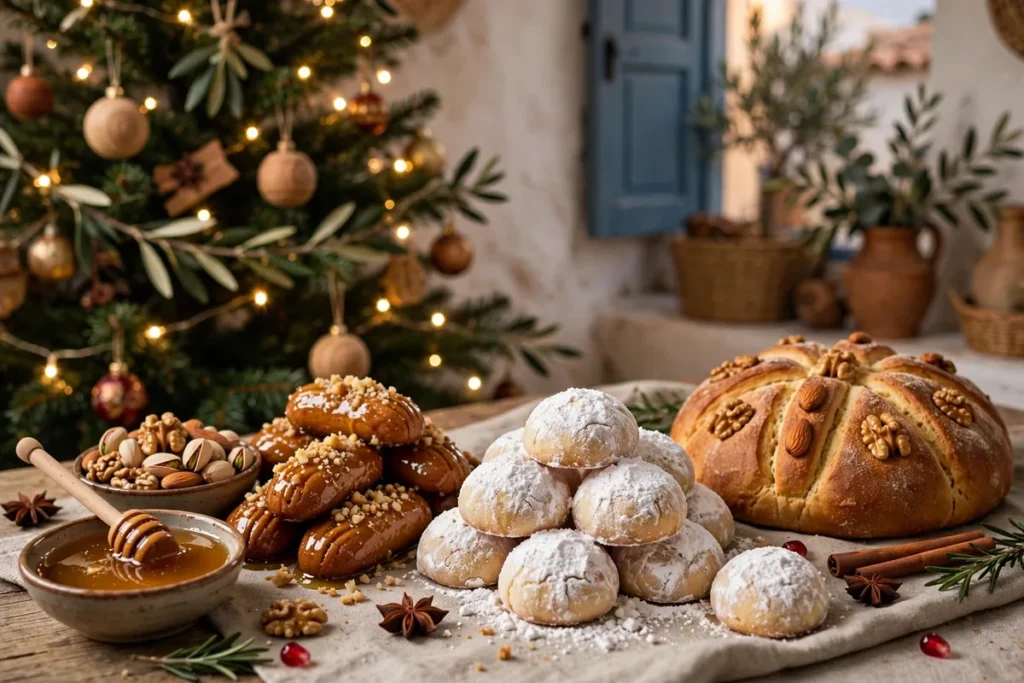
Greek Christmas sweets: melomakarona honey cookies, snow-dusted kourabiedes, christopsomo bread, with a Christmas tree behind.
Watch: Greek Christmas Food Traditions
All the traditional Greek sweets for Christmas — kourabiedes, melomakarona and diples, made for the holidays.
At a Glance: Greek Christmas Food Traditions
From fast to feast: the Greek Christmas calendar.
| Tradition | Date | Key detail |
|---|---|---|
| Nativity Fast | 15 Nov – 24 Dec | 40 days of fasting before the Christmas feast |
| Christopsomo | 24 December | The decorated “Bread of Christ” — baked for the Christmas table |
| Melomakarona | December | Honey-soaked spice cookies — one side of the great cookie debate |
| Kourabiedes | December | Butter-almond cookies dusted with powdered sugar — the other side |
| Christmas Day table | 25 December | Roast pork or turkey after the fast — the hirosfagi tradition |
| Vasilopita | 1 January | New Year’s cake with a hidden coin — the finder gets luck |
| Dodekaimero | 25 Dec – 6 Jan | Twelve days of feasting — kalikantzaroi goblins and the Epiphany blessing of waters |
Frequently Asked Questions
What are the traditional Greek Christmas foods?
The essentials are Christopsomo (decorated Christmas bread), melomakarona (honey-soaked spice cookies), kourabiedes (butter-almond shortbreads), roast pork or stuffed turkey, avgolemono soup, and on New Year’s Day, the vasilopita cake with a hidden lucky coin.
What is the difference between melomakarona and kourabiedes?
Melomakarona are olive-oil-based, honey-soaked spice cookies with walnuts — fasting-friendly, eaten throughout December. Kourabiedes are rich butter-and-almond shortbreads buried in powdered sugar — feast food for Christmas Day and beyond. Greeks traditionally serve both.
Why do Greeks fast before Christmas?
The Nativity Fast (November 15–December 24) is an Orthodox period of abstinence from meat and dairy, preparing the faithful spiritually for Christ’s birth. It shapes the entire food calendar — which is why fasting-friendly dishes like melomakarona and lenten sweets dominate the early season.
What is vasilopita?
Vasilopita is the Greek New Year’s cake (or savory pie, regionally), cut ceremonially on January 1, the feast of St. Basil. A coin hidden inside promises luck to whoever finds it; the first slices are dedicated to Christ, the Virgin Mary, and St. Basil.
Do Greeks celebrate Christmas on December 25?
Yes — the Church of Greece follows the revised Julian calendar and celebrates Christmas on December 25, as in the West. The season extends through the Dodekaimero (Twelve Days) to Epiphany (Theofania) on January 6, when waters are blessed.
What are kalanda?
Kalanda are traditional Greek Christmas carols sung by children door to door on Christmas Eve, New Year’s Eve, and Epiphany Eve, accompanied by small metal triangles. Households reward the singers with sweets, dried fruit, or coins.