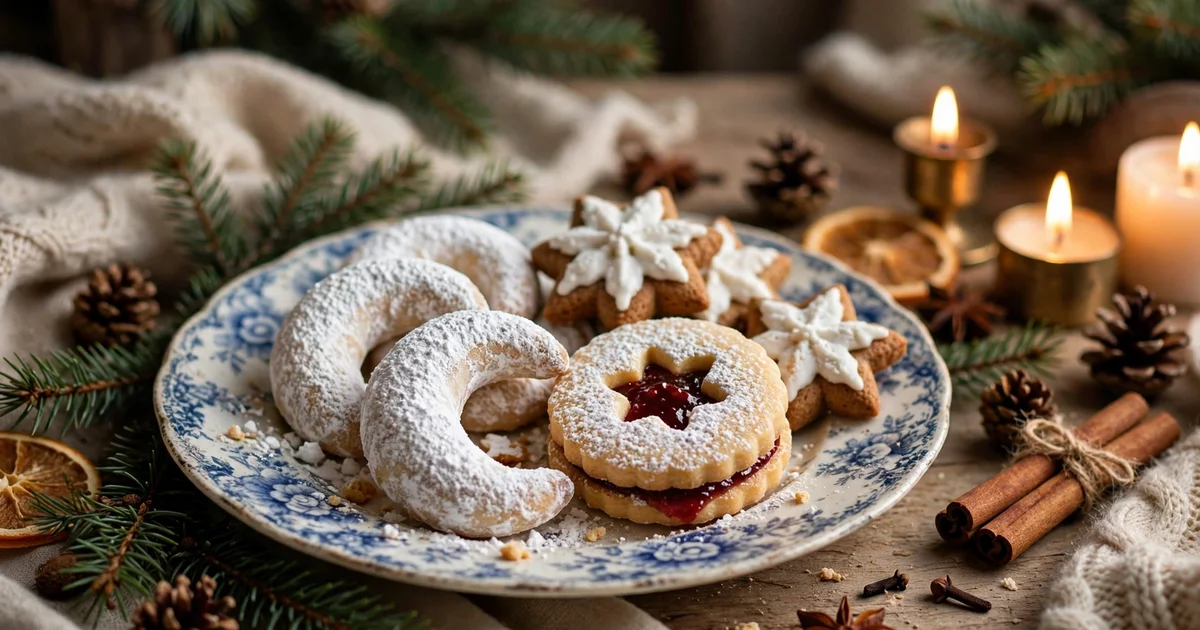
Of all the world’s Christmas cookies, one crescent stands above the rest — and Austrian Christmas cookies Vanillekipferl are the undisputed queens of the Alpine holiday table. These delicate, vanilla-scented crescents made with ground almonds crumble at first bite and dissolve into buttery, nutty perfume. But in Austria, no cookie stands alone: the Vanillekipferl is the centerpiece of the Weihnachtsteller, the Christmas cookie plate, a tradition of Advent baking, tin-stored abundance, and fierce family pride. This guide gives you the definitive Vanillekipferl recipe, its fascinating history, creative variations, and the full canon of Austrian Christmas cookies you need for an authentic cookie plate.
The Austrian Cookie Plate: A Christmas Institution
In Austria, Christmas baking is not a casual December activity — it is a season. From the first Advent Sunday, kitchens fill with the smell of vanilla, cinnamon, and toasted nuts as families embark on Kekse backen (cookie baking), often producing ten, fifteen, even twenty different varieties. The cookies are stored in beautiful tins (Keksdosen), layered between wax paper, where many actually improve with age — the flavors melding and deepening over one to three weeks.
The Weihnachtsteller (Christmas plate) is the edible centerpiece of Austrian hospitality through December: an artfully arranged platter of many cookie varieties offered to every visitor, brought to every gathering, and set out on Heiligabend (Christmas Eve) itself. Assembling a proper plate is a point of honor — variety matters as much as quality, and the Vanillekipferl, fragile and pale, always takes pride of place at the center. Baking together is also cherished family time; many Austrians’ fondest Christmas memories are of shaping kipferl crescents beside a grandparent, a tradition our Christmas activities for families guide would heartily endorse.
The timing follows the Advent calendar: baking typically happens on the Advent weekends, the cookies mature in their tins, and the plates appear from early December through the holidays. By Christmas Eve, when the Christkind (Christ Child) — not Santa — brings the gifts in much of Austria, the cookie plate is already a beloved fixture, half-empty from weeks of “quality control.”
Vanillekipferl: The Queen of Austrian Christmas Cookies
The Vanillekipferl is a study in restraint: flour, butter, ground nuts, sugar, vanilla — five ingredients, infinite subtlety. The dough is rolled into small crescents, baked until just barely golden, and while still warm, rolled generously in vanilla sugar. The result is impossibly tender, fragrant, and fragile; a perfect Vanillekipferl should barely survive the journey from tin to mouth.
A Crescent With a Legend
According to popular Viennese legend, the crescent shape commemorates the 1683 victory over the Ottoman Empire at the Siege of Vienna — the kipferl’s crescent mocking the crescent on the Ottoman banners. Food historians note that crescent-shaped pastries existed in Austria long before 1683, but the legend persists because it is delicious, and the Vanillekipferl as we know it — the vanilla-and-almond Christmas version — is firmly a Viennese creation of the imperial bakery tradition. Whatever its true origin, the crescent has become Austria’s edible emblem, as iconic as the Sachertorte — and every December, millions of hand-shaped crescents prove the legend still bakes true, one fragrant crescent at a time.
What Makes a Perfect Vanillekipferl
- The nuts: Traditionally ground almonds; many Viennese families swear by hazelnuts or walnuts. The nuts must be finely ground but not oily — pulse, don’t process into paste.
- The butter: Good European-style butter, cold and cubed. This is not the cookie for margarine.
- The vanilla: Real vanilla — seeds from the pod in the dough, and genuine vanilla sugar (not vanillin) for the coating. Make your own by burying a split vanilla pod in caster sugar for a week.
- The shape: Small, even crescents with tapered ends — about the length of a finger. Uniformity matters for even baking.
- The bake: Pale, not brown. The bottoms should be just golden; the tops stay ivory. Overbaking is the cardinal sin.
- The coating: Roll in vanilla sugar while the crescents are still warm — they absorb the fragrant sugar as they cool.
The Master Recipe: Classic Viennese Vanillekipferl
This is the canonical recipe — the one Viennese grandmothers measure by feel. Makes about 40 crescents.
Ingredients
- 200g all-purpose flour
- 150g cold unsalted butter, cubed
- 100g finely ground almonds (or hazelnuts)
- 80g granulated sugar
- Seeds of 1 vanilla pod (or 2 tsp pure vanilla extract)
- Pinch of salt
- For coating: 100g powdered sugar mixed with seeds of 1 vanilla pod (or 1 packet genuine vanilla sugar mixed into powdered sugar)
Method
- Combine flour, ground almonds, sugar, salt, and vanilla seeds. Add the cold butter and work quickly — with fingertips or a pastry cutter — into a crumbly dough. Knead briefly until it just comes together.
- Form into a disc, wrap, and chill for at least 1 hour (overnight is better). Cold dough shapes cleanly and holds the crescent form.
- Preheat oven to 175°C (350°F). Line trays with parchment.
- Pinch off walnut-sized pieces, roll each into a small rope, and curve into crescents with tapered ends. Keep them small and uniform — about 5cm long.
- Bake 12–15 minutes until the bottoms are lightly golden but the tops remain pale.
- Cool 2–3 minutes on the tray — just until handleable — then roll gently in the vanilla powdered sugar. The warmth is essential: it makes the sugar cling and perfume the cookie.
- Cool completely, then layer in tins between wax paper. They keep 2–3 weeks and improve after a few days.
Troubleshooting
- Crescents spread flat: dough was too warm — chill longer, and chill the shaped crescents 15 minutes before baking.
- Cookies crack when shaping: dough too cold or too dry — let it warm slightly, or work in a teaspoon of cold water.
- Sugar won’t stick: you waited too long — the rolling must happen while warm.
- Too hard: overbaked or overworked. Handle minimally, bake pale.
Vanillekipferl Variations Worth Trying
Once you master the classic, the crescent is a canvas:
- Haselnusskipferl: swap almonds for toasted hazelnuts — deeper, more autumnal flavor. Many consider this the superior kipferl.
- Walnusskipferl: the walnut version, traditional in many rural regions; slightly more rustic, wonderfully fragrant.
- Schokokipferl: dip the cooled crescents’ ends in dark chocolate — a modern Viennese café twist.
- Doppelte Vanillekipferl: sandwich two flat crescents with apricot jam (Marillenmarmelade) — Austria’s favorite jam meets its favorite cookie.
- Gluten-free kipferl: replace flour with a fine gluten-free blend plus 1 tbsp ground flaxseed; the high nut content makes this adaptation unusually successful.
- Mini-kipferl: bite-sized crescents for the Weihnachtsteller — twice the work, triple the charm.
Building the Perfect Weihnachtsteller: 12 Austrian Classics
A proper Austrian Christmas cookie plate needs variety — different textures, flavors, and shapes. Here is the canonical dozen, with the Vanillekipferl at the center:
- Vanillekipferl — the queen herself; pale, fragile, vanilla-perfumed crescents.
- Linzer Augen (“Linzer eyes”) — sandwich cookies of nutty shortcrust with a cut-out top revealing apricot or raspberry jam, dusted with powdered sugar.
- Zimtsterne — chewy cinnamon stars with crisp meringue tops; naturally gluten-free (almond-based).
- Lebkuchen — Austria’s spiced honey gingerbread, often glazed or chocolate-coated, cut into hearts and stars.
- Kokosbusserl — coconut macaroons, crisp outside and chewy within; sometimes crowned with a whole almond.
- Husarenkrapferl (Engelsaugen) — “hussar’s buttons”: buttery thumbprints filled with red currant or apricot jam.
- Rumkugeln — dark, boozy rum-chocolate truffles rolled in chocolate sprinkles; the adults’ favorite.
- Spritzgebäck — piped butter cookies in S-shapes and rosettes, sometimes half-dipped in chocolate.
- Mandelhörnchen — chewy almond crescents with chocolate-dipped ends (a close cousin of the kipferl, from the marzipan family).
- Schokobrot — dense chocolate-nut “bread” sliced thin; spiced, rich, and excellent with coffee.
- Butterkipferl — the plainer, everyday crescent — less vanilla, more butter — that makes the Vanillekipferl taste even more special by comparison.
- Marzipankartoffeln — marzipan “potatoes” dusted with cocoa; charming, old-fashioned, beloved by children.
Arrange with the palest cookies (kipferl, kokosbusserl) against the darkest (rumkugeln, schokobrot) for visual contrast, and tuck sprigs of fir or dried orange slices between the piles — never plastic decorations. For the global context of Christmas sweets, our Christmas desserts around the world tour shows how Austria’s cookie culture compares — and for a Mediterranean counterpoint to the buttery kipferl, see the great cookie debate in our guide to Greek Christmas food traditions, where olive-oil melomakarona face off against buttery kourabiedes.
Baking Day: How Austrians Do It
The Austrian Kekse backen tradition has its own choreography, refined over generations:
- Schedule by dough type: Bake sturdy keepers (lebkuchen, zimtsterne) first — they need weeks to mature. Bake fragile butter cookies (kipferl, spritzgebäck) closer to Christmas.
- Make it an event: The classic format is a baking afternoon with family or friends — one person rolls, one shapes, one manages the oven. Children get the simple press-and-cut cookies; adults handle the kipferl crescents.
- Store properly: Layer in airtight tins with wax paper between layers. Keep different flavors in separate tins (rumkugeln will perfume everything). Store cool, not refrigerated.
- Know the maturation curve: Lebkuchen and zimtsterne improve for 2–3 weeks; kipferl peak at 3–10 days; spritzgebäck is best within two weeks.
- Gift the overflow: Beautifully packed cookie tins are Austria’s default host gift through December — bake double and thank yourself later.
Heiligabend: What Austrians Eat on Christmas Eve
Cookies rule the season, but Christmas Eve dinner (Heiligabend) has its own quiet traditions. Historically a fast day, the evening meal was often simple: carp (Karpfen) in many regions, or Würstel mit Sauerkraut (sausages with sauerkraut) — humble food before the celebration. Modern tables might feature goose, fondue, or raclette, but the emotional center is not the dinner but the Bescherung: the gift-giving ceremony after dinner, when the Christkind’s bell rings, the tree (kept hidden until then) is revealed blazing with real candles, and Stille Nacht is sung. The cookies, of course, are already on the table — they have been there since Advent.
Austrian Christmas Markets: The Cookie Connection
You cannot understand Austrian Christmas cookies without the Christkindlmärkte — the Christmas markets where the season’s flavors are tasted, judged, and taken home. Vienna’s markets (Rathausplatz, Schönbrunn, Belvedere), Salzburg’s Christkindlmarkt, and Innsbruck’s old-town market all overflow with cookie stalls selling Vanillekipferl by the bag, still fragrant from the bakery.
The markets are also a masterclass in the extended Austrian Christmas sweet canon beyond the cookie tin:
- Gebrannte Mandeln: candied roasted almonds, sold in paper cones, eaten hot — the smell defines the Austrian market experience.
- Maronibrater: roast chestnuts, scored and fire-roasted, sold by the Maronibrater vendors on every corner.
- Baumkuchen and Stollen: market bakeries sell towering stollen loaves, the German cousin of the Italian panettone.
- Glühwein and Punsch: the markets run on hot spiced wine and punch — Orangenpunsch (orange punch) for drivers and children.
- Lebkuchenherzen: decorated gingerbread hearts with icing messages — the edible souvenirs of the season.
Smart Austrian bakers do their market reconnaissance in early December: taste the professionals’ Vanillekipferl, note the texture, then go home and bake their own batch better. The markets set the standard; the home kitchen answers it.
Storing, Gifting, and Shipping Your Cookies
Austrian cookie culture includes a postal system of affection — tins shipped to family across the world. To do it right:
- Choose shippable varieties: Vanillekipferl travel surprisingly well (their density protects them); zimtsterne and lebkuchen are ideal. Avoid rumkugeln (they perfume everything) and anything chocolate-dipped in warm climates.
- Pack like a Viennese grandmother: layer cookies between wax paper in a rigid tin, fill every gap with crumpled wax paper (movement causes breakage), seal the tin, then box it with padding.
- Time it: ship early in the week so tins don’t sit in warehouses over weekends; most cookies arrive at peak maturation 5–10 days after baking — plan backwards from Christmas.
- Gift beautifully: a mixed tin with a hand-written list of the varieties is Austria’s gold-standard host gift. Add the recipe for one cookie — traditionally the recipient’s favorite — as a personal touch.
- Label allergens: nuts, gluten, dairy, eggs — Austrian hospitality includes caring for the recipient’s dietary needs.
Vanillekipferl Beyond Austria
The crescent has conquered far beyond the Alps. In Germany, Vanillekipferl are a beloved Plätzchen staple, baked in millions of homes. In the Czech Republic, vanilkové rohlíčky are the essential Christmas cookie — arguably even more central than in Austria. Hungary bakes vaníliás kifli; Slovakia, Slovenia, and Croatia all claim their versions. The kipferl even crossed the Atlantic with immigrants, becoming a Christmas fixture in Midwestern American bakeries and a year-round offering in Jewish delis (as the almond crescent’s close cousin).
Each country tweaks the formula — more vanilla here, hazelnuts there, a dusting of cocoa somewhere else — but the soul remains Viennese: the fragile crescent, the vanilla sugar snow, the patience of hand-shaping. It is Austria’s most successful culinary export, and it travels in a cookie tin. For another crescent-cookie tradition from the other end of Europe, compare with the buttery kourabiedes in our guide to Greek Christmas food traditions.
The Christkind and St. Nicholas: Austria’s Gift-Bringers
Austria’s Christmas has two gift-bringers, and understanding them explains the season’s rhythm. On December 6, St. Nicholas (Nikolaus) visits with his basket of nuts, oranges, and chocolates for good children — and in Alpine tradition, he is accompanied by the fearsome Krampus, the horned demon who handles the naughty list. The Krampusläufe (Krampus runs) of early December — torch-lit parades of costumed demons through Alpine towns — are among Europe’s most spectacular folk traditions, and they mark the wild, pre-Christmas season.
Then on Heiligabend (December 24), the Christkind — a golden-haired, angelic Christ Child figure — brings the main gifts. The Bescherung ceremony is pure theater: the family waits in another room while the tree room is prepared; a bell rings; the doors open to reveal the tree blazing with real wax candles; Stille Nacht, heilige Nacht (written in Austria in 1818) is sung; and the gifts are discovered. The Christkind is never seen — it has already flown away — which preserves the magic far longer than a Santa sighting could.
The cookie connection: St. Nicholas Day (December 6) is traditionally when the first Weihnachtsteller appears in many homes — the season’s baking is declared ready. From Nikolaus to Heiligabend, the cookie plate is the constant companion of the gift-bringers’ season.
Austrian Christmas Drinks: Punsch, Glühwein, and Zirbenschnaps
Austrian Christmas drinking centers on warmth. Glühwein (mulled red wine with cinnamon, cloves, orange, and sugar) and Punsch (punch — often rum-based, or the non-alcoholic Kinderpunsch and Orangenpunsch) flow at every market and gathering. The Viennese Punsch tradition is so beloved that the city’s Punschstände (punch stands) are social institutions — colleagues meet “for a quick punsch” the way others meet for coffee.
At home, the Christmas drinks cabinet holds Zirbenschnaps (Swiss stone-pine schnapps, ruby-red and resinous), Williamsbirne (pear brandy), and Marillenschnaps (apricot brandy) for digestifs. With the cookie plate, Austrians drink coffee — the Viennese coffee house culture extends to Christmas, with Melange (the Viennese cappuccino) the classic cookie companion. And on Heiligabend itself, Sekt (Austrian sparkling wine) is raised after the Bescherung. The through-line, as with the cookies, is quality over quantity: one good punsch beats three mediocre ones.
The Advent Baking Calendar: A Four-Week Plan
Austrian home bakers work to the Advent calendar — four weekends, four baking waves. Here is the traditional schedule:
- 1st Advent weekend: The long-keepers — Lebkuchen and Zimtsterne. Both need 2–3 weeks to mature from crisp to perfectly chewy. Make the vanilla sugar for the kipferl now too (it needs a week to perfume).
- 2nd Advent weekend: The sturdy butter cookies — Spritzgebäck, Husarenkrapferl, Butterkipferl. Robust enough to store, beloved enough to start disappearing.
- 3rd Advent weekend: The stars — Vanillekipferl, Kokosbusserl, Linzer Augen. The fragile, the fragrant, the ones that peak in 3–10 days — timed perfectly for Heiligabend.
- 4th Advent weekend: The finishers — Rumkugeln (best fresh), Mandelhörnchen, and any repairs (every baker re-bakes the variety that vanished fastest). Assemble the Weihnachtsteller for gifting.
The pacing is practical (fresh cookies for Christmas, matured cookies at their peak) and psychological — four weekends of baking anticipation is the Advent season’s edible countdown. Light the Advent wreath candle, put on the Christmas music, and bake.
In Pictures: Austrian Christmas Cookies — Vanillekipferl
Austria’s Christmas is a cookie plate — and the vanillekipferl, the crescent vanilla-nut cookie, is its queen.
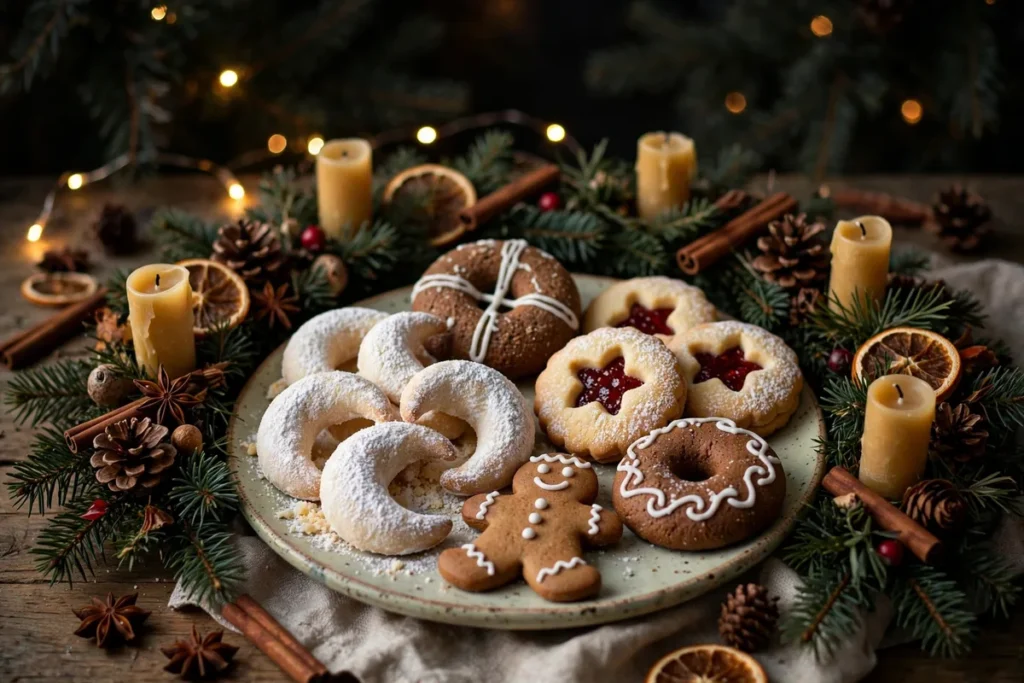
An Austrian Christmas cookie plate: crescent vanillekipferl dusted with vanilla sugar, Linzer cookies, lebkuchen, an Advent wreath behind.
Watch: Austrian Christmas Cookies — Vanillekipferl
The Vienna Tourist Board’s recipe for vanillekipferl — the small crescent vanilla cookies served through Advent and Christmas.
At a Glance: Austrian Christmas Cookies — Vanillekipferl
The Christmas baking of Austria.
| Tradition | When | Key detail |
|---|---|---|
| Vanillekipferl | December | The crescent vanilla-nut cookie — the queen of the Weihnachtsteller |
| The 1683 legend | — | Legend says the crescent shape echoes the Ottoman crescent after the Siege of Vienna |
| Linzer Augen | December | Jam-filled shortbread “eyes” — a Christmas plate classic |
| Lebkuchen | December | Spiced honey gingerbread — the Christmas market cookie |
| Weihnachtsteller | December | The cookie plate — a dozen or more varieties per family |
| Heiligabend | 24 December | Christmas Eve dinner — and the Christkind’s gifts in the evening |
| Christkindlmarkt | December | Vienna’s Christmas markets — cookies, punch and Advent |
Frequently Asked Questions
What are Vanillekipferl?
Vanillekipferl are traditional Austrian Christmas crescent cookies made from flour, butter, ground almonds (or hazelnuts), sugar, and vanilla, rolled in vanilla sugar while warm. They are the centerpiece of the Austrian Christmas cookie plate and among the most beloved Christmas cookies in the German-speaking world.
Why are Vanillekipferl crescent-shaped?
Popular Viennese legend links the crescent shape to the 1683 victory over the Ottoman Empire at the Siege of Vienna, with the kipferl mocking the Ottoman crescent banner. Crescent pastries actually predate 1683 in Austria, but the vanilla-almond Christmas version is a Viennese imperial-bakery creation.
How long do Vanillekipferl keep?
Stored in airtight tins between layers of wax paper, Vanillekipferl keep 2–3 weeks and actually improve after a few days as the vanilla perfume deepens. Keep them cool (not refrigerated) and separate from strongly flavored cookies like rumkugeln.
Can I make Vanillekipferl with hazelnuts instead of almonds?
Absolutely — Haselnusskipferl (hazelnut crescents) are a revered Viennese variation with deeper, toastier flavor. Walnuts work too. Whichever nut you use, grind it finely but stop before it turns to paste.
What is a Weihnachtsteller?
The Weihnachtsteller is the Austrian Christmas cookie plate — an artfully arranged platter of many cookie varieties (often 10–20) offered to visitors and served through December. Variety and abundance are points of honor, with Vanillekipferl traditionally at the center.
Who brings Austrian Christmas gifts — Santa or the Christkind?
In much of Austria, the Christkind (Christ Child) brings gifts on Christmas Eve (Heiligabend), heralded by a bell. The tree is kept hidden until the Bescherung ceremony after dinner, when it is revealed lit with real candles and the family sings Stille Nacht.