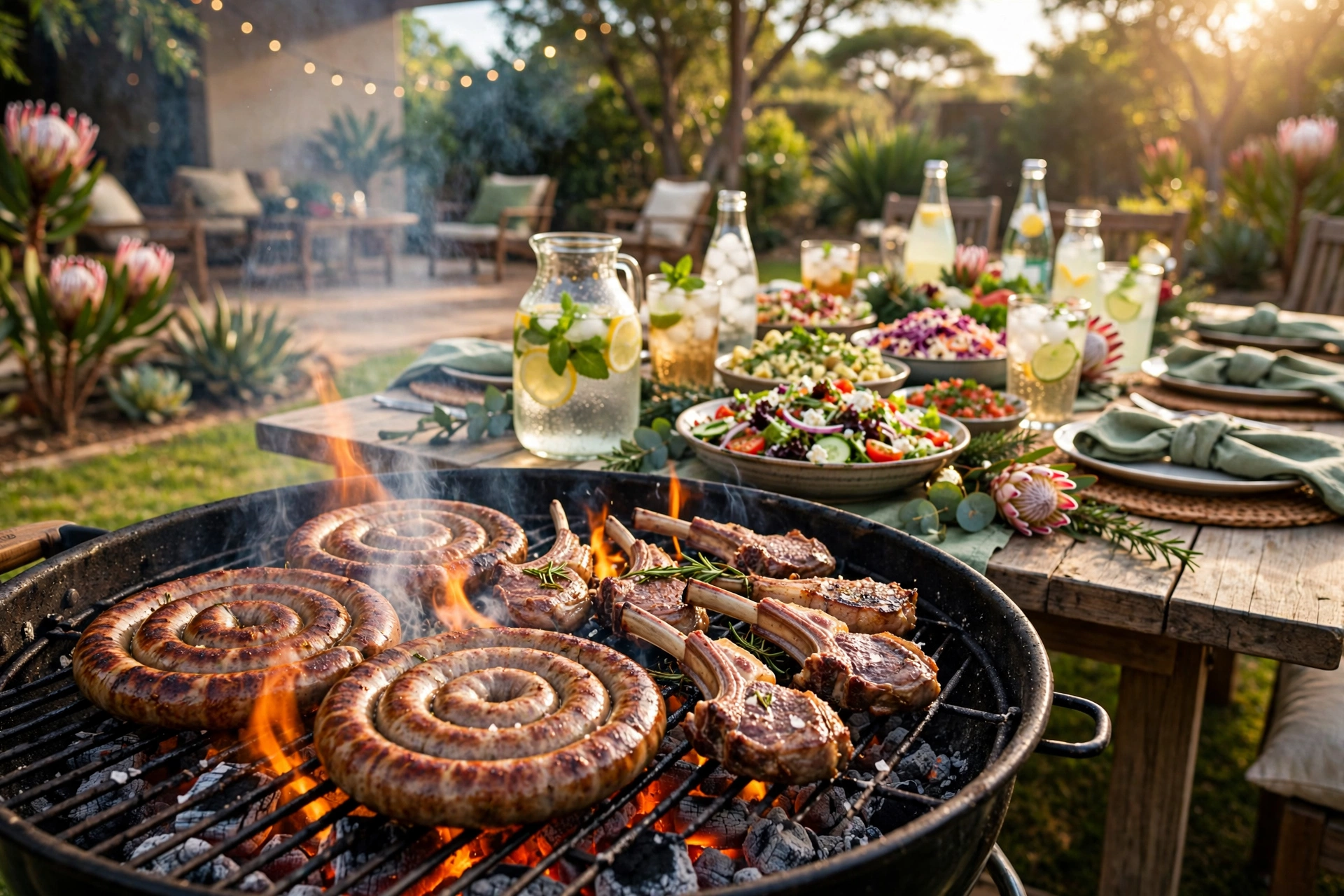
In South Africa, Christmas arrives on a tide of summer heat, not snow. December temperatures regularly climb past 30°C (86°F) across much of the country, so instead of a roasted turkey pulled from an oven, the centerpiece of the South African Christmas table is fire itself — the braai, the beloved national tradition of cooking over open flames. A south african christmas braai menu is part holiday feast, part outdoor celebration: family and friends gather in backyards and on balconies, cold drinks in hand, while boerewors sizzles over coals and the smell of woodsmoke drifts through the afternoon. This guide walks you through everything that makes the South African Christmas braai menu special — the classic grilled meats, the salads that keep things fresh, the desserts that close the day, and a practical hosting timeline so your own Christmas braai runs as smoothly as the ones South Africans have perfected over generations.
Why South Africans Braai on Christmas Day
To understand the South African Christmas braai menu, you first have to understand the braai itself. The word comes from the Afrikaans braaivleis — literally “grilled meat” — and it describes far more than a barbecue. A braai is a social institution: a standing invitation to gather, to talk, to argue about sport, and to eat slowly over several hours. Gas grills are tolerated but widely scorned by purists; real braai uses wood or charcoal, because the smoke is an ingredient. When Christmas falls in high summer, moving the feast outdoors is not a novelty — it is the obvious choice. Nobody wants to roast a bird in a hot oven when the whole family can eat under the trees instead.
The tradition also reflects South Africa’s multicultural table. Afrikaner families bring boerewors and sosaties; English-speaking households contribute gammon and trifle; Cape Malay cooks add curried specialties and pickled fish; Zulu, Xhosa, and other communities bring their own grilling traditions and sides. The result is a Christmas menu that looks nothing like the northern-hemisphere template — and that is exactly the point. Summer Christmas food in South Africa is joyful, informal, and designed for long afternoons.
There is also a practical rhythm to it. Many South Africans take their annual leave over the Christmas season, and 26 December is a public holiday called Family Day (formerly Boxing Day), which means the celebration often stretches across two or three days. Christmas lunch becomes a braai that starts at noon and drifts into the evening; leftovers fuel Family Day; and nobody is in a hurry. If you are planning Christmas gatherings back home, these relaxed long-form holiday feasts pair beautifully with ideas from our Christmas dinner ideas collection.
The Anatomy of a Classic Christmas Braai Menu
A great Christmas braai menu has a structure, even if nobody writes it down. Think of it as four movements: the fireside snacks, the grilled mains, the cool salads and sides, and the desserts. Here is what typically appears, dish by dish.
1. Fireside snacks and starters
The braai begins long before the main course hits the grill. While the coals heat up — a process that can take 45 minutes and is itself a spectator sport — guests graze on snacks designed to pair with cold beer or a glass of white wine:
- Biltong and droëwors: South Africa’s famous air-dried cured meats. Biltong (often beef or game like kudu and springbok) is sliced thin and served as a nibble; droëwors is its dried-sausage cousin.
- Blatjang and cheese: Sweet-savory South African chutneys — apricot blatjang is the classic — served with cheese and crackers.
- Boerewors bites: A small coil of boerewors cut into pieces and served hot off the first, gentlest part of the fire, just to tide everyone over.
- Pickled fish: In Cape Malay households, pickled fish (often hake or snoek in a spiced vinegar) is a Christmas staple, eaten cold before the braai proper begins.
2. The grilled mains
This is the heart of the South African Christmas braai menu. The classic lineup includes:
- Boerewors: The farm-style sausage that is practically the national dish. True boerewors is at least 90% meat (mostly beef, sometimes with pork or lamb) and spiced with coriander, nutmeg, cloves, and allspice. On Christmas, many families buy a special coil or make their own.
- Lamb chops and sosaties: Lamb is the premium braai meat, and Christmas is the occasion to buy the best. Sosaties — cubes of marinated lamb threaded on skewers with dried apricots and peppers — are a Cape Malay gift to the braai tradition, sweet and caramelized over the coals.
- Steak: Rump or sirloin, seasoned simply with salt and pepper, grilled over hot coals.
- Chicken: Often butterflied (spatchcocked) and marinated in a lemon-and-herb or peri-peri marinade. In Durban, with its large Indian community, tandoori-style marinades appear on Christmas braais too.
- Gammon: A hangover from British Christmas tradition, smoked or honey-glazed gammon still appears on many South African Christmas tables — sometimes finished on the braai for a smoky edge.
- Snoek: On the coast, a whole snoek (a long, oily fish) butterflied, basted with apricot jam and butter, and grilled in a folding grid is a legendary Christmas option.
Game meats like venison, kudu, or springbok steaks may appear on rural braais, and pork ribs or belly are common crowd-pleasers. The key principle: several meats, cooked in waves, so the table is never empty and nobody eats everything at once.
3. Salads and sides that keep it cool
Because the day is hot, cold salads are not optional extras — they are load-bearing parts of the menu. The classics include:
- Potato salad: The South African version is creamy, often with a touch of curry powder or mustard, and non-negotiable at most family braais.
- Three-bean salad: Sweet-and-sour dressed beans, a church-bazaar classic that keeps for days.
- Green salad with feta and avocado: Avocados are in season in South Africa in December, and they turn up everywhere.
- Coleslaw and pasta salad: Crowd-pleasing standards.
- Braaibroodjies: Toasted sandwiches — cheese, tomato, and onion with chutney, pressed in a folding grid over the coals until golden. These are legendary and disappear fast.
- Pap: The maize-meal porridge that is a staple across southern Africa. Stywe pap (stiff pap) served with a tomato-and-onion relish (sheba) or krummelpap (crumbly pap) is comfort food alongside grilled meat.
- Roosterkoek: Small bread rolls cooked directly on the braai grid, split and spread with butter or jam.
4. Desserts worth the heat
No South African Christmas braai menu is complete without dessert, and the classics are built for hot weather:
- Malva pudding: The undisputed star — a spongy, apricot-jam pudding soaked in a hot cream sauce, served warm with custard or ice cream. Its caramel sweetness is the taste of South African celebration.
- Trifle: Layers of jelly, custard, fruit, and cream in a big glass bowl, served ice-cold.
- Ice cream and fresh fruit: Mangoes, litchis, and watermelon are in season in December and need no adornment.
- Koeksisters: Syrup-soaked twisted pastries — the Cape Malay version is spiced and cakier; the Afrikaner version is crisp and drenched in syrup.
- Milk tart (melktert): A cinnamon-dusted custard tart that appears at every South African gathering worth the name.
If you love a showstopping sweet finish, our Christmas desserts around the world roundup puts malva pudding in global company, from stollen to pavlova.
A Christmas Braai Timeline: From First Coals to Last Slice of Malva
Hosting your first Christmas braai? The day has a natural rhythm. Here is a timeline that keeps food flowing and guests happy, based on how South African families actually run the day.
Morning: Prep and marinate (8:00–11:00)
Start early, before the heat builds. Make the potato salad, bean salad, and any desserts that need chilling (trifle, malva sauce). Marinate the chicken and sosaties — a few hours is ideal. Set up shade: umbrellas, a gazebo, or the patio. Freeze plenty of ice, because cold drinks are the engine of the day. If you are including gammon, it can be simmered and glazed in the morning, then finished briefly on the braai.
Late morning: Light the fire (11:00–12:00)
The braai master (a self-appointed, fiercely defended role) lights the fire. Wood or charcoal needs 45–60 minutes to burn down to proper coals — cooking over flames scorches meat and is considered a rookie error. Guests arrive, snacks and biltong come out, and the first cold drinks are opened. This unhurried hour is sacred; nobody rushes the fire.
Midday: The first wave (12:00–14:00)
Boerewors and chicken go on first, since they are forgiving. Braaibroodjies and roosterkoek toast on the edges of the grid. Salads hit the table. The meal does not arrive all at once — it unfolds. People eat standing up, plate in hand, drifting back to the fire for the next round.
Afternoon: The second wave (14:00–16:00)
Lamb chops, sosaties, and steak — the premium cuts — get their turn over fresh coals. Snoek, if you are doing it, goes on now. This is the long, lazy heart of the day: swimming, napping in the shade, and going back for seconds. Dessert preparations begin — the malva pudding warms, the trifle comes out of the fridge.
Late afternoon: Dessert and winding down (16:00–18:00)
Malva pudding with custard, cold trifle, sliced mango and watermelon. Coffee and tea for the elders. Kids play with new Christmas presents. The fire dies down to embers, and someone inevitably suggests one last boerewors roll for the road. Planning activities for the long afternoon? Our Christmas activities for families list has plenty of ideas that work beautifully outdoors.
Regional Twists on the Christmas Braai
South Africa’s diversity shows up on the Christmas table, and the braai adapts to every region:
- Cape Town and the Western Cape: Cape Malay influences dominate — sosaties, denningvleis (a sweet-sour lamb stew that may appear as a side), pickled fish, and koeksisters. Snoek on the braai is practically a religion here.
- Durban and KwaZulu-Natal: The large Indian community brings curries, bunny chow, and spiced marinades to the Christmas table; Christmas lunch might be a braai followed by biryani.
- Johannesburg and the Highveld: Thunderstorms are common on summer afternoons, so many Joburg braais happen under covered patios; the menu leans classic — boerewors, lamb, potato salad, malva pudding.
- Rural areas: Game meats (venison, springbok), whole lamb on a spit (skaapbraai), and potjiekos (a slow-cooked stew made in a cast-iron pot over coals) feature heavily.
- The coast: Seafood braais — prawns, calamari, line fish — replace or supplement the red meat.
This regional variety is part of what makes the South African Christmas so fascinating to food lovers — and it echoes the way other countries put their own stamp on the holiday, like the Jamaican Christmas dinner with sorrel or the Indian Christmas kuswar sweets featured elsewhere in this series.
Drinks: What to Serve at a Christmas Braai
Hot weather demands cold drinks, and South Africa is a wine country. Crisp white wines — Sauvignon Blanc from the Cape winelands, or a chilled Chenin Blanc — are the classic braai pairing. Local lagers and craft beers flow freely. For non-drinkers, homemade ginger beer, lemonade, and iced rooibos tea (rooibos is South Africa’s native herbal tea) are festive and refreshing. A favorite Christmas touch is a big bowl of fruit punch with litchis and mint, served over mountains of ice.
Coffee deserves a mention: after dessert, South Africans take their coffee seriously, and a proper pot of filter coffee (or a stovetop espresso for the Italian-influenced households) closes the meal. Rooibos with milk is the caffeine-free alternative that tastes like home to millions.
Hosting Tips for Your Own Christmas Braai
You do not need to live in South Africa to host a Christmas braai — you just need a grill, good weather (or a covered patio), and the right attitude. A few lessons from the masters:
- Wood or charcoal, never gas if you want authenticity — the smoke flavor is the whole point. Fruit woods like apple or local hardwoods are ideal.
- Appoint one braai master and let them work. Unsolicited advice at the fire is a time-honored tradition, but the person holding the tongs has final say.
- Cook in waves, not all at once. The braai is a marathon; keep the table replenished over hours rather than serving one big plate.
- Shade and ice are infrastructure. More umbrellas and more ice than you think you need. Sunburn and warm drinks ruin braais.
- Make the malva pudding ahead. It reheats beautifully, and the hot cream sauce can be made while the last coals die down.
- Embrace the potluck. South African braais are communal — guests bring salads, desserts, and drinks. Assign dishes so you are not cooking everything yourself.
- Plan for the thunderstorm. Summer afternoons in much of South Africa bring dramatic but brief storms. Have a covered backup plan and carry on — a little rain never stopped a braai.
Christmas Eve vs. Christmas Day: How the Celebration Unfolds
In many South African households, the Christmas braai is actually the second act of a two-day celebration. Christmas Eve (24 December) is often the more formal evening: families attend church services — midnight Mass for Catholics, candlelit services for many Protestant denominations — and return home for a late supper that might be lighter and more traditional, such as gammon with salads or a Cape Malay curry. Gifts are frequently exchanged on Christmas Eve evening in families of European descent, following continental custom, while others wait for Christmas morning.
Christmas Day itself is the braai day: relaxed, outdoors, and stretchy. Children play with new toys between courses; adults settle into the long afternoon. Because 26 December is Family Day, a public holiday, there is no pressure to tidy up or drive home early — the party simply continues. Many families braai again on Family Day, working through leftovers, which is why experienced hosts deliberately over-cater on the 25th. Leftover boerewors becomes breakfast rolls; leftover lamb becomes sandwiches; leftover malva pudding, frankly, rarely survives the night.
This unhurried multi-day rhythm is one of the loveliest things about a South African Christmas, and it is worth borrowing even if you are hosting elsewhere: plan for two days, cook once (generously), and let the celebration breathe.
The Shopping List: Sourcing a Christmas Braai
Planning the shop for a Christmas braai menu rewards a little strategy, because South African supermarkets and butchers get extremely busy in the week before Christmas. Here is a practical approach:
- Order meat early: Place your butcher order at least a week ahead — specify boerewors (a thick coil per 4–6 people is a good rule of thumb), lamb chops or a butterflied leg for sosaties, and steak. Ask the butcher to cut chops thick; thin chops dry out over coals.
- Buy biltong from a specialist: Supermarket biltong is fine, but a dedicated biltong shop offers better cuts and the all-important choice of wet, medium, or dry. Buy more than you think; it vanishes.
- Stock the pantry: Apricot jam (for sosaties and malva pudding), blatjang or chutney, curry powder, dried apricots, and good braai spice or just coarse salt and black pepper.
- Fresh produce last: Avocados, mangoes, litchis, watermelon, potatoes, and salad greens are best bought a day or two before, when they are at peak.
- Do not forget the fire supplies: Charcoal or dry hardwood, firelighters, and long tongs. Running out of fuel mid-braai is the classic hosting disaster.
- Drinks and ice: Chill drinks the night before and buy bagged ice the morning of — in December heat, ice melts fast, so double your estimate.
If you are outside South Africa, South African expat shops and online delis in the UK, US, Canada, and Australia stock boerewors, biltong, and malva pudding mix — search for them in December, when seasonal stock arrives. Your local butcher can usually make a boerewors-style sausage to order if you describe the coriander-forward spice profile.
Bringing the Braai Spirit Home (Even in Winter)
You do not need a South African summer to borrow the soul of the Christmas braai. The principles travel: cook over real fire, serve food in leisurely waves, make the meal a social event rather than a seating plan, and finish with something unapologetically sweet. In the northern hemisphere, a Christmas braai can become a New Year braai, a covered-patio grill party, or simply an attitude — boerewors on the grill in October, malva pudding on the Christmas table in December. The South African Christmas braai menu is ultimately a philosophy: good meat, good fire, good company, and no one watching the clock.
In Pictures: South African Christmas Braai
In South Africa, Christmas dinner is cooked over fire — the Christmas braai, where boerewors, gammon, and braaibroodjies share the coals on a long summer afternoon.
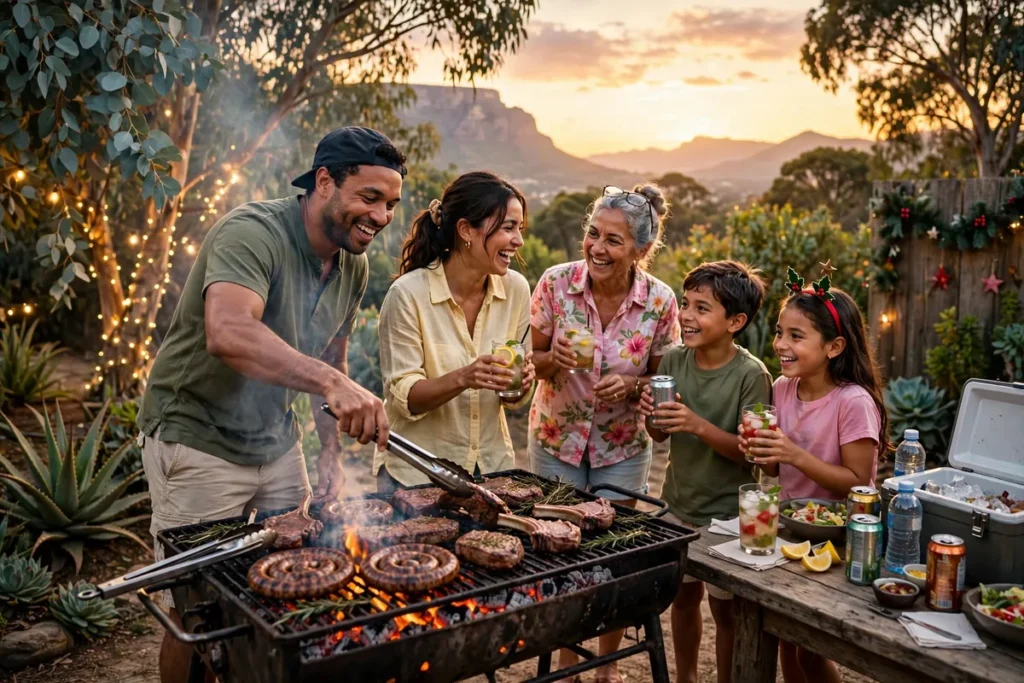
A South African Christmas braai at golden hour: sausages and meat over wood coals while family gathers with cold drinks under a summer sky.
Watch: South African Christmas Braai
South African creator Tsholo Phoka cooks Christmas Day lunch — smoked pork shoulder, rack of lamb, and all the festive sides — in a joyful cook-with-me vlog.
At a Glance: South African Christmas Braai
The classic components of a South African Christmas braai menu, from the coals to the desserts.
| Item | Category | Key detail |
|---|---|---|
| Boerewors | On the coals | The coiled spiced farm sausage — the signature of any braai, Christmas included |
| Gammon | The centerpiece | Glazed ham, a Christmas classic that also roasts beautifully on the braai |
| Sosaties | Skewers | Marinated kebabs with Cape Malay roots — sweet, spicy, and made for the fire |
| Braaibroodjies | The side | Grilled cheese, tomato, and onion sandwiches, toasted right on the braai grid |
| Pap en sous | The staple | Maize porridge with a tomato-onion sauce; purists insist on real wood or charcoal, never gas |
| Malva pudding | Dessert | Warm apricot sponge served with custard or cream — the beloved South African pudding |
| Trifle | Dessert | The English-speaking households' contribution to the multicultural Christmas table |
| Family Day | 26 December | A public holiday (formerly Boxing Day) — the Christmas celebration often stretches across two days |
Frequently Asked Questions
What is on a traditional South African Christmas braai menu?
The classic lineup includes boerewors, lamb chops or sosaties, steak, marinated chicken, and sometimes gammon or snoek, paired with potato salad, three-bean salad, braaibroodjies (toasted sandwiches), pap or roosterkoek, and desserts like malva pudding, trifle, and fresh summer fruit. Snacks like biltong and pickled fish start the day.
Why do South Africans braai instead of roasting turkey at Christmas?
Christmas falls in midsummer in the Southern Hemisphere, with temperatures often above 30°C. Cooking outdoors over a fire keeps the house cool, suits the festive outdoor lifestyle, and the braai is already South Africa’s favorite social ritual — Christmas simply gives it the biggest stage of the year.
What is malva pudding?
Malva pudding is South Africa’s most famous dessert: a spongy baked pudding made with apricot jam, soaked while hot in a sweet cream sauce, and typically served warm with custard or ice cream. It is the standard Christmas dessert at countless South African tables.
What are sosaties?
Sosaties are skewers of marinated meat — traditionally lamb — threaded with dried apricots, peppers, and onions, reflecting Cape Malay culinary influence. The sweet-savory marinade caramelizes beautifully over braai coals.
Can I host a Christmas braai outside South Africa?
Absolutely. All you need is a charcoal or wood grill, the key dishes (boerewors can be found at South African specialty shops or made by a butcher to order), and warm weather — or a covered area. The spirit of the braai is unhurried togetherness, which travels anywhere.
What drinks pair with a Christmas braai?
Crisp cold white wines like Sauvignon Blanc or Chenin Blanc, local lagers, homemade ginger beer, iced rooibos tea, and big bowls of fruit punch. Keep everything well chilled — ice is as essential as the fire.