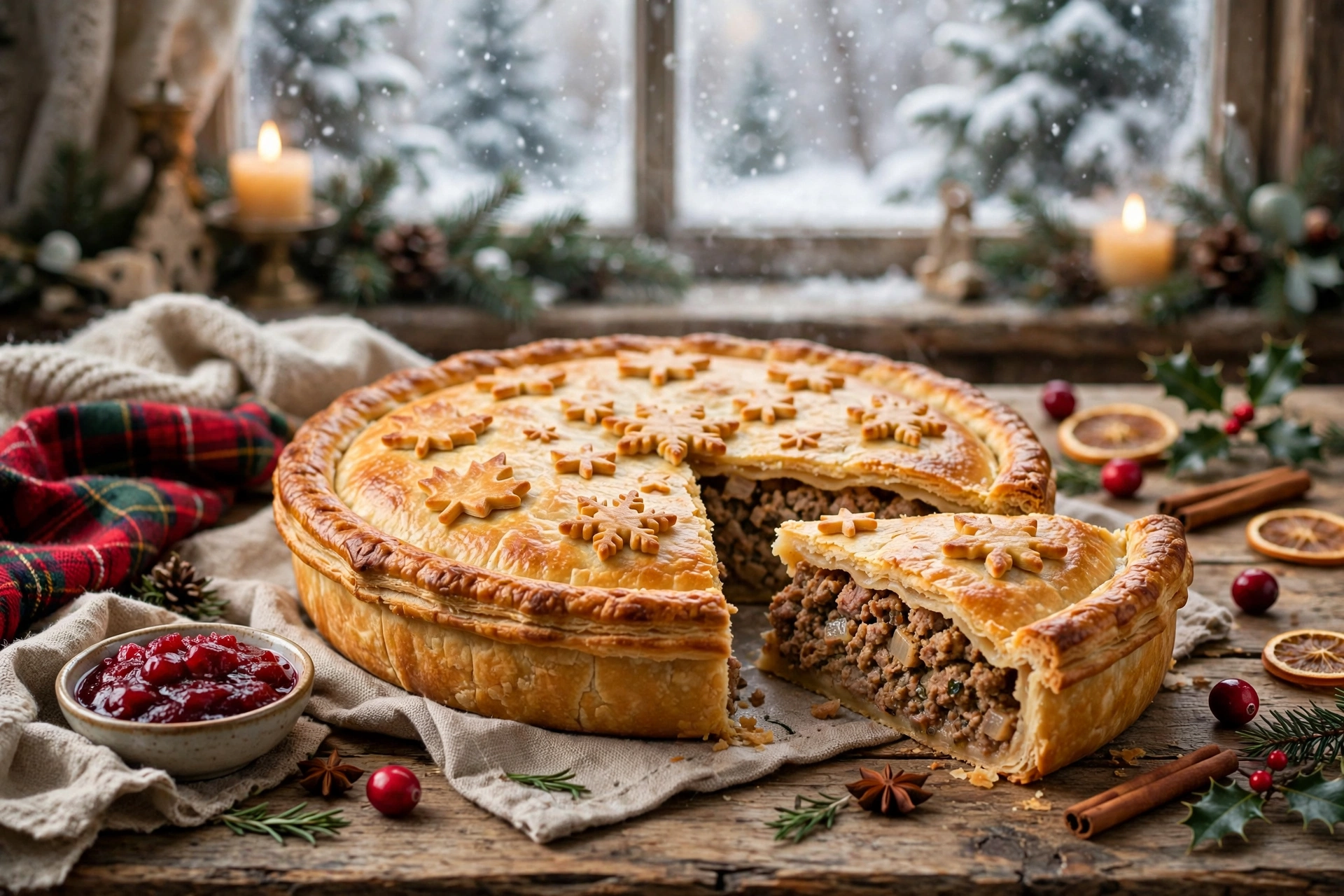
In Quebec, Christmas has a flavor, and it is savory, peppery, and wrapped in flaky pastry. The french canadian christmas tourtière — the traditional meat pie of French Canada — is the undisputed centerpiece of the réveillon, the long festive supper held on Christmas Eve after midnight Mass. For generations of Québécois families, no holiday table is complete without a golden tourtière cooling on the counter, its steam carrying the scent of pork, potato, cinnamon, and clove. This guide is both a cultural history and a practical how-to: you will learn where the tourtière comes from, how it differs across regions of Quebec, and exactly how to make an authentic one for your own Christmas table.
What Is a Tourtière?
A tourtière is a deep, double-crusted meat pie, traditionally filled with seasoned ground pork (sometimes mixed with veal or beef), finely diced potato, and warm spices. The filling is cooked before it goes into the pastry — a key distinction from many other meat pies — and the whole pie is baked until the crust is deeply golden. It is served hot, usually with a tangy accompaniment like fruit ketchup (a sweet-tart tomato chutney), pickled beets, or a sharp mustard.
The name’s origin is debated. The most widely repeated theory traces it to tourte, the old French word for a round pie or tart, with the diminutive suggesting a small tourte. A more colorful folk theory links it to the tourte — the passenger pigeon, once abundant in North America and reportedly used in early versions of the pie. Food historians generally favor the pastry-vessel explanation, but the pigeon story persists in Quebec folklore, a reminder of how deeply the dish is woven into local identity. If you are exploring how other cultures build their holiday tables around a single signature dish, you may enjoy our Christmas dinner ideas collection for more inspiration.
The Réveillon: Quebec’s Christmas Eve Feast
To understand the tourtière, you have to understand the réveillon — from the French réveiller, “to wake up.” The réveillon is the great Christmas Eve supper that begins after midnight Mass and stretches into the early hours of Christmas morning. In traditional Catholic Quebec, Christmas Eve was a day of fasting and abstinence, which made the post-Mass feast — rich, meaty, abundant — all the more celebratory. Families would return from church around 1 or 2 a.m. to a table groaning with food, and the eating, drinking, singing, and storytelling would continue until dawn.
The classic réveillon table, beyond the tourtière, includes:
- Ragoût de pattes: A rich stew of pork hocks in a browned-flour gravy, often served alongside the tourtière.
- Cretons: A pork spread — seasoned ground pork cooked with milk and spices, chilled and spread on toast. A breakfast and snack staple through the holidays.
- Tourtière du Lac-Saint-Jean: In the Saguenay region, a much deeper, more elaborate pie layered with cubed meats and potatoes (more on this below).
- Buche de Noël: The Yule log cake, Quebec’s beloved Christmas dessert, often chocolate with buttercream “bark.”
- Sucre à la crème: A fudgy maple-and-cream confection that appears on every holiday sweet tray.
- Atocas: Cranberries, served as sauce or in desserts — Quebec is cranberry country.
Modern réveillons have relaxed — many families now eat at a civilized hour on Christmas Eve rather than after midnight — but the menu endures. The tourtière remains the non-negotiable anchor. For families planning the full festive evening around the meal, our Christmas party ideas can help round out the celebration.
A Brief History of the French Canadian Christmas Tourtière
The tourtière’s roots reach back to 17th-century New France, when French settlers adapted the meat pies of their homeland to the ingredients of the new colony. Pork was the practical meat — pigs thrived in the Canadian climate and salted pork kept through winter — and the warming spices (cinnamon, clove, allspice, nutmeg) arrived via the fur trade and colonial commerce. Potatoes, once established, stretched the expensive meat and gave the filling its characteristic texture.
Over the centuries, the pie became inseparable from Christmas and New Year’s. In rural Quebec, making tourtières was a communal December ritual: extended families gathered to grind meat, roll pastry, and assemble dozens of pies — some for Christmas, some for the Jour de l’An (New Year’s Day), and some for the freezer. The recipe each family guards is often attributed to a grandmother or great-aunt, and debates about the “correct” version — all pork or mixed meats? potato or no potato? which spices? — are a beloved holiday sport.
Today the tourtière has traveled well beyond Quebec. It appears on tables across Canada, in Franco-American communities in New England (Maine especially), and wherever the Quebec diaspora has settled. Commercial versions fill supermarket freezers every December, but the homemade pie remains the gold standard.
Regional Variations: Not All Tourtières Are the Same
Ask five Québécois families for their tourtière recipe and you will get five different answers — and each will insist theirs is the authentic one. The main regional styles include:
- Montreal-style: Finely ground pork (sometimes with veal), finely diced potato, onion, garlic, and a warm spice blend. Smooth, sliceable, deeply savory — this is the version most outsiders know.
- Tourtière du Lac-Saint-Jean: From the Saguenay–Lac-Saint-Jean region, this is a different beast entirely: a very deep pie filled with cubed (not ground) meats — pork, beef, veal, sometimes wild game like partridge or hare — layered with sliced potatoes and broth, baked for hours. It feeds a crowd and is the pride of the region.
- Acadian pâté: In Acadian communities of New Brunswick and Nova Scotia, the Christmas meat pie is often called pâté and may feature chicken or pork with summer savory, a distinctly Acadian seasoning.
- Franco-Ontarian and Manitoba versions: Similar to Montreal-style but with local tweaks; some families add a splash of maple syrup to the filling.
- Modern twists: Contemporary Quebec chefs make tourtières with duck confit, wild mushrooms, or even vegetarian fillings — delicious, but traditionalists will remind you these are inspired by tourtière rather than the thing itself.
How to Make an Authentic French Canadian Christmas Tourtière
Here is a classic Montreal-style recipe scaled for one deep 9-inch pie (8 servings) — the kind that has anchored Quebec Christmas tables for generations. Read through once before you begin; the filling must cool before assembly.
Ingredients
For the pastry (double crust):
- 2½ cups (315 g) all-purpose flour
- 1 teaspoon salt
- 1 cup (225 g) cold unsalted butter, cubed (or half butter, half lard for extra flakiness)
- 6–8 tablespoons ice water
For the filling:
- 1½ lb (680 g) ground pork (not lean — you want some fat for flavor and moisture)
- ½ lb (225 g) ground veal or beef (optional but traditional in many families)
- 2 medium potatoes, peeled and finely diced (about 1½ cups)
- 1 large onion, finely chopped
- 2 cloves garlic, minced
- 1½ cups chicken or pork stock
- 1 teaspoon salt, plus more to taste
- ½ teaspoon freshly ground black pepper
- ½ teaspoon ground cinnamon
- ¼ teaspoon ground cloves
- ¼ teaspoon ground allspice
- ¼ teaspoon dry mustard (optional)
- 1 bay leaf
To finish: 1 egg beaten with 1 tablespoon milk (egg wash)
Step 1: Make the pastry
Whisk the flour and salt in a large bowl. Cut in the cold butter with a pastry blender or your fingertips until the mixture resembles coarse crumbs with some pea-sized pieces remaining — those pieces are what make the crust flaky. Drizzle in the ice water a tablespoon at a time, tossing with a fork, until the dough just holds together when squeezed. Divide into two discs (one slightly larger for the bottom crust), wrap in plastic, and refrigerate at least 1 hour or overnight.
Step 2: Cook the filling
In a large, heavy pot over medium heat, combine the ground meats, onion, garlic, potatoes, stock, salt, pepper, spices, and bay leaf. Break up the meat with a spoon and bring to a gentle simmer. Cook, stirring occasionally and breaking up any lumps, for 35–45 minutes, until the potatoes are completely tender and most of the liquid has been absorbed — the mixture should be moist but not soupy. Remove the bay leaf. Taste and adjust seasoning; the filling should taste boldly seasoned, as the plain pastry will mellow it. Transfer to a bowl and cool completely (refrigerate if making ahead — cold filling keeps the pastry crisp).
Step 3: Assemble the pie
Heat the oven to 400°F (200°C) with a rack in the lower third. Roll the larger pastry disc on a floured surface into a 12-inch round and fit it into a 9-inch deep-dish pie plate, letting the excess hang over the edge. Fill with the cooled meat mixture, mounding it slightly. Roll the second disc into an 11-inch round and lay it over the filling. Trim the overhang to about ½ inch, fold under, and crimp decoratively. Cut several steam vents in the top crust — a small Christmas tree or fleur-de-lis cutout is traditional and charming — and brush with egg wash.
Step 4: Bake
Bake for 20 minutes at 400°F (200°C), then reduce the heat to 350°F (175°C) and bake 35–45 minutes more, until the crust is a deep, even gold and the filling bubbles gently at the vents. If the edges brown too fast, shield them with foil. Cool the pie on a rack for at least 20 minutes before slicing — this lets the filling set so slices hold their shape.
Step 5: Serve
Serve hot wedges with fruit ketchup, pickled beets, or a grainy mustard. In Quebec, tourtière is often the main event of the réveillon, accompanied by the ragoût, salads, and plenty of good cheer. Leftovers (if any) reheat beautifully and make a legendary Christmas-morning breakfast with a fried egg.
Pro Tips for Tourtière Success
- Do not skip the potato: It binds the filling and gives the pie its classic texture. Dice it small so it cooks through and nearly melts in.
- Season boldly: The warm spices are the soul of the pie. If your filling tastes “flat,” it usually needs more salt and a touch more cinnamon and clove.
- Keep everything cold: Cold butter, ice water, and chilled filling are the three commandments of flaky pastry.
- Make it ahead: The filling can be made up to 2 days ahead and refrigerated; the whole unbaked pie can be frozen for up to 3 months. Bake from frozen at 375°F (190°C) for about 60–70 minutes.
- Vent well: Generous steam vents prevent a soggy top crust and give you a canvas for decorative cutouts.
- Rest before slicing: Twenty minutes of patience yields clean wedges instead of a delicious pile.
What to Serve Alongside Your Tourtière
A tourtière-centered Christmas dinner follows the réveillon template. Build the table with:
- Starters: Cretons on toast, a simple green salad with maple vinaigrette, or a butternut squash soup.
- Sides: Ragoût de pattes for the full traditional spread, glazed root vegetables, and pickled beets for acidity.
- Condiments: Fruit ketchup is the classic — a sweet-tart tomato-and-fruit chutney sold in Quebec grocery stores and easy to make at home. Chili sauce or grainy Dijon also work.
- Dessert: Bûche de Noël, sucre à la crème, and tourtière’s sweet cousin — our Christmas desserts around the world guide has more festive finales.
- Drinks: Quebec’s réveillon traditionally features red wine, and increasingly local craft beers and ciders. Caribou — a fortified wine-and-spirit punch associated with Quebec winter festivals — makes a festive appearance at many tables.
Storing, Freezing, and Reheating
The tourtière is one of the great make-ahead Christmas dishes, which is part of its enduring appeal for hosts. A baked pie keeps 3–4 days refrigerated; reheat slices in a 350°F (175°C) oven for 15–20 minutes to re-crisp the crust (the microwave makes it soggy — avoid it if you can). Unbaked pies freeze superbly for up to 3 months; wrap tightly in plastic and foil, label with the date, and bake from frozen, adding 20–25 minutes to the baking time. Many Quebec families bake a small army of tourtières in early December and give them as gifts — a tradition worth adopting.
Tourtière Beyond Quebec
The French Canadian Christmas tourtière has become a pan-Canadian December staple, and its influence reaches into the northern United States, where Franco-American families in Maine, New Hampshire, and Vermont keep the tradition alive — some towns even hold tourtière festivals and contests. In recent years, the pie has caught the attention of food media worldwide as an emblem of Québécois identity, and Quebec chefs have elevated it onto tasting menus with luxury ingredients. But its heart remains domestic: a pie made by hand, argued over good-naturedly, and eaten at midnight with people you love. That is a tradition any family can adopt, wherever Christmas finds them. If your holiday table leans toward other meat-centered traditions, compare notes with the Hungarian Christmas fish soup or the Czech Christmas carp tradition elsewhere in this series — proof that every culture crowns its Christmas table differently.
The Great Tourtière Debates
Few dishes inspire such passionate, good-natured argument as the tourtière. Every Quebec family has its orthodoxies, and holiday gatherings would not be complete without at least one of these debates:
- All pork vs. mixed meats: Purists insist on 100% pork — shoulder, ideally, ground fresh. Others swear by the pork-veal-beef trinity, claiming the blend gives deeper flavor. Both camps produce delicious pies; the argument is really about whose grandmother was right.
- Potato or no potato: Most Montreal-style recipes include finely diced potato as a binder, but some families consider it filler and use breadcrumbs or nothing at all. The potato faction points to texture; the opposition points to purity.
- Which spices: Cinnamon and clove are nearly universal, but allspice, nutmeg, savory, and even a pinch of cayenne appear in family recipes. A few old recipes include a splash of tea or a spoonful of mustard.
- Lard vs. butter pastry: Lard makes the flakiest, most traditional crust; butter tastes richer. The diplomatic solution — half and half — satisfies almost everyone.
- Ketchup aux fruits vs. plain ketchup: Serving tourtière with ordinary tomato ketchup is, in many Quebec households, a minor scandal. Fruit ketchup — the sweet-tart chutney of tomatoes, apples, and peaches — is the correct answer.
The beautiful thing about these debates is that they are all conducted over second helpings. Nobody ever loses a tourtière argument badly enough to skip dessert.
Where to Taste Tourtière in Quebec
If you are visiting Quebec in December — and the province’s Christmas markets and Old Quebec’s snowy streets make a magnificent holiday trip, as our best places to spend Christmas guide notes — you can taste tourtière beyond the home kitchen:
- Bakeries and pâtisseries: From November through early January, Quebec bakeries sell fresh tourtières by the dozen. In Montreal, historic shops in the Plateau and Hochelaga neighborhoods are local institutions; in Quebec City, bakeries in the Old Town cater to both locals and visitors.
- Christmas markets: The German-style Christmas markets in Quebec City and Montreal feature tourtière slices among the mulled wine and maple treats — an ideal introduction.
- Sugar shacks (cabanes à sucre): While peak season is spring, some sugar shacks open for the holidays with traditional Québécois menus built around tourtière, pea soup, and maple desserts.
- Supermarket freezers: Brands like St-Hubert and other Quebec producers sell respectable frozen tourtières nationwide every December — a fine option when time is short, though homemade remains the benchmark.
- Restaurants: Traditional Quebec restaurants (casse-croûte and bistros) put tourtière on the menu through the holidays, often with a fried egg on top for brunch service.
Tourtière in Quebec Culture
The tourtière is more than dinner; it is a cultural emblem. It appears in Québécois literature, folk songs, and films as shorthand for home, for le temps des fêtes (the holiday season), and for the French-Canadian identity itself. Radio hosts conduct annual on-air debates about the correct recipe. Grocery stores build December displays around it. For the Quebec diaspora — the hundreds of thousands of Franco-Americans in New England, the Québécois communities in Ontario, Western Canada, and Florida — baking a tourtière in December is an act of cultural continuity, a way of keeping the réveillon alive far from home.
It has also become a symbol of Quebec’s distinctiveness within Canada: English Canada has its butter tarts and Nanaimo bars, but the tourtière belongs unmistakably to French Canada. When Canadian food writers list the country’s essential dishes, the Christmas tourtière is always near the top — a savory, steaming argument that Canadian cuisine has deep, delicious roots.
In Pictures: French Canadian Tourtière
In Quebec, Christmas Eve ends with the réveillon — and the réveillon centers on one pie: the tourtière, golden, peppery, and rich with cinnamon and clove.
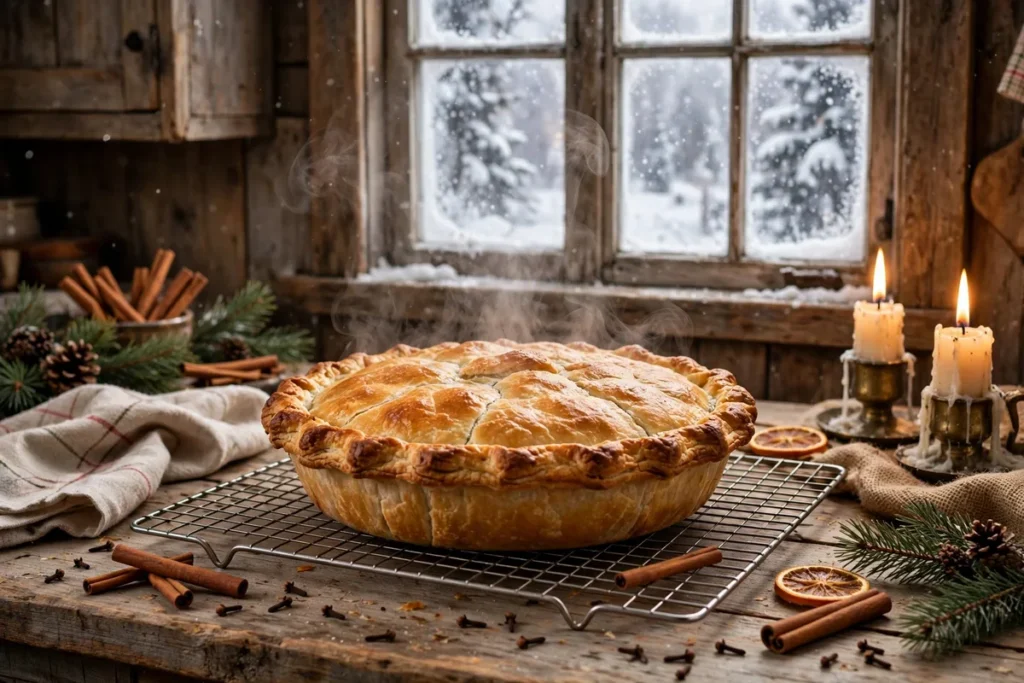
A golden tourtière cooling on a farmhouse counter, its flaky pastry steaming as snow falls outside the kitchen window.
Watch: French Canadian Tourtière
Chef Serge Belair makes his family's tourtière — the spiced Quebec meat pie — as part of his Christmas special, with house ketchup on the side.
At a Glance: French Canadian Tourtière
The pie, the feast, and the traditions around Quebec's Christmas centerpiece.
| Element | What it is | Key detail |
|---|---|---|
| Tourtière | The pie | Deep double-crusted pie of seasoned ground pork, potato, cinnamon, and clove; the filling is cooked before it goes into the pastry |
| Réveillon | The feast | The great Christmas Eve supper after midnight Mass; from réveiller, “to wake up” |
| Lac-Saint-Jean tourtière | The regional variant | Deep-dish meat-and-potato pie from Saguenay–Lac-Saint-Jean, baked low and slow for about 4–5 hours with broth poured inside |
| The name's origin | The debate | Tourte (old French for a pie vessel) is the leading theory; the passenger-pigeon (tourte) folk story persists in Quebec folklore |
| Fruit ketchup | The accompaniment | Sweet-tart tomato chutney traditionally served with hot tourtière, alongside pickled beets |
| The Christmas Eve fast | The tradition | In traditional Catholic Quebec, Christmas Eve was a day of fasting — making the post-Mass feast all the more celebratory |
Frequently Asked Questions
What meat is traditionally in a French Canadian Christmas tourtière?
Ground pork is the classic base, often mixed with veal or beef. Regional versions use cubed meats (tourtière du Lac-Saint-Jean) or game. The meat is always cooked with potato, onion, and warm spices like cinnamon, clove, and allspice before baking in the pastry.
When do Québécois eat tourtière?
Traditionally at the réveillon — the Christmas Eve supper served after midnight Mass — and again at New Year’s. Today many families serve it on Christmas Eve evening or Christmas Day. It is strictly a holiday dish in most households; eating it in July would raise eyebrows.
What is the difference between tourtière and shepherd’s pie?
Tourtière is a double-crusted pastry pie with a spiced pork filling; shepherd’s pie (and its Quebec cousin, pâté chinois) is topped with mashed potato instead of pastry and uses different seasoning. They are entirely different dishes.
Can I make tourtière ahead of time?
Yes — it is ideal for making ahead. Assemble the unbaked pie and freeze it for up to 3 months, then bake from frozen. The filling alone can be refrigerated for 2 days before assembly, and baked leftovers keep 3–4 days.
What do you serve with tourtière?
Fruit ketchup, pickled beets, or grainy mustard are the classic condiments. Round out the réveillon with ragoût de pattes, salads, glazed vegetables, and bûche de Noël for dessert.
Is tourtière the same as the Lac-Saint-Jean tourtière?
They share a name but are quite different dishes. The Lac-Saint-Jean version is a very deep pie of cubed meats and potatoes in broth, baked for hours — a celebratory showpiece of the Saguenay region, while the classic tourtière uses ground meat in a standard pie dish.