When most people hear “Thanksgiving,” they picture a single American holiday: turkey, the fourth Thursday of November, football, and pie. But thanksgiving around the world tells a far richer story. Across every continent, cultures have invented their own ways to say thanks for the harvest — from Ghana’s thunderous Homowo festival, where the Ga people “hoot at hunger,” to South Korea’s Chuseok, when millions travel home to honor their ancestors; from Germany’s Erntedankfest to Japan’s Labor Thanksgiving Day, from Brazil’s Dia de Ação de Graças to China’s moonlit Mid-Autumn Festival. Some of these celebrations share a direct lineage with the American holiday. Others arose entirely independently, proof that gratitude for food is one of humanity’s most universal instincts. This guide tours the world’s thanksgivings — their dates, their foods, their rituals — so you can see how the whole planet gives thanks.
The American Original: Where It All Started
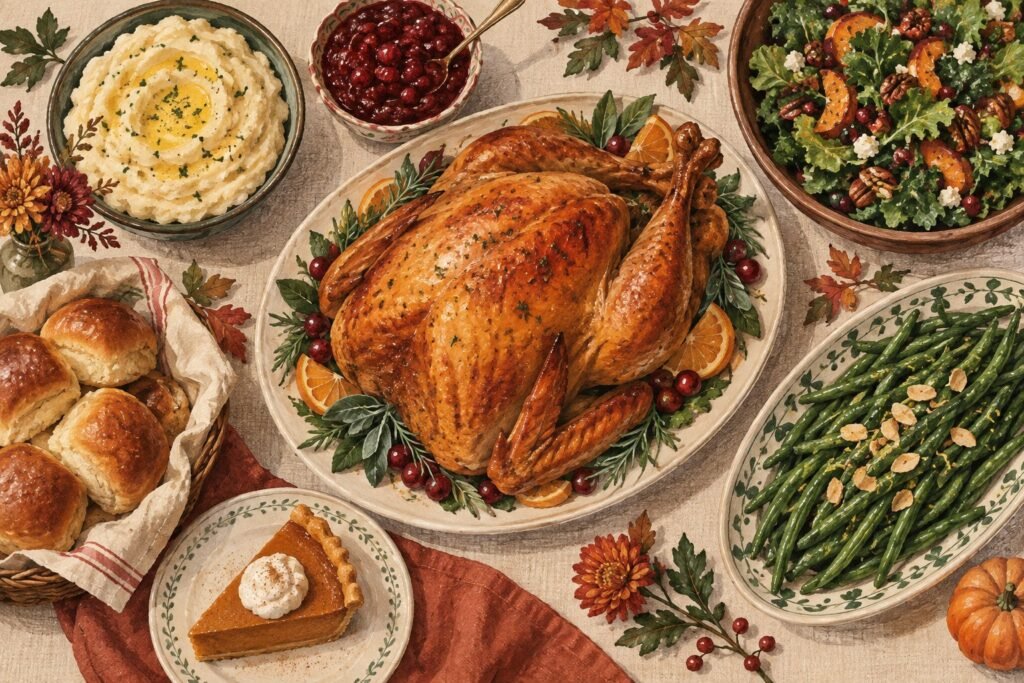
The template for the modern Thanksgiving was set in the United States: a national holiday on the fourth Thursday of November (November 26 in 2026), rooted in the 1621 harvest feast shared by English colonists and Wampanoag people at Plymouth, Massachusetts, and shaped into a yearly national observance by Abraham Lincoln’s 1863 proclamation during the Civil War. Congress fixed the date permanently in 1941. The canonical elements — roast turkey with stuffing, cranberry sauce, mashed potatoes, pumpkin pie; the Macy’s Thanksgiving Day Parade; the presidential turkey pardon; and football — are now exported worldwide through film and television, which is why so many other countries’ celebrations get compared to it. For the full founding story, see our account of the first Thanksgiving story and the Lincoln proclamation that made it national.
Canada: Thanksgiving in October
Canada celebrates its own Thanksgiving — and it comes first. Observed on the second Monday of October (October 12 in 2026), Canadian Thanksgiving is a statutory holiday in most provinces with traditions closely parallel to the American version: roast turkey, family gatherings, and autumn color at its peak. Its origins are distinct, though, tracing to explorer Martin Frobisher’s 1578 thanksgiving for safe passage in the Arctic, and to French settlers’ harvest feasts in New France. Canadians will cheerfully tell you theirs came first — and they have a point. Dive deeper into Canadian Thanksgiving history and traditions for the full story.
Liberia: America’s Thanksgiving in West Africa
One of the world’s least-known Thanksgivings is celebrated in Liberia, the West African nation founded in the 19th century by freed American slaves. Liberia observes Thanksgiving on the first Thursday of November (November 5 in 2026) as an official public holiday, complete with church services, family feasts, and gratitude traditions carried across the Atlantic by Americo-Liberian settlers. The menu blends American and West African influences — turkey may appear, but so do cassava, plantains, and palm-butter dishes. It is a fascinating case of a holiday transplanted wholesale into an entirely different climate and culture, and proof that Thanksgiving can take root far from New England. Read more in our dedicated guide to Thanksgiving in Liberia.
Brazil: Dia de Ação de Graças
Brazil has its own Thanksgiving — Dia de Ação de Graças, Portuguese for “Day of Thanksgiving” — celebrated on the fourth Thursday of November, the same day as the United States (November 26 in 2026). The holiday was established in 1949 under President Eurico Gaspar Dutra, inspired by Brazil’s ambassador to Washington, Joaquim Nabuco, who had fallen in love with the American celebration. It begins with church services giving thanks for the harvest, followed by a family feast similar to the American one — though the cranberry sauce is often replaced with a sauce made from jabuticaba, a grape-like native fruit. It is not a public holiday and remains little-known among ordinary Brazilians, but it is a genuine, officially recognized thanksgiving. Our full history of Dia de Ação de Graças in Brazil tells the remarkable diplomatic story behind it.
Ghana: Homowo — Hooting at Hunger
Every August, the Ga people of Ghana’s Greater Accra Region celebrate Homowo, which means “hooting at hunger.” The festival commemorates a famine the Ga survived during their ancient migration: after settling and praying for rain, they reaped a bumper maize harvest and celebrated by cooking kpokpoi — a fermented corn dish with palm nut soup — and jeering triumphantly at the memory of starvation. The season begins with maize planting in May, observes a month-long ban on drumming and noise, and climaxes when chiefs sprinkle kpokpoi through the streets of Accra’s old quarters to feed the ancestors. It is one of Africa’s oldest thanksgivings and, in spirit, one of the closest parallels to the American holiday anywhere on earth. Explore it in our complete guide to the Ghana Homowo Festival.
United Kingdom: The Harvest Festival
Britain’s answer to Thanksgiving is the Harvest Festival, held on the Sunday nearest the Harvest Moon in late September or October. Churches are dressed with wheat sheaves, fruit, and vegetables; congregations sing We Plough the Fields and Scatter; schools collect tins for food banks; and villages sit down to Harvest Suppers. The modern church festival dates to 1843, when the Reverend Robert Hawker of Cornwall held a thanksgiving service, but its roots reach back through the medieval Harvest Home to pagan harvest rites. Unlike the American holiday it is not a public holiday — it is local, charitable, and quietly communal. Discover UK Harvest Festival traditions in our detailed guide.
Germany and Austria: Erntedankfest
Germany’s Erntedankfest — literally “harvest thanksgiving festival” — is celebrated on the first Sunday in October (October 4 in 2026). Churches are decorated with Erntekrone (harvest crowns woven from grain), fruit, and vegetables; processions and services give thanks for the harvest; and in rural areas, the festival retains a strong agricultural character with parades of decorated tractors and traditional costume. It is primarily a religious observance rather than a family feast day, and it is not a public holiday — but as a thanksgiving for the harvest, it belongs firmly in this global family. Learn more in our guide to the German Erntedankfest harvest festival.
South Korea: Chuseok, the Korean Thanksgiving
Chuseok is one of the biggest holidays in Korea — a three-day harvest festival often called “Korean Thanksgiving.” Its date follows the lunar calendar, falling on the 15th day of the 8th lunar month (September 25 in 2026). Millions of Koreans travel to their hometowns to honor their ancestors with memorial rites (charye), visit and clean family graves (seongmyo), and share a feast featuring songpyeon — delicate half-moon rice cakes filled with sesame, beans, or honey — along with seasonal fruits, jeon pancakes, and rice wines. Traditional games, folk dancing, and wrestling (ssireum) fill the holiday. Chuseok shows what a harvest thanksgiving looks like when ancestor veneration, rather than a founding myth, sits at its center. Read our full explainer on Chuseok, the Korean Thanksgiving.
Japan: Labor Thanksgiving Day
Japan’s contribution to the world’s thanksgivings is Kinrō Kansha no Hi — Labor Thanksgiving Day — a national public holiday held every year on November 23. Its roots lie in Niinamesai, an ancient Shinto harvest ritual in which the Emperor offered the season’s first rice to the gods. After World War II, the holiday was reimagined in its modern form: a day to honor labor, production, and the workers whose efforts sustain the nation — and, by extension, to give thanks for the fruits of that labor. Schoolchildren traditionally make crafts and gifts for community workers such as police officers and firefighters. There is no feast and no turkey, but as a November day of national gratitude with harvest origins, it earns its place on any world tour of thanksgiving. Our guide to Japan’s Labor Thanksgiving Day explains the tradition in full.
China: The Mid-Autumn Festival
China’s great harvest celebration is the Mid-Autumn Festival (Zhōngqiū Jié), held on the 15th day of the 8th lunar month (September 25 in 2026) — the night of the year’s fullest moon. Families gather to gaze at the moon, give thanks for the harvest and for togetherness, and share mooncakes: dense, rich pastries filled with lotus seed paste, red bean, or salted egg yolk. The festival’s legends — Chang’e, the moon goddess, and the Jade Rabbit — give it a mythic depth, while lantern displays and dragon dances make it visually spectacular. With over a billion celebrants across China and the Chinese diaspora, it is arguably the largest harvest thanksgiving on earth. Discover it in our guide to the Mid-Autumn Festival in China.
India: Pongal, the Tamil Harvest Thanksgiving
In the southern Indian state of Tamil Nadu, the harvest is honored with Pongal — a four-day festival in mid-January (January 14–17 in most years) whose name means “to boil over,” for the ceremonial pot of rice, milk, and jaggery that is boiled until it overflows as an offering to Surya, the sun god. Each day has its theme: honoring the sun, the cattle who plow the fields, family bonds, and new beginnings. Freshly harvested rice, sugarcane, and turmeric feature throughout; homes are decorated with kolam rice-flour patterns; and the atmosphere blends devotion with rural joy. Pongal is thanksgiving expressed through the vocabulary of the Indian harvest — rice, sun, and cattle rather than turkey and pie. Read our guide to the Pongal festival in India.
Israel: Sukkot, the Feast of Tabernacles
One of the oldest harvest thanksgivings still observed is Sukkot, the Jewish Feast of Tabernacles, celebrated for seven days beginning on the 15th of Tishrei (October 1–7 in 2026). Originating as the autumn harvest festival of ancient Israel, Sukkot commemorates both the ingathering of the harvest and the Israelites’ forty years of wandering in the desert. Families build and decorate sukkot — temporary booths roofed with branches — and eat, and sometimes sleep, in them for the week, waving the lulav (palm, willow, myrtle, and citron) in daily rituals. It is a thanksgiving that doubles as an exercise in humility: abundance celebrated in a fragile hut. Our explainer on the Sukkot Jewish harvest festival covers its rituals and meaning.
Norfolk Island: Thanksgiving in the South Pacific
Perhaps the most unexpected Thanksgiving of all is celebrated on Norfolk Island, a tiny Australian external territory in the South Pacific. The island’s Thanksgiving was introduced by American whalers and traders in the 19th century and later embraced by the Pitcairn-descended community; it is observed on the last Wednesday of November. Islanders decorate their churches with produce, hold services of thanksgiving, and share communal feasts — a full American-style Thanksgiving transplanted to a subtropical island of fewer than 2,000 people. It is a delightful reminder that thanksgiving traditions can take root anywhere people decide gratitude deserves a day.
What All These Celebrations Share
Survey the world’s thanksgivings and a pattern emerges — a deep structure beneath the surface differences:
Survival remembered. The most powerful thanksgivings are born from hunger survived: the Ga famine behind Homowo, the Pilgrims’ starving winter before the 1621 feast, the desert wandering behind Sukkot. Gratitude is sharpest when it remembers its opposite.
The harvest meal. Every tradition centers a ritual food — turkey, kpokpoi, mooncakes, songpyeon, Pongal rice, the harvest loaf. The meal is never just dinner; it is the theology made edible.
Homecoming. Chuseok’s great migration, Homowo’s Soobii Thursday, Thanksgiving’s cross-country flights — harvest festivals are centripetal; they pull families home.
Sharing with the unseen. Libations for Ga ancestors, charye rites for Korean forebears, harvest produce for British food banks — thanksgiving almost always includes giving something away, to the dead, the gods, or the poor.
A pause in the working year. Whether a public holiday or a Sunday observance, thanksgiving marks a deliberate stop: the work of the year is done, and it is time to say so.
These common threads are why a single article can hold them all. The human need being met is the same on every continent; only the menu changes. For the curious, our comparison of Thanksgiving vs harvest festivals and our answer to is Thanksgiving a public holiday (country by country) extend the tour.
Frequently Asked Questions About Thanksgiving Around the World
How many countries celebrate Thanksgiving?
Only a handful of countries have an official holiday actually called Thanksgiving: the United States, Canada, Liberia, and (unofficially in practice) Brazil and the Australian territory of Norfolk Island. But dozens of countries celebrate harvest thanksgivings under other names — the UK’s Harvest Festival, Germany’s Erntedankfest, Korea’s Chuseok, Japan’s Labor Thanksgiving Day, China’s Mid-Autumn Festival, India’s Pongal, and Ghana’s Homowo among them.
Which country celebrates Thanksgiving in October?
Canada celebrates Thanksgiving on the second Monday of October (October 12 in 2026) — more than a month before the American holiday. Germany’s Erntedankfest also falls in early October, on the first Sunday of the month.
Is Thanksgiving celebrated in the UK?
Not the American holiday — but Britain has its own Harvest Festival in late September/October, with church services, school food collections, and village suppers. See our guides to UK Harvest Festival traditions and does the UK celebrate Thanksgiving.
What is the biggest harvest festival in the world?
By number of celebrants, China’s Mid-Autumn Festival — observed by well over a billion people — is the largest. Korea’s Chuseok, which sends millions traveling at once, creates one of the world’s great annual migrations. India’s Pongal and the constellation of harvest festivals across Asia each draw hundreds of millions.
Do any countries celebrate Thanksgiving on the same day as the US?
Yes — Brazil’s Dia de Ação de Graças falls on the fourth Thursday of November by law, deliberately aligned with the American date. Thanksgiving 2026 is November 26 in both countries.
Which thanksgiving is the oldest?
Sukkot, the Jewish Feast of Tabernacles, has been observed for well over two thousand years, with roots in the harvest festivals of ancient Israel. Ghana’s Homowo also predates European colonization by centuries. Among the holidays actually named “Thanksgiving,” the American tradition (1863 as a national holiday) is the oldest continuous national observance.
Conclusion: One Human Hunger, A Thousand Tables
Thanksgiving around the world is not one holiday but a human instinct wearing a thousand local costumes. Whether it is kpokpoi sprinkled on an Accra street, mooncakes shared under a Beijing moon, songpyeon steamed in Seoul, or turkey carved in Ohio, the gesture is identical: we survived, we harvested, we remember — and we say thanks. The next time you sit down to your own thanksgiving table, wherever in the world it stands, know that you are keeping company with Ghanaian chiefs, Korean grandmothers, German farmers, and Tamil rice-boilers, all doing the same timeless thing. Explore more Thanksgiving guides and harvest celebrations on DayZora — and consider timing a trip to experience one of these festivals in person. Gratitude, it turns out, is the world’s most widely shared recipe.
How to Experience the World’s Thanksgivings: A Travel Calendar
One of the great pleasures of the global thanksgiving calendar is that there is almost always one happening somewhere. With a little planning, you can build a year of gratitude travel around them:
- January: Pongal in Tamil Nadu, India (mid-January) — four days of rice-boiling rituals, cattle honors, and kolam art.
- August: Homowo in Accra, Ghana — the Ga festival of hooting at hunger, with street processions and the sacred kpokpoi.
- September: Chuseok in South Korea and the Mid-Autumn Festival across China and East Asia (both on the full moon of the 8th lunar month — September 25 in 2026); the UK Harvest Festival on the Sunday nearest the Harvest Moon.
- October: Sukkot in Israel (October 1–7 in 2026); Erntedankfest in Germany and Austria (first Sunday — October 4 in 2026); Canadian Thanksgiving (second Monday — October 12 in 2026).
- November: Labor Thanksgiving Day in Japan (November 23, a public holiday); Dia de Ação de Graças in Brazil, US Thanksgiving, and Thanksgiving on Norfolk Island (all on the fourth Thursday — November 26 in 2026); Liberian Thanksgiving (first Thursday — November 5 in 2026).
That is eleven distinct thanksgivings across ten months — a reminder that gratitude, unlike summer, has no off season. If you can only attend one, choose the one whose rituals speak to you: Homowo for raw communal power, Chuseok for family devotion, the Mid-Autumn Festival for sheer spectacle, or the UK Harvest Festival for village warmth.
Thanksgiving Etiquette for Travelers
Attending someone else’s thanksgiving is a privilege, and a few principles apply everywhere. First, remember that you are a guest at a sacred or family occasion, not a spectator at a show — dress modestly, follow the lead of locals, and ask before photographing rituals or people. Second, bring something: food, a small gift, or a contribution to the collection is appropriate at nearly every harvest celebration on earth, from a British Harvest Supper to a Korean charye table. Third, eat what you are offered with visible appreciation; refusing festival food is one of the few genuine insults in the global thanksgiving vocabulary. Fourth, learn the local words of thanks — obrigado, gamsahamnida, arigatō, medaase — and use them often. Finally, give something back: volunteer, donate to the food bank collection, or simply help with the washing up. Thanksgiving everywhere is built on reciprocity, and the best way to honor it is to participate in the giving, not just the receiving.
More Questions About World Thanksgivings
What is the difference between Chuseok and the Mid-Autumn Festival?
Both fall on the 15th day of the 8th lunar month (the same day — September 25 in 2026), but they are distinct holidays. Chuseok is Korean, centered on ancestor memorial rites, grave visits, and songpyeon rice cakes. The Mid-Autumn Festival is Chinese, centered on moon-gazing, mooncakes, and legends of Chang’e. They share lunar-calendar timing and harvest roots, not rituals.
Is Thanksgiving celebrated in Australia?
Mainland Australia does not celebrate Thanksgiving — but the Australian external territory of Norfolk Island does, on the last Wednesday of November, a tradition introduced by American whalers. For the full answer, see does Australia celebrate Thanksgiving.
In Pictures: Thanksgiving Around the World
From Norfolk Island's whaler legacy to Liberia's November holiday, Thanksgiving wears a different face in every country that keeps it. Here's the worldwide celebration.

A collage-style world scene with Thanksgiving tables from different cultures — American turkey, Korean songpyeon, and Brazilian farofa.
Watch: Thanksgiving Around the World
The real untold history of Thanksgiving in full documentary form — including the harvest festivals and global traditions most people never hear about.
At a Glance: Thanksgiving Around the World
Where and when the world gives thanks.
| Place | When | The story in brief |
|---|---|---|
| United States | 4th Thursday of November | The original — federal holiday since Lincoln's 1863 proclamation |
| Canada | 2nd Monday of October | Older roots (Frobisher, 1578); fixed by Parliament in 1957 |
| Liberia | 1st Thursday of November | Brought by freed American settlers; law since 1883 |
| Norfolk Island | Last Wednesday of November | A legacy of American whalers who settled the island in the 1800s |
| Brazil | 4th Thursday of November | Dia de Ação de Graças — official since 1949, but not a day off |
| Japan | 23 November | Labor Thanksgiving Day — a harvest-rooted national holiday honoring workers |