The ghana homowo festival is one of Africa’s most stirring harvest celebrations — a centuries-old thanksgiving observed every August by the Ga people of Ghana’s Greater Accra Region. Its name translates as “hooting at hunger,” a defiant, joyful commemoration of a famine the Ga survived long before Accra became a capital city. For weeks each summer, the city’s Ga quarters hum with ritual preparation: maize is planted in May, a month-long ban on drumming and noise settles over the towns, and on the climactic Saturday in August, chiefs and family heads sprinkle a sacred maize-and-palm-nut dish called kpokpoi along the streets, feeding the ancestors and mocking the memory of hunger. If you are interested in how different cultures give thanks for the harvest, Homowo belongs on your list alongside Thanksgiving and the world’s other great gratitude festivals. This guide explains what Homowo is, why it exists, how it unfolds from May to August, what kpokpoi means, where to witness it in Accra, and how visitors can attend respectfully.
What Is the Ghana Homowo Festival?
Homowo is the principal harvest and thanksgiving festival of the Ga, the Indigenous people of the coastal plain where Ghana’s capital, Accra, now stands. It is celebrated annually between August and September, with the climactic Homowo Day falling on a Saturday in August chosen by traditional authorities. Every Ga community observes it, but each town and clan quarter does so on its own assigned day, so the season stretches across several weeks — families with ties to more than one traditional area can attend multiple celebrations.
At its core, Homowo is both a harvest festival and a memorial. It remembers a historical famine the Ga endured during their migration to their present homeland, and it celebrates the abundant crops that followed when they tilled the land and prayed for rain. The festival is also a homecoming: Ga families return from across Ghana and from the diaspora to their ancestral houses, debts are forgiven, disputes are set aside, and the living share a ritual meal with the dead. Processions of drummers, dancers, and singers fill the streets; chiefs in full regalia tour their jurisdictions; and the entire city participates in a communal act of thanksgiving that has continued, uninterrupted in spirit, for generations. In August 2026 the Ga State marked its 200th documented edition — a bicentennial opened by the Ga Mantse himself sprinkling kpokpoi at clan houses across Accra — a testament to how deeply the festival is woven into Ga identity.
Unlike commercialized holidays, Homowo remains firmly in the hands of traditional rulers, family heads, and priests. There is no single ticketed venue; the festival happens in streets, family compounds, and clan houses. That makes it extraordinarily vivid to witness — and it also means visitors should arrive informed, dressed modestly, and ready to follow local guidance.
The Story Behind the Festival: Hooting at Hunger
Every Ga child grows up hearing the story that Homowo keeps alive. According to Ga tradition, the Ga people migrated — by their own account, from the region of Cush in ancient Egypt — toward the coastal plain of what is now Ghana. During the journey they were struck by a devastating famine. Rains failed, food ran out, and many people died of hunger.
When they finally settled on the Accra plains, they resolved to fight hunger with the hoe rather than surrender to it. They cleared the land, planted maize, and called on Ataa-Naa Nyonmo — God, in both masculine and feminine attributes — and on their ancestral spirits through libation, asking for the rains to come. The rains did come, in abundance. The maize grew tall and yielded a bumper harvest. Being skilled fishers, the Ga also pulled enormous catches from the sea, including giant red snappers they call tsile and great tunas called odaa. Their sheep and goats multiplied on rich green pasture.
Faced with this sudden plenty, the people did something remarkable: they cooked a special meal from the new corn — an unfermented maize dish called kpokpoi (also rendered kpekple) — served with palm nut soup made with fish, and as they ate, they hooted at hunger. The name says it all: homo means hunger and wo means to hoot at. To hoot at something, in Ga culture, is to jeer at it, to show contempt for it, to declare that it no longer has power over you. Homowo is therefore not a mournful remembrance of famine but a triumphant, noisy, delicious taunt directed at the memory of starvation. The people poured libation, set aside portions of the meal for the ancestral spirits, and celebrated.
That victory over hunger is what Homowo commemorates every year. It is a thanksgiving in the deepest sense: gratitude for food, for survival, for ancestors who endured, and for the gods who answered. Scholars of Ga culture note that the festival predates European colonization of the region entirely — it is among Africa’s oldest continuously observed ancestral celebrations, and it continues to be marked not only in Ghana but by Ga descendants in the United States, in cities such as New York and Houston, who keep the tradition alive far from the Accra plains.
The Road to Homowo: Key Dates in the Festival Season
Homowo is not a single day but a season with its own rhythm, beginning months before the August climax. Understanding the sequence helps visitors appreciate what they are seeing and plan their trip around the moments that matter most.
May: Planting the Festival Maize
The festival year begins in May, when maize is sown specifically for the preparation of kpokpoi. This is no ordinary crop — it is the ritual harvest, planted with the festival in mind. Some accounts describe a pre-festival sowing rite that marks the start of the agricultural cycle for the season.
The Ban on Noise-Making
Following the planting comes one of Homowo’s most distinctive observances: a thirty-day ban on noise-making, with particular emphasis on drumming, singing, and loud music. The Ga believe that noise during this period hampers the maturing of the crops. For a full month, Accra’s Ga quarters fall unusually quiet — no drums at funerals, no amplified music, no celebratory noise. The silence is itself a form of devotion, a city holding its breath while the maize ripens. Visitors in June and July will notice the calm and should respect it: this is not the time for loud parties in Ga traditional areas.
Soobii: Thursday of the Homecomers
The Thursday before Homowo Day is known as Soobii, or “Thursday People” day. On this day, thousands of Ga people travel from across Ghana and abroad back to the Accra plains to visit their families and their homeland. They arrive bearing vegetables and other harvest products that will be used to prepare the festival meal. Crowds gather to welcome the homecomers, and a period of peace and reconciliation begins — old debts are forgiven and differences are put aside, so that the whole community can celebrate as one.
Friday: Honoring Twins
The Friday before Homowo is dedicated to twins, who are revered in Ga culture as special births. Twins are adorned with whitish clay, dressed in white clothing, and presented before the priests for blessings. Gifts are exchanged, and families with twins celebrate their good fortune. It is a day of tenderness within a festival better known for noise and feasting.
Homowo Eve: A Night of Spirits
Friday night is Homowo Eve, when tradition holds that spirits wander the streets. People are advised to stay indoors after dark, and gunshots are sometimes heard through the night as warning signals. Visitors should treat this evening with particular respect — it is a sacred, liminal time, not a night for sightseeing.
Homowo Day: The Sprinkling of Kpokpoi
On the climactic Saturday — Homowo Day — the ritual heart of the festival takes place. The sacred kpokpoi meal is prepared in the morning, and then each Ga chief, accompanied by drummers, dancers, singers, and clan members, tours his area sprinkling the dish at doorsteps, family houses, cemeteries, and other places where the spirits of the departed are believed to gather. Libations are poured. The Ga Mantse, the paramount chief of the Ga, performs the ultimate sprinkling across the houses that form the Ga stool, communing with ancestors and offering thanks for another year of safety and harvest. Maidens may carry fire along the ceremonial route to cleanse it before the procession begins. After the sprinkling comes the great family feast, when homes open to visitors and the sharing of food is followed by a durbar — a grand assembly — and the Homowo dance.
Noowala: Sunday of Greetings
On Sunday, known as Noowala Day, the mood turns gentle. People make family visits, exchanging new year’s greetings and well wishes. It is the soft landing after the festival’s climax — a day of visiting, resting, and looking ahead to the year to come.
Kpokpoi: The Sacred Meal at the Heart of Homowo
No understanding of the ghana homowo festival is complete without kpokpoi. This is not festival food in the casual sense; it is the ritual object around which the entire celebration turns. Kpokpoi is prepared from steamed, fermented corn meal, combined with palm nut soup and smoked fish — traditionally the great catches of the Ga sea harvest. It is cooked communally, often in large quantities, and its preparation is itself part of the festival.
The dish serves three purposes at once. First, it is eaten — families feast on it together on Homowo Day, in the same spirit as a Thanksgiving turkey, as the taste of survival and plenty. Second, it is sprinkled — chiefs, elders, family heads, and traditional priests scatter portions of kpokpoi at specific locations: clan houses, family compounds, cemeteries, and street corners. This sprinkling is an act of communion between the living, the dead, and the ancestral spirits; the Ga believe that as human beings eat, the spirits and the departed must not be left to their fate, because it is through their benevolence — and that of Ataa-Naa Nyonmo — that the harvest exists. Third, it is symbolic: a small portion is offered to the gods to solicit protection and blessing for the coming year.
The sprinkling is performed in a strict order of jurisdiction — family heads within their compounds, clan leaders within their quarters, and finally the Ga Mantse across the twenty-one houses of the Ga stool. Watching the procession is the single most memorable sight of Homowo: the chief moving through the streets, drummers setting the pace, kpokpoi scattered like blessings, and the crowds parting and following in a wave of color and sound after a month of enforced quiet.
Where Homowo Is Celebrated: Accra and Beyond
The heartland of Homowo is the Greater Accra Region, and within it, the historic Ga quarters of the capital. Ga Mashie — the old coastal town at the center of Accra, home to landmarks such as James Fort and Ussher Fort — is the spiritual epicenter, where the Ga Mantse performs the culminating sprinkling. Around it, the great Ga towns each hold their Homowo on their own assigned days across August and September: Teshie to the east, Nungua beyond it, La (Labadi) along the coast, Osu with its famous Oxford Street now lying within modern Accra, and Tema, the industrial port city that grew from a Ga fishing town. Because the towns celebrate in succession rather than simultaneously, a visitor staying two or three weeks in August can experience several Homowos, each with its own flavor, its own chiefs, and its own crowds.
The celebrations are at their most intense in the old quarters, where family houses — the ancestral compounds that anchor Ga lineage — become the stages for the sprinkling rites. Streets close to traffic as processions pass. Drums, silent for a month, return in full voice. Market women sell festival foods, cloth sellers do brisk business in kente and prints, and the beaches at La and the plazas of Ga Mashie fill with dancers. For the most ceremonial moments — the Ga Mantse’s procession, the durbar of chiefs — Ga Mashie on Homowo Day itself is the place to be, though it is also the most crowded.
Beyond Ghana, Homowo travels with the Ga diaspora. Communities of Ga descent in the United States — in cities including New York and Houston — and in Britain observe the festival, preparing kpokpoi as best they can with local ingredients, pouring libation, and teaching the story of the famine and the harvest to a new generation. The 2026 bicentennial, opened on 9 August 2026 by Ga Mantse Nii Tackie Teiko Tsuru II with the sacred kpokpoi sprinkling at clan houses, drew Ga people home from around the world — a reminder that Homowo is not a folk curiosity but a living national institution of the Ga State, two hundred documented years strong and far older in memory.
Attending Homowo as a Visitor: What to Expect
Homowo is a public festival in the truest sense — it happens in the streets, and onlookers are welcome. But it is also a sacred rite, and respectful behavior matters enormously. A few practical guidelines will help you experience it well.
When to Go
Plan for August, with flexibility into early September. Because each town celebrates on its own day, check local announcements — Ghanaian media, the Ghana Tourism Authority, and hotel concierges in Accra publish schedules as the season approaches. The main Homowo Day in Ga Mashie is the headline event, but Teshie, Nungua, and La each offer superb celebrations with slightly smaller crowds.
What to Wear
Dress modestly and comfortably. Lightweight clothing in breathable fabrics is essential in August heat, but avoid beachwear at ritual sites — cover shoulders and knees near family houses, shrines, and processions. Many visitors choose African print clothing as a mark of respect; it is widely available in Accra’s markets. Wear sturdy, closed shoes: you will be on your feet in crowded streets, and the ground around sprinkling sites can be slippery.
Etiquette at the Rituals
Do not touch the kpokpoi being sprinkled or interfere with a chief’s procession — the sprinkling is a sacred act, and the route is cleansed for a reason. Ask permission before photographing individuals, especially priests, chiefs, and the twins honored on Friday; a smile and a gesture toward your camera is usually enough, and a small gift or purchase from a market stall afterward is appreciated. On Homowo Eve, stay indoors after dark as tradition advises. During the month-long noise ban, keep music and celebrations discreet in Ga traditional areas.
Food and Hospitality
Accept food when it is offered — sharing is the point of the festival, and refusing can offend. Kpokpoi has a distinctive sour-fermented tang from the corn and a rich depth from the palm nut soup; it is unlike anything most visitors have tasted. Wash your hands before eating, eat with your right hand if eating communally, and compliment the cook. If you are invited into a family house, bring a small gift — a bottle of schnapps is traditional for libation, or a practical contribution to the feast.
Getting Around
Base yourself in Accra — Osu, Labadi, or the airport residential area all give good access to the Ga quarters. On Homowo Day itself, roads around Ga Mashie close; go early, travel light, and consider hiring a local guide through your hotel. A knowledgeable Ga guide transforms the experience, explaining which clan is processing, what the drumming patterns mean, and where the best vantage points are.
Homowo and Thanksgiving: Two Harvest Thanksgivings
Visitors from the United States often feel a shock of recognition at Homowo. Strip away the particulars — maize instead of turkey, palm nut soup instead of gravy, August instead of November — and the structure is the same: a historical hunger survived, a harvest that followed, a communal meal shared with the living and the honored dead, and an explicit act of thanks. The Ga hoot at hunger; Americans pardon a turkey and go around the table naming gratitudes. Both festivals insist that plenty is not an accident but a blessing to be acknowledged.
The differences are instructive too. Homowo is decentralized and sacred, run by chiefs and priests rather than retailers; it has no fixed menu beyond the ritual dish and no commercial season attached. It is also, in a sense, more theologically direct — the meal is literally shared with the gods and ancestors, not just dedicated to them. For anyone exploring Thanksgiving around the world, Homowo offers one of the richest parallels on the planet: proof that the human impulse to feast in gratitude after hunger is universal, even when the food, the calendar, and the gods are entirely different. Our comparison of Thanksgiving vs harvest festivals places Homowo alongside Britain’s Harvest Festival and Germany’s Erntedankfest for the full picture.
Frequently Asked Questions About the Ghana Homowo Festival
When is the Homowo festival celebrated?
Homowo is celebrated annually between August and September. The season begins with the planting of festival maize in May, followed by a thirty-day ban on noise-making, and climaxes on Homowo Day — a Saturday in August chosen by traditional authorities. Each Ga town (Ga Mashie, Teshie, Nungua, La, Osu, Tema) celebrates on its own assigned day, so festivities stretch across several weeks.
What does “Homowo” mean?
Homowo comes from two Ga words: homo, meaning hunger, and wo, meaning to hoot at. The festival’s name therefore means “hooting at hunger” — a triumphant mockery of the famine the Ga people survived during their migration, commemorated each year with feasting and the ritual sprinkling of food.
What is kpokpoi?
Kpokpoi (also spelled kpekple) is the sacred festival dish of Homowo, made from steamed fermented corn meal served with palm nut soup and smoked fish. It is eaten communally on Homowo Day and sprinkled by chiefs and family heads at clan houses, cemeteries, and street corners as an offering to the gods and ancestors — an act of communion between the living and the dead.
Who celebrates Homowo?
Homowo is celebrated by the Ga people of Ghana’s Greater Accra Region — all Ga towns and clans observe it, each in their own way. Ga communities in the diaspora, including in the United States and Britain, also mark the festival. Visitors are welcome at the public processions and street celebrations.
Can tourists attend Homowo?
Yes. Homowo happens in public streets and is open to onlookers, but visitors should dress modestly, ask permission before photographing rituals or individuals, avoid interfering with processions, and respect the Homowo Eve tradition of staying indoors after dark. Hiring a local Ga guide is strongly recommended.
How is Homowo different from Thanksgiving?
Both are harvest thanksgivings born from surviving hunger, but Homowo is a sacred, chief-led rite in August centered on a ritual maize dish shared with ancestors, while American Thanksgiving is a November family holiday centered on a turkey feast. Homowo has no fixed calendar date — each town chooses its day — and no commercial dimension. For the broader context, see Thanksgiving in Liberia, another African thanksgiving tradition with its own distinct history.
Conclusion: The Loudest Thanks in Africa
The ghana homowo festival is thanksgiving at its most elemental: a people who knew real hunger, survived it, and chose to remember it not with solemnity but with drums, dancing, and a meal flung joyfully into the streets. In an age when harvest festivals can feel like quaint relics, Homowo remains fierce, sacred, and alive — two hundred documented years young and still hooting at hunger. Whether you travel to Accra to witness the sprinkling or simply carry its story to your own table, it is a reminder of what gratitude is for. Explore more harvest and Thanksgiving celebrations around the world on DayZora, and consider experiencing Homowo in person next August — the Ga will welcome you, feed you, and teach you how to hoot.
In Pictures: Ghana's Homowo Festival
Homowo means 'hooting at hunger' — the Ga people's triumphant harvest festival in Accra, celebrating survival over famine. Here's the vibrant tradition.
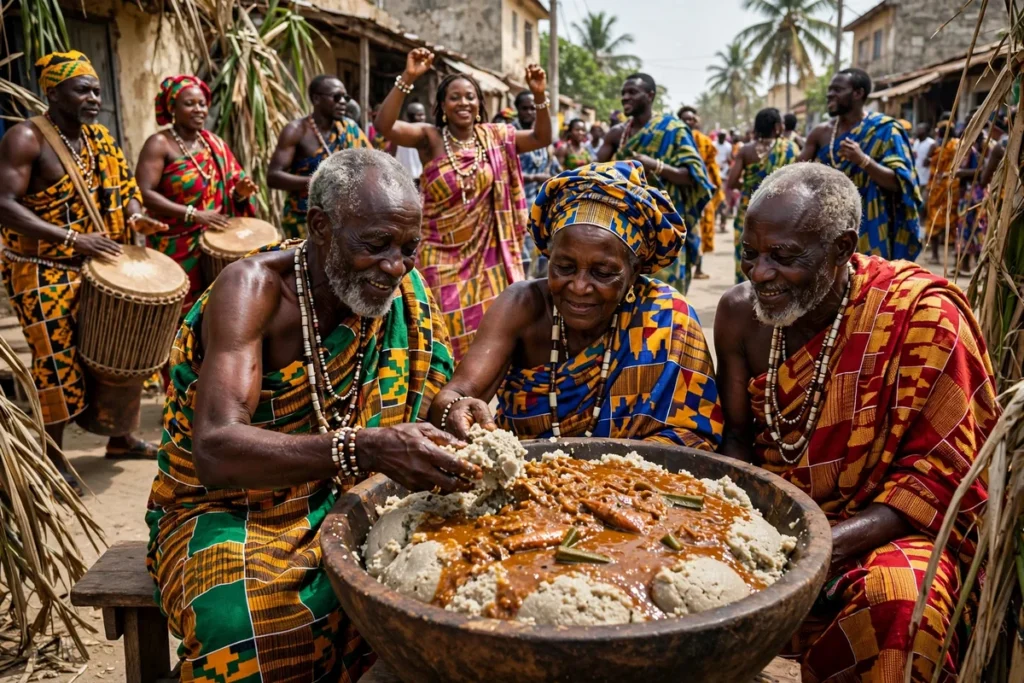
A colorful Homowo celebration in Accra with traditional Ga dancers, drummers, and festive crowds in kente cloth.
Watch: Ghana's Homowo Festival
The Ga people celebrate Homowo in Accra — honoring ancestral heritage and the triumph over hunger.
At a Glance: Ghana's Homowo Festival
The essentials of the Ga harvest celebration.
| Fact | Detail |
|---|---|
| The people | The Ga of Greater Accra, Ghana — Homowo is their principal traditional festival |
| The timing | August each year, at the start of the main harvest season |
| The meaning | 'Homowo' means 'hooting at hunger' — a celebration of overcoming famine in Ga history |
| The sacred meal | Kpokpoi (kpekple) — steamed cornmeal with palm nut soup, sprinkled to honor the gods and ancestors |
| The customs | Processions, drumming, dancing, and traditional rites led by chiefs and priests |