Does the UK celebrate Thanksgiving? It’s one of the most-asked questions about the holiday — and the short answer is no, not officially. There is no Thanksgiving Day on the British calendar, no day off work, no national turkey dinner in November. But the full answer is more interesting than a simple no. Britain has its own centuries-old harvest traditions that predate the American holiday, a thriving expat scene that celebrates Thanksgiving with genuine enthusiasm, and a complicated cultural relationship with the whole idea. Whether you’re an American in London wondering how to mark the day, or simply curious about why the UK never adopted Thanksgiving, this guide covers everything.
The Short Answer: No — and Here’s Why
The United Kingdom does not celebrate Thanksgiving as a public holiday or national observance. November’s fourth Thursday is an ordinary working day in Britain. Offices are open, schools are in session, and there is no official ceremony, proclamation, or tradition attached to the date.
The reason is straightforward: Thanksgiving is rooted in specific North American history. The American holiday commemorates the 1621 harvest feast at Plymouth Colony and was fixed as a national holiday by Abraham Lincoln’s 1863 proclamation during the Civil War. Britain, having been on the other side of the colonial relationship, has no Plymouth story of its own to commemorate — and frankly, from a British perspective, the holiday celebrates the success of colonists who would soon rebel against the Crown. There was never a historical reason for Britain to adopt it, and unlike Halloween or Black Friday, it never crossed the Atlantic as a commercial import either.
That said, “not officially” is not the same as “not at all.” Thanksgiving in Britain exists in three distinct forms: the ancient harvest festival tradition that is Thanksgiving’s British cousin, the expat celebration kept alive by hundreds of thousands of Americans living in the UK, and the cultural curiosity of Britons who have absorbed the holiday through American films, TV shows, and Friends episodes. Each deserves a closer look.
Britain’s Own Harvest Tradition: The Harvest Festival
Long before Thanksgiving existed, Britain was celebrating the harvest — and in many ways, it still is. The Harvest Festival (Erntedankfest‘s British sibling, for those who know the German harvest thanksgiving) is one of the oldest continuously observed traditions in the country, with roots in pagan harvest celebrations and the medieval church calendar.
What the Harvest Festival Looks Like
Traditionally held on or near the Sunday of the Harvest Moon — the full moon closest to the autumn equinox, usually in late September — the Harvest Festival is marked in thousands of churches across England, Scotland, Wales, and Northern Ireland. The classic scene: a village church decorated with sheaves of wheat, baskets of apples and pumpkins, marrows, and autumn flowers piled around the altar. The congregation sings harvest hymns — most famously “We Plough the Fields and Scatter” and “Come, Ye Thankful People, Come” — and gives thanks for the year’s crops.
The festival has two beloved social institutions. The first is the Harvest Supper, a communal feast held in the village hall or church, where the community shares a hot meal — traditionally featuring seasonal produce, often with a roast. The second is the harvest offering: donations of food, now usually tins and packets for local food banks rather than fresh produce, collected in churches and schools. In fact, if you walk past a British primary school in late September, you’ll likely see exactly this — children bringing in cans of soup and boxes of cereal for a harvest assembly, singing songs about scarecrows and wheat.
How Old Is It?
The church Harvest Festival in its modern form was revived in 1843 by the Reverend Robert Hawker, the eccentric vicar of Morwenstow in Cornwall, who invited his parishioners to a harvest thanksgiving service. The idea spread rapidly through Victorian England. But the underlying customs — harvest homes, harvest suppers, the last-sheaf ceremonies — are far older, stretching back through medieval “harvest home” celebrations to pre-Christian rites marking the end of the grain harvest. When Americans sit down to Thanksgiving dinner, they’re participating in a tradition whose British roots run at least as deep. For the full picture of these parallel traditions, see our guide to UK harvest festival traditions.
The Expat Thanksgiving: How Americans Celebrate in Britain
Here’s where the answer to “does the UK celebrate Thanksgiving” gets a qualified yes. The UK is home to one of the largest American expat communities in the world — well over 100,000 Americans live in Britain, concentrated heavily in London — and for them, Thanksgiving is non-negotiable. The fourth Thursday of November sees a parallel holiday unfold across the capital and beyond.
Restaurant Thanksgivings
Dozens of London restaurants serve full Thanksgiving dinners on the day, from American-style diners and BBQ joints to upscale hotels. These dinners book out weeks in advance — the expat demand is real and growing, with more Britons joining in each year out of curiosity. If you’re an American spending the holiday in London, our guides to celebrating Thanksgiving in London and where to eat Thanksgiving dinner in London have the practical details.
The Great Turkey Hunt
One of the classic expat challenges is sourcing the bird. British supermarkets do sell turkeys — but the big turkey season in the UK is Christmas, not November, so availability in late November can be patchy and sizes run smaller than the American ideal. Savvy expats order from specialist butchers or online suppliers well in advance. Cranberry sauce, canned pumpkin, and marshmallows (for the sweet-potato casserole) are the other notorious treasure-hunt items — our guide to where to buy turkey in the UK covers the best sources.
Friendsgiving, British Style
Because most Americans in the UK can’t fly home for a single Thursday, “Friendsgiving” — the friends-as-family Thanksgiving dinner — is the dominant form. Held on the nearest weekend, these gatherings mix Americans, Britons, and other nationalities around improvised feasts. They’re often more relaxed and more international than the stateside original, and many participants say they prefer them. Offices with American staff, international schools, and university American societies all host versions.
The NFL and the Parade on TV
American sports bars in London open early for the NFL Thanksgiving games, and the Macy’s Thanksgiving Day Parade streams to homesick viewers. It’s a small but heartfelt corner of the day.
Black Friday: The Thanksgiving Import Britain Did Adopt
Ironically, while Britain rejected Thanksgiving itself, it enthusiastically adopted the shopping frenzy that follows it. Black Friday arrived in the UK in the early 2010s, imported by American retailers like Amazon and Asda (then owned by Walmart), and has grown into one of the biggest retail events of the British year — arguably bigger, relative to the calendar, than in the US, because it lands a full month before Christmas and serves as the unofficial start of British Christmas shopping.
The result is a peculiar British November: no Thanksgiving dinner on Thursday, but massive Black Friday sales on Friday, in a country that doesn’t celebrate the holiday the sales are named after. Most Britons under 40 know exactly what Black Friday is; far fewer could tell you why it’s called that. It’s a neat illustration of how commercial culture travels faster than the traditions behind it.
What Britons Think of Thanksgiving
British attitudes toward Thanksgiving are a revealing mix of affection, bemusement, and mild historical awkwardness:
- Genuine fondness for the concept. Many Britons love the idea of Thanksgiving — a holiday dedicated purely to gratitude, family, and food, unconnected to religion or gift-giving. Polls and media coverage routinely note a certain envy: “why don’t we have something like that?”
- The history problem. The trickier part is the story. The traditional American narrative of Pilgrims and Native Americans doesn’t translate well in a country increasingly attentive to colonial history — and in Britain, the Pilgrims were religious dissenters who left. There’s no comfortable British version of the myth.
- Pop-culture familiarity. Thanks to decades of American television — the Friends Thanksgiving episodes are practically a British institution — most Britons know the iconography: turkey, parades, football, “what are you thankful for” speeches. They know it the way they know prom: vividly, but as someone else’s ritual.
- The food curiosity. Sweet potato with marshmallows, green bean casserole, and pumpkin pie remain exotic to most British palates. Pumpkin pie in particular divides opinion — Britons who try a good one tend to convert instantly.
Could the UK Ever Adopt Thanksgiving?
Every few years, a columnist proposes it: Britain should adopt its own Thanksgiving — perhaps in September, aligned with the harvest, stripped of the colonial narrative, focused on gratitude and community. The arguments in favor are real: late autumn in Britain has no major holiday between the August bank holiday and Christmas, and a gratitude-focused celebration could fill that gap beautifully.
The arguments against are equally real. Britain already has the Harvest Festival tradition covering the same emotional ground. Inventing a new national holiday by fiat rarely works — holidays need organic roots, and “we’re copying America but in September” lacks them. And the calendar is already crowded: Halloween, Bonfire Night (November 5), Remembrance Sunday, and then Christmas. Most observers conclude that Britain will keep its harvest festivals, keep its expat Thanksgivings, and leave the official holiday to North America — which, honestly, seems to suit everyone.
How to Celebrate Thanksgiving in the UK: A Practical Guide
If you’re in Britain on the fourth Thursday of November and want to mark the day, here’s how to do it well:
- Book a restaurant dinner early. London’s Thanksgiving-serving restaurants fill up fast — reserve two to three weeks ahead. Hotel restaurants and American-style venues are your best bets.
- Host a Friendsgiving. Invite friends for the weekend before or after. Assign dishes potluck-style to spread the effort, and don’t stress about authenticity — the spirit matters more than the marshmallows.
- Source ingredients ahead. Order your turkey from a butcher, not a supermarket, and hunt down cranberry sauce, pumpkin purée, and pecans early. British cranberry sauce exists but tends toward the tart; American-style jellied sauce is an expat specialty-shop item.
- Embrace local twists. Some of the best UK Thanksgivings blend traditions: a roast turkey with all the trimmings followed by a proper British cheese course, or pumpkin pie alongside mince pies. Fusion is a feature, not a bug.
- Watch the parade and football. Stream the Macy’s parade in the afternoon (UK time) and catch the NFL games in the evening at a sports bar — it’s the closest thing to the full American experience.
- Give it a British charity angle. Take a cue from the Harvest Festival tradition and pair your feast with a food-bank donation — gratitude expressed as generosity, in the best spirit of both traditions.
The Forgotten English Beginning: Thanksgiving’s Mayflower Roots
Here’s the irony that makes the “does the UK celebrate Thanksgiving” question so delicious: the American holiday is, in a very real sense, an English story. The Pilgrims were English Separatists — a congregation from Scrooby in Nottinghamshire who fled religious persecution first to the Netherlands and then, in 1620, across the Atlantic. The Mayflower sailed from Plymouth, England (after stops in Southampton and Dartmouth), carrying 102 passengers who were overwhelmingly English. The 1621 harvest feast at Plymouth, Massachusetts, was cooked by English people, in the English harvest-home tradition, giving thanks in the English Puritan manner.
Plymouth, England, has never forgotten this. The city’s Mayflower Museum and the commemorations around the 400th anniversary in 2020 keep the connection alive, and there’s a quiet pride in the West Country about the whole thing. Some historians argue that the Pilgrims’ thanksgiving was essentially an English harvest festival transplanted to New England soil — the same “harvest home” suppers, the same psalms of gratitude, adapted to maize and wild turkey instead of wheat and goose. Viewed that way, Thanksgiving isn’t a holiday Britain failed to adopt; it’s a British tradition that emigrated, flourished abroad, and came home unrecognizable.
This is also why the “history problem” mentioned earlier is more nuanced than it first appears. Yes, the Pilgrims left England — but they left as English people, and their feast was an English custom. A Britain comfortable with that framing could, if it wished, claim Thanksgiving as a distant cousin rather than a foreign import. It simply chooses not to, which is itself a very British decision.
Britain’s Harvest Calendar: A Year of Thanksgivings
Part of the reason Britain never needed a single Thanksgiving Day is that its traditional calendar was already full of harvest gratitude, spread across the autumn:
- Lammas Day (August 1) — From the Old English hlaf-mas, “loaf-mass,” this was the festival of the first wheat harvest, when loaves baked from the new grain were blessed in church. It marked the beginning of the harvest season.
- Harvest Home (late August–September) — The great celebration when the last sheaf was cut. Farmworkers were given a feast by the farmer — roast meats, ale, and merriment — and the decorated last sheaf (the “harvest queen” or “mell sheaf”) was carried home in procession. This was the working countryside’s real thanksgiving.
- Michaelmas (September 29) — The feast of St. Michael, traditionally the end of the harvest and the start of the new farming year. Goose was the customary Michaelmas dish — “eat goose on Michaelmas and never want money” — and rents and accounts were settled. If any single day was medieval England’s Thanksgiving dinner, it was this one.
- The Harvest Festival (late September) — The Victorian revival, described above, which folded the older customs into a church-centered celebration and remains the living tradition today.
- Martinmas (November 11) — The old feast of St. Martin, when livestock not kept for winter were slaughtered and salted — the original reason November became associated with feasting before winter.
Seen against this calendar, the American Thanksgiving looks less like an invention and more like a consolidation: the Pilgrims and their descendants took the scattered English harvest customs and fused them into a single November feast. Britain kept the scattered version. Neither approach is more “authentic” — they’re two branches of the same tree, which is exactly what makes comparing them so rewarding. Our Thanksgiving vs. harvest festival guide explores these parallels in depth.
How to Talk About Thanksgiving With British Friends
If you’re an American explaining the holiday to British friends — or a Brit trying to understand what your American colleagues are on about — a few translations help. When Americans say “Thanksgiving,” Britons hear a word they associate with the Harvest Festival and church, not with a national holiday. The concept of a secular-but-universal day of gratitude, where everyone from every background sits down to the same meal, is the part that tends to land: it’s the inclusivity, not the turkey, that impresses. And if you want to win a Brit over completely, skip the history lecture and lead with the food. A well-made pumpkin pie has converted more skeptics than any number of explanations about the Mayflower. The shared language of a good meal needs no translation — which, when you think about it, is the whole point of Thanksgiving in the first place.
In Pictures: Does the UK Celebrate Thanksgiving
Britain doesn't officially do Thanksgiving — but with American expats, US-style restaurants, and a growing appetite for the feast, it's quietly catching on. Here's the British take.
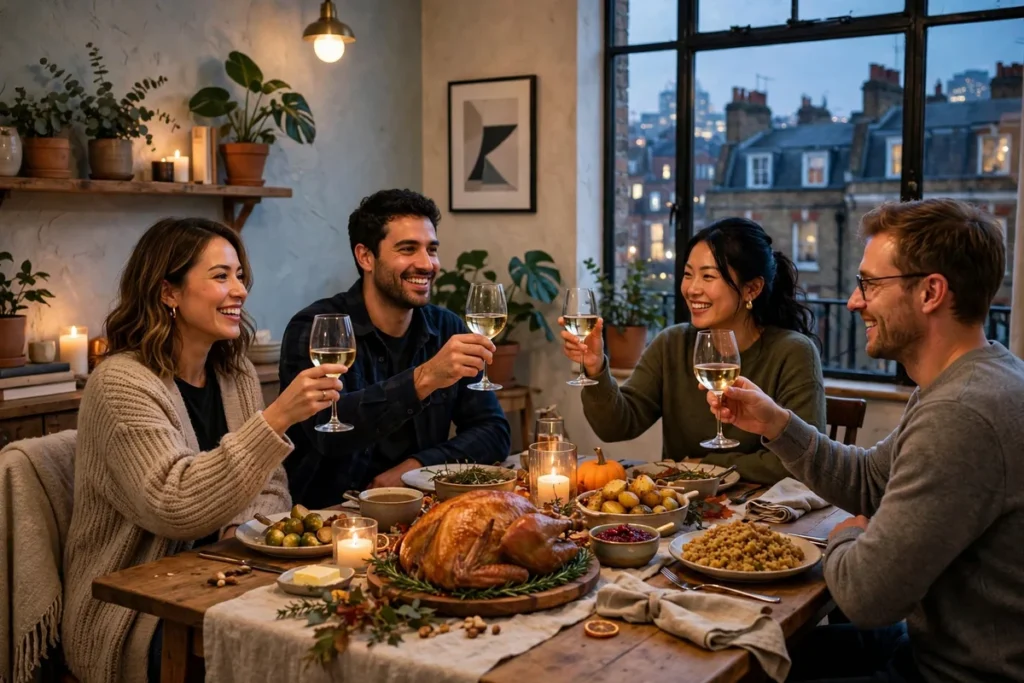
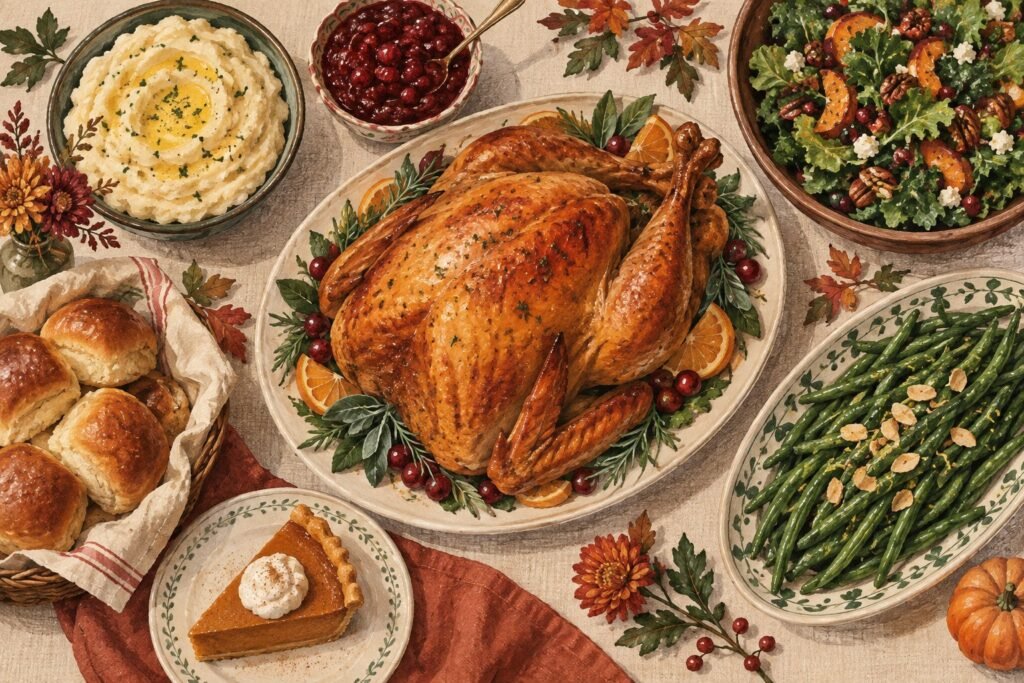
A British family enjoying a Thanksgiving-style roast dinner with all the trimmings in a cozy UK dining room.
Watch: Does the UK Celebrate Thanksgiving
Brits cook the ultimate Thanksgiving dinner with family — a fun look at how the holiday translates across the pond.
At a Glance: Does the UK Celebrate Thanksgiving
Thanksgiving's unofficial — but growing — footprint in Britain.
| Aspect | Detail |
|---|---|
| Official status | Not a public holiday — no day off, no official observance |
| The expat engine | London's large American community drives most celebrations, from home dinners to restaurant feasts |
| Restaurant scene | London venues serve Thanksgiving menus each November — typically on the last Thursday, around £60–£160 per person |
| The turkey problem | Britain's turkey industry gears up for Christmas, so November birds mean ordering early from a butcher |
| Harvest Festival | Britain's own autumn tradition — church and school harvest celebrations, usually in September or October |
Frequently Asked Questions
Does the UK celebrate Thanksgiving?
No, the UK does not officially celebrate Thanksgiving. It is not a public holiday, there is no day off, and most Britons treat the fourth Thursday of November as an ordinary day. However, American expats celebrate it enthusiastically, many restaurants serve Thanksgiving dinners, and Britain has its own ancient Harvest Festival tradition in late September covering similar ground.
Why doesn’t the UK celebrate Thanksgiving?
Thanksgiving commemorates specific North American colonial history — the Plymouth harvest feast and Lincoln’s Civil War-era proclamation — which has no British equivalent to celebrate. Britain’s own harvest thanksgiving tradition, the Harvest Festival, predates the American holiday and continues in churches and schools each autumn.
Do British schools teach about Thanksgiving?
Some do, usually in the context of American culture or history lessons, but it’s not part of the national curriculum in the way it is in the US. British schoolchildren are far more likely to celebrate the Harvest Festival — bringing food donations to school assemblies in late September — than to learn the story of the Pilgrims in depth.
Can you get a Thanksgiving dinner in London?
Absolutely. Dozens of London restaurants serve Thanksgiving dinner on the fourth Thursday of November, from casual American diners to luxury hotels. Book well in advance — the best spots sell out. See our guide to where to eat Thanksgiving dinner in London for options.
Is Black Friday celebrated in the UK?
Yes — Black Friday is now one of the UK’s biggest shopping events, despite the country not celebrating Thanksgiving. It was imported by American retailers in the early 2010s and now marks the unofficial start of the British Christmas shopping season.
What is the UK equivalent of Thanksgiving?
The closest equivalent is the Harvest Festival, held in late September around the Harvest Moon. Churches are decorated with produce, harvest hymns are sung, Harvest Suppers bring communities together over a shared meal, and food donations go to those in need — gratitude for the harvest, expressed communally, just without the turkey and the Thursday.
Conclusion
So, does the UK celebrate Thanksgiving? Officially, no — and it likely never will. But look closer and you’ll find the spirit of the holiday alive in Britain in forms both older and newer than the American original: in the candlelit Harvest Festivals of village churches, in the packed London restaurants serving turkey to homesick expats every fourth Thursday of November, and in the Friendsgiving tables where Americans and Britons share pumpkin pie and compare notes on gratitude. Britain doesn’t need to import Thanksgiving, because it already had the idea first — it just celebrates it in September, with hymns instead of parades. And honestly? There’s something rather wonderful about that. For more on how the holiday travels, explore Thanksgiving around the world, or browse the full Thanksgiving collection.