The German Erntedankfest harvest festival is Germany’s answer to Thanksgiving — and in many ways, it’s the older, deeper tradition. Each autumn, churches across Germany are transformed into blazing displays of grain, fruit, and flowers; villages crown their harvests with towering wreaths of wheat; and communities gather for parades, services, and feasts giving thanks for the year’s yield. Unlike the American holiday, Erntedankfest carries no pilgrim mythology and no fixed national menu. What it offers instead is a living link to centuries of European harvest ritual, still practiced with genuine devotion in the 21st century. This is the complete guide to what it is, where it comes from, and how to experience it.
Erntedankfest at a Glance
| Detail | Answer |
|---|---|
| Name | Erntedankfest (Ernte = harvest, Dank = thanks, Fest = festival) |
| English | Harvest Thanksgiving Festival |
| When | Usually the first Sunday in October (some regions: last Sunday of September) |
| Erntedankfest 2026 | Sunday, October 4, 2026 |
| Erntedankfest 2027 | Sunday, October 3, 2027 |
| Observed by | Catholic and Protestant churches; rural communities; some cities |
| Legal status | Not a national public holiday (it’s a Sunday); a major church festival |
| Signature symbols | The Erntekrone (harvest crown), decorated altars, harvest parades |
| Core meaning | Thanksgiving for the harvest and for God’s provision |
Two things distinguish Erntedankfest immediately from the American Thanksgiving. First, it is a church festival rather than a national holiday — its home is the parish, not the parliament. Second, its date floats within early autumn rather than being fixed by law, because it follows the agricultural reality of the harvest rather than a historical anniversary. For the broader context of how harvest celebrations differ from the Thanksgiving model, see our Thanksgiving vs. harvest festival comparison.
What “Erntedankfest” Means
The compound word tells the whole story: Ernte (harvest) + Dank (thanks) + Fest (festival/celebration) = the festival of harvest thanks. Germans sometimes shorten it to Erntedank. The name is descriptive rather than poetic — German practicality at its finest — but the festival itself is anything but plain.
It’s worth noting what Erntedankfest is not: it is not “German Thanksgiving” in the sense of a German version of the American holiday. No German family sits down on the first Sunday of October for a ritual turkey dinner with pumpkin pie. The festival’s center of gravity is the church service and the community celebration, not the dining table — though festive meals absolutely follow. Think of it less as Thanksgiving dinner and more as Thanksgiving worship, with the whole village invited.
Origins: From Pagan Fields to Christian Altars
Harvest thanksgiving in German lands predates Christianity by millennia. The Germanic tribes held autumn rites honoring the earth’s fertility — offerings of the first grain, feasts when the harvest was safely gathered, ceremonies around the last sheaf cut from the field. These weren’t quaint superstitions but survival rituals: in a world where a failed harvest meant famine, gratitude for a good one was existential.
As Christianity spread through German territories, the church absorbed rather than abolished these customs. Medieval Catholic practice included blessing the fields (the Flurprozessionen, or field processions, still held in some regions), harvest masses, and the decoration of churches with the season’s produce. The Reformation added a Protestant layer: Martin Luther’s emphasis on God’s providence in daily life — including the harvest — gave thanksgiving for crops strong theological grounding in Lutheran regions.
The modern Erntedankfest took shape in the 19th century, when both Catholic and Protestant churches formalized autumn thanksgiving services. A key milestone came in 1773, when the Prussian king Frederick the Great — famously no friend of church ceremony — nevertheless supported harvest thanksgiving observances, recognizing their importance to rural life. By the late 1800s, Erntedankfest was firmly established across German-speaking Europe as the autumn counterpart to the spring’s Easter celebrations.
The 20th century added darker chapters. The Nazi regime attempted to co-opt harvest festivals for propaganda, staging massive Reichserntedankfeste on the Bückeberg near Hamelin — choreographed spectacles of “blood and soil” ideology that perverted the genuine tradition. Postwar Germany deliberately reclaimed Erntedankfest as a humble, local, church-centered observance — which is why today’s festival feels so authentically grassroots. The grandiosity was tried, and rejected.
The Erntekrone: Symbol of the Festival
If Erntedankfest has a single iconic image, it’s the Erntekrone — the harvest crown. Woven from the season’s grain (wheat, rye, barley, oats), often four-sided or rounded, and decorated with ribbons, flowers, and fruit, the harvest crown is both decoration and theology: a crown for the King of the harvest, offered back to God from the fields He blessed.
Making an Erntekrone is genuine folk craft. In farming villages, the crown is woven communally in the weeks before the festival — often by the local Landjugend (rural youth group) or women’s association — using grain from local fields. The finished crown, sometimes over a meter tall, is carried in procession to the church and hung above the altar or in the church porch, where it remains for weeks. Some crowns are true artworks, incorporating dozens of grain varieties, dried flowers, and symbolic elements like a bread loaf or a sheaf of flax.
The smaller cousin of the crown is the Erntekranz (harvest wreath), hung on doors and barns. Together, crowns and wreaths turn German villages into galleries of agricultural art each October — a visual thanksgiving that needs no translation.
How Erntedankfest Is Celebrated
The Church Service
The heart of Erntedankfest is the Sunday thanksgiving service. Churches — Catholic and Protestant alike — are decorated with extraordinary abundance: altars banked with pumpkins, apples, grapes, cabbages, and sheaves of grain; floors lined with baskets of produce; the Erntekrone suspended overhead. The service includes harvest hymns (the beloved “Nun danket alle Gott” — “Now Thank We All Our God” — is practically the festival’s anthem), readings about providence and stewardship, and often a special children’s component.
A distinctive feature is the Erntegaben — harvest gifts. Congregants bring produce from their gardens (or purchased food) to decorate the church, and after the festival the food is donated to those in need: food banks, homeless shelters, refugee accommodations. The decoration is the charity — beauty converted directly into generosity.
The Harvest Parade (Erntedankumzug)
In many towns, the service is followed — or preceded — by a parade. Tractors draped in flowers and grain, floats depicting rural life, marching bands, folk-dance groups in Tracht (traditional dress), and children carrying baskets of fruit process through streets lined with spectators. These parades range from intimate village affairs to major regional events drawing thousands.
The Harvest Ball and Festival
Evening brings the social side: the Erntedankball or harvest dance, community feasts in festival tents, and markets selling regional produce, crafts, and seasonal foods. In wine regions, Erntedankfest blends with the grape harvest celebrations; in the north, it overlaps with the end of the grain harvest. The mood is joyful but grounded — gemütlich in the truest sense.
What Germans Eat
There’s no single Erntedankfest menu, but the festive tables lean into the season’s best: Zwiebelkuchen (onion tart) with Federweißer (new wine) in wine regions; roast goose or duck as autumn approaches; pumpkin soup; apple cakes and plum cakes (Zwetschgenkuchen); and breads baked from the new grain — the literal fruits of the harvest being celebrated. In many parishes, the post-service gathering features coffee and cake rather than a full meal, in classic German Kaffeeklatsch style.
Where to Experience Erntedankfest
Erntedankfest is at its most vivid in rural Germany, but several places offer standout experiences for visitors:
- Berlin — The capital hosts one of Germany’s most visible Erntedankfest celebrations, with a major thanksgiving service and festivities around the Kaiser Wilhelm Memorial Church on Breitscheidplatz, typically timed near German Unity Day (October 3). It’s the best urban option.
- Bavaria — Villages across Bavaria celebrate with particular gusto: full Tracht parades, brass bands, and harvest crowns of exceptional craftsmanship. The Alpine backdrop doesn’t hurt.
- The Rhineland wine villages — Here Erntedankfest merges with the wine harvest, adding Federweißer, wine queens, and vineyard processions to the traditional elements.
- Northern Germany — In Schleswig-Holstein and Lower Saxony, the grain-harvest character is strongest, with impressive Erntekrone and tractor parades.
- Austria and Switzerland — The tradition extends across German-speaking Europe, with Austrian villages and Swiss farming communities holding their own Erntedankfeste, often with local variations.
If you’re an American in Germany wondering how to mark your own Thanksgiving, Berlin’s expat scene is lively — see our guide to celebrating Thanksgiving in Berlin — but consider attending a local Erntedankfest too. It’s the deeper experience, and Germans are welcoming to respectful visitors.
Erntedankfest vs. American Thanksgiving
| Erntedankfest | American Thanksgiving | |
|---|---|---|
| Date | First Sunday of October (floating) | Fourth Thursday of November (fixed) |
| Nature | Church festival, community celebration | National holiday, family celebration |
| Central ritual | Thanksgiving church service | Family feast |
| Signature symbol | Erntekrone (harvest crown) | Turkey, cornucopia |
| Traditional meal | None prescribed; seasonal foods | Turkey, stuffing, cranberry sauce, pumpkin pie |
| Origin story | Ancient harvest rites, Christianized | 1621 Plymouth feast, 1863 proclamation |
| Commercialization | Minimal | Extensive (Black Friday etc.) |
The Bückeberg Years: When the Festival Was Stolen — and Reclaimed
No honest history of Erntedankfest can skip the 1930s. The Nazi regime, obsessed with rural romanticism and “blood and soil” ideology, seized upon the harvest festival as propaganda material. From 1933 to 1937, the regime staged the Reichserntedankfest — the Reich Harvest Thanksgiving — on the Bückeberg hill near Hamelin, drawing crowds estimated in the hundreds of thousands. These were not village church services but massive choreographed rallies: torchlight processions, military formations, and speeches by Hitler and propaganda minister Goebbels, all draped in harvest symbolism perverted to serve the regime.
The contrast with the genuine tradition could hardly have been starker. Where the village Erntedankfest was humble, local, and directed toward God, the Bückeberg spectacle was grandiose, centralized, and directed toward the Führer. Farmers were bussed in as props; the Erntekrone became a stage decoration for tyranny. After the war, the Bückeberg site was left to decay — deliberately unmemorialized for decades, a place Germans preferred to forget.
The postwar reclamation of Erntedankfest is therefore one of the tradition’s most meaningful chapters. Rather than abandoning a tainted festival, German churches and villages quietly took it back — stripping away the pageantry, returning it to the parish and the village square, and insisting on its original meaning: simple gratitude for the harvest, offered to God, shared with neighbors. Today’s festival carries no trace of the Bückeberg years precisely because ordinary Germans refused to surrender it. That resilience is worth remembering every first Sunday of October: traditions belong to the people who practice them with integrity, not to whoever shouts the loudest.
(The Bückeberg site itself has in recent years become a documentation center addressing this history openly — a mature confrontation with the past that mirrors Germany’s broader approach to remembrance.)
Erntedankfest Beyond Germany: Austria and Switzerland
The harvest thanksgiving tradition extends throughout German-speaking Europe, with local character in each country.
In Austria, Erntedankfest is celebrated with particular warmth in the farming regions of Lower Austria, Styria, and Upper Austria. Austrian celebrations often feature the Erntedankkrone carried in procession, brass-band music, and the beloved Sturm — the cloudy, just-fermenting new wine — served with roasted chestnuts (Maroni). In Vienna, the festival takes an urban form, with churches decorated and special markets. The Austrian wine harvest, centered on the Weinlese, gives the festival a distinctly vinous accent.
In Switzerland, the tradition appears as Erntedankfest in German-speaking cantons, often tied to the Alpabzug — the ceremonial driving of cattle down from summer mountain pastures, decorated with flowers and bells. The combination of harvest thanksgiving and the cows’ homecoming creates some of the most photogenic autumn scenes in Europe: flower-crowned cattle processing through villages to the sound of alphorns. In French-speaking Switzerland, the Fête des Vendanges (wine harvest festival) in Neuchâtel serves a similar role.
German-speaking communities worldwide — from the Amish and Mennonites of Pennsylvania (whose harvest homecomings echo the same roots) to German diaspora churches in Brazil, Namibia, and Canada — maintain their own versions, making Erntedankfest a quietly global tradition.
How to Celebrate Erntedankfest at Home (Wherever You Live)
You don’t need to be German or Lutheran to borrow the festival’s beautiful ideas. Here’s how to hold your own harvest thanksgiving on the first Sunday of October:
- Decorate with the harvest. Pile your table with the season’s best: pumpkins, apples, grapes, nuts, wheat stalks from a craft store. The Erntedankfest aesthetic — abundance made visible — works in any home.
- Bake from the new grain. The heart of the festival is bread from the harvest. Bake a loaf — even a simple one — and share it. There’s theology in it, but there’s also just good sense: fresh bread is gratitude you can taste.
- Give the decoration away. Adopt the Erntegaben practice: after your celebration, donate the food you used as decoration to a food bank. Beauty converted to generosity is the festival’s loveliest idea.
- Learn the hymn. “Nun danket alle Gott” (“Now Thank We All Our God”) is singable in English too, and it was written by a German pastor, Martin Rinckart, during the miseries of the Thirty Years’ War — gratitude as defiance, which is the deepest kind.
- Take a harvest walk. The German tradition of the autumn walk — through fields, orchards, or even a city park — is thanksgiving with your feet. Notice what’s ripening. That’s the whole sermon.
- Say it in German. “Frohes Erntedankfest!” (Happy Harvest Thanksgiving!) is the greeting. Use it on October’s first Sunday and watch German friends light up.
Erntedankfest Vocabulary: Useful German Words
- Erntekrone — harvest crown, the woven grain crown
- Erntekranz — harvest wreath
- Erntegaben — harvest gifts (food donations)
- Erntedankgottesdienst — harvest thanksgiving church service
- Erntedankumzug — harvest thanksgiving parade
- Erntedankball — harvest thanksgiving dance/ball
- Federweißer — new, partially fermented wine served at harvest time
- Zwiebelkuchen — onion tart, the classic harvest-time dish
- Landjugend — rural youth group, often the crown-makers
- Almabtrieb / Alpabzug — the ceremonial cattle drive from mountain pastures
The Festival’s Future: Why Erntedankfest Is Growing Again
For much of the late 20th century, Erntedankfest seemed destined to fade with the farming villages that sustained it. Urbanization emptied the countryside, church attendance declined, and the festival felt to many young Germans like a relic. But the 21st century has brought an unexpected revival — driven not by nostalgia, but by the very modern concerns of sustainability, local food, and climate awareness.
Urban churches in Berlin, Hamburg, and Munich now hold Erntedankfest services that draw crowds who’ve never seen a wheat field, decorating altars with farmers’-market produce and community-garden harvests. The Erntegaben food donations resonate powerfully in an era of food-bank growth. Environmental groups have embraced the festival’s implicit theology — gratitude for the earth, responsibility toward it — as a natural ally. And the farm-to-table movement has given the harvest crown a new audience: young Germans who care deeply about where food comes from find in Erntedankfest a tradition that was locavore before the word existed.
The festival is also becoming more ecumenical and inclusive. Interfaith harvest celebrations, school programs teaching children to weave grain, and “open church” events inviting the merely curious have broadened its reach. Erntedankfest survived the Nazis, secularization, and urbanization; its current revival suggests that the human need to say thank you for the harvest is, like the harvest itself, perennial.
In Pictures: German Erntedankfest Harvest Festival
Germany's harvest thanksgiving is a church-centered celebration of gratitude — harvest crowns, decorated altars, and village parades. Here's Erntedankfest in its full glory.
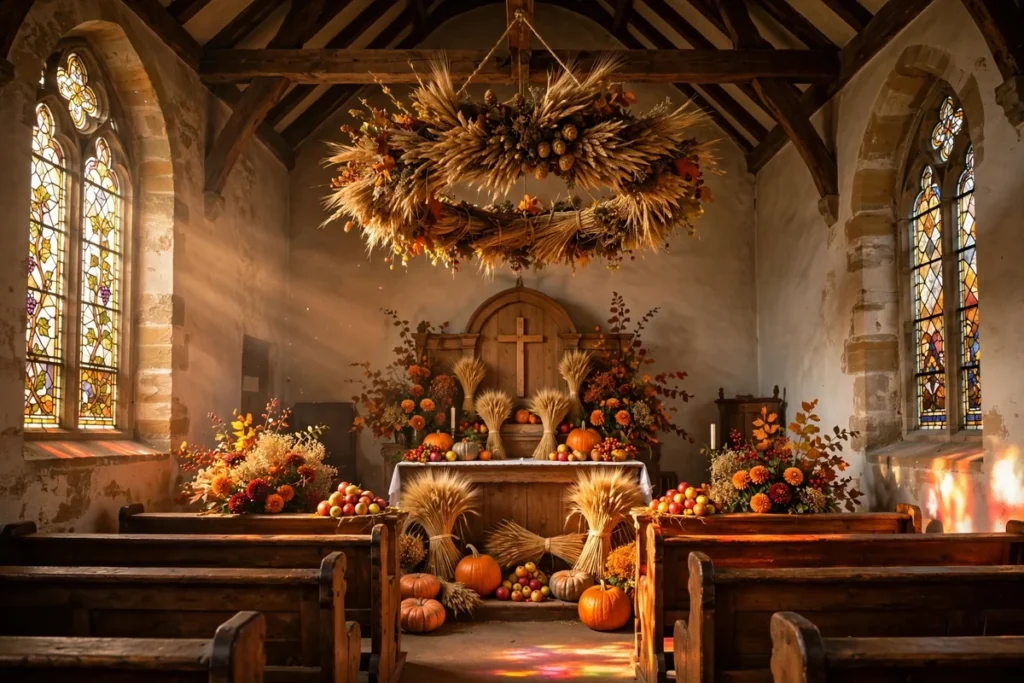
A German Erntedankfest celebration with a traditional harvest crown (Erntekrone) and decorated church altar laden with produce.
Watch: German Erntedankfest Harvest Festival
A traditional harvest thanksgiving celebration in Germany — the solemn blessing, the harvest queen, and the festive parade through the village.
At a Glance: German Erntedankfest Harvest Festival
The essentials of Germany's harvest thanksgiving.
| Fact | Detail |
|---|---|
| The date | First Sunday of October — set by the German Bishops' Conference in 1972; some regions celebrate on Michaelmas (29 September) |
| The name | 'Erntedankfest' literally means 'harvest thanksgiving festival' |
| The Erntekrone | The harvest crown — a woven crown of grain, fruit, and flowers carried in procession and hung in the church |
| The setting | Primarily a religious observance: decorated church altars, thanksgiving services, and blessings of the harvest |
| The Bückeberg | In the 1930s the festival was co-opted for mass rallies at the Bückeberg — postwar, it returned to its church roots |
Frequently Asked Questions
What is Erntedankfest in Germany?
Erntedankfest is Germany’s harvest thanksgiving festival, celebrated in churches and communities usually on the first Sunday of October. It centers on thanksgiving church services with elaborately decorated altars, harvest crowns (Erntekrone), parades, and community feasts — a tradition of gratitude for the harvest with roots stretching back to pre-Christian times.
When is Erntedankfest 2026 and 2027?
Erntedankfest is typically observed on the first Sunday of October: October 4, 2026, and October 3, 2027. Some parishes and regions celebrate on the last Sunday of September instead, so check locally.
Is Erntedankfest a public holiday in Germany?
No. Erntedankfest is a church festival, not a public holiday — but since it’s always on a Sunday, most people are free to attend anyway. The related German Unity Day (October 3) is a public holiday and often falls near the festival.
What is an Erntekrone?
The Erntekrone (harvest crown) is the signature symbol of Erntedankfest: a large crown woven from the season’s grains and decorated with ribbons, flowers, and fruit. Made communally in villages, it’s carried to the church and hung above the altar as an offering of thanks.
Do Germans eat turkey on Erntedankfest?
Not traditionally. There’s no prescribed Erntedankfest meal; festive tables feature seasonal foods like onion tart with new wine, roast goose or duck, pumpkin soup, and cakes made with autumn fruit. Turkey is associated with Christmas in Germany, not the harvest festival.
How is Erntedankfest different from Thanksgiving?
Erntedankfest is a church-centered community festival focused on worship and the harvest itself, with no fixed national menu or origin myth. American Thanksgiving is a national family holiday centered on a feast, with a specific historical narrative. They share the theme of gratitude but express it in fundamentally different ways.
Conclusion
The German Erntedankfest harvest festival reminds us that thanksgiving doesn’t need a founding myth or a fixed menu — it needs a harvest, a community, and a willingness to say thank you. In the grain-woven crowns, the produce-banked altars, and the village parades of early October, Germany keeps alive one of Europe’s oldest continuous traditions of gratitude: older than the American holiday, quieter, and in its uncommercialized sincerity, perhaps the most authentic harvest thanksgiving in the Western world. Whether you attend a service in a Bavarian village or simply pause to appreciate the season’s abundance, Erntedankfest offers a model of gratitude worth carrying into every autumn. For more harvest traditions worldwide, explore Thanksgiving around the world, compare it with its British cousin in our UK harvest festival traditions guide, or browse the full Thanksgiving collection.