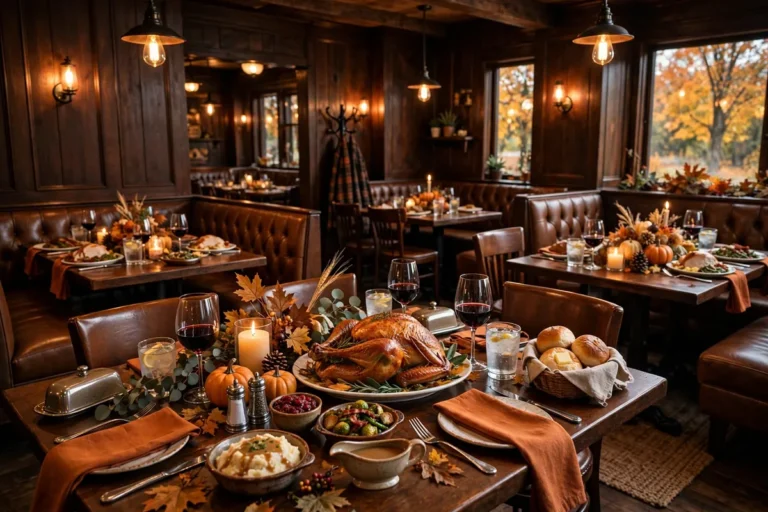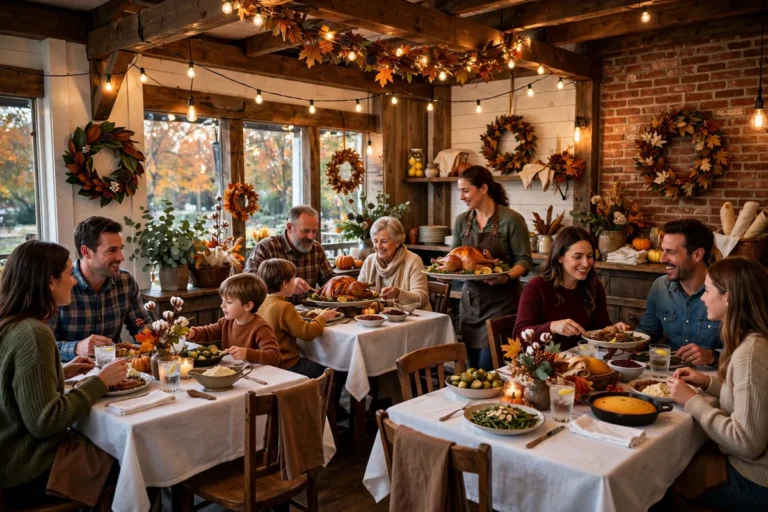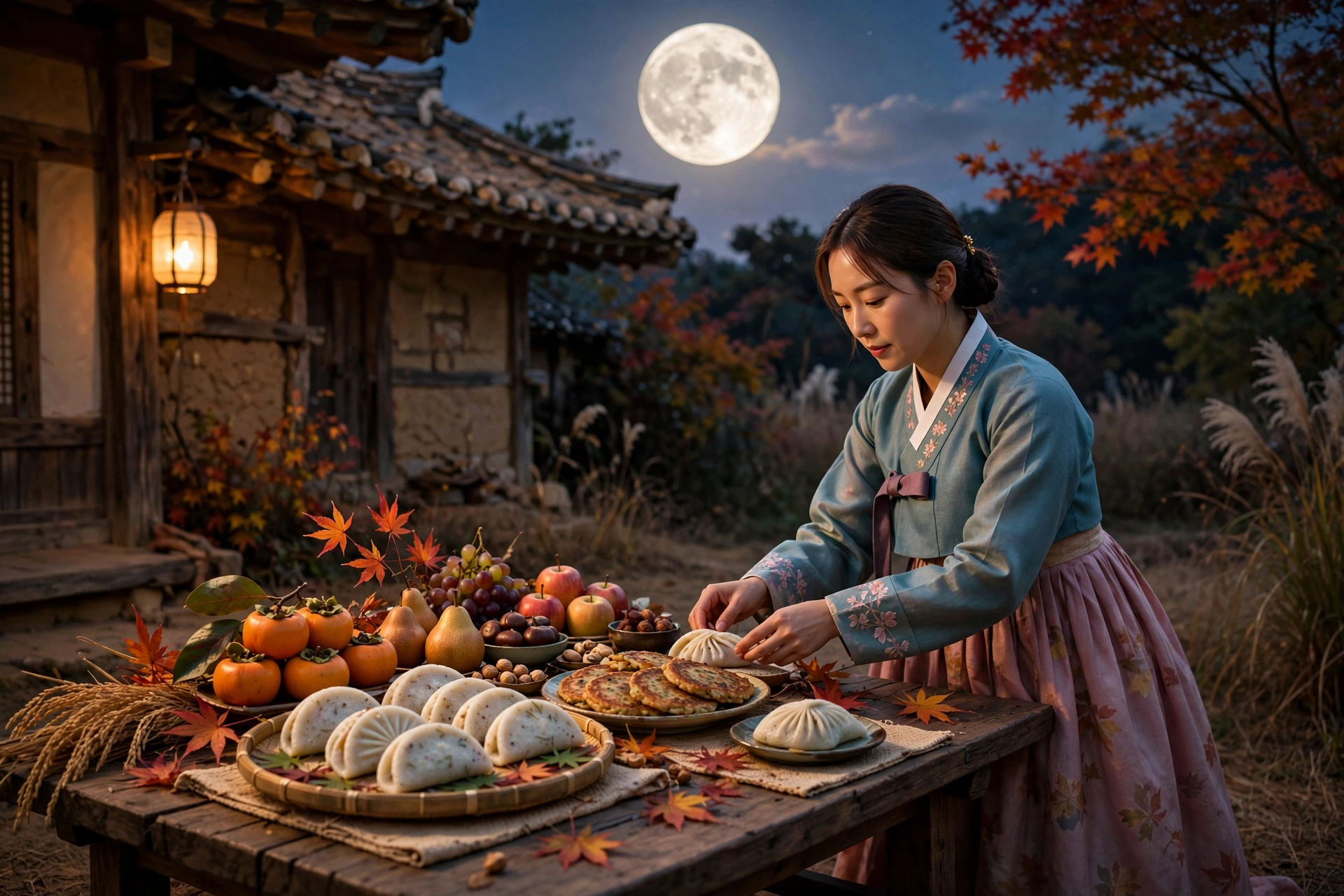
Chuseok Korean Thanksgiving is one of Asia’s great holidays — a three-day harvest festival that sends tens of millions of Koreans streaming to their ancestral hometowns, fills tables with half-moon rice cakes and pancakes, and turns the whole country toward family, ancestors, and the full harvest moon. Often called “Korean Thanksgiving” in English, Chuseok is far older than its American namesake, with roots stretching back over two thousand years. Whether you’re planning a trip to Korea, celebrating with Korean friends, or simply curious about the world’s harvest traditions, this is the definitive guide to dates, history, rituals, foods, and how to take part.
Chuseok at a Glance
| Detail | Answer |
|---|---|
| Korean name | 추석 (Chuseok), also called Hangawi (한가위, “the great middle of autumn”) |
| Meaning | “Autumn evening” — the harvest moon festival |
| Date | 15th day of the 8th lunar month (the full moon); a 3-day public holiday including the day before and after |
| Chuseok 2026 | September 24–26 (Chuseok Day: Friday, September 25) |
| Chuseok 2027 | September 14–16 (Chuseok Day: Wednesday, September 15) |
| Status | One of South Korea’s two biggest national holidays (with Seollal, Lunar New Year) |
| Core rituals | Charye (ancestral memorial rites), seongmyo (grave visits), family feasts |
| Signature food | Songpyeon (half-moon rice cakes) |
| Traditional dress | Hanbok |
The “Korean Thanksgiving” nickname is useful but incomplete. Like the American holiday, Chuseok is about harvest, family reunion, gratitude, and abundant food. Unlike it, Chuseok is governed by the moon, centered on ancestor veneration, and celebrated with folk games, traditional wrestling, and circle dances under the full moon. For how it compares with its Chinese counterpart on the same full moon, see our guide to the Mid-Autumn Festival in China.
When Is Chuseok? Understanding the Lunar Date
Chuseok falls on the 15th day of the eighth month of the Korean lunisolar calendar — the night of the full harvest moon. Because the lunar calendar drifts against the Gregorian calendar, the date moves each year, always landing in September or October:
| Year | Chuseok Day | Public Holiday Period |
|---|---|---|
| 2025 | Monday, October 6 | October 5–7 |
| 2026 | Friday, September 25 | September 24–26 |
| 2027 | Wednesday, September 15 | September 14–16 |
| 2028 | Tuesday, October 3 | October 2–4 |
In South Korea, the holiday officially spans three days — the day before, the day of, and the day after the full moon. In 2026, that means Thursday September 24 through Saturday September 26, with Sunday the 27th extending the break to four days. Note that if a Chuseok holiday day falls on a weekend, a substitute weekday holiday may be designated — but with its own rules distinct from other Korean holidays.
Origins: Two Thousand Years of Harvest Moons
Chuseok’s roots reach deep into Korean antiquity. The festival’s origins are traced to the ancient kingdom of Silla (57 BCE–935 CE), where legend holds that King Yuri instituted a month-long weaving contest between two teams of women in the sixth lunar month, with the losing team hosting a feast for the winners on the full moon of the eighth month. This gabae contest — part craft competition, part harvest celebration — is often cited as Chuseok’s founding story, giving the holiday a pedigree of over 2,000 years.
The name Hangawi — “the great middle of autumn” — reflects the festival’s agricultural soul: it marks the point when the rice harvest is in and the year’s labor can be celebrated. Over the centuries, Chuseok absorbed Confucian ancestor-veneration practices, Buddhist influences, and shamanic folk customs, becoming the layered, multifaceted holiday it is today. Through dynasties, colonization, war, and industrialization, Chuseok endured — and in modern South Korea, it remains arguably the single most important family occasion of the year, rivaled only by Seollal.
The Great Migration: Home for Chuseok
To understand modern Chuseok, picture this: in the days before the holiday, Seoul — a metropolis of nearly 10 million — empties. Highways jam for dozens of kilometers. Train tickets sell out in minutes. The airports fill. An estimated 30+ million people — well over half the population — travel to their ancestral hometowns (gohyang) to be with extended family. It is one of the largest annual human migrations on earth, Korea’s answer to Chinese New Year’s Spring Festival travel rush.
This homecoming is the emotional core of the holiday. Korea’s rapid industrialization scattered families across the country; Chuseok is when the scattered regather. Grandparents who see grandchildren once a year, cousins who grew up as strangers, ancestral homes opened for three precious days — the holiday runs on reunion the way engines run on fuel. If you’re traveling in Korea during Chuseok, expect a quiet Seoul, packed intercity transport, and a countryside suddenly full of life.
Charye: The Ancestral Memorial Rite
The spiritual heart of Chuseok is charye (차례), the ancestral memorial ceremony performed on Chuseok morning. Rooted in Confucian filial piety, charye is how Korean families honor deceased ancestors — typically going back four generations — and ask for their blessing.
The ritual follows a precise choreography. Before dawn, the women of the family (traditionally — though practices are modernizing) prepare an elaborate spread of food: rice, soups, pancakes (jeon), steamed dishes, fruits, and rice cakes, arranged on a table according to strict directional rules — a kind of edible cosmology, with specific placements for each dish. A memorial tablet bearing ancestors’ names is placed at the head of the table. Family members, dressed in hanbok or formal attire, bow deeply in unison, offer wine, and pray. The eldest male descendant typically leads, though customs vary by family and region.
After the rites, the family shares the food together — the ancestors symbolically partake first, the living feast after. The meal is both solemn and joyful: remembrance and reunion in a single sitting. For many Koreans, charye is the most meaningful hour of the year.
Seongmyo: Visiting the Ancestral Graves
On Chuseok or the surrounding days, families also perform seongmyo (성묘) — visiting ancestors’ graves to tidy them, clear weeds, and make offerings of food and wine. The grave visit connects the family to its physical roots: the hillside burial mounds, the village, the land the ancestors farmed. In an age of cremation and urban columbaria, seongmyo is evolving, but the impulse — to stand where your people stood — remains.
The Feast: What Koreans Eat at Chuseok
Chuseok food is a cuisine unto itself, prepared over days and eaten over hours. The spread is staggering in its variety:
Songpyeon: The Soul of Chuseok
Songpyeon (송편) are small half-moon-shaped rice cakes, steamed over pine needles, filled with sesame seeds, chestnuts, red bean, or honey. The pine needles impart a distinctive fresh fragrance; the half-moon shape symbolizes growth and hope — a crescent moon waxing toward fullness, like the family’s fortunes. Making songpyeon is traditionally a communal, multigenerational activity: grandmothers teach grandchildren to pinch the dough closed, and there’s a beloved saying that whoever makes the prettiest songpyeon will have a beautiful daughter (or, in modern retellings, a handsome spouse). Families steam dozens, sharing them with neighbors and relatives.
Jeon: The Savory Pancakes
Jeon (전) — savory pancakes of meat, fish, and vegetables dipped in egg batter and pan-fried — are the workhorse of the Chuseok table. Donggeurangttaeng (meat patties), saengseonjeon (fish), hobakjeon (zucchini), and kimchijeon appear in golden stacks. The sizzle of jeon frying is, for many Koreans, the sound of the holiday itself.
The Full Spread
Beyond songpyeon and jeon: japchae (glass noodles with vegetables), galbijjim (braised short ribs), bulgogi, namul (seasoned vegetable dishes), torantang (taro soup), fresh persimmons, Korean pears, chestnuts, jujubes, and hangwa (traditional honeyed sweets). Dongdongju or makgeolli (rice wines) flow freely. The table is a map of the Korean harvest — and of the family’s love.
Folk Games and Traditions
Chuseok isn’t all solemnity. The holiday bursts with folk entertainment, much of it performed under the full moon:
- Ganggangsullae — A mesmerizing women’s circle dance performed under the full moon, with dancers in hanbok holding hands and singing. Designated a UNESCO Intangible Cultural Heritage, it’s Chuseok’s most beautiful tradition — and legend says it originated as a military ruse, with women dancing on hillsides to make invaders overestimate the village’s defenders.
- Ssireum — Traditional Korean wrestling, with competitors in loincloth-like satba belts grappling on sand. The Chuseok ssireum champion was historically awarded a bull — a prize fit for a harvest festival.
- Yutnori — The beloved board game of wooden sticks, played by families (and now by the whole country, it seems) over the holiday.
- Neolttwigi — Traditional seesaw jumping, where participants bounce high enough to see over walls — originally, legend says, so cloistered women could glimpse the world outside.
- Julbatgi and folk music — Tightrope walking, pansori narrative singing, and farmers’ percussion bands (nongak) animate village squares.
- Gift-giving — Modern Chuseok involves enormous gift exchange: premium fruit sets, hanwoo beef, spam gift sets (yes, really — Spam is a prestige gift in Korea), health supplements, and gift cards. Department stores do a huge portion of annual business in the weeks before.
Chuseok Greetings and Etiquette
The standard greeting is “Chuseok jal bonaeseyo” (추석 잘 보내세요) — “Have a good Chuseok.” Elders receive deep bows (sebae-style, though the full New Year’s prostration is for Seollal); children and younger relatives receive cash gifts in envelopes. If you’re invited to a Korean family’s Chuseok:
- Dress respectfully — hanbok is ideal but formal modern dress is fine.
- Bring a gift: premium fruit, quality rice cakes, or a gift set. Never arrive empty-handed.
- Follow the lead of the family during charye — observe quietly, bow when others bow.
- Accept food enthusiastically and try everything. Refusing dishes can offend.
- Offer to help with preparation or cleanup — the women of the family traditionally bear an enormous cooking burden, and help is deeply appreciated. (This gendered division of holiday labor is a live topic of debate in modern Korea.)
Chuseok for Travelers: What to Expect
Visiting Korea during Chuseok is a double-edged sword. On one hand, you’ll witness the country’s most important holiday: folk festivals at places like the National Folk Museum of Korea and Namsangol Hanok Village in Seoul, special Chuseok events at palaces (Gyeongbokgung often hosts performances), and a rare glimpse of traditional life. On the other hand, practical travel gets complicated: intercity trains and buses sell out weeks ahead, many restaurants and shops close (especially on Chuseok Day itself), and Seoul can feel eerily empty.
Tips: book all transport far in advance; stock up on essentials before the holiday; embrace the folk festivals, which are designed for public enjoyment; and if a Korean friend invites you to their family celebration — say yes immediately. It’s the invitation of a lifetime.
Chuseok Around the World: The Diaspora Celebrates
With millions of ethnic Koreans living abroad — in the United States (especially Los Angeles, New York/New Jersey), Canada, China, Japan, and beyond — Chuseok is now a global holiday. Korean-American communities hold Chuseok festivals with songpyeon-making, hanbok parades, ssireum demonstrations, and K-pop performances. Korean markets in diaspora neighborhoods stock up on Chuseok ingredients weeks ahead. Many Korean-American families blend the holidays, celebrating Chuseok in September and American Thanksgiving in November — a double harvest season that one food writer called “the best of both moons.” For tips on bridging the two, see our guide to hosting Thanksgiving abroad.
Chuseok vs. American Thanksgiving: Side by Side
| Chuseok | American Thanksgiving | |
|---|---|---|
| Date | 15th day of 8th lunar month (Sept/Oct) | Fourth Thursday of November (fixed) |
| Duration | 3-day public holiday | 1 day (often a 4-day weekend) |
| Age | 2,000+ years (Silla origins) | ~160 years as national holiday (1863) |
| Central ritual | Charye ancestral rites, grave visits | Family feast |
| Signature food | Songpyeon (half-moon rice cakes) | Roast turkey |
| Spiritual focus | Ancestor veneration, filial piety | Gratitude (broadly secular/religious) |
| Traditional dress | Hanbok | None (casual/festive) |
| Folk entertainment | Ganggangsullae, ssireum, yutnori | Parades, football |
| Gift-giving | Major (fruit, beef, gift sets) | Not traditional |
| Moon | Central symbol (full harvest moon) | Not symbolically important |
The table makes the relationship clear: these are sibling holidays, not twins. Both answer the human need to mark the harvest with family and gratitude, but they grew from entirely different soils — Confucian ancestor veneration on one side, Puritan providentialism on the other. The “Korean Thanksgiving” label is a bridge for English speakers, not a definition.
The Economics of Chuseok: Korea’s Biggest Spending Season
Chuseok is an economic event as much as a cultural one. The weeks before the holiday see one of Korea’s two great annual retail surges (the other is Seollal). Department stores and hypermarkets compete fiercely over Chuseok gift sets — meticulously packaged Korean pears, apples, and persimmons; premium hanwoo beef sets; wild ginseng; and the famous Spam gift sets, which baffle foreigners and delight Koreans (Spam’s prestige dates to the postwar era, when American processed meats were luxury goods).
Food prices spike: the government monitors the “Chuseok basket” of 20 essential holiday foods the way economists watch inflation indices, and releases stockpiled produce to stabilize prices. Travel spending surges despite the short break. And the holiday’s labor economics are a perennial news story — the days of cooking, cleaning, and hosting fall disproportionately on women, sparking annual debates about the “holiday labor” (myeongjeol junggwa) burden and driving the trend toward simplified rites, restaurant charye meals, and even “Chuseok divorce” headlines (an exaggeration, but a revealing one). Modern Korea is renegotiating Chuseok in real time — which is exactly what living traditions do.
Chuseok in North Korea
North of the DMZ, Chuseok exists in a different key. The North Korean regime long suppressed traditional holidays as feudal remnants, but Chuseok survived stubbornly in family practice and was eventually rehabilitated — it’s now an official public holiday in the North as well, though observed for a single day rather than three. Defector accounts describe families quietly visiting ancestral graves and sharing what food they can, stripped of the South’s commercial spectacle but preserving the core: remembrance and reunion.
The divided Chuseok is one of the Korean Peninsula’s quiet tragedies. Since the 1950–53 war, millions of separated families have been unable to visit ancestral graves together — the seongmyo that Southerners perform freely is impossible for those whose family graves lie across the border. Occasional reunion events have allowed a lucky few elderly Koreans to meet siblings for the first time in 70 years, often around Chuseok or Seollal. The holiday’s emphasis on ancestors and homecoming gives these reunions unbearable poignancy: Chuseok is, at heart, about going home, and for separated families, home is unreachable.
Try It at Home: A Mini Chuseok Celebration
You don’t need to be Korean to honor the holiday’s spirit. Here’s a simplified Chuseok for anywhere in the world:
- Make songpyeon (or cheat gracefully). Real songpyeon requires rice flour, fillings, and pine needles — doable with a Korean market nearby. Short on time? Buy them fresh from a Korean bakery in the days before Chuseok; they’re widely available in cities with Korean communities.
- Cook jeon. Savory pancakes are the most accessible Chuseok food: slice zucchini, dip in beaten egg, pan-fry. Add kimchi jeon (kimchi + flour batter) for the full effect.
- Set a memorial moment. The heart of charye is remembrance. Light a candle, place a photo of departed loved ones, share a favorite food in their memory, and tell their stories. You don’t need the full Confucian rite to honor its spirit.
- Play yutnori. Yut game sets are inexpensive and the rules take five minutes to learn — it’s genuinely fun for all ages.
- Moon-gaze. On Chuseok night, go outside and look at the full moon. The Korean tradition holds it’s the year’s most beautiful. Share the moon with someone far away — text them. That’s tuanyuan-style reunion, Korean edition.
- Say the greeting. “Chuseok jal bonaeseyo” (추석 잘 보내세요) — “Have a good Chuseok.” Your Korean friends will be delighted.
In Pictures: Chuseok, Korean Thanksgiving
Chuseok is Korea's great homecoming — a three-day harvest festival of ancestral rites, half-moon rice cakes, and the year's brightest full moon. Here's the celebration.
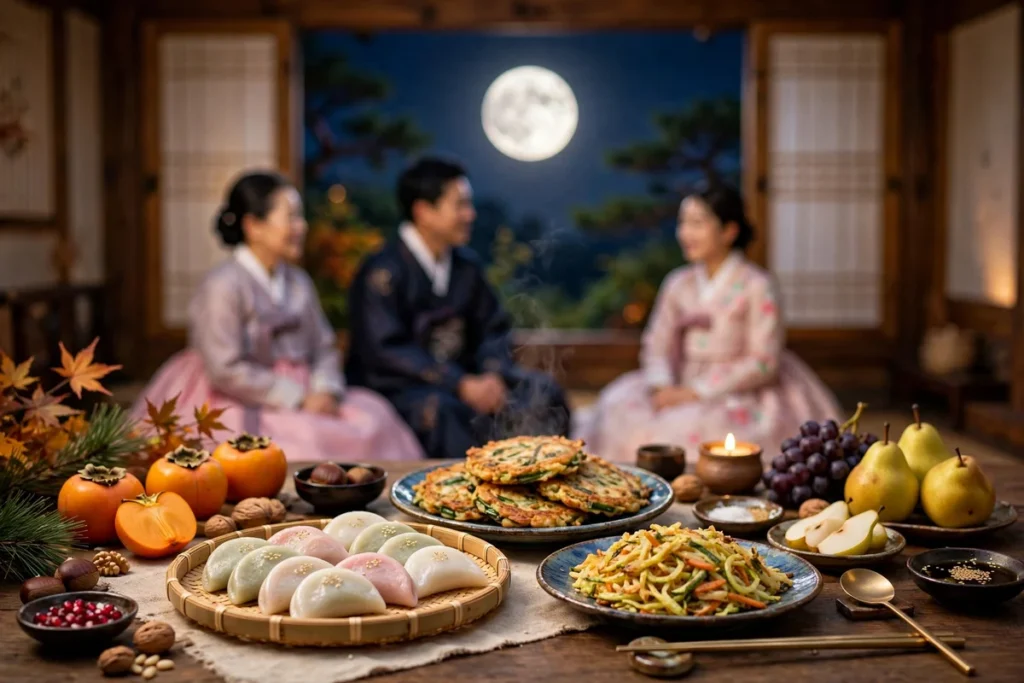
A traditional Korean Chuseok table with songpyeon rice cakes, fresh fruit, and families in hanbok gathered for the ancestral rite.
Watch: Chuseok, Korean Thanksgiving
Chuseok and the Mid-Autumn Festival explained together — the customs, foods, and full-moon traditions behind Korea's Thanksgiving.
At a Glance: Chuseok, Korean Thanksgiving
The essentials of Korea's harvest holiday.
| Fact | Detail |
|---|---|
| 2027 dates | 14–16 September (main day: Wednesday 15 September, the full moon of the 8th lunar month) |
| The meaning | 'Chuseok' (추석) means 'autumn evening' — also called Hangawi; a celebration of the harvest around 2,000 years old |
| Charye | The ancestral memorial rite: families set a table of harvest foods to honor their forebears |
| Songpyeon | Half-moon rice cakes steamed over pine needles — the signature Chuseok food |
| The homecoming | Millions travel to ancestral hometowns; it's one of Korea's biggest annual migrations |
Frequently Asked Questions
Is Chuseok the Korean Thanksgiving?
Chuseok is often called “Korean Thanksgiving” because both holidays celebrate the harvest, reunite families, and center on gratitude and feasting. But Chuseok is much older (2,000+ years), follows the lunar calendar, and revolves around ancestor veneration (charye), grave visits, and folk traditions like the ganggangsullae moon dance — making it a distinct holiday with its own deep identity.
When is Chuseok 2026?
Chuseok Day 2026 falls on Friday, September 25, with the public holiday running September 24–26. In 2027, Chuseok Day is Wednesday, September 15, with the holiday September 14–16.
What is songpyeon?
Songpyeon are half-moon-shaped rice cakes steamed over pine needles, filled with sesame, chestnut, red bean, or honey. They’re the signature food of Chuseok, symbolizing growth and hope, traditionally made communally by families.
How long is the Chuseok holiday?
The official public holiday in South Korea is three days: the day before, the day of, and the day after Chuseok. With weekends, many Koreans get four to five days off, and some take additional leave for a full week.
What do Koreans do on Chuseok?
Travel to ancestral hometowns, perform the charye ancestral memorial rite, visit family graves (seongmyo), share a massive feast, play folk games (yutnori, ssireum, neolttwigi), dance ganggangsullae under the full moon, wear hanbok, and exchange gifts.
Can tourists participate in Chuseok?
Yes — folk villages, palace grounds, and museums across Korea hold public Chuseok festivals with performances, games, and food. Book transport early, expect closures on Chuseok Day, and accept any invitation to a family celebration: it’s the most authentic experience available.
Conclusion
Chuseok Korean Thanksgiving is far more than Korea’s version of an American holiday — it’s a 2,000-year-old harvest moon festival that happens to share Thanksgiving’s themes of family, food, and gratitude, expressed through uniquely Korean rituals: the dawn charye, the pine-scented songpyeon, the moonlit ganggangsullae. In a hypermodern nation, Chuseok remains the annual moment when Korea turns homeward — tens of millions of journeys converging on ancestral villages under the same full moon their ancestors watched. Whether you celebrate with songpyeon in Seoul or in Los Angeles, the invitation is the same: gather your people, honor those who came before, and give thanks for the harvest. For more harvest celebrations across Asia and beyond, explore Thanksgiving around the world or browse the full Thanksgiving collection.