These turkey injection marinade recipes solve the fundamental problem of big birds: surface seasoning never reaches the center. A whole turkey is thick — the middle of the breast sits inches from any rub or brine — and injection is the only technique that delivers flavor and moisture directly into the deep meat. Pitmasters and Cajun fryers have known this for decades; competition barbecue teams inject as a matter of course. With a $15 injector and one of the four marinades below, your turkey will be seasoned in every single slice, not just on the skin.
This guide covers how injection works and when to choose it over brining, the injector technique step by step (depth, pattern, quantities), four complete marinade recipes — Cajun butter, garlic-herb, apple-cider, and a spicy honey-Sriracha blend — plus food-safety rules, troubleshooting, and pairings with roasting, smoking, and frying. If you are still weighing brine options, our brine comparison helps you decide — but note that injection and brining are either/or choices, not stackable ones. Let us get flavor where the fork actually goes.
Why Inject? The Case for Going Deep
A turkey breast can be 4 inches thick at its deepest point. Salt from a dry brine migrates inward at roughly 1/4 inch per day — excellent over 48 hours, but it still seasons by gradient, strongest at the surface. A wet brine surrounds the bird but dilutes flavor as it adds water. Injection bypasses diffusion entirely: you place seasoned liquid exactly where you want it, in minutes rather than days.
The benefits compound for specific cooking methods. Deep frying cooks so fast that surface seasoning barely penetrates — injection is arguably essential for a flavorful fried bird (see our deep-fry guide). Smoking dries surfaces over long cooks; injected moisture and fat inside the meat provide insurance no surface treatment can. Roasting benefits whenever the bird is large, the timeline is short (no time for a 48-hour dry brine), or the crowd demands bold flavor. Injection is also the fastest path from purchase to seasoned bird: inject the night before (or even the morning of) and you are done.
The trade-off: injection adds liquid, so the texture can turn slightly spongy if you overdo the volume, and it does nothing for the skin (pair it with a good exterior rub — our dry rub guide — for the complete package). Used with restraint, though, it is the highest-impact 20 minutes in turkey prep.
Equipment and Technique
Choosing an Injector
A dedicated meat injector — a large syringe (typically 2-ounce capacity) with a thick needle — costs little and lasts years. Look for a stainless-steel needle with holes along the sides (not just at the tip), which distributes marinade laterally as you withdraw. The needle must be wide enough for your marinade: butter-based blends need a larger bore than thin broth blends, and any marinade with particles (minced garlic, herbs) will clog a fine needle — strain or finely blend those recipes. Dishwasher-safe stainless models are worth the small premium.
The Injection Technique, Step by Step
- Prepare the marinade and keep butter-based blends warm (not hot) so they flow. Strain out any solids that could clog the needle.
- Work on a rimmed sheet pan to catch drips. Keep the turkey cold — inject straight from the refrigerator.
- Inject the breasts first: Insert the needle deep into the thickest part of each breast at a slight angle, depress the plunger slowly while withdrawing the needle gradually — this lays down a trail of marinade rather than a single pool. Use 3 to 4 injection sites per breast half, spaced evenly.
- Then the thighs and drumsticks: 2 to 3 sites per thigh, 1 to 2 per drumstick. Dark meat needs less help (it is naturally juicier) but benefits from flavor.
- Go deep but not through: The needle should reach the center of the muscle without poking out the other side. If marinade leaks from the entry hole, you injected too fast or too much in one spot — slow down.
- Quantity guide: About 1 to 2 ounces of marinade per 5 pounds of turkey — roughly 1/2 to 3/4 cup total for a 12- to 14-pound bird. More is not better; over-injection creates pockets of liquid and spongy texture.
- Wipe the exterior clean of any leaked marinade (surface butter burns in the fryer and steams the skin in the oven), then season the outside with your rub and refrigerate 8 to 24 hours. The rest lets the marinade distribute evenly instead of sitting in pockets.
Food Safety for Injection
You are puncturing the meat’s surface and introducing liquid into the interior — so hygiene matters more than with surface seasoning. Keep the turkey refrigerated before and after injecting (never inject a room-temperature bird and leave it out). Use the marinade promptly; do not save and reuse leftover marinade that has contacted raw poultry or the used needle — discard it. Sanitize the injector thoroughly after use: disassemble, wash hot and soapy, and run through the dishwasher if possible. And as always, the finished turkey must reach 165°F (74°C) internally — injection does not change the target, though it can slightly speed the cook, so start checking temperature early.
Recipe 1: Cajun Butter Injection (The Classic)
The Louisiana original — the marinade that made injection famous, and the mandatory companion to deep-fried turkey. Rich, savory, with a warm Cajun kick that permeates every slice.
Ingredients (makes about 2 cups — enough for a 14–16 lb turkey)
- 1 cup (2 sticks) unsalted butter
- 1/2 cup turkey or chicken stock
- 2 tablespoons Cajun seasoning (salt-free or low-salt preferred)
- 1 tablespoon garlic powder
- 1 tablespoon onion powder
- 1 teaspoon cayenne pepper (adjust to taste)
- 1 teaspoon black pepper
- 1 teaspoon dried thyme
- 1 tablespoon Worcestershire sauce
- 1 teaspoon kosher salt (omit if your Cajun seasoning is salted)
Method
- Melt the butter in a saucepan over medium-low heat. Whisk in the stock, then all dry seasonings, Worcestershire, and salt.
- Simmer gently 3 to 4 minutes, whisking, until fully combined and fragrant. Do not boil hard — you want emulsion, not separation.
- Strain through a fine-mesh sieve into a measuring cup to remove any undissolved particles that could clog the needle.
- Cool to warm (not hot — about 100°F/38°C). Inject as directed above. Keep any unused portion warm during injecting; butter solidifies as it cools.
Pairs with: deep frying (the classic), roasting, smoking. Match with a Cajun-style exterior rub and serve with mashed potatoes to catch the spiced juices.
Recipe 2: Garlic-Herb Butter Injection (The Crowd-Pleaser)
For tables that want savory depth without heat — the injection equivalent of the classic herb-butter roast, delivered to the center of the meat.
Ingredients (makes about 1½ cups)
- 3/4 cup (1½ sticks) unsalted butter
- 1/2 cup turkey or chicken stock
- 6 cloves garlic, smashed
- 1 tablespoon fresh thyme leaves
- 1 tablespoon fresh sage, chopped
- 2 teaspoons fresh rosemary, finely chopped
- 1 teaspoon black pepper
- 1 teaspoon kosher salt
- 1 teaspoon lemon zest
Method
- Melt the butter with the smashed garlic over low heat; cook gently 5 minutes until the garlic softens and perfumes the butter (do not brown it).
- Add stock, herbs, pepper, salt, and lemon zest; simmer 2 minutes.
- Blend briefly with an immersion blender, then strain through a fine-mesh sieve — this must be completely smooth to pass through the needle.
- Cool to warm and inject. Particularly good under the skin-adjacent breast meat, where the herbs echo the exterior seasoning.
Pairs with: classic oven roasting and spatchcocking. Finish with a drippings gravy — the herb notes carry straight through.
Recipe 3: Apple Cider and Maple Injection (The Autumn Blend)
Sweet-savory and unmistakably seasonal — a thinner, broth-style injection that distributes beautifully and caramelizes gently during roasting.
Ingredients (makes about 2 cups)
- 1 cup fresh apple cider
- 1/2 cup turkey or chicken stock
- 1/4 cup pure maple syrup
- 4 tablespoons unsalted butter, melted
- 1 tablespoon apple cider vinegar
- 2 teaspoons kosher salt
- 1 teaspoon black pepper
- 1/2 teaspoon ground cinnamon
- 1/4 teaspoon ground nutmeg
- 1/4 teaspoon ground allspice
Method
- Combine everything in a saucepan and warm over medium heat, whisking until the butter melts and the salt dissolves — about 3 minutes. Do not boil.
- Strain through a fine-mesh sieve (the spices should dissolve, but strain for needle safety).
- Cool to room temperature or slightly warm and inject. This thinner marinade flows easily — reduce your per-site volume slightly since it spreads further.
Pairs with: roasting and smoking (apple cider + applewood smoke is a natural rhyme; see our smoked turkey breast guide). For a deeper cider character, pair with our apple cider brine on a separate occasion — do not combine injection and brining.
Recipe 4: Honey-Sriracha Injection (The Bold One)
Sweet heat for the adventurous table — honey for caramelization, Sriracha and lime for punch. A guaranteed conversation piece.
Ingredients (makes about 1½ cups)
- 1/2 cup honey
- 1/2 cup turkey or chicken stock
- 1/4 cup Sriracha (adjust to taste)
- 4 tablespoons unsalted butter, melted
- 2 tablespoons lime juice, freshly squeezed
- 1 tablespoon soy sauce
- 2 teaspoons garlic powder
- 1 teaspoon kosher salt
- 1 teaspoon black pepper
Method
- Whisk everything together in a saucepan over low heat until the honey loosens and the mixture is uniform, about 3 minutes. Do not boil — high heat dulls the Sriracha and lime.
- Strain through a fine-mesh sieve and cool to warm.
- Inject as directed. Note: the sugars in this marinade accelerate browning significantly — tent the breast with foil earlier than usual and watch color closely.
Pairs with: roasting and grilling. Serve with cooling sides — cranberry sauce‘s tartness is a perfect foil for the heat — and warn guests with low spice tolerance.
Injection by Cooking Method
Roasting an Injected Turkey
Roast as normal at 325°F (163°C), but start checking temperature about 30 minutes earlier than usual — injected birds often cook slightly faster because the added liquid conducts heat efficiently. The butter-based marinades baste from within, so you can skip basting entirely. Tent when the skin reaches deep golden.
Smoking an Injected Turkey
Injection and smoking are a natural partnership: the interior moisture offsets the smoker’s drying airflow over the long cook. Inject 12 to 24 hours ahead so the marinade distributes fully. Use the Cajun butter or garlic-herb recipe — the honey-Sriracha blend’s sugars can scorch over extended smoke. Details in our smoked turkey breast guide.
Frying an Injected Turkey
The classic pairing — most fried-turkey devotees inject as a rule. Inject 12 to 24 hours ahead, then wipe the exterior meticulously: any surface butter or marinade spatters violently in hot oil. Use the Cajun butter recipe (the original fryer marinade) and follow every safety rule in our deep-fry guide — the turkey must still be fully thawed and patted dry, injection or not.
Troubleshooting
The Needle Keeps Clogging
Unstrained solids — herb bits, undissolved spice, garlic pieces. Strain every marinade through a fine-mesh sieve, blend herb recipes smooth first, and use the widest-bore needle you have. In a pinch, rewarm a butter-based marinade that has started to solidify mid-session.
Marinade Leaks Out of the Injection Sites
You are injecting too fast or too much per site. Depress the plunger slowly while withdrawing the needle gradually, distributing each dose along a track rather than dumping it in one spot. Smaller doses at more sites beat large doses at few sites, every time.
Texture Seems Spongy
Over-injection — too much total volume. Stick to 1 to 2 ounces per 5 pounds of turkey. If a bird is already over-injected, there is no fix for this cook; note the volume and reduce next time. Restraint is the whole game.
Flavor Is Uneven — Strong Pockets, Bland Spots
Too few injection sites, or no rest time after injecting. Use more sites (think grid pattern, 2 inches apart across the breast) and always rest the injected bird 8 to 24 hours refrigerated so the marinade migrates and equalizes.
Can I Inject and Brine?
No — choose one. Both add salt and liquid; combining them oversalts the meat and wrecks the texture. Injection replaces brining for short timelines and bold flavor; brining replaces injection for gentle, even seasoning with time to spare. Our brine comparison helps you pick the right single method.
Storage and Make-Ahead
Marinades (before contact with poultry) keep 5 days refrigerated in sealed jars — make them the weekend before Thanksgiving and inject Wednesday evening. An injected turkey rests safely in the refrigerator up to 24 hours before cooking. Never reuse marinade that has touched raw poultry or a used needle; discard it. After cooking, standard rules apply: refrigerate carved meat within 2 hours, keep 3 to 4 days, reheat to 165°F (74°C). Injected turkey makes phenomenal leftovers — the interior seasoning means even plain cold slices taste complete, no gravy required (though leftover planning never hurts).
DIY Cajun Seasoning Blend
Store-bought Cajun seasoning varies wildly in salt content — making your own puts you in control, which matters when the blend goes inside the bird:
- 2 tablespoons paprika
- 1 tablespoon garlic powder
- 1 tablespoon onion powder
- 1 tablespoon dried thyme
- 1 tablespoon dried oregano
- 2 teaspoons cayenne pepper
- 2 teaspoons black pepper
- 1 teaspoon white pepper (optional, for back-heat)
Mix thoroughly and store airtight for up to 6 months. This makes about 1/2 cup — use 2 tablespoons per batch of Cajun butter injection, and rub the bird’s exterior with another tablespoon mixed with 1 teaspoon of kosher salt. Because you control the salt separately, there is no risk of the double-salting that ruins birds made with salty commercial blends plus added salt.
Injector Care: Cleaning and Storage
A neglected injector is a sanitation risk and a future clog. Immediately after use, disassemble completely — plunger, barrel, needle — and flush hot water through the needle in both directions. Wash all parts in hot soapy water, running the included brush (or a pipe cleaner) through the needle bore. Sanitize in the dishwasher if the model allows, or soak 2 minutes in diluted bleach solution (1 teaspoon per quart of water) and rinse thoroughly. Dry completely before reassembling — trapped moisture corrodes even stainless steel over time. Store disassembled in its case or a zip-top bag with the needle capped. A well-maintained injector lasts indefinitely; a poorly maintained one clogs mid-injection on Thanksgiving morning, which is exactly when you cannot afford it.
Injection Beyond Turkey
The technique transfers directly to other poultry. Whole chickens take beautifully to the garlic-herb injection (halve the recipe, inject 4 hours ahead) — it is the fastest way to a roast chicken that tastes seasoned through. Duck pairs wonderfully with the apple cider-maple blend, echoing classic fruit-and-duck combinations. Cornish hens need only a tablespoon or two per bird of any thin marinade. The rules never change: keep it cold, distribute across many sites, rest before cooking, and cook to safe temperature (165°F/74°C for all poultry). Once you own the injector, it earns its drawer space year-round.
Injection Ratios at a Glance
- Whole turkey (12–16 lbs): 1/2–3/4 cup total, 12–18 sites, 8–24 hours ahead
- Turkey breast (5–7 lbs): 1/4–1/3 cup total, 8–10 sites, 8–12 hours ahead
- Whole chicken (4–5 lbs): 1/4 cup total, 8 sites, 4–8 hours ahead
- Cornish hens: 1–2 tablespoons per bird, 4 sites, 2–4 hours ahead
When scaling any marinade recipe, keep the salt proportion constant — it is the functional ingredient. Fats, acids, and aromatics can flex with your taste; the salt ratio cannot.
In Pictures: Turkey Injection Marinades
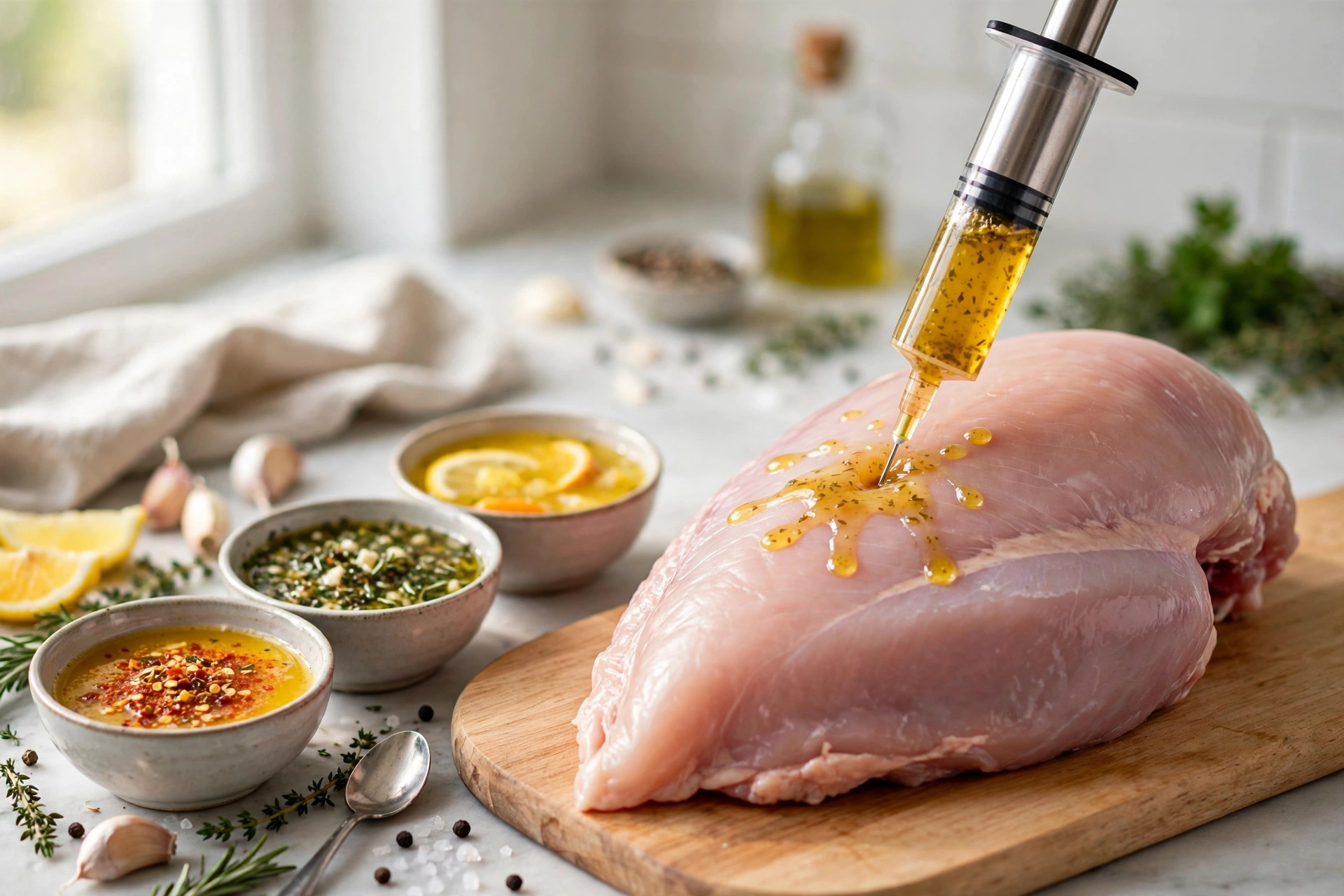
Injection puts flavor deep inside the meat where rubs cannot reach. A look at the injector, the marinade, and the technique in action.

A turkey being injected with marinade, the needle sliding into the breast to deliver flavor deep inside.
Watch: Turkey Injection Marinades
Shotgun Red shows how to inject a turkey with a Cajun butter solution before deep-frying — the classic way to get seasoning into every bite of a big bird.
At a Glance: Turkey Injection Marinades
Injection essentials, from the guide.
| Topic | Notes |
|---|---|
| Why inject | Rub flavors the surface; injection carries butter, stock, and seasoning deep into the breast and thighs |
| Equipment | A food-safe marinade injector with a wide-bore needle that won’t clog on herbs or spices |
| The technique | Inject in a grid pattern into the thickest parts of the breast, thighs, and drumsticks |
| Classic recipe | Cajun butter injection — about 2 cups is enough for a 14- to 16-pound turkey |
| Food safety | Keep the marinade cold, inject just before cooking, and never reuse leftover marinade |
| Best pairings | Injection shines on big birds, smoked turkeys, and deep-fried turkeys where the skin is the star |
Frequently Asked Questions
How far in advance should I inject a turkey?
Eight to 24 hours before cooking is ideal — the marinade needs time to distribute evenly from the injection tracks. In a pinch, even 4 hours helps. Do not inject more than 24 hours ahead; the punctures give bacteria entry points, so the clock matters.
How much marinade do I inject?
About 1 to 2 ounces per 5 pounds of turkey — roughly 1/2 to 3/4 cup total for a 12- to 14-pound bird, distributed across many small sites. More volume does not mean more flavor; it means spongy texture.
Can I inject a turkey breast instead of a whole bird?
Absolutely — breasts benefit enormously since they are the leanest, thickest part. Use about 1/4 to 1/3 cup for a 5- to 7-pound breast. Our bone-in breast recipe and smoked breast guide both pair well with injection.
Do I still need to season the outside?
Yes. Injection flavors the interior; the skin and outer 1/4 inch still need a rub or butter. Pair any of these marinades with an exterior seasoning — a Cajun rub with the Cajun injection, an herb rub with the garlic-herb injection — for complete coverage.
Is injecting safe?
Yes, with basic hygiene: keep the bird cold, do not reuse contaminated marinade, sanitize the injector, and cook to 165°F (74°C) internal. The punctures are a reason to be careful, not a reason to worry.
What injector should I buy?
A stainless-steel meat injector with a side-ported needle (holes along the shaft, not just the tip) and at least 2-ounce capacity. Avoid flimsy plastic models — they bend on turkey breast and cannot be properly sanitized.
Conclusion
Injection is the power tool of turkey seasoning: fast, precise, and transformative, putting flavor exactly where the fork goes. Pick the marinade that matches your table — Cajun butter for the fryer, garlic-herb for the classic roast, apple cider-maple for autumn warmth, honey-Sriracha for the bold — inject with restraint across many sites, rest overnight, and cook to temperature. Every slice will taste seasoned through, and no one will guess the 20 minutes of prep that made it happen. That is the quiet magic of these turkey injection marinade recipes.