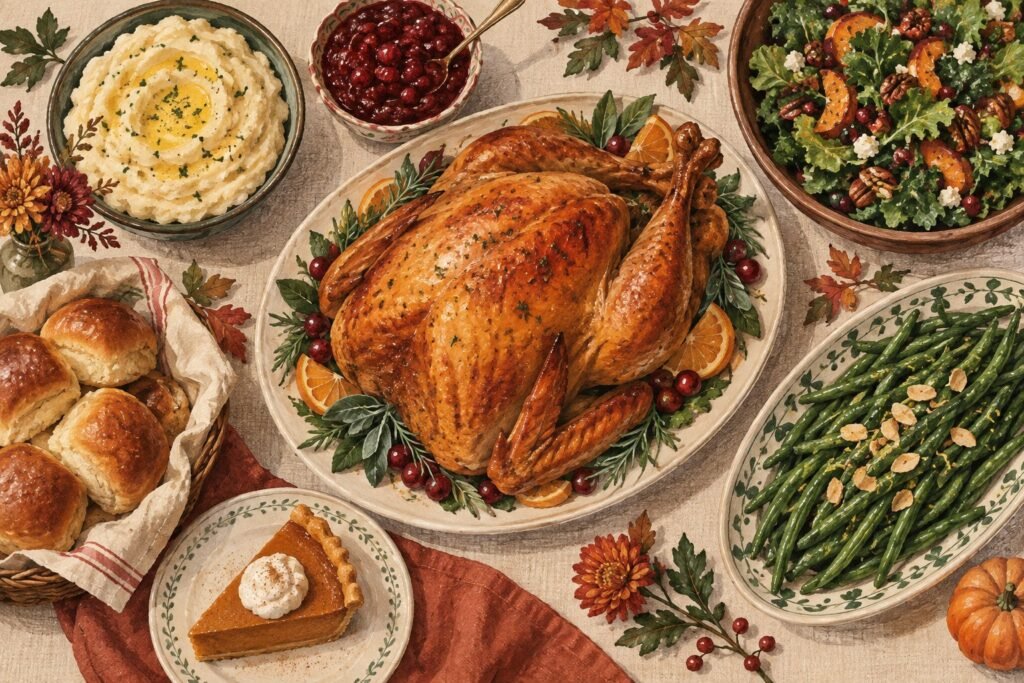
The dry brine vs wet brine turkey debate is the most consequential technique argument in Thanksgiving cooking — and one of the few where food science gives a fairly clear answer. Both methods use salt to make turkey juicier and better seasoned, but they work through different mechanisms, demand different logistics, and produce noticeably different birds. Choose wrong for your situation and you either wrestle a sloshing bucket in the fridge or wonder why your “brined” turkey tastes underseasoned in the middle.
This guide compares the two methods head-to-head: how each one works at the molecular level, honest pros and cons, exact formulas and timelines for both, which cooking methods pair best with each, and a final verdict with clear recommendations by scenario. Whether you are deep frying (see our guide on how to deep fry a turkey), roasting classic-style (how to cook Thanksgiving turkey), or smoking, you will leave knowing exactly which brine to use and why.
What Each Method Actually Is
Wet Brining: The Saltwater Soak
Wet brining submerges the turkey in a saltwater solution — typically about 1 cup of kosher salt per gallon of water, often with sugar, herbs, and aromatics — for 12 to 24 hours. The bird absorbs roughly 6 to 8 percent of its weight in liquid through osmosis and diffusion. Advocates love the insurance policy: that extra water content means the turkey stays perceptibly juicy even if slightly overcooked. It is the traditional competition-barbecue approach and the method behind many “juiciest turkey ever” claims.
Dry Brining: Salt, Time, and Nothing Else
Dry brining — sometimes called pre-salting — means rubbing the turkey all over with kosher salt (about 1 tablespoon per 4 to 5 pounds) and refrigerating it uncovered for 12 to 48 hours. No water, no bucket, no brine bag. The salt first draws moisture out of the meat, dissolves into that liquid, and then the concentrated brine reabsorbs into the muscle over many hours. The result: deeply seasoned meat with its natural juices intact, plus skin that air-dries in the fridge for superior crisping.
The Science: How Salt Transforms Turkey
To judge the debate fairly, you need the mechanism. Salt does three things to meat over time, and both methods exploit them:
1. Salt Denatures Proteins, Which Hold More Water
Salt dissolves some muscle proteins (notably myosin), loosening the tightly wound protein structures. Loosened proteins trap water more effectively during cooking — instead of contracting and squeezing juices out under heat, the relaxed protein matrix holds onto moisture. This is the core juiciness benefit, and both brines deliver it. The effect needs time: meaningful protein changes take at least 12 hours, which is why a 2-hour brine does almost nothing and overnight is the minimum.
2. Diffusion Carries Seasoning Inward
Salt moves from high concentration to low concentration — from the surface (or the brine) toward the center of the meat. This is slow: salt penetrates roughly 1/4 inch per 24 hours in dense muscle, faster along the grain. A dry brine’s concentrated surface salt creates a steep gradient that drives seasoning deep over 24 to 48 hours. A wet brine’s dilute solution creates a gentler gradient but surrounds the meat entirely, including the cavity. Either way, patience is the active ingredient.
3. Wet Brine Adds Water; Dry Brine Concentrates Flavor
Here the methods diverge. A wet brine adds external water to the bird — the turkey genuinely weighs more after brining. That water dilutes the meat’s natural flavor slightly (brined turkey can taste milder, sometimes described as “hammy” if over-brined) while providing a large moisture buffer against overcooking. A dry brine adds no water; instead, the initial moisture drawn out reabsorbs as concentrated turkey juice, so the meat tastes more intensely of turkey. Dry-brined birds also lose less moisture in the oven because the dissolved proteins hold the natural juices tighter.
Food scientists who have tested both methods side by side generally find: wet-brined turkey reads as “juicier” to tasters (more liquid released when chewing), while dry-brined turkey reads as “more flavorful” (more concentrated turkey taste) with comparably moist texture. Neither is wrong — they optimize for different things.
Head-to-Head Comparison
Juiciness and Moisture
Winner: Wet brine, narrowly. The added water weight is real insurance — a wet-brined breast stays succulent even at 170°F internal, where a dry-brined breast starts to suffer. If your oven runs hot, your thermometer is unreliable, or you are cooking for a crowd and cannot babysit, wet brining’s margin of error is genuinely valuable. But the gap closes significantly with proper temperature control: a dry-brined bird pulled at 160°F and rested properly is juicy by any reasonable standard.
Flavor Depth
Winner: Dry brine, clearly. Because no water dilutes the meat, dry-brined turkey tastes more like turkey — savory, concentrated, with the seasoning integrated throughout. Wet-brined turkey can taste slightly washed out by comparison, and over-brining (too long, too salty) produces a distinctly ham-like flavor that no one asked for. If “turkey that tastes intensely of itself” is the goal, dry brine wins.
Skin Crispness
Winner: Dry brine, decisively. This is the least debatable category. A dry-brined bird rests uncovered in the fridge, and 24+ hours of cold dry air desiccates the skin — it roasts up crackling and deeply browned. A wet-brined bird emerges from its bath waterlogged; even with hours of air-drying afterward, the skin rarely matches dry-brine crispness and often turns out soft or leathery. For skin lovers, this alone settles the debate.
Effort and Logistics
Winner: Dry brine, by a landslide. Dry brining requires salt, a sheet pan, and fridge space. Wet brining requires a food-safe container large enough to submerge a turkey (a brining bag, a cooler, or a 5-gallon bucket), a gallon-plus of brine, refrigerator space for the whole vessel — or ice management if brining in a cooler — and a potentially messy transfer of a dripping 15-pound bird. For apartment dwellers and anyone with a full holiday fridge, wet brining is a genuine logistical project.
Food Safety
Winner: Dry brine. A wet brine must stay below 40°F (4°C) for the entire soak — a cooler with melting ice on a warm day is a risk. Dry brining happens entirely in the refrigerator with no temperature ambiguity. Both methods are safe when done correctly, but dry brining has fewer failure modes.
Cost
Winner: Dry brine. A few tablespoons of kosher salt versus cups of salt, gallons of water, sugar, aromatics, and possibly a brining bag. Dry brining costs pennies.
How to Dry Brine a Turkey (Exact Method)
- Calculate salt: Use 1 tablespoon of kosher salt per 4 pounds of turkey (Diamond Crystal; if using Morton’s kosher, which is denser, use 2 teaspoons per 4 pounds). A 12-pound bird needs about 3 tablespoons.
- Prep the bird: Remove giblets and neck, pat the turkey completely dry inside and out.
- Salt everywhere: Rub salt over all exterior surfaces, under the breast skin where you can reach, inside the cavities, and over the legs and wings. Be thorough and even — this is the only seasoning the deep meat gets.
- Refrigerate uncovered 24 to 48 hours: Set the bird on a rack over a rimmed sheet pan and refrigerate uncovered. Twenty-four hours is the practical minimum; 36 to 48 hours is ideal for birds over 14 pounds. The uncovered rest is doing double duty: brining the meat and drying the skin.
- Do not rinse. Rinsing washes away the concentrated surface seasoning and re-wets the skin you spent a day drying. If you see excess salt patches, just brush them off.
- Season and roast: Add your herbs, butter, or dry rub (use a salt-free or low-salt rub — the bird is already salted), then roast normally. Expect excellent browning and plan for the bird to cook slightly faster than an unbrined one.
How to Wet Brine a Turkey (Exact Method)
Classic Wet Brine Formula (for 12–16 lb turkey)
- 2 gallons cold water
- 2 cups kosher salt (Diamond Crystal; 1½ cups Morton’s)
- 1 cup brown sugar
- 2 tablespoons black peppercorns
- 6 bay leaves
- 1 tablespoon allspice berries
- 4 sprigs thyme, 2 sprigs rosemary (optional)
- 1 gallon ice (to cool and keep cold)
- Dissolve: Bring 1/2 gallon of the water to a simmer with the salt, sugar, and spices, stirring until dissolved. Remove from heat.
- Cool completely: Add the remaining cold water and the ice. The brine must be below 40°F (4°C) before the turkey goes in — a warm brine is a food-safety hazard.
- Submerge: Place the turkey in a brining bag or food-safe container, pour in the brine, and ensure the bird is fully submerged (weigh it down with a plate if needed). Refrigerate or keep in a cooler with ice, maintaining below 40°F.
- Brine 12 to 24 hours: About 1 hour per pound is the rule of thumb; do not exceed 24 hours or the texture turns spongy and ham-like.
- Rinse and dry: Remove, rinse briefly under cold water, and pat very dry. Then refrigerate uncovered 8 to 12 hours if possible — this drying step is what separates decent wet-brined skin from soggy skin.
- Roast: Season with salt-free aromatics (the bird is already well salted) and roast. Start checking temperature early — brined birds often cook 10 to 15 percent faster.
Which Brine for Which Cooking Method?
Roasting: Dry Brine
For the classic oven-roasted turkey, dry brining is the clear recommendation — superior skin, deeper flavor, and trivial logistics. The uncovered rest is pure upside in an oven context.
Deep Frying: Dry Brine
Wet-brined birds carry surface moisture into hot oil — dangerous and counterproductive. Dry brine (or no brine plus injection) is the safe choice for frying. See our deep-fry guide and injection recipes for the full fryer setup.
Smoking: Wet Brine (Slight Edge)
The smoker is the one method where wet brining earns its keep — the long cook and drying airflow make the extra moisture buffer genuinely useful, and smoke flavor compensates for the milder meat taste. That said, a dry brine plus a water pan in the smoker produces excellent results with better skin. Either works; wet has the edge for beginners. Our smoked turkey breast guide uses a wet brine for exactly this reason.
Spatchcocking: Dry Brine
The flattened bird’s entire appeal is fast, even, crispy roasting — a wet brine undermines the skin advantage. Dry brine 24 hours ahead, as in our spatchcock turkey recipe.
Grilling: Dry Brine
Same logic as roasting — dry skin crisps over the grill’s heat, and there is no pot of water involved. Dry brine wins.
Common Brining Mistakes
Brining an Already-Enhanced Turkey
Many supermarket turkeys are pre-injected with up to 8 percent salt solution (“enhanced,” “basted,” or “marinated” on the label). Brining these — either method — produces inedibly salty meat. Check the label; if it lists salt, broth, or sodium phosphate, skip brining entirely or reduce salt drastically.
Too Much Time in Wet Brine
Beyond 24 hours, muscle texture degrades — the meat turns soft, spongy, and ham-flavored as the salt over-denatures proteins. Set a timer. Dry brining is far more forgiving of extra time (up to 72 hours is fine).
Using Table Salt by Volume
Tablespoon-for-tablespoon, table salt is roughly twice as salty as Diamond Crystal kosher by volume because of crystal density. Recipes written for kosher salt will over-salt if you substitute table salt volumetrically. If table salt is all you have, use about half the volumetric amount — or better, weigh it: you want roughly 10 grams of salt per 4 pounds of turkey for dry brining.
Brining in a Too-Warm Cooler
A wet brine above 40°F (4°C) for more than 2 hours is unsafe. If you lack fridge space for the brining vessel, use a cooler with plenty of ice and check the temperature with a thermometer — “it feels cold” is not a measurement.
Skipping the Post-Brine Drying (Wet Brine)
Going straight from brine to oven guarantees pale, steamy skin. The uncovered refrigeration rest after rinsing is not optional if you care about the exterior.
The Verdict
For most Thanksgiving cooks, most of the time: dry brine. It delivers deeper turkey flavor, decisively crispier skin, near-zero logistical hassle, lower cost, and simpler food safety — while matching wet brine on juiciness whenever you cook to proper temperature (pull at 160°F/71°C, rest to 165°F/74°C). The wet brine’s advantages — a bigger moisture safety net and slight edge in the smoker — are real but situational.
Choose wet brine when: you are smoking (especially as a beginner), your thermometer situation is unreliable, you are cooking for a crowd where the bird may sit and overcook, or you simply love that plump, deli-style juiciness. Choose dry brine for everything else — roasting, frying, spatchcocking, grilling — and enjoy the crispiest skin of your life with a fraction of the effort. Either way, you are salting ahead of time, which already puts you ahead of most Thanksgiving turkeys ever cooked.
What Professionals Actually Choose
It is telling to look at who uses which method when the stakes are real. Competition barbecue teams overwhelmingly inject or wet-brine — when a single bite judged against dozens of others decides prize money, the moisture insurance of added liquid wins. Restaurant chefs lean heavily toward dry brining: walk-in fridge space is precious, wet-brining dozens of birds is logistically absurd, and the superior skin photographs and plates better. Test kitchens that have run blind tastings repeatedly land in the same place — dry-brined birds win on flavor, wet-brined on pure juiciness perception, and the dry brine wins overall once skin crispness enters the scoring.
The pattern is consistent: the more your constraints resemble a home kitchen on Thanksgiving (limited fridge space, one oven, skin that must impress guests), the more the dry brine wins. The more your situation resembles a competition (single criterion, moisture above all), the more wet brining makes sense. Your kitchen is not a competition — dry brine accordingly, unless you are smoking, where the wet brine’s insurance earns its keep.
Can You Brine Parts Instead of a Whole Bird?
Absolutely — and it is faster. A bone-in turkey breast dry-brines in 12–24 hours instead of 24–48, and turkey legs or thighs need only 8–12 hours. The salt math stays the same (about 1 tablespoon of kosher salt per 4 pounds), just applied to smaller pieces on a sheet pan. This is the move for hosts who bought parts, for small households, and for anyone who wants dark and white meat brined to their own ideal timelines. A spatchcocked bird also dry-brines faster than a whole one — the flattened shape exposes more surface area to the salt. Wet-brining parts works too: halve the brine recipe and use a large zip-top bag instead of a bucket.
Your Brining Decision Checklist
Run through this list three days before Thanksgiving:
- Check the label: enhanced or pre-basted bird? Skip brining entirely.
- Check the calendar: 48 hours available? Dry brine. Only 12? Wet brine or inject.
- Check the fridge: room for a sheet pan but not a bucket? Dry brine. Plenty of space or a cooler with ice? Either method.
- Check the cooking method: frying → dry brine or inject; smoking → wet brine or inject; roasting, grilling, or spatchcocking → dry brine.
- Check the crowd: guests who prize crispy skin? Dry brine. Anyone who struggles with dry meat? Wet brine’s insurance is kindness.
- Check your thermometer: reliable instant-read? Either method. No thermometer? Wet brine for the margin of error — and buy a thermometer before Thursday.
Whichever you choose, write down what you did — salt quantity, hours, method — and note the result honestly. Thanksgiving comes every year, and a one-line log turns this year’s experiment into next year’s perfected tradition.
In Pictures: Brining a Turkey
The brine debate boils down to one question: soak the bird, or salt it and walk away? A visual comparison of the two approaches and what each does to the meat.
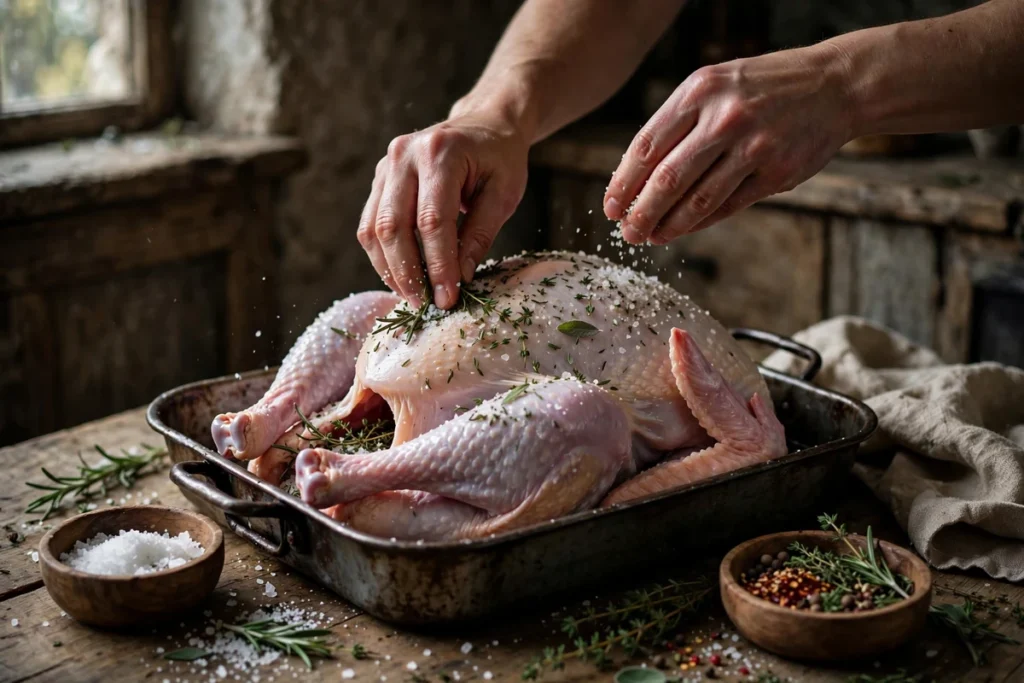
A turkey being prepared two ways side by side: one submerged in a wet brine, one rubbed with dry salt.
Watch: Brining a Turkey
Alison Roman’s Home Movies turkey episode is the definitive dry-brine demo: salt, brown sugar, and pepper rubbed on a day or two ahead, roasted on a sheet pan with gravy made from the drippings.
At a Glance: Brining a Turkey
Head-to-head comparison of the two methods, from the guide.
| Method | What it is / result |
|---|---|
| Wet brine | The bird soaks in a saltwater bath; it adds moisture but needs a huge container and fridge space |
| Dry brine | Salt (plus sugar and seasonings) is rubbed directly on the bird; nothing else — it rests uncovered in the fridge |
| The science | Salt denatures proteins so they hold more water, and diffusion carries seasoning inward |
| Flavor difference | Wet brine adds water; dry brine concentrates the turkey’s own flavor |
| Timing | Typically 24 to 48 hours uncovered in the fridge for a full dry brine |
| Skin bonus | Dry-brined birds get crispier skin because the surface dries out during the rest |
Frequently Asked Questions
Can I dry brine a frozen turkey?
No — the turkey must be fully thawed first, since salt cannot penetrate ice and the bird needs the full brining time in the refrigerator. Thaw first (see our turkey thawing guide), then dry brine 24 to 48 hours.
How far in advance should I brine?
Dry brine: 24 to 48 hours (up to 72 for large birds). Wet brine: 12 to 24 hours, about 1 hour per pound. Both need a minimum of 12 hours for the salt chemistry to meaningfully change the meat.
Do I rinse the turkey after brining?
After dry brining: no, never rinse — just brush off any visible excess salt. After wet brining: a brief rinse is standard, followed by thorough drying and ideally an uncovered rest in the fridge.
Can I combine brining with injection?
Pick one primary method. Dry brine plus injection is overkill on salt and risks mushy texture; wet brine plus injection is redundant. If you inject (see our injection marinade recipes), skip the brine and just season the exterior.
Does brining make the turkey cook faster?
Yes, typically 10 to 15 percent faster, because the dissolved proteins conduct heat more efficiently and the relaxed muscle structure offers less resistance. Start checking temperature early — this is the most common reason brined turkeys still overcook.
Which is better for a first-timer?
Dry brine. It has fewer steps, fewer ways to fail, no food-safety tightrope, and it produces better skin — the thing guests notice first. Salt the bird Tuesday, roast it Thursday, take the credit.
Conclusion
The dry brine vs wet brine turkey debate ends, for most kitchens, with the dry brine winning on flavor, skin, simplicity, safety, and cost — while the wet brine keeps its crown as the ultimate insurance policy for smokers and uncertain thermometers. Whichever you choose, the real lesson is that salting ahead transforms turkey more than any other single step. Pick your method, give it the full time, cook to temperature, and serve a bird that tastes like you knew exactly what you were doing — because now you do.