This spatchcock turkey recipe is the technique that quietly converted a generation of Thanksgiving cooks: remove the backbone, flatten the bird, and roast it in about 90 minutes with skin that crisps evenly and breast meat that stays juicy. Spatchcocking — also called butterflying — sounds like butcher-shop surgery, but it takes ten minutes with kitchen shears and transforms the geometry of roasting in your favor. If you have ever served a turkey with a gorgeous breast and a raw-deep thigh, or waited four hours while your oven was held hostage, this method was designed for you.
In this guide you will learn exactly how to spatchcock a turkey step by step, the herb-butter recipe that makes the skin sing, precise temperatures and timing by weight, how to turn the removed backbone into the best gravy you have ever made, and how to adapt the method to grills and smokers. It is faster than traditional whole-roast turkey, more forgiving than high-heat roasting, and the flattened bird even fits better in a crowded oven. Let us break it down.
What Is Spatchcocking, Exactly?
Spatchcocking means removing the turkey’s backbone and pressing the bird flat before cooking. The term is old — it appears in 18th-century cookbooks, possibly from “dispatch cock,” meaning a chicken killed and cooked quickly — but the technique earned its modern fame from roast chicken, where food writers discovered that a flattened bird cooks faster and more evenly than a whole one. The same physics applies to turkey, with even more dramatic results because turkeys are bigger and their uneven shape causes more problems.
A whole turkey is essentially a lopsided football: the breast sits high and exposed while the legs tuck underneath, shielded from heat. The breast — lean and quick to dry — overcooks while the thighs — dense and slow — catch up. Spatchcocking lays everything in a single plane, so the legs and breast receive heat simultaneously and finish at nearly the same time. The skin, fully exposed and flat, renders and crisps uniformly instead of steaming where it touches the pan. And with the backbone removed, you gain a bonus: roasted backbone pieces that become extraordinary turkey gravy.
Why Spatchcocking Beats Traditional Roasting
Nearly Half the Cooking Time
A spatchcocked 12- to 14-pound turkey roasts in roughly 80 to 100 minutes at 450°F (232°C) — compared with 3 to 4 hours for a whole bird at 325°F. The flattened shape exposes far more surface area to hot air, heat penetrates from both sides, and there is no deep cavity insulating the interior. On Thanksgiving, when oven real estate is the scarcest resource in the house, getting the turkey done in 90 minutes instead of four changes the entire day’s logistics. Your Thanksgiving side dishes get the oven back sooner, and you are not chained to basting.
Even Doneness Without the Guesswork
The classic Thanksgiving tragedy — dry breast, underdone thighs — is a geometry problem, and spatchcocking solves it geometrically. With legs splayed outward into the heat and the breast no longer towering above everything, the dark meat and white meat converge on doneness together. Many cooks find they barely need to tent or fuss: the bird simply cooks evenly. You still verify with a thermometer (165°F/74°C in breast and thigh), but the readings surprise you by agreeing with each other.
Crispier Skin, Everywhere
A whole turkey’s skin steams wherever it contacts the roasting pan and the bird’s own curves. A flattened turkey presents nearly all of its skin to circulating hot air, and the higher roasting temperature (450°F vs. the traditional 325°F) renders fat aggressively. The result is uniformly golden, crackling skin across the entire bird — the part guests fight over, with enough to go around.
It Carves Like a Dream
Carving a whole roast turkey is an awkward wrestling match. A spatchcocked bird practically falls into serving pieces: the legs pull away cleanly, the breast lifts off the flat ribcage in two neat lobes ready for slicing. If carving intimidates you, read our how to carve a turkey guide — but know that spatchcocking makes every step of it easier.
Choosing Your Turkey and Tools
Spatchcocking works for turkeys from 10 to about 16 pounds. Below 10 pounds the technique still works but the time savings matter less; above 16 pounds the flattened bird may not fit on a standard half-sheet pan, and the backbone gets genuinely hard to cut through. A 12- to 14-pound bird is ideal. Fresh or fully thawed frozen both work — if frozen, consult our turkey thawing guide and finish thawing a day early.
Skip kosher, pre-brined, or “enhanced” turkeys for this recipe: the herb-butter seasoning below assumes a natural bird, and pre-salted turkeys can taste over-seasoned. As with any method, remove the giblets and neck from the cavities and save them for stock.
You will need:
- Sturdy kitchen shears: The single essential tool. They must be strong enough to cut through rib bones — flimsy shears will frustrate you. A sharp chef’s knife helps for scoring but shears do the real work.
- Large rimmed half-sheet pan with a wire rack: The flattened bird needs to fit in one layer with air circulating underneath. No rack? A bed of roughly chopped carrots, onions, and celery works and flavors your drippings.
- Instant-read thermometer: Non-negotiable for verifying 165°F (74°C).
- Paper towels, cutting board (large), and kitchen twine (optional): For drying, a stable work surface, and tidying leg position if you like.
How to Spatchcock a Turkey: Step by Step
Set the turkey breast-side down on a large cutting board, with the legs pointing toward you. Take a breath — this looks more dramatic than it is, and the whole job takes about ten minutes.
- Locate the backbone. With the bird breast-down, you will see the spine running down the center of the back, flanked by the ribs. The backbone is the strip you are removing; everything else stays.
- Cut along one side of the backbone. Starting at the tail end, slide your kitchen shears along the right side of the spine and cut forward through the ribs toward the neck. Use strong, steady snips. Turkey bones are thicker than chicken bones — if the shears stall, reposition and cut in shorter bites rather than forcing them.
- Cut along the other side. Repeat on the left side of the backbone. You now have the spine freed as a single strip, possibly with the tail attached.
- Remove and reserve the backbone. Lift out the backbone strip and set it aside — do not discard it. Roasted alongside the bird (or simmered separately), it becomes the foundation of remarkable gravy. Remove any remaining giblet packets or loose bits from the cavities.
- Score the breastbone. Flip the bird breast-side up. With a sharp knife, make a shallow cut along the center of the breastbone cartilage. This helps the bird lie truly flat.
- Flatten firmly. Place your palms on the breast and press down hard until you hear and feel the breastbone crack. The turkey should now lie reasonably flat. Do not be timid — confident pressure is what makes the difference between “sort of flat” and properly spatchcocked.
- Tuck and arrange. Tuck the wing tips behind the breast (or trim them and add to your gravy stock). Angle the legs slightly outward so heat reaches the inner thighs. The bird is ready to season.
If cutting through the backbone feels intimidating the first time, ask your butcher to do it — most will spatchcock a turkey on request, sometimes for a small fee. There is no shame in it; the roasting benefits are identical.
Spatchcock Turkey Recipe: Herb-Butter Roast
This recipe pairs the flattened bird with a classic herb butter pushed under the skin, where it bastes the breast meat from the inside as it roasts. The high heat does the rest.
Ingredients
- 1 turkey (12–14 lbs), spatchcocked, giblets and neck removed
- 10 tablespoons (140 g) unsalted butter, softened
- 4 cloves garlic, minced to a paste
- 2 tablespoons fresh thyme leaves, chopped
- 1 tablespoon fresh rosemary, finely chopped
- 1 tablespoon fresh sage, finely chopped
- 2 teaspoons kosher salt (use 1 teaspoon if your butter is salted)
- 1 teaspoon freshly cracked black pepper
- 1 teaspoon lemon zest
- 1 tablespoon olive oil, for the skin
- Backbone pieces, 1 onion (quartered), 2 carrots (chunked), 2 celery stalks (chunked), for the pan
Instructions
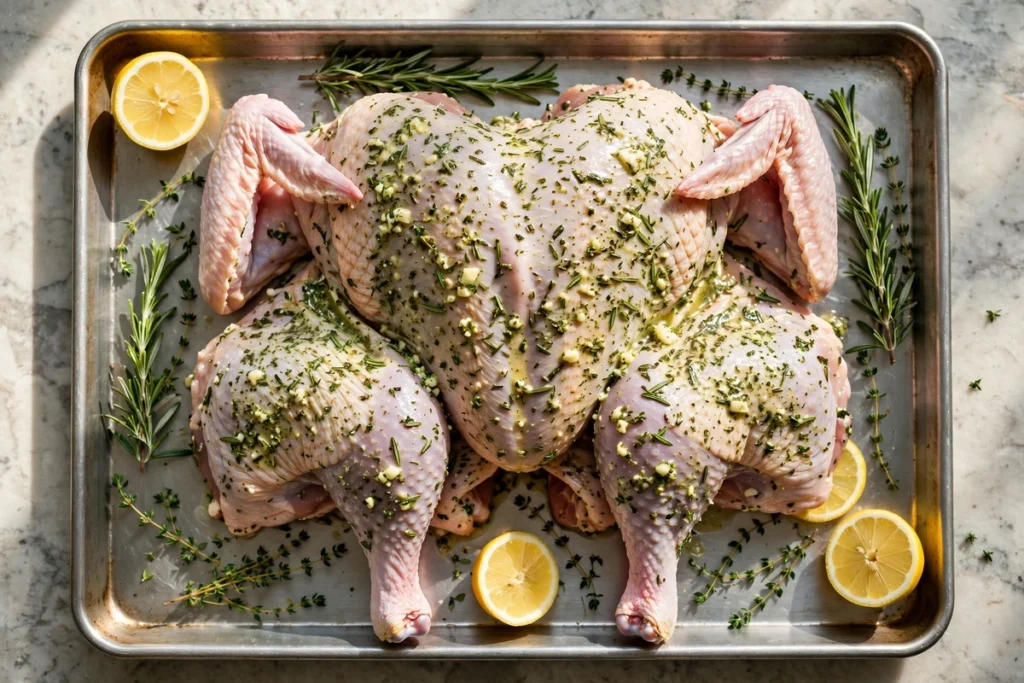
- Dry-brine (recommended, 12–24 hours ahead): Pat the spatchcocked turkey very dry. Rub the salt evenly over all surfaces, including under the breast skin where you can reach. Refrigerate uncovered on its rack-lined sheet pan. The salt draws out moisture, dissolves, and reabsorbs — seasoning the meat deeply while the uncovered rest dries the skin for maximum crispness. (Short on time? Season 1 hour ahead and skip to step 3; the result is still excellent.)
- Make the herb butter: Mash the softened butter with garlic, thyme, rosemary, sage, pepper, and lemon zest until uniform. If you dry-brined, the salt is already on the bird — do not add extra salt to the butter.
- Butter under the skin: Gently slide your fingers between the breast skin and meat to loosen it (both breasts and, if you can reach, the thighs). Push about two-thirds of the herb butter under the skin in an even layer; rub the rest over the outside of the skin along with the olive oil.
- Set up the pan: Scatter the backbone pieces, onion, carrots, and celery on the sheet pan around (not under) the rack — they roast in the drippings and become gravy gold. Set the wire rack over them and lay the turkey flat on the rack, skin up.
- Roast at 450°F (232°C): Place on the middle rack and roast 80 to 100 minutes for a 12- to 14-pound bird (roughly 6 to 7 minutes per pound). Rotate the pan once halfway through. Do not baste — opening the oven repeatedly costs heat, and the butter under the skin handles moisture.
- Check temperature early: Start probing at 75 minutes. The turkey is done when the thickest part of the breast reads 160–165°F (71–74°C) and the inner thigh reads at least 165°F. Remember carryover cooking: the breast will rise about 5°F as it rests, so pulling at 160°F is correct and safe — it coasts to 165°F on the counter.
- Rest 20 to 30 minutes: Transfer to a cutting board, tent loosely with foil, and rest. Meanwhile, use the roasted backbone and vegetables for gravy — strain the pan drippings, skim the fat, and build the best gravy of your life while the bird rests.
Backbone Gravy: The Spatchcock Bonus
The removed backbone is not waste — it is the best gravy starter you will ever have. While the turkey roasts, the backbone pieces brown in the turkey’s own drippings alongside the vegetables. After the bird comes out, transfer everything to a saucepan, add 4 cups of turkey or chicken stock, and simmer 30 minutes. Strain, skim the fat (or use a fat separator), and whisk in a roux of 3 tablespoons each butter and flour, or a cornstarch slurry for gluten-free. Season with salt, pepper, and a splash of the pan drippings. This gravy tastes like it simmered all day because, in a sense, the flavor did — it roasted at 450°F in concentrated drippings. For a deeper dive on technique, see our turkey gravy from drippings guide.
Variations
Smoked Spatchcock Turkey
Spatchcocking is arguably even better on a smoker, where the flattened shape absorbs smoke evenly and the shorter cook time means less time for the meat to dry in the smoker’s airflow. Smoke at 275°F (135°C) with apple or cherry wood until the breast hits 160°F — roughly 2.5 to 3 hours for a 12-pounder. Finish over higher heat or in a hot oven for 10 minutes to crisp the skin, which smokers leave rubbery.
Grilled Spatchcock Turkey
Set up a two-zone fire (coals or burners on one side only) and grill the flattened bird indirect at 350–375°F (177–190°C), breast up, with the lid closed — about 90 minutes for 12 pounds. The flat shape sits stably on grill grates, and you get gentle smoke plus roasted flavor. This is also the answer when the oven is full of Thanksgiving desserts.
Flavor Variations on the Herb Butter
Swap the herb profile to suit your menu: smoked paprika + brown sugar + cumin for a barbecue lean; miso + ginger + scallion butter for an umami twist; or orange zest + fennel + thyme for a bright Mediterranean version. Keep the salt level constant and the butter quantity the same — the method does not change, only the aromatics.
Troubleshooting
The Bird Will Not Lie Flat
You probably did not crack the breastbone firmly enough. Flip it breast-down again, find the keel bone’s center ridge, and press with the heel of your hand until you feel it give. A second scoring cut along the cartilage helps stubborn birds. It does not need to be pancake-flat — “mostly flat with the legs splayed” roasts nearly as well.
The Breast Is Done but the Thighs Lag
Angle the legs further outward so hot air reaches the inner thigh, and make sure the thighs are not shielded by the pan’s rim — the bird should sit fully on the rack, not draped over the pan edges. If the gap persists near the end, slide a small piece of foil just over the breast (not the thighs) for the last 15 minutes.
The Skin Is Browning Too Fast
At 450°F this can happen with sugary rubs or very buttery skin. Tent the breast loosely with foil once it reaches deep golden — usually around the 60-minute mark — and continue roasting until the thermometer says done. Color is not doneness; the thermometer is.
Shears Struggle With the Backbone
Turkey ribs are genuinely tough. Cut in short snips, repositioning the shears between each cut, and cut as close to the spine as possible where the ribs are thinnest. If your shears are old or light-duty, poultry shears with a bone notch are a worthwhile upgrade — or ask the butcher to spatchcock the bird when you buy it.
Storage and Reheating
Carve leftover meat off the bones within two hours and refrigerate in shallow covered containers; it keeps 3 to 4 days. The flattened carcass, picked clean, still makes excellent stock — simmer the bones with the leftover roasted vegetables for a rich broth that beats anything from a carton. Reheat slices gently: a 325°F (163°C) oven with a splash of stock in a covered dish preserves moisture far better than a microwave. Freeze portions you will not eat within four days for up to 3 months. Leftover spatchcock turkey is particularly good in sandwiches and Thanksgiving leftover casseroles because the even cooking means the breast meat reheats without turning to sawdust.
Spatchcock Turkey Time and Temperature Chart
Use these as starting points at 450°F (232°C), then rely on your thermometer for the final call. Times assume a fully thawed bird, patted dry, roasted on a rack:
- 10 lbs: 60–75 minutes
- 12 lbs: 75–90 minutes
- 14 lbs: 85–100 minutes
- 16 lbs: 95–115 minutes
Two variables shift these numbers. A convection (fan) oven roasts about 10–15 percent faster — reduce the temperature to 425°F (218°C) and start checking 15 minutes early. A dry-brined bird also cooks slightly faster than an unbrined one because the dissolved proteins conduct heat more efficiently. In both cases the rule never changes: pull the breast at 160°F (71°C) and let carryover bring it to 165°F (74°C), verifying the thigh reads at least 165°F. If you layered extra herb butter thickly under the skin, add about 5 minutes — fat insulates slightly. Keep a simple log of your bird’s weight and actual roast time; after one Thanksgiving you will own a personalized chart no generic guide can match.
In Pictures: Spatchcock Turkey
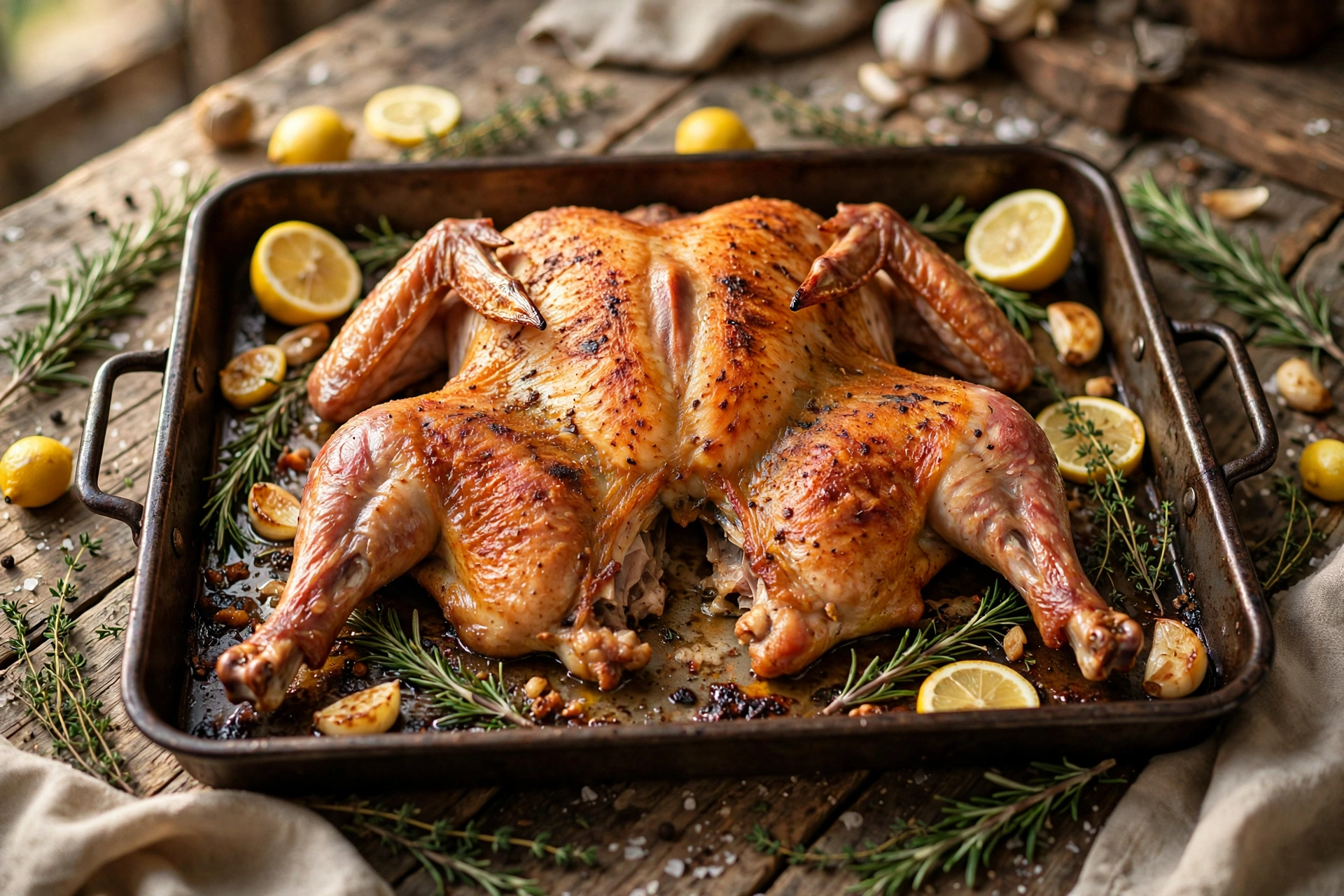
Removing the backbone and flattening the bird is the single biggest upgrade you can make to a roast turkey. See the butterflied bird laid flat and ready for the oven.
A spatchcocked turkey laid flat in a roasting pan, backbone removed and legs splayed for even roasting.
Watch: Spatchcock Turkey
If you have never butterflied a turkey, watch this Food Network clip first: Ree Drummond shows how to split the backbone and roast the bird flat in about two hours.
At a Glance: Spatchcock Turkey
Why spatchcocking beats the traditional roast, straight from the guide.
| Claim | Why it works |
|---|---|
| What it is | The backbone is cut out with kitchen shears and the bird is pressed flat, breast-side up |
| Faster cooking | Cooking time drops to nearly half because heat reaches every part evenly |
| Even doneness | No more overcooked breast waiting on raw thighs — everything finishes together |
| Crispier skin | The entire surface is exposed to hot oven air instead of steaming in the cavity |
| Easy carving | Legs and breasts separate cleanly for serving pieces |
Frequently Asked Questions
How long does a spatchcock turkey take to cook?
At 450°F (232°C), budget roughly 6 to 7 minutes per pound — about 80 to 100 minutes for a 12- to 14-pound turkey. That is roughly half the time of a traditional whole roast. Always verify with a thermometer: 165°F (74°C) in the thigh, with the breast pulled at 160°F to coast up during rest.
Can I spatchcock a turkey the day before?
Yes — and you should. Spatchcocking, salting, and refrigerating uncovered overnight is the ideal prep: it seasons the meat deeply and dries the skin for better crisping. The bird can rest spatchcocked and salted in the fridge for up to 24 hours before roasting.
What do I do with the backbone?
Roast it on the sheet pan alongside the turkey with vegetables, then simmer it into gravy. The backbone pieces brown in the turkey’s drippings at high heat, producing a deeply flavored stock in 30 minutes of simmering. Do not throw it away — it is one of the best parts of spatchcocking.
Can I stuff a spatchcocked turkey?
Not in the traditional sense — there is no cavity once the bird is flattened. Instead, bake your classic bread stuffing separately in a dish, which is safer and gives you crispier dressing anyway. If you want the flavors together, roast the dressing in the pan beneath the turkey so it catches the drippings.
Does spatchcocking work for very large turkeys?
Up to about 16 pounds, yes, if the flattened bird fits your sheet pan. Beyond that, the backbone becomes very difficult to cut and the bird may not fit in one layer. For 18- to 20-pound birds, consider roasting two smaller turkeys or switching to a bone-in turkey breast plus a second smaller bird.
Is spatchcock turkey safe? The cooking time seems short.
Completely safe, provided you verify temperature. The short time is real physics — more surface area, heat from all sides — not a shortcut. Poultry is safe at 165°F (74°C) internal temperature regardless of how quickly it got there. Use a thermometer every time.
Conclusion
This spatchcock turkey recipe delivers what Thanksgiving cooks actually want: a bird that cooks in about 90 minutes, browns evenly, stays juicy, and carves without a struggle — plus a backbone that becomes extraordinary gravy. The ten minutes of butchery up front pay off in every way that matters on a busy holiday. Once you serve a flattened, herb-buttered turkey with shattering skin and perfectly cooked thighs, the whole-bird roast starts to look like tradition for tradition’s sake. Try it once; the shears will earn a permanent place in your Thanksgiving kit.