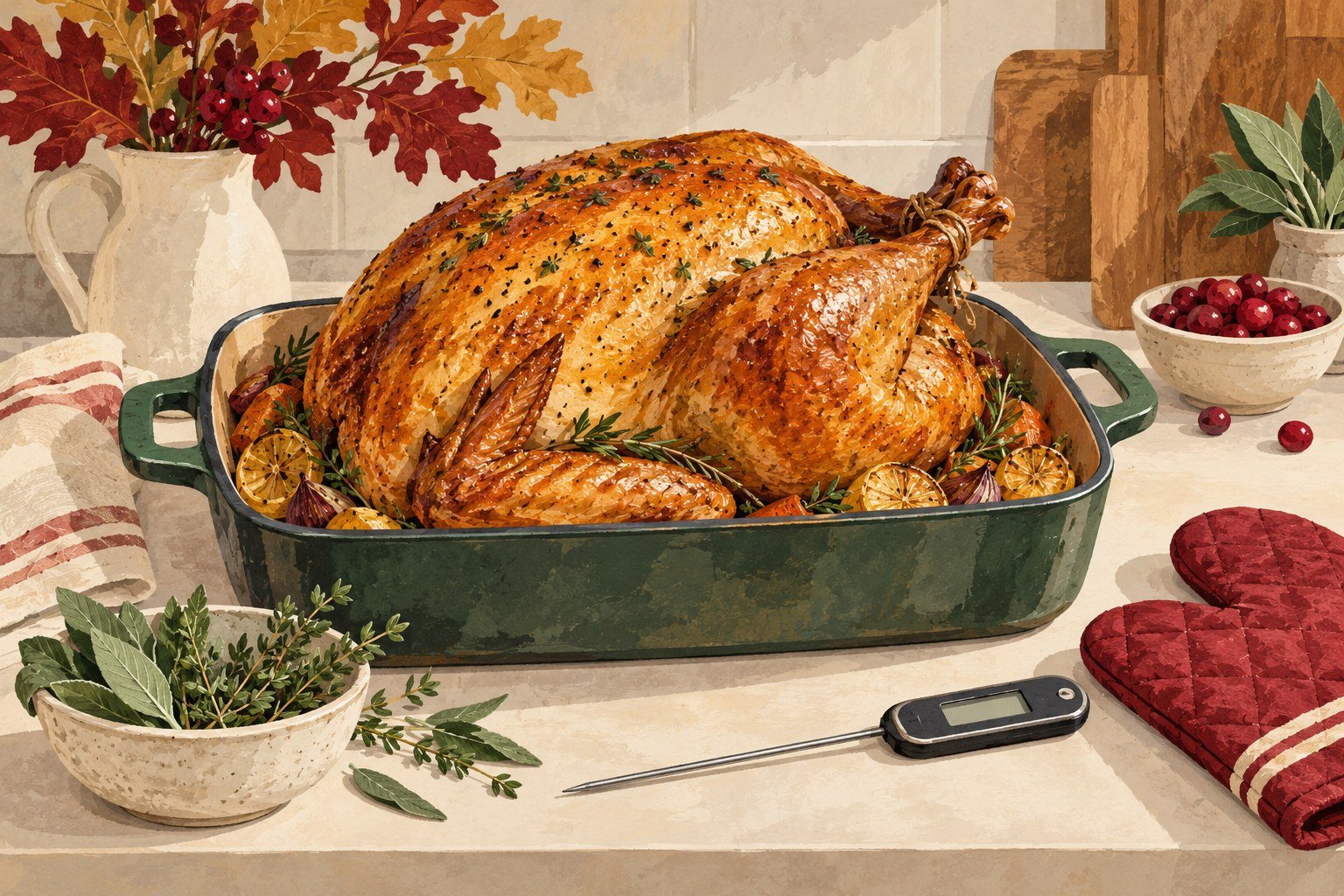
To cook a Thanksgiving turkey safely, thaw it using an approved method, roast in an oven set to at least 325°F, and check that the thickest breast and innermost thigh and wing each reach at least 165°F. A clock, brown skin or clear-looking juices cannot replace a food thermometer.
For Thanksgiving 2026—Thursday, November 26—work backward from dinner time and allow several days for refrigerator thawing when needed. This guide uses USDA, CDC, FoodSafety.gov and US Fire Administration guidance for safety. The herb-roast recipe is an original editorial formulation; it is not presented as a DayZora kitchen-tested recipe.
Turkey cooking at a glance
| Decision | Practical starting point | What determines safety |
|---|---|---|
| Roasting | Conventional oven at 325°F or higher | At least 165°F in all three checked areas |
| Refrigerator thawing | About 24 hours per 4–5 pounds | Refrigerator at 40°F or below |
| Cold-water thawing | About 30 minutes per pound | Leakproof bag, cold water changed every 30 minutes; cook immediately |
| Smoking | Fully thawed, unstuffed turkey; smoker 225–300°F | Separate smoker and food thermometers; turkey reaches 165°F |
| Resting | About 20 minutes before carving | Reach the safe temperature before resting |
| Leftovers | Portion into shallow containers promptly | Refrigerate within 2 hours, or 1 hour above 90°F |
The FoodSafety.gov roasting and thawing chart is the reference for the oven and timing figures. Different appliances may have additional manufacturer instructions; follow those without lowering the safe food-temperature requirement.
Choose a bird that fits the meal and equipment
A useful shopping starting point is roughly 1–1½ pounds of raw, bone-in whole turkey per person, depending on appetites, the number of sides and desired leftovers. This is a planning allowance, not a precise cooked yield. A bird contains bones and other weight that will not become carved portions.
For four people, a breast may be more manageable than a whole turkey. For eight, a 10–12-pound bird with several sides is a reasonable starting option; choose more if generous leftovers are important. For a larger gathering, check whether two smaller birds or separately cooked pieces fit your equipment better than one very large bird. Two birds in an oven can still change airflow and cooking time.
Measure the roasting pan and oven before shopping. The door must close, the pan must sit securely and hot air needs space to circulate. Check refrigerator space too: a turkey on a tray should not crush produce or drip on ready-to-eat food.
Fresh versus frozen
Frozen turkey gives you more shopping flexibility, but thawing must be scheduled. Keep it frozen until the planned thawing period begins. Fresh poultry has a short refrigerated storage window; follow its label and current USDA guidance rather than buying it far ahead and assuming it will last.
Read the label for added solution, self-basting, injected or kosher preparation. Those products may already contain salt. Adding a full brine can make them unpleasantly salty. The word “natural” by itself should not substitute for reading the ingredient and handling information.
How to thaw a turkey safely
Refrigerator method
Keep the bird wrapped on a tray or in a container that catches leaks. Place it in a refrigerator at 40°F or below. Allow about 24 hours for each 4–5 pounds; large birds take several days. Once refrigerator-thawed, the turkey can remain refrigerated for another 1–2 days before cooking, according to CDC's holiday turkey guidance.
| Turkey weight | Approximate refrigerator thawing time |
|---|---|
| 4–12 pounds | 1–3 days |
| 12–16 pounds | 3–4 days |
| 16–20 pounds | 4–5 days |
| 20–24 pounds | 5–6 days |
For a 12–16-pound turkey intended for Thursday morning, think in terms of beginning the thaw several days earlier, then checking progress. The exact start depends on its weight, your refrigerator and whether you want time for a refrigerated brine. Do not add brining days beyond the safe post-thaw storage window.
Cold-water method
Use a leakproof bag and completely submerge the bird in cold tap water. Change the water every 30 minutes and allow approximately 30 minutes per pound. Cook immediately after thawing. This method requires active attention; it is not an overnight unattended soak.
Make sure the container and sink can be cleaned afterward and keep nearby ready-to-eat foods away. Water used around raw poultry is not a clean preparation surface. A 12-pound bird can require about six hours of monitored thawing, so this is still a substantial scheduling commitment.
Microwave method
Use only if the bird fits and your microwave manufacturer provides a suitable thawing procedure. Follow the specified weight limits and power settings, then cook immediately. Some areas may begin cooking during defrosting, which is why the turkey should not go back into a long waiting period.
Methods to avoid
Do not thaw on the counter, in warm water, on the porch, in a garage or in a car. A frozen center does not prove the outside has stayed safe. If the handling history is unsafe or unknown, extra roasting is not a dependable repair strategy.
Clean preparation without washing the bird
Do not rinse raw turkey. Splashing can carry contamination to the sink, nearby food and utensils. Remove packaging carefully, discard it and pat the bird dry with disposable paper towels if needed. Wash hands with soap and water before and after handling raw poultry.
Keep a separate cutting board and utensils for raw turkey. Clean and sanitize contaminated work surfaces before preparing salad or carving cooked food. Plan the work area first: an open trash container, a stable tray and a clear route to the sink reduce the number of handles touched with raw-poultry hands.
Remove giblets and neck from both cavities when accessible. Keep them refrigerated if using them in a cooked preparation. Do not leave the bird on the counter while you spend an hour chopping vegetables or rearranging the oven.
Should you brine the turkey?
Brining is optional seasoning, not a safety treatment. It does not replace refrigeration, proper thawing or cooking. Skip it when the turkey is already salted or when your refrigerator cannot safely hold the bird and container.
Dry brine
A dry brine uses measured salt rubbed onto the bird with optional herbs. USDA's poultry brining guidance gives 1 tablespoon kosher or seasoned salt per 5 pounds of poultry, held in a sealed food-grade bag in the refrigerator for up to two days. Salt crystal sizes differ, so use the specified type and avoid casually substituting the same volume of a finer salt.
Fit brining inside the safe refrigerated window after thawing. Pat dry before cooking; do not add another full dose of salt in the roasting rub. Keep the bag on a tray to contain leaks.
Wet brine
Wet brining needs a food-grade container large enough to submerge the bird and fit in the refrigerator. Use a measured, reliable formula and keep the turkey at 40°F or below throughout. Do not use a household trash bag. Discard the used brine and clean anything it touched.
Wet brining creates a heavy, slippery container and more contaminated liquid to manage. For a first-time host, seasoning without a brine is a perfectly practical choice. Avoid a last-minute improvised bucket on a cold porch; outdoor air temperature is not controlled refrigeration.
Herb-roasted turkey: a straightforward method
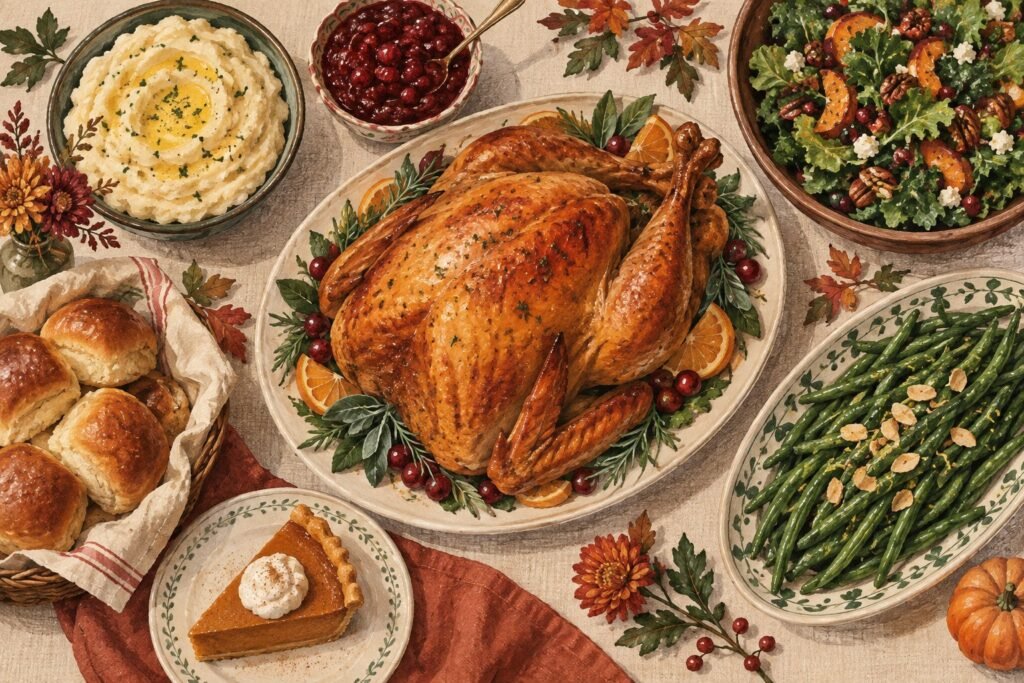
Prep: about 25 minutes after thawing. Cooking: approximately 2¾–3 hours for an unstuffed 8–12-pound bird at 325°F, with additional time if required by temperature checks. Rest: about 20 minutes. Serves: roughly 8, depending on bird size, appetites and sides. Thawing and optional brining are additional.
Ingredients and equipment
- One fully thawed 10–12-pound whole turkey, unstuffed
- 3 tablespoons olive oil or softened unsalted butter
- 1 tablespoon chopped fresh thyme or rosemary
- 1 teaspoon black pepper
- Salt appropriate to the bird's label and any prior brining; for an unbrined, unsalted bird, begin with 1 teaspoon fine salt in the surface rub
- 1 cup low-sodium broth for the pan, with more only if needed to prevent drippings scorching
- A stable roasting pan, rack, food thermometer, clean carving board and oven mitts
Step-by-step roasting
- Set the oven to 325°F. Arrange a rack so the bird will sit near the center with clearance above it. Prepare the pan before handling the raw turkey.
- Remove packaging, neck and giblets. Do not wash the bird. Pat dry if needed, then set breast-side up on the roasting rack.
- Mix the oil or butter with herbs, pepper and appropriate salt. Rub over the surface. Leave the cavity unstuffed so this recipe's timing assumptions remain relevant.
- Add broth to the pan without pouring away the surface seasoning. Roast uncovered. Check that pan liquid is not burning; add a little hot water or broth if necessary, carefully avoiding splashes.
- Begin checking before the estimated finishing time. Measure the thickest breast and innermost thigh and wing, avoiding bone. Check more than one side when placement or heating may be uneven.
- Continue cooking until every required location reaches at least 165°F. If the skin is browning too quickly, cover the breast loosely with foil while the rest finishes. Do not stop because one spot is ready.
- Transfer carefully to a clean board and rest about 20 minutes before carving. Keep raw-poultry utensils away from the cooked bird. Use the resting period to finish gravy and organize serving.
Basting is optional. Opening the oven repeatedly loses heat and can lengthen cooking. If you baste, use clean utensils and continue checking the turkey's actual internal temperature. No surface treatment guarantees a particular level of juiciness.
Turkey roasting times: a planning table
These estimates apply to an unstuffed turkey in a 325°F oven and come from FoodSafety.gov. They are not a promise that every bird of that weight will be ready at the earliest time.
| Turkey size | Approximate roasting time |
|---|---|
| 4–6-pound breast | 1½–2¼ hours |
| 6–8-pound breast | 2¼–3¼ hours |
| 8–12-pound whole turkey | 2¾–3 hours |
| 12–14-pound whole turkey | 3–3¾ hours |
| 14–18-pound whole turkey | 3¾–4¼ hours |
| 18–20-pound whole turkey | 4¼–4½ hours |
| 20–24-pound whole turkey | 4½–5 hours |
Oven accuracy, starting temperature, pan shape, airflow and how often the door opens all affect timing. Leave a buffer in the dinner plan. If the bird runs late, serve an appetizer or move dinner; do not lower the safety endpoint to match an invitation.
Where to check the temperature
The required locations are the thickest part of the breast and the innermost parts of the thigh and wing. Insert the probe into meat rather than against bone. Follow the thermometer's instructions for insertion depth and response time, and clean the probe between uses.
A single pop-up indicator is not a complete check of all those areas. Neither pinkness nor its absence is a reliable standalone test. If one area is below 165°F, continue cooking and check again. Resting happens after the bird reaches the safe minimum, not as an excuse to remove it below that threshold in this guide.
Spatchcock turkey
Spatchcocking removes the backbone so the bird can lie flatter. It changes the shape and often the cooking schedule, but not the safe endpoint. A flattened bird needs a broad rimmed pan; its juices must stay contained rather than spill into the oven.
Ask a butcher to prepare it if you are not comfortable cutting through poultry bones. If doing it yourself, use appropriate poultry shears, a stable board and enough space to keep raw juices away from other food. Follow a complete method matched to the bird and pan, and check breast, thigh and wing temperatures individually. Do not apply the whole-bird timing table as an exact spatchcock schedule.
Smoked turkey
Start with a completely thawed, unstuffed turkey. USDA's alternate cooking guide describes smoking an 8–12-pound bird with smoker air maintained at 225–300°F and an estimated 20–30 minutes per pound. Use one thermometer for the chamber and another for the food.
Wind, outdoor temperature and fuel behavior can change the cooking process. Follow the smoker manufacturer's instructions, maintain heat continuously and keep enough fuel available. Use food-smoking wood intended for the purpose, not painted, treated or resinous scrap wood.
The bird still needs at least 165°F in the breast, thigh and wing. Smoke color, a browned exterior or a calculated finish time cannot establish safety. If equipment fails, act promptly using a safe cooking method; do not leave partially cooked poultry waiting at room temperature for a later restart.
Deep-fried turkey: fire safety comes first
Hot-oil turkey frying can cause serious burns and fires. Do not attempt it indoors, in a garage, under roof eaves or near structures. Never lower a frozen, partly frozen, icy or wet turkey into hot oil. A first-time cook without suitable equipment and a safe outdoor setup should choose roasting instead.
The US Fire Administration's fryer guidance calls for a sturdy level surface, at least 10 feet from the home, correct fill level, oil-temperature monitoring and protective mitts. Keep children and pets away. Do not move the fryer while in use.
Follow the appliance's capacity and complete operating procedure, including how to determine oil quantity before heating. If measuring displacement with water, dry the equipment and bird thoroughly before oil is involved. Do not improvise a fill level, leave heating oil unattended or treat this overview as a substitute for the appliance instructions. Cooked turkey must still reach 165°F in the required locations.
Resting and carving
After the safe temperature is reached, rest the bird about 20 minutes on a clean board with a channel for juices. Use a stable surface and keep the board from sliding. A large turkey is awkward to transfer; have another adult help if needed.
Remove legs at the joints, separate thighs and drumsticks, then remove breast meat from each side and slice across its grain. Put portions on a warm platter rather than letting guests reach around the carving knife. Set aside bones for a later cooked stock only if you can refrigerate them promptly.
Simple turkey gravy
For about 3 cups, skim fat from the cooked pan juices. Use 3 tablespoons of the fat or butter in a saucepan, stir in 3 tablespoons flour and cook for 2 minutes. Gradually whisk in a total of 3 cups liquid made from strained drippings plus low-sodium broth. Simmer until thickened, then taste before salting, especially if the turkey was brined.
If drippings are scorched or too salty, use broth instead. Keep a separate vegetable gravy for guests who do not eat turkey. For more accompaniments, see the side-dish collection.
Leftovers: do the cooling before relaxing
Carve remaining meat into smaller portions and refrigerate in shallow containers within two hours of cooking, or one hour if exposed to temperatures above 90°F. You do not need to wait for a whole bird to become completely cool on the counter. Keep the refrigerator at 40°F or below.
Use cooked turkey within 3–4 days or freeze it. Reheat leftovers to at least 165°F. Making soup on day three does not reset the original turkey's storage history. Label containers with the cooking date and send guests home with a plan to keep their portions cold. See FoodSafety.gov's storage chart.
Common questions
Can I roast a turkey that is still frozen?
USDA provides a separate frozen-roasting method with substantially more time. Do not apply this thawed-bird recipe unchanged, and never smoke or deep-fry a frozen bird. Consult the linked USDA alternate-method guide before choosing frozen roasting.
Can I cook the turkey the day before?
Yes, if you fully cook it, portion and refrigerate it promptly, and reheat to 165°F. Do not partially roast it one day and finish the next. Plan enough refrigerator space for shallow containers and enough time for even reheating.
Should I put stuffing inside?
For simpler, safer timing, cook dressing separately. Stuffing inside a bird must itself reach 165°F, which can extend the cook. This guide's recipe and primary table are explicitly unstuffed.
What if the breast finishes first?
Shield it loosely with foil and continue until the other required areas are safe. Check probe placement before assuming a large difference is real. Do not carve and serve undercooked portions because the breast is ready.
What should I prepare around the turkey?
Use the Thanksgiving dinner planner to assign oven and burner space. The 2026 holiday guide covers the date and the rest of the celebration.