There is a particular silence that falls over a Thanksgiving table when someone tastes real cranberry sauce for the first time after a lifetime of the canned kind. Homemade cranberry sauce — fresh cranberries simmered with sugar and water until they pop and collapse into a glossy, jewel-toned sauce — bears almost no resemblance to the ridged cylinder from a can. It is brighter, more complex, less cloyingly sweet, and it takes about fifteen minutes of mostly hands-off cooking.
This is a technique guide as much as a recipe. You will learn the simple science of how cranberries thicken themselves with their own natural pectin, why the sauce always looks too thin in the pot (and why that is correct), how to judge doneness by sound as much as by sight, and how to steer the flavor with variations ranging from orange-spiced to port-spiked. There is troubleshooting for every common problem, storage guidance that makes this the easiest make-ahead dish on your menu, and an honest comparison with the canned classic. Three ingredients, one pot, fifteen minutes — and a condiment that makes the entire Thanksgiving plate taste more like itself.
Why Homemade Beats Canned
The canned version has its loyalists, and nostalgia is a real flavor — no one is taking that away from anyone. But on purely culinary terms, homemade wins on every axis. Fresh cranberries bring a bright, floral tartness that the canning process flattens. You control the sweetness, so the sauce can be tart enough to actually cut through rich turkey, buttery potatoes, and gravy instead of just adding more sugar to an already rich plate. And the texture — whole berries suspended in a glossy gel, or a smooth strained sauce if you prefer — is incomparably more interesting than a uniform jelly.
There is also the matter of effort versus reward. Cranberry sauce is the highest-leverage dish on the Thanksgiving menu: fifteen minutes of cooking, most of it unattended, for a condiment that elevates everything it touches. If you only make one thing from scratch this holiday, make it this. It sits beautifully on any Thanksgiving dinner menu, and it keeps for weeks, so there is no downside.
The Science: How Cranberries Thicken Themselves
Cranberries are unusually rich in natural pectin, the same gelling carbohydrate that makes jam set. When you heat cranberries with sugar and water, three things happen in sequence. First, the heat bursts the berries’ skins — you will hear them popping, which is both the doneness signal and one of the great small pleasures of holiday cooking. Second, the released pectin dissolves into the hot sugary liquid. Third, as the sauce cools, the pectin molecules link into a loose gel network that thickens the whole mixture.
This is why the sauce always looks too thin when it is hot. A cranberry sauce that looks perfectly thick in the pot will set into an unspreadable brick once cool. The correct hot consistency is looser than you expect — it should flow easily off a spoon and look almost soupy. Trust the pectin: as the sauce cools to room temperature, it will thicken into a spoonable, glossy sauce that holds its shape softly. This single insight prevents the most common beginner mistake, which is overcooking the sauce into cranberry candy.
The Only Three Ingredients
Classic cranberry sauce needs exactly three things. Everything else is variation.
Cranberries
One 12-ounce bag of fresh cranberries is the standard unit — it is how they are sold, and it makes about 2 1/4 cups of sauce, enough for 8 to 10 people. Frozen cranberries work identically to fresh; do not thaw them first, just add a minute or two to the cooking time. Pick through fresh berries and discard any soft, shriveled, or discolored ones. The berries should be firm and bounce slightly — the old “bounce test” is real: fresh cranberries bounce because of the air pockets inside them.
Sugar
One cup of granulated sugar per 12-ounce bag is the classic ratio, and it produces a sauce that is sweet-tart in balance. Sugar does more than sweeten here — it helps the pectin gel set properly and acts as a preservative, which is part of why the sauce keeps so well. You can reduce it to 3/4 cup for a tarter sauce, but do not go much lower or the set suffers. Brown sugar, maple syrup, and honey all work as variations (see below), each bringing its own character.
Water
One cup of water per bag. That is it. The water gives the berries room to pop and the pectin room to dissolve. Some recipes use orange juice in place of part of the water — that is the beginning of the orange variation, and it is delicious — but plain water lets the pure cranberry flavor shine.
Ingredients You’ll Need
- 1 (12-ounce) bag fresh cranberries, picked over (about 3 cups)
- 1 cup granulated sugar
- 1 cup water
- Pinch of fine sea salt
- 1 teaspoon orange zest or 1/2 teaspoon vanilla extract (optional, for depth)
Ingredient notes
The salt: A tiny pinch does not make the sauce salty — it suppresses bitterness and makes the fruit flavor pop. Cranberries have bitter undertones that salt tames beautifully.
The optional zest or vanilla: Neither is traditional in the strictest sense, but a little orange zest or vanilla rounds out the flavor and adds complexity without announcing itself. If you want the purest cranberry flavor, leave them out.
Step-by-Step Instructions
- Dissolve the sugar. Combine the water and sugar in a medium saucepan over medium heat. Stir until the sugar dissolves completely — the liquid should look clear, not cloudy. Dissolving the sugar first ensures a smooth syrup rather than a grainy sauce.
- Add the cranberries. Stir in the cranberries and the pinch of salt. Increase the heat to medium-high and bring to a boil, then reduce to a steady simmer.
- Cook until they pop. Simmer 10 to 12 minutes, stirring occasionally. You will hear the berries begin to pop after a few minutes — first a few, then a lively crackling chorus. Most berries should burst and collapse; a few intact berries left whole give the sauce a beautiful texture. Do not cook past 12 to 15 minutes: the sauce will look thin and loose, and that is correct.
- Finish and cool. Remove from the heat and stir in the orange zest or vanilla if using. Transfer to a bowl or jar. The sauce will thicken dramatically as it cools — first to room temperature (about 1 hour), then fully in the refrigerator. Taste once cool and adjust: a little more sugar if too tart (dissolve it in while the sauce is still warm), a squeeze of lemon if too sweet.
- Serve. Serve chilled or at room temperature. Cold sauce has the firmest set and the brightest flavor; room-temperature sauce is softer and more aromatic. Both are correct — it is a matter of preference.
Technique Details Worth Knowing
Judge doneness by sound
The popping is your timer. When the vigorous popping subsides and most berries have collapsed, the sauce is done — even if it looks thin. Beginners who wait for visual thickness always overcook. Listen for the moment the pot goes from lively crackling to a lazy bubble, and take it off the heat.
Whole-berry vs. smooth
The classic American style is whole-berry: berries burst but largely intact, suspended in gel. For a smooth, jelly-style sauce, press the hot sauce through a fine-mesh sieve, pushing firmly with a spatula — you will get a seedless, glossy purée that sets into a sliceable jelly in a mold. Both are traditional; the whole-berry version is more common on modern tables and far less work.
The spoon test
If you want a visual check, drag a spoon through the hot sauce: it should leave a brief trail that fills back in within a second or two. If the trail holds its shape in the hot pot, you have already gone too far — but even then, whisking in a few tablespoons of hot water off the heat will usually loosen it back to a workable consistency.
Variations to Try
Orange-cranberry sauce
Replace half the water with fresh orange juice and add a 2-inch strip of orange peel plus 1 teaspoon of zest. The citrus brightens the cranberries and adds a floral note that is especially good with turkey. This is the gateway variation — if you only try one, try this. (For the no-cook raw version with a completely different texture, see our cranberry orange relish.)
Spiced cranberry sauce
Add a cinnamon stick, 3 whole cloves, and a star anise to the pot with the cranberries; remove them before cooling. Warm spices make the sauce taste like the holidays smell — this version is particularly good alongside deeply savory dishes like turkey gravy from drippings, where the spice bridges the gap between the condiment and the main plate.
Maple cranberry sauce
Replace the granulated sugar with 3/4 cup pure maple syrup. The sauce will be slightly looser (maple brings its own water) and carry a warm, caramel-like depth. Reduce the water to 3/4 cup to compensate. This version is superb with roasted root vegetables and ham as well as turkey.
Ginger cranberry sauce
Add 1 tablespoon of grated fresh ginger with the cranberries. The heat and brightness of ginger cut through the richness of the Thanksgiving plate like nothing else. A squeeze of lime juice at the end, instead of lemon, pushes it in a fresher direction.
Port or red wine cranberry sauce
Replace half the water with ruby port or a fruity red wine. The alcohol cooks off, leaving a deep, wine-dark sauce with remarkable complexity. This is the dinner-party version — it looks stunning and tastes like something from a restaurant.
Jalapeño cranberry sauce
Add 1 minced jalapeño (seeds removed for mild, left in for heat) with the cranberries. Sweet heat is a revelation with turkey — the sauce wakes up the whole plate. Start with half a pepper if you are cautious; you can always add more next time.
Pear and cranberry sauce
Add 1 diced ripe pear with the cranberries and reduce the sugar to 3/4 cup. The pear melts into the sauce, adding body and a honeyed sweetness that lets you cut the sugar without losing balance. Vanilla is especially good in this version.
Canned vs. Homemade: An Honest Note
Let us be fair to the can. Canned cranberry sauce — the jellied kind that holds the shape of the can, ridges and all — is a genuine American tradition with its own pleasures: the clean slice, the wobble, the pure sweet-tart hit. Some families would riot if it disappeared. Homemade does not have to replace it; the two can coexist, and many tables serve both. But if your table currently serves only the canned kind, adding a small bowl of homemade alongside it is a low-risk experiment with a high probability of converting at least a few people.
Troubleshooting: Fixing Common Problems
Too tart
Cranberries vary in tartness by bag and by season. If the cooled sauce makes you pucker, stir in more sugar a tablespoon at a time — do it while the sauce is still warm so it dissolves, or make a quick simple syrup to stir into cooled sauce. A drizzle of honey works too. Next time, start with the full cup of sugar and adjust down only if you know your berries are mild.
Too sweet
Stir in a teaspoon of lemon juice or a splash of orange juice — acid restores the perception of tartness without removing sugar. A pinch more salt also helps by suppressing sweetness. Next time, cut the sugar to 3/4 cup, but do not go below that or the pectin set weakens.
Too thin, even when cool
Under-extracted pectin, usually from too little cooking time or too much water. Return the sauce to the pot and simmer 3 to 5 minutes more, then cool again — pectin needs sustained heat to fully dissolve. Also check your sugar: very low-sugar versions genuinely set less firmly. As a last resort, a teaspoon of powdered pectin whisked in during a brief re-boil will firm anything up.
Too thick or gummy
Overcooked. Whisk in hot water a tablespoon at a time until it loosens to a spoonable consistency — do this while the sauce is warm, or gently rewarm it first. It will not be quite as glossy as a correctly cooked batch, but it will be perfectly servable. Set a timer next time and trust the “looks too thin” rule.
Bitter aftertaste
Some bitterness is inherent to cranberries, but excessive bitterness comes from overcooking or from including damaged berries. The pinch of salt in the recipe tames normal levels. For a bitter batch, a little extra sugar and a squeeze of orange juice usually balance it. Picking over the berries carefully before cooking is the real prevention.
Make-Ahead, Storage, and Freezing
Make ahead
Cranberry sauce is the ultimate make-ahead dish: it needs at least a few hours to set properly, and it keeps beautifully. Make it up to 2 weeks ahead and refrigerate in a sealed jar. In fact, many cooks swear the flavor improves after a day or two as the tartness mellows and the flavors marry. Cross this one off your list early and enjoy the smugness.
Refrigerator storage
Sealed and refrigerated, homemade cranberry sauce keeps 2 to 3 weeks — the sugar and the cranberries’ natural acidity are both preservatives. Always use a clean spoon for serving to avoid introducing bacteria that shorten its life.
Freezing
Freeze in airtight containers for up to 3 months; thaw overnight in the refrigerator. The texture survives freezing remarkably well — the pectin gel is stable. This makes cranberry sauce a brilliant candidate for making a double batch: one for Thanksgiving, one for the December holidays.
Serving Ideas: Beyond the Thanksgiving Plate
Cranberry sauce earns its place next to the turkey, but its working life extends far beyond one meal. Its sweet-tart profile makes it one of the most versatile condiments in the holiday kitchen — think of it less as a Thanksgiving-only side and more as a seasonal staple.
On the Thanksgiving plate
Placement matters. Serve the sauce in its own small bowl rather than dolloped directly on the turkey — guests have strong opinions about sauce-to-bite ratios, and a separate bowl lets everyone calibrate. A spoonful alongside each bite of turkey is the classic move, but the sauce truly shines as a bridge between bites: a little cranberry between a mouthful of rich turkey gravy-covered potatoes and a forkful of buttery stuffing resets the palate the way a good pickle does with barbecue. Encourage guests to experiment — the best bite on the plate is often turkey, a little stuffing, and cranberry sauce all at once.
Leftover magic
Day-after Thanksgiving is where cranberry sauce becomes a star. Spread it on turkey sandwiches with mayonnaise and lettuce — the sweet-tart layer against savory turkey is the definitive leftover sandwich. Swirl it into plain yogurt or oatmeal for breakfast. Warm it slightly and spoon it over vanilla ice cream or cheesecake for an instant dessert. Stir a spoonful into sparkling water or club soda with a squeeze of lime for a festive spritzer, or shake it into cocktails — cranberry sauce dissolves beautifully into bourbon or vodka with citrus. It also makes an excellent glaze: thin it with a little orange juice and brush it over roasted chicken, pork tenderloin, or even baked brie.
Gifting
A jar of homemade cranberry sauce, labeled and tied with ribbon, is a genuinely appreciated host gift or neighbor gift during the holidays. It keeps for weeks refrigerated, travels well, and signals far more care than its fifteen minutes of effort would suggest. Make a double batch in November and you will have gifts ready all season.
In Pictures: Homemade Cranberry Sauce
Homemade cranberry sauce needs just three ingredients and about fifteen minutes — and it gels itself. The sauce, ruby-red and glossy in its serving bowl.
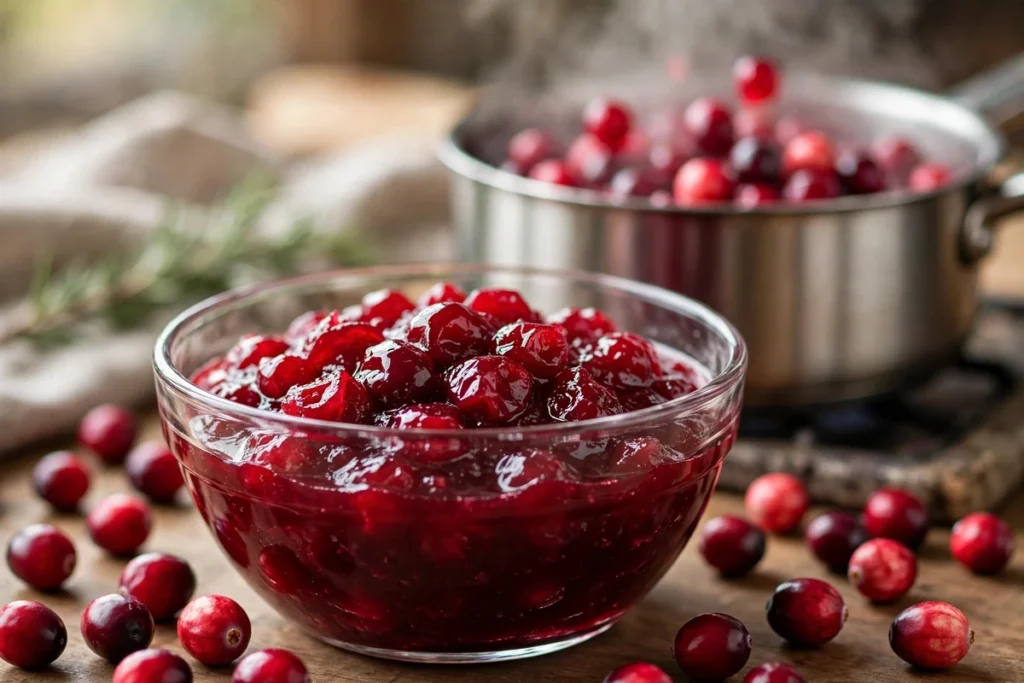
A bowl of glossy homemade cranberry sauce, deep ruby red, with fresh cranberries alongside.
Watch: Homemade Cranberry Sauce
This simple stovetop tutorial proves how easy the swap is: fresh cranberries, sugar, and liquid simmered about ten minutes — with the pro tip to skim the foam for a cleaner flavor.
At a Glance: Homemade Cranberry Sauce
The only three ingredients, from the guide.
| Ingredient | Role |
|---|---|
| Cranberries | One 12-ounce bag of fresh cranberries; they burst and release natural pectin |
| Sugar | About a cup total (white, brown, or a mix) to balance the berries’ tartness |
| Liquid | Water or orange juice; juice adds brightness that pairs beautifully with turkey |
| The science | Cranberries thicken themselves — their pectin sets the sauce as it cools, no gelatin needed |
| The foam trick | Skim the foam that rises while simmering to remove bitterness |
| Make ahead | It keeps about a week refrigerated and the flavor improves after a day |
Frequently Asked Questions
Can I use frozen cranberries?
Yes — they work identically to fresh. Add them to the pot straight from the freezer without thawing, and give the sauce an extra minute or two of simmering. There is no detectable difference in the finished sauce, so buy whichever is cheaper or available.
Why is my cranberry sauce runny?
If it is still warm, it is supposed to look runny — the pectin gel sets as it cools, not as it cooks. Give it at least an hour at room temperature plus time in the refrigerator before judging. If it is fully chilled and still runny, it was undercooked; simmer it a few minutes more and cool again.
How far in advance can I make cranberry sauce?
Up to 2 weeks ahead, refrigerated in a sealed container. It is one of the rare dishes that is genuinely better made early — the flavors meld and the set firms up perfectly. This makes it the ideal first item to check off your Thanksgiving prep list.
What is the difference between cranberry sauce and cranberry relish?
Cranberry sauce is cooked — the berries are simmered with sugar until they burst and the natural pectin thickens the mixture into a glossy sauce. Cranberry relish, like our cranberry orange relish, is typically raw: fresh cranberries ground or chopped with orange and sugar, never heated. The relish is brighter, crunchier, and more intensely tart; the sauce is deeper, jammier, and more mellow. They are different condiments, and a well-set table can happily hold both.
Can I reduce the sugar?
Somewhat. You can drop to 3/4 cup per 12-ounce bag without much compromise, especially if you add orange juice or a sweeter fruit like pear. Below that, the set weakens and the tartness can become aggressive. If you need a truly low-sugar version, use a pectin formulated for low-sugar recipes and follow its instructions.
Do I need to add pectin?
No — cranberries contain abundant natural pectin, which is the whole beauty of this recipe. Commercial pectin is unnecessary and would actually make the texture rubbery. The only exception is a very low-sugar version, where added pectin compensates for the sugar’s role in the gel.
Conclusion
Homemade cranberry sauce is proof that the best holiday cooking is often the simplest: three ingredients, one pot, fifteen minutes, and a result that outshines anything from a can. Learn to trust the pectin, respect the cooling time, and taste before you judge — then make it two weeks early and forget about it until the turkey is resting. Serve it next to your Thanksgiving turkey, watch it cut through every rich bite on the plate, and enjoy the particular pleasure of a condiment that took almost no effort and gets talked about all dinner long.