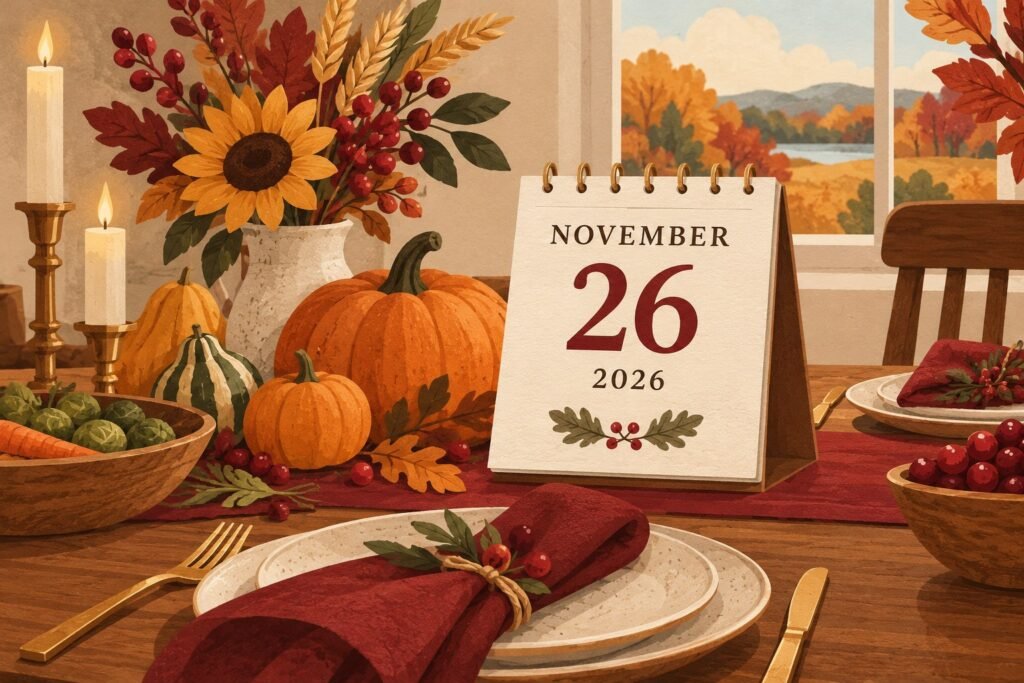
A great Thanksgiving dinner is never really cooked on Thanksgiving — it is orchestrated in the weeks before. This Thanksgiving dinner timeline is your complete countdown planner for Thursday, November 26, 2026, mapping every task from three weeks out to the moment you carve. Follow it, and instead of a frantic holiday, you get a calm one: the turkey thawed on schedule, the sides prepped in stages, the table set the night before, and you — the host — actually enjoying your own party.
Why does a timeline matter so much? Because Thanksgiving is a logistics problem disguised as a meal. A single oven must produce a turkey, multiple hot sides, and sometimes dessert. Refrigerator space vanishes. Guests arrive with dishes that need reheating. The difference between chaos and grace is simply sequencing — doing the right thing at the right time, and, just as importantly, knowing what can wait. This guide gives you that sequence, with day-by-day checklists, a minute-by-minute Thanksgiving Day schedule, contingency plans, and adaptations for small gatherings, big crowds, and first-time hosts.
How to Use This Timeline
The golden rules of Thanksgiving planning
Before the countdown begins, internalize five principles that make everything else work. First, work backward from serving time. If dinner is at 4:00 PM, the turkey must rest 30 to 45 minutes before carving, which means it comes out of the oven around 3:15, which means it goes in at a time determined by its weight and roasting method. Every task in this timeline is anchored the same way.
Second, front-load everything possible. Any task that can be done Tuesday can be done Tuesday — Wednesday-you will be grateful. Third, protect your refrigerator space like the scarce resource it is; the timeline staggers prep so you are never storing more than the fridge can hold. Fourth, write your menu down — not in your head, on paper or in a note on your phone — including who is bringing what, oven times, and serving dishes. Fifth, build in buffers: turkeys run long, guests run late, and a timeline with no slack is a timeline that breaks.
Pick your serving time and anchor everything to it
Most Thanksgiving dinners land between 2:00 PM and 5:00 PM. Earlier seatings (1:00–3:00 PM) give you a relaxed evening and align with the classic rhythm of the day; later seatings (4:00–6:00 PM) suit working guests and night owls. Whatever you choose, commit to it now and communicate it clearly on invitations — “dinner at 4:00” means guests should arrive by 3:30, not that the turkey goes in at 4:00.
Throughout this guide, schedules are written for a 4:00 PM dinner, the most common choice. If your dinner is at 3:00 PM, shift every Thanksgiving Day time one hour earlier; for 5:00 PM, shift one hour later. The relative spacing between tasks stays identical. For a deeper dive on structuring the day itself, see our companion Thanksgiving Day cooking schedule, which zooms in on the hour-by-hour oven plan.
Three Weeks Out: The Foundation (November 5–11)
Finalize the guest list and menu
Three weeks out is decision week. Confirm your guest list — not approximately, but actually: names, plus-ones, children and their ages, and any dietary restrictions or allergies. Every restriction you learn now is a crisis you avoid later. A vegan guest, a celiac cousin, a nut allergy — each one shapes the menu, and the menu shapes the shopping list, and the shopping list shapes everything.
Draft the full menu in writing: appetizers, the main protein, three to five sides, bread or rolls, desserts, and drinks. Be realistic about your oven, your skill, and your help. A first-time host attempting a brined heritage turkey, six from-scratch sides, and three pies is planning a breakdown; a first-time host doing a simple roast turkey, three reliable sides (one make-ahead), store-bought rolls, and one homemade plus one purchased dessert is planning a triumph. Our Thanksgiving dinner menu for 2026 offers a complete, balanced template you can adopt wholesale or adapt.
Order the turkey and specialty items
If you want a fresh (never frozen) turkey, order it now from a butcher or grocery — fresh birds sell out, and three weeks is the sweet spot for ordering. If you are buying frozen, you can purchase it now too; a frozen turkey keeps perfectly for months in a freezer. This is also the moment to order anything that ships: specialty ingredients, a meat thermometer if yours is unreliable, extra serving platters, or a roasting pan if you do not own one.
Take inventory of your equipment with fresh eyes. Do you own a roasting pan large enough for your turkey? A reliable instant-read thermometer? Enough serving dishes, or will you be plating mashed potatoes in a mixing bowl? Enough chairs? Make the shopping list for equipment now, while stores are fully stocked and shipping is fast. Borrow what you can — most Thanksgiving equipment is used once a year, and someone you know owns a spare roasting pan.
Checklist: three weeks out
- Guest list finalized with dietary restrictions noted
- Full menu drafted in writing
- Turkey ordered (fresh) or purchased (frozen)
- Equipment inventory done; missing items ordered or borrowed
- Serving time decided and communicated to guests
- Potluck assignments sent if guests are bringing dishes (see our guide on how to organize a Thanksgiving potluck)
Two Weeks Out: Prep and Procurement (November 12–18)
Write the master grocery list
Two weeks out, translate the menu into a complete grocery list, organized by store section and by trip. Many items — spices, canned pumpkin, broth, flour, sugar, disposable roasting pans, paper goods — can be bought now, well before the pre-Thanksgiving rush empties shelves. Perishables wait for the final shop, but everything shelf-stable should be in your pantry by the end of this week. Our detailed Thanksgiving grocery list gives you a printable, section-by-section checklist so nothing gets forgotten.
Shop strategically across two trips if you can: a big pantry-and-supplies run now, and a fresh-perishables run on Tuesday of Thanksgiving week. Buying heavy, non-perishable items early also spreads the cost across two pay cycles, which matters — see our budget Thanksgiving dinner guide for a full cost breakdown and savings strategies.
Begin the thaw if you bought frozen
This is the single most timing-critical task of the entire timeline, and the one most often botched. A frozen turkey thaws in the refrigerator at a rate of roughly 24 hours per 4 to 5 pounds (about 2 kg). That means a 20-pound turkey needs a full 5 days, and a 24-pounder needs 6. Count backward from Thanksgiving morning and mark the start-thaw date on your calendar in red. Thawing on the counter is unsafe — the exterior enters the bacterial danger zone long before the interior thaws — so the refrigerator is the only safe slow method.
| Turkey weight | Fridge thaw time | Start thawing (for Nov 26 dinner) |
|---|---|---|
| 8–12 lbs (3.5–5.5 kg) | 2–3 days | Monday Nov 23 |
| 12–16 lbs (5.5–7 kg) | 3–4 days | Sunday Nov 22 |
| 16–20 lbs (7–9 kg) | 4–5 days | Saturday Nov 21 |
| 20–24 lbs (9–11 kg) | 5–6 days | Friday Nov 20 |
If you are brining, factor that in too: a wet brine needs 12 to 24 hours in the bird’s schedule, and a dry brine needs 1 to 3 days. Both happen after thawing and before roasting, entirely inside the refrigerator. Our guide to cooking a Thanksgiving turkey covers thawing, brining, and roasting in full detail.
Checklist: two weeks out
- Pantry and non-perishable grocery run complete
- Thaw start date marked on calendar (or turkey already thawing)
- Brine plan decided; brine ingredients purchased
- Freezer audit: make room for make-ahead dishes and the thawing turkey
- Table linens washed; centerpiece plan decided
- Serving dishes assigned to each menu item (label with sticky notes)
One Week Out: The Calm Before (November 19–22)
Confirm, clean, and clear space
The week of Thanksgiving should feel like a slow exhale, not a scramble. Start by confirming the headcount — a quick message to every guest (“Still on for Thursday? Dinner at 4, come at 3:30!”) catches cancellations and surprises while there is still time to adjust quantities. If you are unsure how much food you need for your final number, our per-person quantity guide has exact charts for turkey, sides, and dessert by guest count.
Clean the refrigerator thoroughly and clear maximum space. You are about to store a thawing turkey, brining bags, prepped vegetables, and make-ahead casseroles — most hosts underestimate how much room this takes. Eat down existing leftovers, toss expired condiments, and consider stashing drinks in a cooler with ice to free a whole shelf. If you have a garage or balcony in a cold climate, it can serve as overflow cold storage for drinks and sturdy produce (never for the turkey or dairy — temperatures fluctuate too much).
Make-ahead wave one: the freezer-friendly dishes
One week out is prime time for dishes that freeze well. Pie dough can be made, wrapped, and frozen. Dinner roll dough can be shaped and frozen. Cranberry sauce — which keeps for weeks refrigerated — can be made entirely now. Stock or broth for gravy can be simmered and frozen in portions. Each of these is a gift to your future self. Our make-ahead Thanksgiving recipes guide maps every dish to its ideal prep window.
Polish the house and set the table early
Do the deep clean now — bathrooms, guest rooms, the living areas — so Thanksgiving week cleaning is just maintenance. And here is a professional host’s secret: set the table completely on the weekend before, if the dining room allows it. Plates, glasses, cutlery, linens, centerpiece — all of it. Cover it with a clean sheet to keep dust off. Walking past a set table all week builds anticipation, and it removes a dozen small tasks from the big day.
Checklist: one week out
- Headcount confirmed with all guests
- Refrigerator cleaned and cleared; overflow plan ready
- Freezer-friendly prep done (pie dough, cranberry sauce, stock)
- House deep-cleaned; table set (or linens ready)
- Wine, beer, and non-alcoholic drinks purchased
- Ice purchased or ice maker emptied into bags (you will need more than you think)
- Takeout containers or foil bought for sending guests home with leftovers
Monday–Tuesday: Final Shopping and Prep (November 23–24)
Tuesday: the big fresh shop
Tuesday is the ideal day for the fresh grocery run — close enough that produce stays crisp, early enough to beat the Wednesday crowds. Buy the turkey if you are getting fresh, plus all dairy, fresh herbs, bread, and produce. Shop with your list organized by section, and buy a little extra of the things that vanish: butter (you will use more than the recipes say), heavy cream, and fresh herbs for garnish.
When you get home, do the unglamorous work immediately: wash and chop sturdy vegetables (onions, celery, carrots for stock and stuffing), wash herbs and store them properly, and get the turkey into its brine if you are brining. A dry brine — salt and seasonings rubbed under and over the skin — needs 24 to 72 hours, so Tuesday evening is the perfect start for a Thursday dinner.
Monday–Tuesday prep tasks
- Fresh grocery shop (Tuesday ideal)
- Chop mirepoix and sturdy vegetables; store in sealed containers
- Start dry brine Tuesday evening (or wet brine Wednesday morning)
- Make pie dough if not already frozen; blind-bake crusts that need it
- Assemble casseroles that improve with an overnight rest (green bean casserole base, sweet potato casserole)
- Make cranberry sauce if not already done
- Chill wine and beverages
- Charge camera batteries; clear phone storage for photos
Wednesday: Mise en Place Day (November 25)
Wednesday is the most important prep day of the year, and its motto is simple: tomorrow you cook; today you prepare. Nothing that can be chopped, measured, mixed, or assembled should wait until Thursday. Professional kitchens call this mise en place — everything in its place — and it is the difference between a host who enjoys the day and one who survives it.
Morning: stocks, sauces, and desserts
Make the gravy base now — roast turkey wings or use the neck and giblets to make a rich stock, then build the gravy and refrigerate it. On Thursday you will whisk in the roasting-pan drippings to finish it, a two-minute job that tastes like you slaved all day. Bake pies today: pumpkin, pecan, and apple pies all hold perfectly overnight at room temperature (fruit pies) or refrigerated (custard pies like pumpkin). Assemble any casseroles that bake Thursday, cover tightly, and refrigerate.
Afternoon: vegetables, bread, and the table
Prep every vegetable that will be cooked tomorrow: peel and cut potatoes and hold them in cold water; trim green beans; cube bread for stuffing and leave it out to stale slightly (stale bread absorbs broth better). Make compound butters, whip the cream for desserts (stabilized with a little powdered sugar, it holds overnight), and set up the beverage station. Lay out every serving dish with a sticky note naming its dish — this prevents the 3:00 PM panic of “what do I put the gravy in?”
Evening: the calm checklist
- Gravy base made and refrigerated
- Pies baked and stored
- Casseroles assembled and refrigerated
- Vegetables prepped; potatoes in cold water
- Stuffing bread cubed; aromatics chopped
- Serving dishes laid out and labeled
- Table set (if not done last weekend) and centerpiece placed
- Turkey brining (or thawed and refrigerated, ready to prep)
- Trash bags in bins, recycling bin empty, dishwasher empty and ready
- Outfit chosen; phone chargers in the kitchen
- Early night — Thursday starts early
Thanksgiving Day: The Hour-by-Hour Schedule (November 26)
This schedule assumes a 4:00 PM dinner and a 14 to 16 pound turkey roasted at 165°C (325°F), which needs roughly 3 1/2 to 4 hours plus resting. Adjust backward or forward for your bird and oven using a thermometer — always the thermometer, never the clock alone — as your final authority.
| Time | Task | Notes |
|---|---|---|
| 7:30 AM | Wake up, coffee, light breakfast | Eat! You will need the energy. Pumpkin pancakes are ideal. |
| 8:00 AM | Turkey out of fridge; oven preheating | Let the bird lose its chill 30–60 min for even cooking |
| 8:30 AM | Prep and season the turkey | Pat dry, oil or butter under/over skin, season; stuff aromatics in cavity |
| 9:00 AM | Turkey goes into the oven | Legs tied, breast up; insert probe thermometer |
| 9:30 AM | Assemble anything not yet done; tidy kitchen | Stuffing assembled (bake later); salad washed |
| 10:30 AM | Baste turkey (if basting); rotate pan | Quick in-and-out to keep oven heat |
| 11:00 AM | Set out appetizers prep; chill drinks | Cheese, dips, crudités ready to plate later |
| 11:30 AM | Baste again; check turkey temp | Tent breast with foil if browning too fast |
| 12:00 PM | Lunch break for the cook | Light lunch — save room. Shower and dress now. |
| 12:30 PM | Start side dishes needing the oven | Strategy below for sharing oven with turkey |
| 1:30 PM | Mashed potatoes on the stove; rolls proofing | Potatoes can be mashed and held warm 1 hour |
| 2:00 PM | Check turkey temp; plan the exit | Target 74°C/165°F in thickest thigh |
| 2:30 PM | Guests begin arriving; appetizers out | You greet; the kitchen runs itself for 20 min |
| 3:00 PM | Turkey out; REST (tented with foil) | Rest 30–45 min — juices redistribute; do not skip |
| 3:00 PM | Casseroles and rolls into the hot oven | Oven is free and already hot — the golden window |
| 3:15 PM | Finish gravy with pan drippings | Whisk drippings into Wednesday’s gravy base |
| 3:30 PM | Carve the turkey | Carve in the kitchen; arrange on warmed platter |
| 3:45 PM | Plate everything; final garnish | Fresh herbs on top; bring dishes to table |
| 4:00 PM | Dinner is served | Sit down. Eat. You earned it. |
The oven-sharing strategy
One oven, many dishes — this is the puzzle at the heart of Thanksgiving. The solution is sequencing by temperature and timing. While the turkey roasts low and slow at 165°C (325°F), the oven is occupied; use the stovetop for mashed potatoes, gravy, and sautéed vegetables, and the microwave for quick reheats. When the turkey comes out to rest (3:00 PM), you gain a 45-minute window with a hot, empty oven: this is when casseroles, stuffing, and rolls bake at 190–200°C (375–400°F). Dishes that were assembled Wednesday go straight from fridge to oven. Anything that only needs warming can ride along on a lower rack.
Slow cookers are the secret weapon of oven logistics. Mashed potatoes hold beautifully in a slow cooker on warm for up to two hours. Mulled cider simmers away without supervision. Even stuffing can be cooked entirely in a slow cooker, freeing the oven completely. If you own one, deploy it; if a guest offers to bring one, say yes.
What the guests should (and should not) do
Guests who ask “what can I do?” are offering gold — accept it. Assign simple, non-critical tasks: filling water glasses, lighting candles, taking coats, entertaining kids, or photographing the table. Do not assign anything timing-critical or technique-sensitive to a well-meaning guest; the gravy is yours. And if guests bring dishes, have a reheating plan: label a spot in the oven schedule or the microwave queue, and ask them to bring dishes in oven-safe containers.
Timeline Variations for Different Households
The intimate dinner (2–4 guests)
Small does not mean careless — it means edited. A turkey breast or a small 8 to 10 pound bird replaces the 20-pounder; two or three sides replace five; one pie replaces three. The timeline compresses naturally: start thawing Monday, shop Tuesday, prep Wednesday, and on Thursday the turkey needs only 2 to 2 1/2 hours in the oven, so everything shifts about 90 minutes later. The real luxury of a small Thanksgiving is flexibility — you can linger over coffee, take a walk, and treat the day as a holiday rather than a production. Our Thanksgiving dinner for two guide is built exactly for this scale.
The big crowd (16–25 guests)
Large gatherings change the math, not the method. You will likely need two turkeys (or a turkey plus a ham or roast) because a single bird over 24 pounds cooks unevenly — the exterior dries before the interior finishes. Two 12 to 14 pound turkeys cook faster and more evenly than one 24-pounder, and they give you four drumsticks for the traditionalists. Borrow a second oven if possible (a neighbor’s, a countertop roaster oven), recruit a sous-chef with a written task list, and lean hard on make-ahead dishes — at this scale, at least half the menu should be fully prepped by Wednesday night. Start thawing the previous Friday, and add one extra day to every prep window.
The first-time host
If this is your first Thanksgiving, simplify ruthlessly and follow the timeline exactly — it was written with you in mind. Choose a menu of five items you have each cooked before, even if separately: roast turkey (practice the thermometer, not the bird), mashed potatoes, one roasted vegetable, store-bought rolls warmed in the oven, and one pie. Say yes to every dish a guest offers to bring. Read our first-time hosting guide for the full beginner’s playbook, including the pep talk you will need around 2:00 PM Thursday when everything feels behind (it is not behind; that feeling is traditional).
The potluck Thanksgiving
When guests bring dishes, your timeline shifts from cooking to conducting. Your jobs become the turkey, the gravy, one signature side, and logistics: confirm each guest’s dish and its reheating needs by the weekend before, assign oven slots on Wednesday, and ask everyone to bring food in oven-safe containers labeled with their name and reheating instructions. Set up a buffet rather than plating family-style — it is more forgiving of dishes arriving at different temperatures. The timeline’s Wednesday and Thursday schedules still apply to your contributions; you have simply traded cooking volume for coordination volume.
Contingency Plans: When Things Go Sideways
The turkey is still frozen Thursday morning
It happens. The cold-water thaw is your rescue: submerge the wrapped turkey in cold water in a clean sink or large pot, changing the water every 30 minutes. This thaws roughly 30 minutes per pound — a 12-pound bird in about 6 hours. Start at 6:00 AM and you can still roast by early afternoon. Never use hot water, which invites bacterial growth on the thawed exterior.
The turkey is done too early (or too late)
A turkey that finishes early is a gift, not a crisis: tent it with foil and hold it at room temperature for up to 90 minutes — the rest only improves it, and you can warm sliced meat in gravy later if needed. A turkey running late is managed with heat and physics: increase the oven to 200°C (400°F) for the final stretch, and remember that carryover cooking adds a few degrees after it comes out. If you are more than an hour behind, serve appetizers generously, pour more drinks, and carve the moment it hits temperature — hungry guests forgive late dinners served with confidence.
The oven breaks
Rare but real. A countertop roaster oven can cook a turkey beautifully (many cooks prefer it). A grill with a lid functions as an oven for the bird. Sides can be finished on the stovetop and in slow cookers. And in the true worst case, a high-quality rotisserie chicken or pre-cooked turkey breast from the store, warmed and served with excellent homemade sides and gravy, still makes a wonderful Thanksgiving — the holiday is about gathering, and no one remembers the crisis, only how the host handled it.
Key equipment fails
Thermometer dies? The old visual cues still work: juices run clear (not pink) when the thigh is pierced, and the leg wiggles freely in its joint — though a backup thermometer is a $15 insurance policy worth buying in the two-weeks-out shop. Gravy lumps? Whisk vigorously, then strain through a sieve; no one will ever know. Potatoes gluey? They were overworked — fold in extra warm butter and cream and serve them rustic-style; texture sins are forgiven under gravy.
After Dinner: The Wind-Down Timeline
The first hour: enjoy, then act
Linger at the table. Have pie. Have coffee. This unhurried stretch is the point of everything. But do not linger past 90 minutes with food sitting out: perishable food should not remain at room temperature longer than 2 hours total (1 hour if your kitchen is very warm). Set a quiet timer if you must. Our Thanksgiving food safety guide covers the full rules.
Packing leftovers like a professional
Carve all remaining turkey off the bone before storing — meat stored on the carcass dries out and takes up enormous space. Portion into shallow containers (shallow cools faster and more safely than one deep tub) and refrigerate within the 2-hour window. Save the carcass for stock: simmer it Friday morning for the best turkey noodle soup you will ever make. Send guests home with packed plates — buy extra containers for exactly this purpose — and label everything with the date. Leftovers keep 3 to 4 days refrigerated; freeze anything you will not eat by Sunday.
Friday and beyond
The day after is for leftovers creativity, not cooking: the ultimate leftover turkey sandwich, turkey pot pie, and turkey tetrazzini are all waiting. Strip and wash the linens, return borrowed equipment with a thank-you note and a container of leftovers (this guarantees you can borrow again), and write down what worked and what did not while it is fresh — next year’s timeline starts with this year’s notes.
In Pictures: Thanksgiving Dinner Timeline
A calm Thanksgiving is a planned Thanksgiving. This is what organized prep actually looks like.
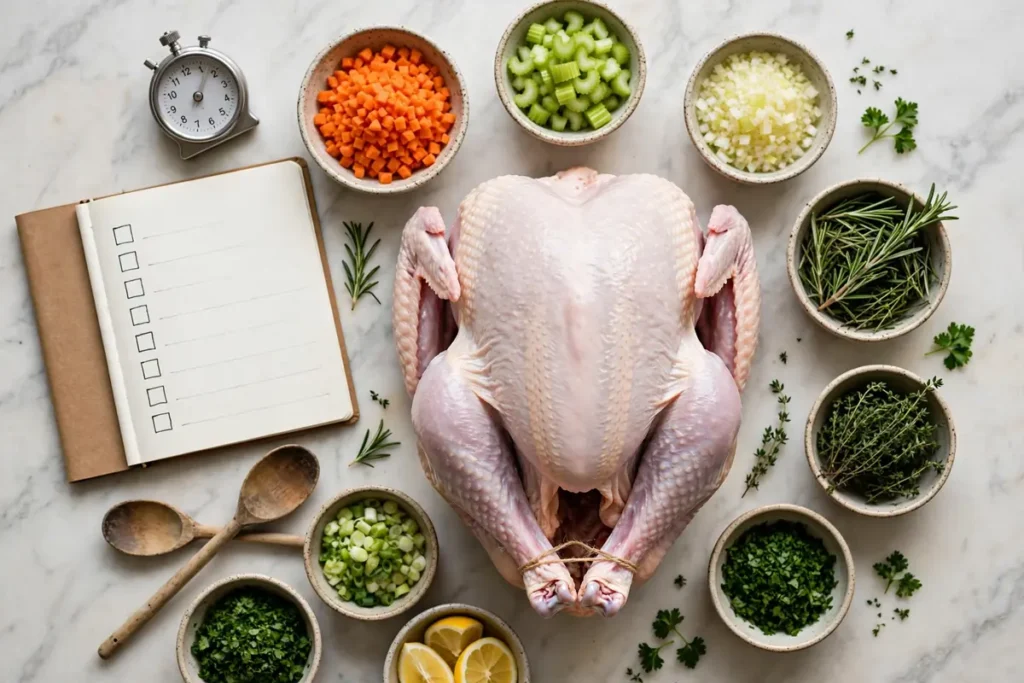
Overhead flat-lay of Thanksgiving prep organization: checklist, timer, prepped vegetables and a turkey.
Watch: Thanksgiving Dinner Timeline
Ree Drummond shares her step-by-step gameplan for the perfect Thanksgiving.
At a Glance: Thanksgiving Dinner Timeline
The key milestones of a Thanksgiving timeline, from days out to serving time.
| When | Task |
|---|---|
| 1 week out | Finalize the menu, guest count and grocery list |
| 3 days out | Thaw the turkey in the refrigerator; shop for fresh items |
| Day before | Prep sides, bake pies, brine the turkey, set the table |
| Morning of | Turkey goes in early; assemble casseroles |
| 2 hours before | Rest the turkey; reheat sides; make the gravy |
| Serving | Carve just before guests sit down for the juiciest meat |
| Turkey temp | Cook to 165°F at the thickest part of the thigh |
Frequently Asked Questions
When should I start planning Thanksgiving dinner?
Three weeks out is the ideal start for the full timeline in this guide — it gives you time to order a fresh turkey, spread costs across shops, and prep without stress. If you are starting late, do not panic: the timeline compresses well. With two weeks, skip the early equipment ordering and move straight to the two-weeks-out tasks. With one week, focus on the thaw schedule (start immediately), the Tuesday fresh shop, Wednesday mise en place, and the Thursday schedule. Even starting Wednesday, a simple menu executed from the Thursday hour-by-hour plan will work — the timeline’s core value is sequencing, and that helps at any scale.
What time should I put the turkey in the oven?
Work backward: serving time, minus 30–45 minutes of resting, minus roasting time. A 14 to 16 pound turkey at 165°C (325°F) needs about 3 1/2 to 4 hours, so for a 4:00 PM dinner it goes in around 9:00–9:30 AM. A 20 to 24 pound bird needs 4 1/2 to 5 hours, so it goes in around 7:00 AM. Always verify with an instant-read thermometer (74°C/165°F in the thickest part of the thigh), because ovens vary and stuffing, brining, and starting temperature all shift the timing. When in doubt, start earlier — a rested turkey holds beautifully, but a late turkey holds up dinner.
How far in advance can I make side dishes?
It depends on the dish, and this is exactly what the timeline staggers. Cranberry sauce: up to 2 weeks ahead (refrigerated) or months (frozen). Pie dough: 1 month frozen. Casseroles like green bean or sweet potato: assembled 1–2 days ahead, baked Thursday. Mashed potatoes: made Thursday morning and held warm up to 2 hours, or made Wednesday and reheated with extra cream. Gravy base: Wednesday, finished Thursday with drippings. Salads and fresh garnishes: Thursday only. Our make-ahead recipes guide gives every dish its ideal prep window.
How do I keep everything warm if I only have one oven?
Sequence is everything: the turkey’s 30 to 45 minute resting window frees the oven for casseroles, stuffing, and rolls at high heat. Before that, use the stovetop for potatoes, gravy, and vegetables; a slow cooker on warm for mashed potatoes or cider; and insulated carriers or towels-wrapped dishes for anything finished early. Serve on warmed plates (a quick stack in the cooling oven works) so food does not lose heat to cold china. And remember that most sides are excellent at warm-room temperature — only the turkey truly needs to be hot.
What should I do the night before Thanksgiving?
Wednesday evening is your final systems check: gravy base made, pies baked, casseroles assembled, vegetables prepped, table set, serving dishes labeled, turkey brining or thawed and ready, dishwasher empty, trash bins empty, outfit chosen. Then stop. The single most valuable thing you can do Wednesday night is sleep — Thursday rewards a rested cook far more than a midnight pie-crimping session. Set two alarms, lay out coffee supplies, and go to bed knowing that everything that could be done is done.
How do I handle guests with dietary restrictions in the timeline?
Build restrictions into the menu from the three-weeks-out stage, not as afterthoughts. The timeline-friendly approach is to make naturally accommodating dishes rather than separate meals: roast vegetables in olive oil instead of butter (vegan and dairy-free), keep nuts as a topping rather than mixed in (allergy-safe), use vegetable broth in one batch of gravy, and set aside plain portions before adding dairy or gluten. Label buffet dishes with small cards noting common allergens. And always ask about restrictions when you confirm the headcount — people are often shy about mentioning them unprompted, and knowing early lets you plan instead of improvising.
Conclusion: The Calm Is the Point
Every task in this Thanksgiving dinner timeline serves a single purpose: moving work away from Thursday so that Thursday feels like a holiday instead of a shift. The turkey ordered three weeks out, the cranberry sauce made last weekend, the gravy base waiting in Wednesday’s refrigerator, the table set and glowing — each one is a small act of kindness toward your future self.
Print this timeline, or copy it into your notes app, and check things off as you go. Adapt it freely — shift the serving time, scale the menu, swap the dishes — but keep the skeleton: decide early, shop in waves, prep on Wednesday, sequence Thursday by the clock, and rest the turkey. Do that, and when 4:00 PM arrives on November 26, you will do the thing every host dreams of: sit down at your own table, look at the people you love, and actually taste the dinner you made.
Ready for the next steps? Build your shopping list with our Thanksgiving grocery list, calculate exact quantities with our per-person food guide, and master the main event with how to cook a Thanksgiving turkey. Happy planning — and happy Thanksgiving.