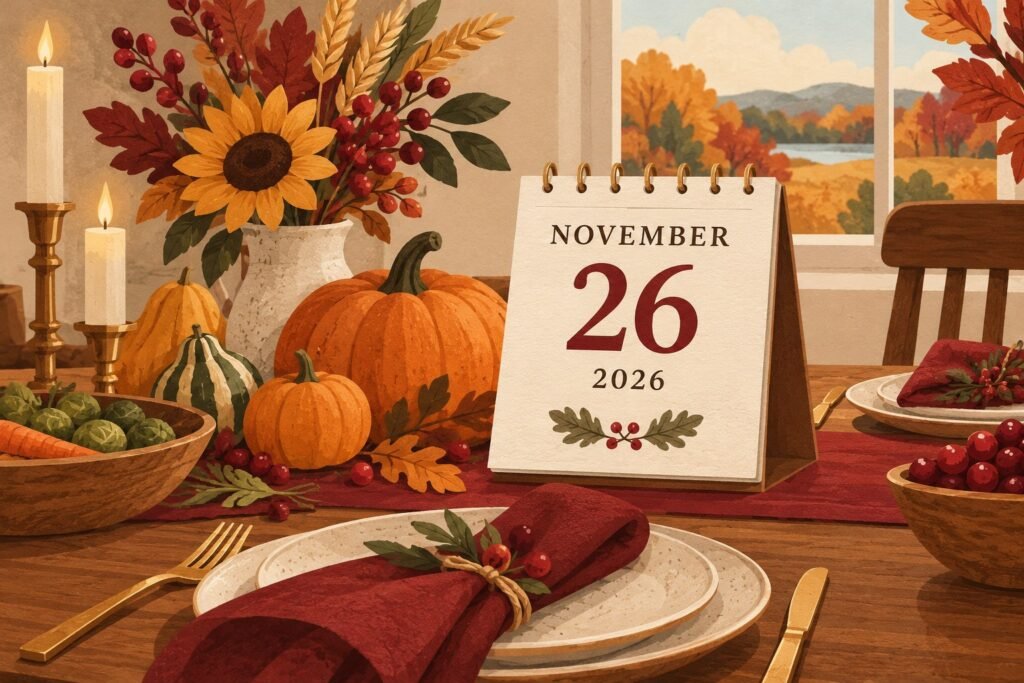
So you’ve volunteered — or been volunteered — to host Thanksgiving this year. Congratulations, and take a breath: learning how to host Thanksgiving for the first time feels enormous, but it’s really just a project with a deadline, and projects are manageable when you break them into steps. Thousands of first-time hosts pull off wonderful Thanksgivings every year, not because they’re professional chefs, but because they planned ahead, kept the menu realistic, and asked for help where it counted. This is your complete first-timer’s playbook: a week-by-week countdown from early November to the big day (Thursday, November 26, 2026), a realistic menu that won’t break you, a full hosting checklist covering guests, table, timeline, and budget, troubleshooting for everything that can go wrong, and the day-after plan nobody tells you about. Follow it, and you’ll not only survive your first Thanksgiving — you’ll enjoy it.
First Things First: The Mindset of a First-Time Host
Before the planning starts, get your head right. Three truths will carry you through.
Done is better than perfect
Your guests are coming for warmth, food, and togetherness — not a magazine spread. A slightly lopsided pie served with love beats a store-bought perfect one served with stress. Give yourself permission to be a beginner. Nobody at your table is grading you against their grandmother; they’re grateful someone cooked.
Thanksgiving is a team sport (even when you’re the host)
The biggest rookie mistake is trying to cook everything yourself. Experienced hosts delegate: assign dishes to guests, accept every offer of help, and buy what doesn’t need to be homemade (bakery rolls are not cheating — they’re strategy). A potluck-style Thanksgiving where you cook the turkey and coordinate the rest is still your Thanksgiving. Our Thanksgiving potluck organization guide shows how to delegate without chaos.
Keep the menu smaller than you think
First-time hosts routinely plan 12 dishes for 8 people. Scale it back: one centerpiece, three to four sides, one salad or appetizer, one or two desserts. That’s a full, generous Thanksgiving. Every dish you cut is an hour of your life returned and one less thing that can go wrong. You can always expand next year once you know your kitchen’s rhythm.
Your Week-by-Week Countdown
Thanksgiving rewards early birds. Here’s your timeline from three weeks out to the morning of.
Three weeks out (early November): decisions
Lock the guest list and send invitations now — a group text or email is fine. Decide the dinner time and communicate it clearly (“dinner at 4, come at 3”). Choose your menu and write it down. Take a kitchen inventory: roasting pan, meat thermometer, enough plates, glasses, cutlery, and serving dishes? Make a shopping list of equipment gaps (a $15 thermometer is the single best investment a first-time host can make). If you’re ordering a fresh turkey, order it now; if frozen, buy it now so thawing isn’t a crisis later.
Two weeks out: the big shop and the thaw plan
Buy all non-perishables: canned pumpkin, broth, flour, sugar, spices, foil, disposable containers for leftovers. Buy the frozen turkey now if you haven’t — a 12–14 pound bird needs 3 days to thaw in the fridge, so it moves from freezer to refrigerator on Sunday, November 22. Confirm dietary restrictions with guests now, not later. If guests offered dishes, assign them this week with specifics (dish, quantity, arrival time). Our Thanksgiving grocery list is built exactly for this shop.
One week out: prep begins
This is make-ahead week. Bake and freeze pie dough (or whole pies — they freeze beautifully). Make cranberry sauce (keeps a week refrigerated). Dry-brine the turkey if that’s your method (salt it 2–3 days ahead). Chop all vegetables and store them in labeled bags. Make stock for gravy. Assemble casseroles and refrigerate unbaked. Set the table now if you have the space — one less thing on Thursday. Review the make-ahead Thanksgiving recipes guide to front-load as much as possible.
Wednesday (the day before): the calm before
Wednesday is your most valuable day. Bake the pies. Assemble any remaining casseroles. Brine or season the turkey. Chill drinks. Set out serving dishes with sticky notes naming each dish. Charge your phone (you’ll need the timer). Lay out your clothes. Go to bed at a reasonable hour — Thursday starts early, and a rested host is a gracious host.
Thanksgiving morning: execution
Follow a written schedule — don’t wing it. Our Thanksgiving Day cooking schedule gives you an hour-by-hour plan from turkey-in-the-oven to dinner-is-served. Tape it to the fridge, set timers for everything, and work the plan. When in doubt, the turkey’s thermometer is the boss: 165°F in the thigh means done.
Building a First-Timer’s Menu
Your menu is the foundation. Here’s a realistic one for 8–10 guests, with notes on what to cook versus buy versus delegate.
The centerpiece: keep it simple
Roast turkey is traditional, but it’s also the hardest dish for a beginner. You have options: a whole roasted turkey (classic, impressive, very doable with a thermometer — see how to cook a Thanksgiving turkey for the full technique), a turkey breast (smaller, faster, nearly foolproof), or even a roasted chicken or ham if turkey isn’t your thing. There’s no law requiring turkey. Choose the centerpiece you’re least afraid of — confidence matters more than tradition.
Sides: the 3-plus-1 formula
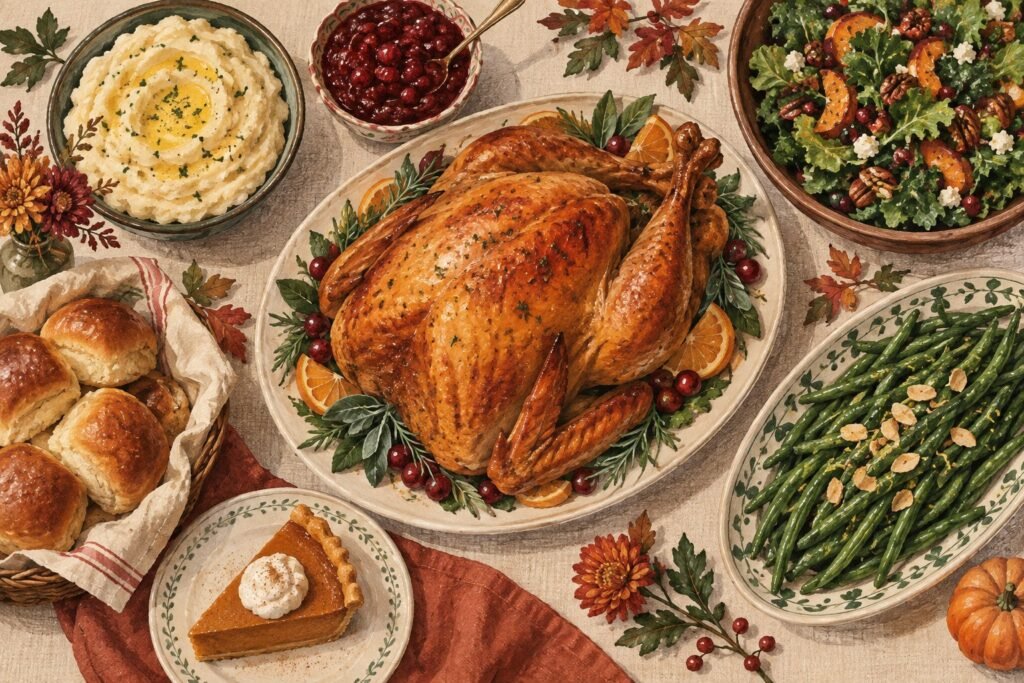
Pick three hot sides and one cold/room-temperature side. A proven first-timer combo: mashed potatoes + gravy (counts as one), bread stuffing baked separately, roasted vegetables (Brussels sprouts and carrots on one sheet pan), plus cranberry sauce (make-ahead, no stress). That’s a complete, classic plate. Our best Thanksgiving side dishes roundup offers alternatives if you want to swap one.
Appetizer and dessert: delegate or simplify
Assign the appetizer to a guest (a charcuterie board is perfect — no cooking required) and either assign dessert too or buy one excellent bakery pie plus vanilla ice cream. Nobody will judge a bakery pie; many will prefer it. If you love baking, make one pie from scratch and buy the second — balance ambition with sanity.
How much food per person
The standard planning rule: 1 to 1.5 pounds of turkey per person (bone-in), about 1 pound of total sides per person, and one pie per 6–8 guests. For 10 guests, a 14-pound turkey, 10 pounds of sides, and two pies gives you dinner plus real leftovers. Our portion planning guide has the full calculator with a handy table.
The Hosting Checklist: Guests, Table, and House
Hosting is more than cooking. This checklist covers the hospitality half.
Guest logistics
Confirm the headcount 3–4 days out (people forget to mention plus-ones). Ask about dietary restrictions, allergies, and kids’ needs when you invite, and confirm again the week of. Share practical details unprompted: parking, your address with any tricky navigation notes, what time to arrive, and whether they should bring anything. If guests are staying overnight, prep the guest room and bathroom by Wednesday — fresh towels, an empty drawer, phone chargers, and the Wi-Fi password written down.
Setting the table
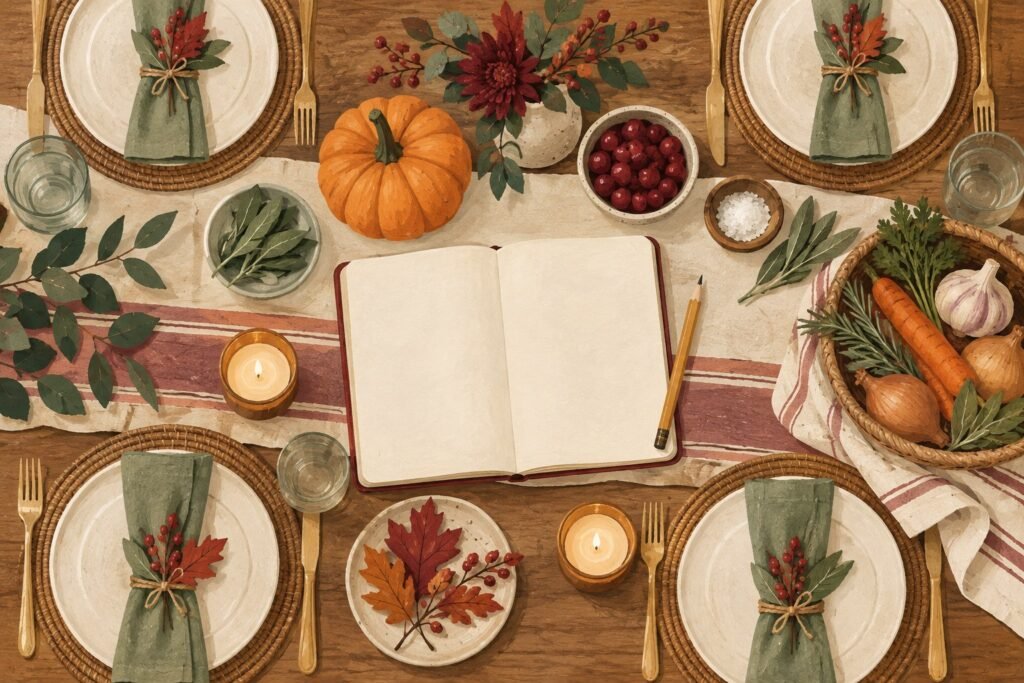
You don’t need matching china — you need enough plates. Count place settings against your guest list plus two spares. A simple, clean table beats a fussy one: a tablecloth or runner, cloth napkins if you have them (paper is fine), a low centerpiece that doesn’t block sightlines (pumpkins, eucalyptus, candles), water glasses filled before guests sit, and serving spoons in every dish. Set the table Wednesday night or Thursday morning — never during the final cooking hour.
The house
Guests notice three rooms: the entryway, the bathroom, and the dining area. Focus your cleaning there. Clear a spot for coats and bags. Put out hand towels and soap in the bathroom, empty the trash cans, and light a subtle candle (nothing overpowering near food). Background music at low volume fills awkward silences — a jazz or acoustic playlist works. And secure the pets if they’re jumpers; not every guest loves a lap dog during dinner.
Drinks station
Set up a self-serve drinks area away from the cooking zone: water, sparkling water, wine (red and white), beer, cider, and something non-alcoholic and festive like Thanksgiving mocktails or mulled cider in a slow cooker. Self-serve drinks mean you’re not playing bartender during the critical cooking window. Chill whites and sparkling well ahead; open reds 30 minutes before dinner.
Thanksgiving Day Timeline for First-Timers
Here’s a simplified day-of rhythm. (For the detailed oven-by-oven version, use the Thanksgiving dinner timeline.)
Morning: turkey in, house calm
Get the turkey in the oven on schedule (work backward from dinner time: 13 minutes per pound at 325°F plus 45 minutes rest plus 30 minutes carving). While it roasts undisturbed, eat breakfast, shower, dress, and do a final house tidy. This is your calm window — protect it.
Midday: sides assembly
Assemble casseroles, boil potatoes, prep salads. Receive guest dishes as they arrive and slot them into the plan (fridge, counter, or oven per your schedule). Put appetizers out 60–90 minutes before dinner for early arrivals.
The final hour: controlled intensity
Turkey rests (tented in foil — it stays hot). Sides rotate through the freed oven. You carve, make gravy from the drippings, and transfer everything to serving dishes. This hour is busy but short. Breathe. Set a timer for every oven item so nothing burns while you’re carving.
Dinner: you did it
Call everyone to the table, say whatever words feel right (thanks, a toast, a moment of quiet — your call), and sit down. Eat your own food while it’s hot. Accept compliments gracefully. You earned this.
Troubleshooting: When Things Go Wrong
Something will deviate from the plan. Here’s how to handle the classics.
The turkey is undercooked at serving time
Don’t carve an undercooked bird hoping for the best. Put it back in at 350°F, tented in foil, and serve appetizers to buy 30–45 minutes. Check with the thermometer — 165°F in the thigh. To avoid this, start the turkey 30 minutes earlier than the math says; an early turkey rests happily, a late turkey stresses everyone.
The turkey is dry
Gravy fixes almost everything — make plenty. Slice the breast thin against the grain, arrange it on a platter, and spoon warm gravy over the top just before serving. Next year, consider brining (wet or dry) and pulling the bird at exactly 165°F rather than overcooking “to be safe.”
A side dish is ruined or forgotten
Skip it without apology, or pivot: burnt rolls become croutons for salad, lumpy gravy gets whisked with a splash of cream or strained, a forgotten casserole becomes tomorrow’s lunch. Nobody remembers the missing dish; everybody remembers a relaxed host. Never announce the disaster at the table — just serve what worked.
Too many cooks / kitchen crowding
Assign would-be helpers specific jobs away from the stove: setting the table, arranging the drinks station, taking coats, entertaining kids. A small kitchen with four “helpers” is a hazard; one helper with a defined task is a gift. It’s okay to say, lovingly, “I’ve got the kitchen — could you handle the drinks?”
Guest conflicts or awkward moments
Seat potential friction apart, keep the conversation flowing with a toast or a round of “what are you grateful for,” and have an activity ready for the post-dinner lull (a walk, a board game, football). As host, you’re the thermostat — your calm sets the room’s temperature.
Budget: Hosting Thanksgiving Without Breaking the Bank
A first Thanksgiving doesn’t have to be expensive. A turkey for 10 costs less than most people fear, and the biggest savings come from strategy, not sacrifice.
Where the money goes
The turkey is typically the single biggest expense, followed by wine and specialty ingredients. Everything else — potatoes, vegetables, flour, canned goods — is cheap in November when stores compete for holiday shoppers. Watch for loss-leader turkey sales in the two weeks before Thanksgiving; many stores discount birds steeply to get you in the door.
Five real money-savers
One: go potluck for sides and desserts — you cook the turkey, guests bring the rest. Two: buy store brands for staples (flour, sugar, broth, canned pumpkin are identical in blind tests). Three: bake from scratch instead of buying pre-made — a homemade pie costs a few dollars versus $15+ bakery. Four: limit the alcohol to wine and beer rather than a full bar. Five: borrow equipment (roasting pan, extra chairs) instead of buying. Our budget Thanksgiving dinner guide breaks down a full cost-saving plan.
The Day After: Leftovers and Recovery
Thanksgiving doesn’t end at dessert. Plan the after.
Leftover strategy
Refrigerate all perishables within 2 hours of serving — set a timer so the post-dinner conversation doesn’t make you forget. Portion leftovers into meal-sized containers (future you will be grateful). Turkey keeps 3–4 days refrigerated; freeze what you won’t eat by Sunday. Our food safety guide covers storage times for every dish.
Cleanup triage
Don’t deep-clean Thursday night. Scrape and stack dishes, soak the roasting pan, wipe counters, take out trash, and run the dishwasher. The detailed cleaning — polishing silver, mopping — waits for the weekend. Accept help with dishes; many guests genuinely want to contribute, and a 20-minute group effort beats an hour alone.
Rest and reflect
Friday is for leftovers, naps, and zero obligations. Jot down notes while it’s fresh: what worked, what you’d change, which dishes were hits, how the timing felt. Next year’s Thanksgiving just got easier — and yes, after pulling this off, there will be a next year. You’ve joined the ranks of Thanksgiving hosts.
The Night-Before Confidence Checklist
Wednesday evening, run through this list and you’ll sleep well.
Kitchen readiness
Turkey seasoned or brining in the fridge. Pies baked and cooling. Casseroles assembled and refrigerated. Vegetables chopped and bagged. Serving dishes laid out with sticky-note labels. Roasting pan, thermometer, carving knife, and foil within reach. Trash bags and leftover containers staged. Dishwasher empty and ready for the morning’s prep bowls.
House and table readiness
Table set (or linens and settings staged to set in the morning). Drinks chilled. Bathroom clean with fresh towels. Entryway cleared for coats. Phone chargers accessible. Playlist queued. If overnight guests are coming, their room is made and the Wi-Fi password is written down. Lay out your own clothes — one less decision on a busy morning.
In Pictures: How to Host Thanksgiving for the First Time
First time hosting? Deep breath — with a plan, it is far more fun than it is scary.
A first-time host presenting a roasted turkey to family around a decorated table.
Watch: How to Host Thanksgiving for the First Time
NYT Cooking's Melissa Clark shares eight brilliant tips for hosting Thanksgiving.
At a Glance: How to Host Thanksgiving for the First Time
The first-timer's checklist, from guest count to the calm moment before serving.
| Detail | Tip |
|---|---|
| Guest count | Confirm numbers a week out so you can plan quantities |
| Menu | Keep it to one showpiece plus 4–5 sides you trust |
| Timeline | Work backward from serving time; write it down |
| Table | Set it the night before to free up the morning |
| Delegating | Let guests bring sides, drinks or dessert |
| Day-of calm | Build in 30 buffer minutes — something always runs long |
Frequently Asked Questions
How far in advance should I start planning my first Thanksgiving?
Start major decisions (guest list, menu, turkey order) three weeks out, in early November. Two weeks out, do the big non-perishable shop. One week out, begin make-ahead prep. This pacing spreads the work so no single day is overwhelming. If you’re starting late, prioritize in this order: turkey plan, guest count, menu, shopping — everything else is flexible.
What size turkey do I need for my first Thanksgiving?
Plan 1 to 1.5 pounds of bone-in turkey per person. For 8 guests, a 10–12 pound bird; for 10–12 guests, a 14–16 pounder. When in doubt, size up slightly — leftover turkey is a feature, not a bug. A smaller bird also cooks faster and more evenly, which is a genuine advantage for a first-timer.
Should I brine my turkey?
Brining (wet or dry) improves juiciness and is very beginner-friendly — a dry brine is just salting the bird 1–3 days ahead, no bucket required. But it’s optional. A well-cooked unbrined turkey with good gravy beats a brined turkey that’s overcooked. If brining adds stress, skip it this year and focus on nailing the temperature.
How do I keep everything warm when I only have one oven?
Sequence, don’t stack: turkey roasts in the morning, rests while sides bake. Hold mashed potatoes in a slow cooker on warm, tent casseroles in foil, and keep gravy on the stove’s lowest heat. Dishes served at room temperature (salads, cranberry sauce, bread) need no oven at all. A detailed rotation is in our Thanksgiving Day cooking schedule.
What if a guest has a dietary restriction I didn’t plan for?
Ask about restrictions when you invite — this prevents 99% of problems. If one surfaces late, adapt what you can (set aside plain roasted vegetables before adding butter, keep gravy separate) and don’t panic about perfection. A simple, honest effort plus one safe dish is always enough. For plant-based guests, our vegetarian Thanksgiving recipes offer easy additions.
Is it okay to ask guests to bring dishes to my first Thanksgiving?
Absolutely — it’s smart hosting, not a failure. Frame it warmly when you invite: “I’m cooking the turkey and would love contributions — can you bring a side or dessert?” Most guests are delighted to contribute; it makes them feel part of the day rather than just consumers of your labor. Assign specific categories to avoid five desserts.
Conclusion
Learning how to host Thanksgiving for the first time is really learning three skills: planning ahead, keeping the menu realistic, and letting people help. Start three weeks out, cook the turkey with a thermometer as your co-pilot, delegate boldly, and remember that your guests came for you — not for perfection. On November 26, 2026, when everyone’s seated and the platters are empty, you’ll know something experienced hosts have known forever: the best Thanksgiving isn’t the flawless one. It’s the one where the host got to sit down too. Keep this playbook, annotate it with what you learned, and pull it out next November — your second Thanksgiving will feel like a victory lap.