The secret of every relaxed Thanksgiving host is not talent or a bigger kitchen — it is timing. Make ahead Thanksgiving recipes let you spread the work of the biggest meal of the year across days instead of cramming it into a single frantic morning. Done right, you can walk into Thanksgiving Day with the cranberry sauce finished, the pies baked, the casseroles assembled, the gravy base simmered, and the turkey brining — leaving Thursday for the joyful parts: roasting, reheating, and actually enjoying your guests.
This is a complete strategy guide, not just a recipe list. You will learn the food science of what makes a dish make-ahead friendly, a master calendar that maps every classic Thanksgiving dish to its ideal prep window, detailed make-ahead methods for each course, storage and reheating instructions that protect texture and flavor, and the dishes you should never make ahead (and what to do instead). Whether Thanksgiving 2026 is your first time hosting or your thirtieth, this guide will change how the holiday feels.
The Science of Make-Ahead Cooking
What makes a dish make-ahead friendly?
Three qualities determine whether a dish improves, survives, or suffers from advance preparation. First is moisture stability: dishes with stable moisture — braises, casseroles bound with sauce, cranberry sauce — hold beautifully, while dishes that rely on crispness or delicate emulsions degrade. Second is flavor development over time: many dishes genuinely taste better after a rest, as flavors meld and deepen. Cranberry sauce, brined turkey, pie dough, and gravy all improve with time. Third is reheat tolerance: can the dish be brought back to serving temperature without overcooking? Dense, saucy dishes reheat gracefully; delicate proteins and fried foods do not.
Food safety underpins all of it. Cooked food must be cooled quickly (within 2 hours) and refrigerated at or below 4°C (40°F); reheated food should reach 74°C (165°F) throughout. Shallow containers cool faster than deep ones — spread hot food in a thin layer if you are in a hurry. These are not fussy rules; they are the reason your make-ahead feast is safe as well as delicious. Our Thanksgiving food safety guide covers the complete rules.
The three make-ahead methods
Every make-ahead recipe uses one of three strategies. Fully cook and store works for dishes served at room temperature or reheated well: cranberry sauce, pies, gravy base, dinner rolls. Assemble and bake later is ideal for casseroles and stuffing: you do all the chopping, mixing, and layering on Wednesday, then bake fresh on Thursday for that just-cooked taste with a fraction of the work. Prep components means doing the knife work, measuring, and partial cooking in advance — chopped vegetables, cubed bread, toasted nuts, compound butter — so Thursday cooking becomes simple assembly.
The most powerful approach combines all three across the menu: fully cook what holds well, assemble what bakes well, and component-prep the rest. A typical optimized menu might have cranberry sauce and pies fully done, two casseroles assembled, vegetables chopped, bread cubed, gravy based, and the turkey brined — leaving Thursday for roasting, baking, mashing, and reheating. That is a genuinely manageable day.
The Master Make-Ahead Calendar
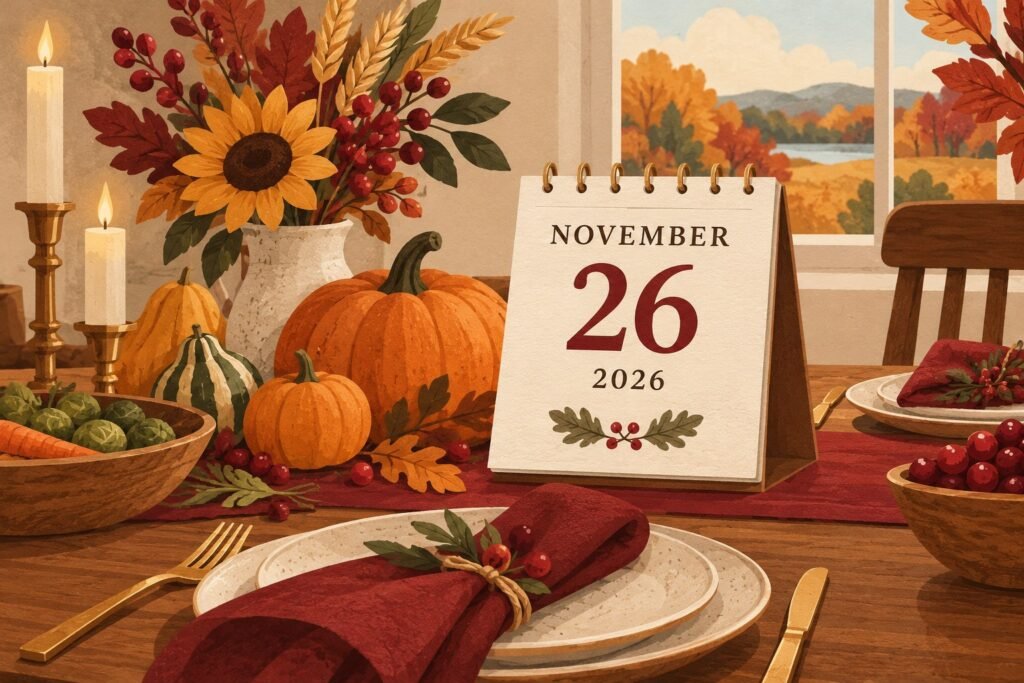
Thanksgiving 2026 falls on Thursday, November 26. Here is when to make everything, working backward from the holiday.
| Dish | Best prep window | Method | Storage |
|---|---|---|---|
| Pie dough | Up to 1 month ahead | Make, wrap, freeze | Freezer; thaw overnight in fridge |
| Cranberry sauce | Up to 2 weeks ahead | Fully cook | Refrigerator in sealed jar |
| Turkey stock / gravy base | Up to 1 week ahead | Fully cook, freeze or refrigerate | Freezer up to 3 months |
| Dinner rolls (dough) | Up to 1 month ahead | Shape, freeze unbaked | Freezer; thaw and proof Thursday |
| Compound butter | Up to 1 week ahead | Fully make | Refrigerator, rolled in parchment |
| Vegetables (chopped) | 2–3 days ahead | Component prep | Sealed containers, refrigerator |
| Stuffing / dressing | 1 day ahead | Assemble, bake Thursday | Covered, refrigerator |
| Sweet potato casserole | 1–2 days ahead | Assemble, bake Thursday | Covered, refrigerator |
| Green bean casserole | 1 day ahead | Assemble without topping; bake Thursday | Covered, refrigerator |
| Mashed potatoes | 1 day ahead | Fully cook, reheat gently | Refrigerator; reheat with cream |
| Pies (baked) | 1 day ahead | Fully bake | Room temp (fruit) or fridge (custard) |
| Gravy (finished) | Thursday | Finish with drippings | Serve immediately |
| Turkey | Thursday | Roast fresh | — |
| Fresh salads | Thursday | Assemble last minute | — |
Course-by-Course Make-Ahead Guide
Cranberry sauce: the make-ahead champion
If you make one thing ahead, make it cranberry sauce. It keeps for two weeks refrigerated and actually improves as the flavors meld — the tartness rounds out, the spices bloom, and the texture sets into a perfect gel. Combine 340 g (12 oz) fresh cranberries, 200 g (1 cup) sugar, and 240 ml (1 cup) water or orange juice; simmer 10 minutes until the berries burst; cool and jar. Variations — orange zest, a cinnamon stick, a splash of port, diced pear — all hold equally well. Make it the weekend before and cross it off the list with satisfaction.
Gravy: the two-stage method
Gravy is the dish hosts fear most and the one that benefits most from staging. On Tuesday or Wednesday, roast turkey wings (or the neck and giblets) with onion, carrot, and celery until deeply browned, then simmer into a rich stock for 2 to 3 hours. Build the gravy base: make a roux, whisk in the stock, season boldly, and refrigerate. On Thursday, after the turkey comes out, pour the roasting-pan drippings through a fat separator into your base, whisk, simmer 5 minutes, and adjust seasoning. The result tastes like all-day gravy because the flavor work was done across two days. The base also freezes perfectly for up to 3 months — ambitious cooks make it in October.
Mashed potatoes: the reheating trick
Mashed potatoes have an unfair reputation as a day-of-only dish. Made Wednesday and reheated properly, they are indistinguishable from fresh. The keys: use Yukon Gold or russet potatoes, mash while hot with warmed butter and cream (cold dairy makes gluey potatoes), and slightly under-season — you will adjust after reheating. Cool quickly, refrigerate in a covered dish, and reheat gently: in a slow cooker on low for 2 hours, in a double boiler, or in a 165°C (325°F) oven covered with foil, stirring in warm cream and butter to restore silkiness. Never microwave a giant bowl at once — the edges overcook while the center stays cold. For the full technique, see our Thanksgiving side dishes collection.
Stuffing and dressing: assemble Wednesday, bake Thursday
Stuffing is the ideal assemble-ahead dish because its flavors genuinely improve overnight — the bread absorbs the seasoned broth, the aromatics permeate everything, and Thursday’s bake finishes it with a crisp top. Cube and dry the bread (stale or lightly toasted), sauté the aromatics, combine everything with broth and eggs, and refrigerate the assembled dish covered. On Thursday, let it sit at room temperature 30 minutes while the oven heats, then bake as usual, adding 5 to 10 minutes to account for the cold start. Food safety note: never stuff the turkey the night before — assemble the dressing separately and bake it in a dish.
Sweet potato casserole and green bean casserole
Both classics follow the same pattern: build the base Wednesday, add the topping Thursday. For sweet potato casserole, mash the sweet potatoes with butter, brown sugar, and spices, spread in the baking dish, cover, and refrigerate; add the pecan streusel or marshmallow topping just before baking so it stays crisp and distinct. For green bean casserole, blanch the beans and make the mushroom sauce Wednesday, combine and refrigerate; add the crispy fried onions only before baking — stirred in early, they turn soggy and sad. Both bake at 175–190°C (350–375°F) for 25 to 35 minutes until bubbling.
Pies: bake Wednesday, serve Thursday
Almost all Thanksgiving pies are better made the day before. Pumpkin and other custard pies need hours to set properly — a pumpkin pie baked Wednesday evening slices cleanly Thursday, while one baked Thursday morning may still be wobbly at serving time. Fruit pies hold perfectly at room temperature overnight; their filling sets and the flavors meld. Pecan pie, with its dense filling, is ideal made ahead. Store custard pies refrigerated, fruit pies at cool room temperature covered loosely. Make whipped cream Thursday (stabilized with powdered sugar it can be made Wednesday), and no one will ever guess the pies are not oven-fresh.
Dinner rolls: freeze the dough
Fresh-baked rolls are a luxury that seems incompatible with a busy Thursday — unless the dough is waiting in the freezer. Mix, knead, shape, and freeze rolls on a sheet pan up to a month ahead; transfer to a bag once solid. Wednesday night, move them to the refrigerator to thaw; Thursday morning, let them proof at room temperature 1 to 2 hours until puffy, then bake. Alternatively, bake rolls fully up to a day ahead and refresh in a hot oven for 5 minutes before serving — the crust re-crisps beautifully.
The turkey: brine ahead, roast fresh
The turkey itself cannot be cooked ahead — reheated whole turkey is dry turkey — but everything around it can be staged. A dry brine (salt and herbs rubbed over and under the skin) started Tuesday or Wednesday seasons the meat deeply and helps the skin crisp; a wet brine started Wednesday morning does the same with added moisture. Both are entirely hands-off refrigerator time. You can also break down prep: make an herb butter compound days ahead, ready to slip under the skin Thursday morning. For the complete roasting method, see how to cook a Thanksgiving turkey.
Appetizers and salads
Dips, cheese balls, and spreads are natural make-ahead candidates — most improve after a day for flavors to marry. Our cheese ball recipe and baked brie with cranberry both work beautifully prepped ahead (assemble the brie, bake Thursday). Wash and chop salad greens and sturdy vegetables Wednesday; store greens with a paper towel in a sealed container. Dress salads at the last minute — no exceptions.
Dishes You Should Never Make Ahead
Honesty requires the other side of the ledger. Some dishes simply do not survive advance preparation, and knowing which ones saves you from disappointment.
The do-not-make-ahead list
- The roast turkey itself. A whole roasted turkey held overnight and reheated dries out badly. Roast it Thursday, always. (Sliced leftover turkey reheated gently in gravy is a different story — that is delicious.)
- Fried anything. Fried onions for topping, fried appetizers, crispy shallots — frying is a last-minute act. The coating goes limp within an hour.
- Dressed green salads. Dressing wilts greens in minutes. Prep components; dress at the table.
- Whipped cream (unstabilized). Plain whipped cream weeps within hours. Stabilize with powdered sugar or a little mascarpone for make-ahead, or whip Thursday.
- Delicate fish or seafood appetizers. Shrimp cocktail can be cooked ahead, but assemble and chill — the texture suffers after 24 hours dressed.
- Meringue toppings. Weep and shrink overnight. If a pie needs meringue, it is a Thursday pie.
Smart swaps for Thursday-only dishes
When a dish cannot be made ahead, component-prep it instead. Salad: wash, chop, and store components; whisk the dressing and jar it; combine Thursday. Fried garnishes: slice shallots Wednesday and store in water in the fridge; fry Thursday in 5 minutes. The principle holds: if you cannot finish it early, you can almost always start it early.
Storage and Reheating: Protecting Your Work
Cooling and storing rules
The danger zone — 4°C to 60°C (40°F to 140°F) — is where bacteria multiply rapidly, so hot food must pass through it quickly. Divide large batches into shallow containers no more than 5 cm (2 inches) deep; a big pot of mashed potatoes left to cool on the counter is a food safety failure, while the same potatoes in two shallow dishes are fine. Refrigerate within 2 hours of cooking. Label everything with the dish name and date — by Wednesday night your fridge will be a landscape of identical foil-covered dishes, and labels are the only map.
Reheating methods ranked
| Method | Best for | Temp / time | Watch out for |
|---|---|---|---|
| Oven, covered with foil | Casseroles, stuffing, rolls | 165°C/325°F, 20–30 min | Remove foil last 10 min to re-crisp tops |
| Slow cooker on low | Mashed potatoes, mulled cider, gravy | 2–3 hours, stir occasionally | Edges can scorch; stir and add liquid |
| Stovetop, gentle heat | Gravy, cranberry sauce, soups | Low, stirring, to simmer | Whisk gravy to prevent lumps |
| Double boiler | Mashed potatoes (delicate) | Steam heat, 20–30 min | Slow but foolproof against scorching |
| Microwave | Small portions only | 50% power, stir halfway | Uneven heating; rest 2 min after |
The universal reheating rule: bring everything to steaming hot — 74°C (165°F) — throughout, not just on the surface. A food thermometer is as useful on Thursday as it is for the turkey. And add moisture when reheating: a splash of broth into stuffing, cream into potatoes, a knob of butter onto casseroles under the foil. Reheated food loses moisture; you are simply giving it back.
Freezer strategy for the ambitious
The freezer is a time machine for October and early-November cooking. Pie dough, dinner roll dough, turkey stock, gravy base, cranberry sauce, and even fully baked (unfrosted) dinner rolls freeze beautifully for 1 to 3 months. Freeze in portion-sized flat bags for fast thawing, press out air, label with contents and date, and thaw overnight in the refrigerator — never on the counter. A host who freezes strategically in early November faces Thanksgiving week with a shocking sense of calm.
Three Sample Make-Ahead Menus
Menu 1: The classic (serves 8–10)
- Weekend before: Cranberry sauce (fully made). Pie dough (made and frozen).
- Tuesday: Turkey stock simmered; gravy base built and refrigerated. Compound herb butter made.
- Wednesday: Pies baked. Stuffing assembled. Sweet potato casserole assembled (no topping). Green bean casserole base assembled. Vegetables chopped. Rolls thawing in fridge.
- Thursday: Turkey roasted. Casseroles baked. Potatoes mashed. Gravy finished with drippings. Rolls baked. Salad assembled. Pies served.
Menu 2: The crowd (serves 16–20)
Double the classic quantities and add a second protein (a glazed ham, fully cooked and just reheated — hams are the ultimate make-ahead main). Add one more assembled casserole and a big-batch appetizer like Thanksgiving charcuterie board components prepped Wednesday. Deploy the slow cooker for mashed potatoes and recruit one helper with a written Thursday task list. Everything else follows Menu 1’s rhythm — the calendar does not change, only the volume.
Menu 3: The streamlined (serves 4–6, minimal stress)
- Weekend before: Cranberry sauce made. One pie dough frozen.
- Wednesday: Pie baked. Vegetables chopped. Potatoes peeled and held in water. Gravy base made (small batch).
- Thursday: Small turkey or turkey breast roasted. Potatoes mashed fresh (a small batch takes 25 minutes). One roasted vegetable. Gravy finished. Store-bought rolls warmed. Pie served.
This menu involves roughly 90 minutes of Wednesday work and a relaxed Thursday — proof that make-ahead strategy scales down as well as up. Pair it with our Thanksgiving dinner timeline for the full countdown and our Thanksgiving grocery list to shop it all in one trip.
Make-Ahead Breakfast Bonus
Do not forget Thanksgiving morning itself. A host who has prepped dinner ahead still needs breakfast, and the same principles apply. Our overnight French toast casserole is assembled Wednesday night and baked Thursday morning while the turkey rests — it is the flagship make-ahead breakfast. Cinnamon rolls can be shaped and refrigerated overnight for a slow cold proof, then baked fresh. Pumpkin pancakes work from a dry-mix jar prepared weeks ahead. Feed yourself well; the day is long.
In Pictures: Make-Ahead Thanksgiving Recipes
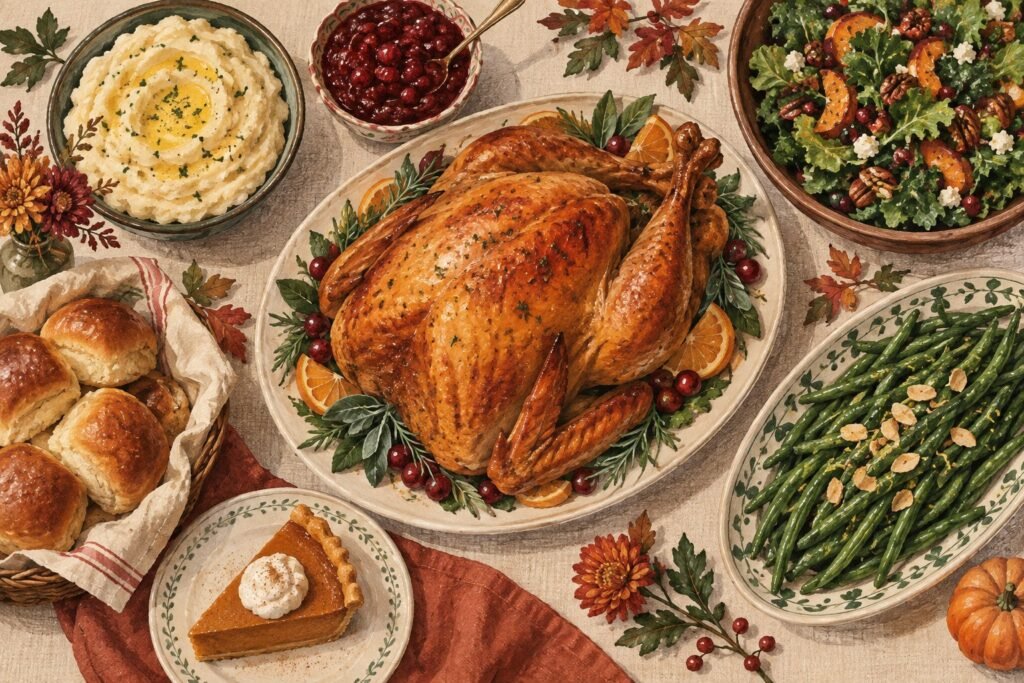
The secret to a relaxed Thanksgiving? Half the cooking happens before the big day even starts.
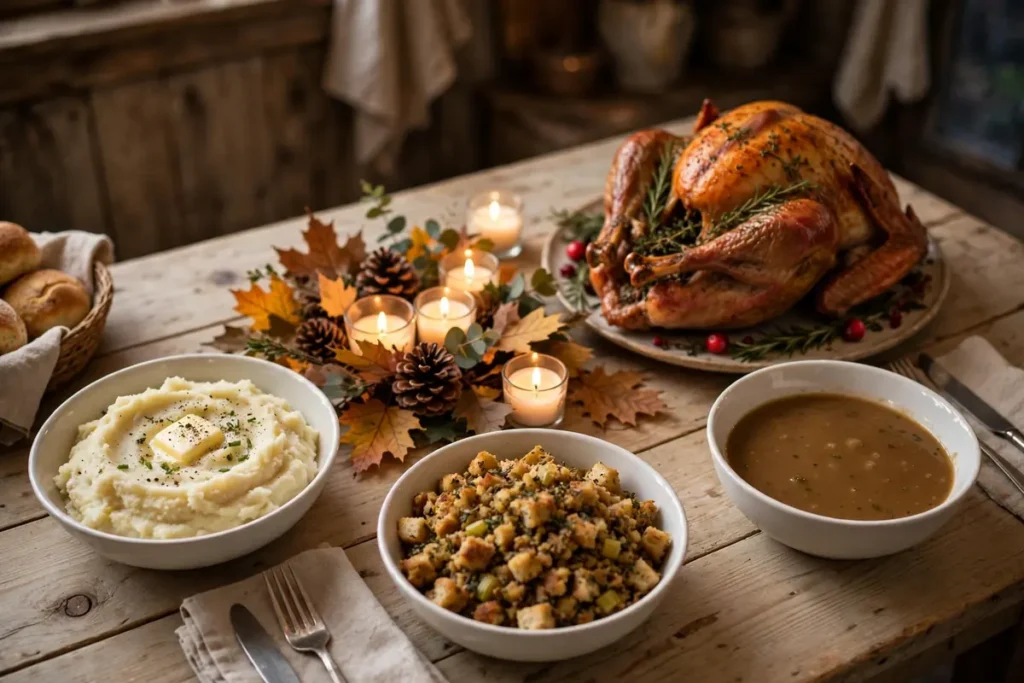
Make-ahead Thanksgiving prep: labeled containers of sides, a covered pie and rolled dough on a counter.
Watch: Make-Ahead Thanksgiving Recipes
Ree Drummond makes a make-ahead Thanksgiving turkey on Food Network — proof the bird can be prepped early.
At a Glance: Make-Ahead Thanksgiving Recipes
What can be made ahead, and how far in advance each part of the feast holds up.
| Dish | Make-ahead window |
|---|---|
| Turkey | Brine 1–2 days ahead; roast day-of for best texture |
| Gravy | Make up to 3 days ahead; refresh with pan drippings |
| Mashed potatoes | Prep 1–2 days ahead; reheat with a splash of milk |
| Stuffing | Assemble a day ahead; bake before serving |
| Pies | Bake 1–2 days ahead; most keep well chilled |
| Rolls | Shape and refrigerate overnight; bake fresh |
| Cranberry sauce | Keeps up to a week refrigerated — make it early |
Frequently Asked Questions
How many days in advance can I start making Thanksgiving dinner?
Up to a month for freezer-friendly items like pie dough, roll dough, and turkey stock. Two weeks for cranberry sauce. One week for gravy base and compound butters. Two to three days for chopped vegetables. One day (Wednesday) for the big push: assembled casseroles, baked pies, prepped vegetables, and finished sauces. Thursday is for roasting the turkey, baking assembled dishes, mashing potatoes, finishing gravy, and assembling salads. This staged approach means no single day carries more than a few hours of work.
Can I make mashed potatoes the day before?
Yes — they reheat beautifully if you follow three rules. First, use starchy potatoes (russet or Yukon Gold) and mash them while hot with warmed butter and cream. Second, slightly under-season, since flavors concentrate overnight and you will adjust after reheating. Third, reheat gently — slow cooker on low, double boiler, or covered in a 165°C (325°F) oven — stirring in warm cream and butter to restore the silky texture. Avoid the microwave for large batches, and never reheat them twice.
Is it safe to assemble stuffing the night before?
Yes, with one critical rule: assemble and refrigerate the stuffing separately — never stuff the turkey the night before. A stuffed bird sitting overnight is a food safety hazard because the dense, moist stuffing cools slowly and warms slowly, spending too long in the bacterial danger zone. Assembled dressing in a baking dish, refrigerated promptly and baked Thursday to 74°C (165°F) throughout, is perfectly safe and actually tastes better after the overnight rest.
How do I reheat everything without drying it out?
Moisture and gentleness are the whole game. Reheat covered (foil or lids trap steam), at moderate temperatures (165°C/325°F for the oven), and add liquid back: broth into stuffing and casseroles, cream into potatoes, a drizzle of melted butter over rolls before warming. Bring dishes to room temperature for 30 minutes before reheating so they warm evenly. Finish uncovered for the last 10 minutes to re-crisp toppings. And use a thermometer — food is done reheating at 74°C (165°F) throughout, and pulling it then (not later) is what keeps it moist.
What is the single best make-ahead dish for a first-time host?
Cranberry sauce. It is nearly impossible to mess up (cranberries, sugar, liquid, simmer 10 minutes), it keeps for two weeks, it improves with age, it frees up zero Thursday time, and homemade cranberry sauce impresses guests far beyond its effort. A close second is the gravy base — conquering gravy on Wednesday removes the single most stressful Thursday task. Do those two, and you will feel like a different cook.
Can I freeze a whole Thanksgiving dinner?
Individual components, yes; the assembled feast, no. Freeze pie dough, roll dough, stock, gravy base, cranberry sauce, and even baked casseroles (without crispy toppings) for up to 3 months. Do not freeze the roast turkey whole with the intent to serve it reheated as the centerpiece — the texture suffers badly. Do freeze leftover sliced turkey in gravy or broth; it reheats moist and makes superb turkey pot pie and turkey noodle soup later.
Conclusion: Cook Smarter, Celebrate More
Make ahead Thanksgiving recipes are not about cutting corners — they are about redistributing effort so the holiday feels like a celebration instead of a endurance test. Every dish you finish on Tuesday or Wednesday is a gift of time to Thursday-you: time to greet guests at the door instead of hovering over the stove, time to sit down at the table instead of ferrying dishes, time to actually taste the meal you worked so hard to create.
Start this weekend. Make the cranberry sauce. Freeze the pie dough. Simmer the stock. Feel the quiet satisfaction of a refrigerator filling up with readiness. By the time Thursday, November 26 arrives, you will understand what experienced hosts have always known: the best Thanksgiving dinner is the one that was mostly finished before the day even began.
Plan the full sequence with our Thanksgiving dinner timeline, shop it with our Thanksgiving grocery list, and portion it with our per-person quantity guide. And when the big day comes, our turkey cooking guide will walk you through the main event.