There are few smells on earth as powerful as cinnamon rolls baking in the oven — warm yeast, melting butter, caramelizing brown sugar, and cinnamon blooming in the heat. On Thanksgiving morning, that smell is a promise: the day will be good. Homemade cinnamon rolls, soft and pillowy with gooey centers and cream cheese frosting melting into every swirl, are the holiday breakfast worth planning around. They take time, yes — but almost all of it is waiting while the dough rises, and the overnight method in this guide moves every bit of active work to the evening before.
This is a complete baking masterclass, not just a recipe. You will learn how to make cinnamon roll dough that is tender rather than bready, how to roll and slice for perfect spirals, how to nail the overnight rise so the rolls bake fresh on Thanksgiving morning, how to make frosting that melts rather than sits, and how to troubleshoot every common failure — dense rolls, dry rolls, filling that leaks, centers that stay raw. By the end, you will understand cinnamon rolls deeply enough to improvise your own variations with confidence.
What Makes a Great Cinnamon Roll
Before touching flour, it helps to define the target. A great cinnamon roll has four qualities:
- A soft, tender crumb — pillowy and slightly chewy, never bready or dense. This comes from enriched dough (milk, butter, eggs, sugar) and from not overworking or overbaking it.
- A gooey, caramelized center — the filling should melt into a sticky, buttery swirl, not leak out onto the pan or bake into a dry stripe. Butter quantity and tight rolling control this.
- Distinct, even spirals — clean layers that pull apart in ribbons. This is about rolling technique and slicing method, both covered below.
- Balanced sweetness — sweet enough to feel like a treat, with the tang of cream cheese frosting cutting the richness. Over-sugared rolls taste one-dimensional.
Every technique in this guide serves one of those four goals. Keep them in mind and the “why” behind each step will make sense.
Understanding the Dough: Enriched Yeast Basics
Cinnamon roll dough is an enriched dough — flour, yeast, and water plus generous amounts of fat (butter), sugar, eggs, and milk. Enrichment is what makes the crumb tender and flavorful, but it also makes the dough slower and fussier than lean bread dough. A few principles:
Yeast: Active Dry vs. Instant
Both work. Instant yeast (also sold as rapid-rise or bread-machine yeast) can be mixed directly into the dry ingredients — no proofing required — and it works slightly faster. Active dry yeast should be dissolved in warm liquid first. This recipe is written for instant yeast with a note for active dry. One packet (2 1/4 teaspoons) is the standard dose for this quantity of dough. Do not double the yeast to speed things up; excess yeast produces off flavors and a coarse, uneven crumb.
Liquid Temperature Matters
Yeast is a living organism with preferences: liquids between 105°F and 115°F (40–46°C) wake it up happily. Below 100°F it works sluggishly; above 130°F (54°C) it starts dying. Use a thermometer until you can judge by touch — the milk should feel warm like bathwater, not hot. This is the single most common beginner error, and it is entirely preventable.
Kneading: Developing Just Enough Gluten
Knead until the dough is smooth, elastic, and slightly tacky — about 8 to 10 minutes by stand mixer with a dough hook, or 10 to 12 minutes by hand. The windowpane test is the reliable check: stretch a small piece of dough thin; if you can see light through it without it tearing, the gluten is developed. Under-kneaded dough bakes up dense; over-kneaded dough (hard to do by hand, possible with a powerful mixer run too long) becomes tough. Slightly tacky is correct — resist the urge to add flour until the dough is firm. A soft, slightly sticky dough makes soft rolls.
The Two Rises
Enriched dough rises slowly — plan on 1 to 1.5 hours for the first rise (until doubled) at warm room temperature, and 30 to 45 minutes for the second rise after shaping. Cold kitchens slow everything down; if your house is cool, let the dough rise in the oven with just the light on, which creates a gentle 75–80°F environment. The poke test tells you when a rise is done: press a floured finger into the dough; if the indentation springs back slowly and incompletely, it is ready. Springs back fast means under-proofed; collapses means over-proofed.
Classic Homemade Cinnamon Rolls Recipe
Makes 12 large rolls in a 9×13-inch pan. Active time: about 45 minutes spread across the process. Total time: 3 to 4 hours (or overnight — see below).
Ingredients: The Dough
- 1 cup (240 ml) whole milk, warmed to 105–115°F (40–46°C)
- 2 1/4 teaspoons (1 packet) instant yeast
- 1/2 cup (100 g) granulated sugar
- 1/3 cup (75 g) unsalted butter, melted and slightly cooled
- 2 large eggs, at room temperature
- 1 teaspoon pure vanilla extract
- 1 teaspoon kosher salt
- 4 to 4 1/2 cups (500–560 g) bread flour or all-purpose flour, plus more for dusting
Ingredients: The Filling
- 1/2 cup (115 g) unsalted butter, very soft (not melted)
- 1 cup (220 g) packed light brown sugar
- 2 1/2 tablespoons ground cinnamon
- 1/4 teaspoon ground nutmeg (optional)
- Pinch of kosher salt
Ingredients: The Cream Cheese Frosting
- 4 ounces (115 g) cream cheese, at room temperature
- 1/4 cup (55 g) unsalted butter, at room temperature
- 1 cup (120 g) powdered sugar, sifted
- 1 teaspoon pure vanilla extract
- Pinch of kosher salt
- 1 to 2 tablespoons milk, as needed
Step 1: Mix and Knead the Dough
In the bowl of a stand mixer (or a large mixing bowl), combine the warm milk, yeast, and a pinch of the sugar; let sit 5 minutes until foamy if using active dry yeast (skip the wait for instant yeast — just combine everything). Add the remaining sugar, melted butter, eggs, vanilla, and salt; whisk to combine. Add 4 cups of flour and mix with the dough hook on low until a shaggy dough forms. Increase to medium-low and knead 8 to 10 minutes, adding flour a tablespoon at a time only if the dough is unworkably sticky — it should remain soft and slightly tacky. Perform the windowpane test to confirm gluten development.
Step 2: First Rise
Shape the dough into a ball, place it in a lightly greased bowl, and turn to coat. Cover with plastic wrap or a damp towel and let rise in a warm, draft-free spot until doubled, 1 to 1.5 hours. Do not rush this with excessive heat — a slow rise develops better flavor.
Step 3: Roll and Fill
Punch the dough down gently and turn it onto a lightly floured surface. Roll into a rectangle about 16 × 12 inches, with the long side facing you, keeping the thickness even — about 1/4 inch. An even rectangle is the foundation of even spirals; take a minute to square the corners with your hands.
Spread the very soft butter over the entire surface, edge to edge — every uncovered patch is a dry patch in the finished roll. In a small bowl, mix the brown sugar, cinnamon, nutmeg, and salt; sprinkle it evenly over the butter and press it in gently with your hands or the back of a spoon so it adheres.
Step 4: Roll Up Tightly and Slice
Starting from the long edge closest to you, roll the dough into a tight log, tucking as you go to eliminate air pockets. A tight roll is the secret to defined spirals and gooey centers — a loose roll unfurls during baking and the filling leaks. Pinch the seam closed.
For slicing, skip the knife: slide a piece of unflavored dental floss or thread under the log, cross the ends over the top, and pull — it cuts cleanly without squishing the spiral. (A sharp serrated knife works if you use a gentle sawing motion and do not press down.) Cut into 12 equal pieces, about 1 1/4 inches each. The end pieces are always a little scraggly — baker’s treat.
Step 5: Second Rise
Butter a 9×13-inch baking dish. Arrange the rolls cut-side up with a little breathing room between them — they will expand to fill the gaps. Cover loosely and let rise until puffy and touching, 30 to 45 minutes. They should look plump and fill the pan. Meanwhile, preheat the oven to 350°F (175°C).
Step 6: Bake
Bake for 25 to 30 minutes, until the tops are golden brown and the centers of the middle rolls reach 190°F (88°C) on an instant-read thermometer. The thermometer is the reliable doneness test — color alone can mislead, since sugary tops brown fast. If the tops darken before the centers are done, tent loosely with foil.
Step 7: Frost While Warm
While the rolls bake, beat the cream cheese and butter until completely smooth — no lumps — then beat in the powdered sugar, vanilla, and salt. Thin with milk a teaspoon at a time until spreadable but not runny. Spread generously over the rolls 5 to 10 minutes out of the oven, while they are hot enough to melt the frosting into every swirl but not so hot it slides off. Serve warm.
The Overnight Method for Thanksgiving Morning
This is the technique that makes cinnamon rolls viable on Thanksgiving. After Step 5 (shaping and arranging in the pan), cover the pan tightly with plastic wrap and refrigerate for 8 to 12 hours instead of doing the room-temperature second rise. The cold slows the yeast to a crawl — the rolls rise very slowly overnight.
In the morning, take the pan out of the refrigerator and let it sit at room temperature for 45 to 60 minutes while the oven preheats. The rolls should look puffy and fill the pan; if your kitchen is cold and they still look flat after an hour, give them more time — do not bake under-proofed rolls. Then bake as directed. The overnight cold rise actually improves flavor, giving the yeast more time to develop subtle complexity.
Thanksgiving morning timeline: rolls out of the fridge at 6:45 AM, into the oven at 7:45, breakfast at 8:15 — and the oven is free by 8:30 for turkey prep. Pair with our Thanksgiving day cooking schedule to slot everything else around it.
Frosting Options Beyond Cream Cheese
Cream cheese frosting is the classic, but the alternatives have their devotees:
Brown Butter Glaze
Brown 6 tablespoons of butter in a saucepan until nutty and amber, then whisk with 1 1/2 cups powdered sugar, 2 tablespoons milk, and a teaspoon of vanilla. Pour over warm rolls. The brown butter adds a toffee-like depth that is extraordinary with cinnamon.
Simple Vanilla Glaze
Whisk 1 1/2 cups powdered sugar with 3 tablespoons milk and a teaspoon of vanilla. Thinner and lighter than cream cheese frosting — the choice when you want the roll itself to be the star. This is also the best option for dairy-sensitive guests if made with oat milk (though the rolls themselves contain dairy).
Maple Frosting
Beat 4 tablespoons soft butter with 1 cup powdered sugar, 3 tablespoons pure maple syrup, and a pinch of salt. Unapologetically autumnal, and a natural fit for Thanksgiving morning alongside mulled apple cider.
Flavor Variations
Apple Pie Cinnamon Rolls
Spread a thin layer of apple butter over the dough before the cinnamon-sugar filling, and fold 1 cup of finely diced sautéed apples into the filling. The apple butter keeps everything moist and adds a second layer of spice. Top with the brown butter glaze.
Pumpkin Spice Cinnamon Rolls
Replace 1/4 cup of the butter in the filling with pumpkin butter, and add 1 teaspoon of pumpkin pie spice to the cinnamon-sugar mix. The pumpkin keeps the centers extra gooey. These are a natural companion to our pumpkin pancakes for a full pumpkin-spice breakfast spread.
Orange–Cardamom Morning Rolls
Add the zest of 2 oranges to the filling and replace half the cinnamon with ground cardamom. Bright, fragrant, and slightly Scandinavian in spirit — a refreshing change from the standard spice profile. The vanilla glaze suits these best.
Pecan Sticky Buns (Upside-Down Variation)
Before arranging the sliced rolls, spread the bottom of the pan with a mixture of 1/2 cup melted butter, 3/4 cup brown sugar, 1/4 cup honey or maple syrup, and 1 cup chopped pecans. Arrange the rolls on top, rise, and bake as usual — then invert the whole pan onto a serving platter immediately after baking so the caramel-pecan layer ends up on top. Let the pan sit inverted for 2 minutes so all the caramel releases. No frosting needed.
Troubleshooting: Every Common Cinnamon Roll Problem
Dense, Heavy Rolls
The most common complaint, with three usual causes: too much flour (the dough was stiff rather than soft and tacky), under-kneading (weak gluten structure could not trap gas), or under-proofing (the rolls went into the oven before the yeast finished its work). Measure flour by weight or with the spoon-and-level method, knead to the windowpane stage, and do not bake until the rolls look visibly puffy and fill the pan.
Dry Rolls
Overbaking is the primary culprit — even 5 extra minutes dries out enriched dough. Use the thermometer (190°F/88°C in the center) rather than color alone. Under-enrichment is the secondary cause: do not reduce the butter, eggs, or sugar thinking you are making them “healthier” — the enrichment is structural, not decorative.
Filling Leaked Out During Baking
This happens when the butter in the filling was melted rather than soft (melted butter runs), when the roll was loose (gaps let filling escape), or when the seam was not pinched. Use very soft but not liquid butter, roll tightly, and place the rolls seam-side down. A little leakage is normal and delicious — the caramelized bits on the pan are the cook’s reward — but rivers of filling mean one of these three went wrong.
Raw, Doughy Centers
The rolls were crowded too tightly, the oven temperature was off, or they were underbaked. Leave a finger’s width between rolls when arranging (they expand to fill it), verify your oven with a thermometer — many ovens run 25°F off — and check the center roll with an instant-read thermometer. Tenting with foil lets you extend the bake without burning the tops.
Lumpy Frosting
Cream cheese and butter were not at true room temperature, or the powdered sugar was not sifted. Cold cream cheese never beats smooth. Leave both out for a full hour (longer in a cold kitchen), sift the powdered sugar, and beat the fats completely smooth before adding anything else.
Rolls Stuck to the Pan
The sugary filling caramelizes and glues itself to ungreased metal. Butter the pan generously — not a light greasing, a real coating — or line it with parchment with overhanging edges for lifting. For sticky buns, the immediate inversion is essential; wait even 10 minutes and the caramel sets like concrete.
Make-Ahead, Storage, and Freezing
Refrigerator (Overnight Method)
As detailed above: shape, arrange, cover tightly, refrigerate 8 to 12 hours, then proof at room temperature 45 to 60 minutes before baking. Do not exceed 16 hours in the refrigerator — the yeast exhausts itself and the rolls will not rise properly in the oven.
Freezer (Unbaked)
Freeze shaped, unbaked rolls solid on the pan, then transfer to a freezer bag for up to 1 month. Thaw overnight in the refrigerator, then proof at room temperature (this takes longer from frozen — allow 1.5 to 2 hours) and bake. The texture is nearly indistinguishable from fresh.
Freezer (Baked, Unfrosted)
Cool baked rolls completely, wrap tightly, and freeze up to 2 months. Thaw at room temperature, warm at 300°F (150°C) for 10 minutes, then frost fresh. Never freeze frosted rolls — cream cheese frosting separates when thawed.
Leftovers
Store at room temperature in an airtight container for up to 2 days (the frosting has enough sugar to be safe briefly, but refrigerate if your kitchen is warm). Refresh individual rolls with 15 seconds in the microwave or 5 minutes in a 300°F oven. Stale rolls make excellent bread pudding — cube them and use them in place of brioche in our overnight French toast casserole method.
Serving Cinnamon Rolls on Thanksgiving Morning
Twelve large rolls serve 10 to 12 as part of a breakfast spread, or 6 to 8 very happy people as the main event. Serve them warm from the pan — cinnamon rolls wait for no one — with strong coffee, and consider a fresh counterpoint on the table: a bowl of berries or sliced oranges cuts the richness and keeps the breakfast from feeling heavy before the big meal. If the household includes savory-breakfast loyalists, a side of bacon or a simple egg dish rounds out the spread; our Thanksgiving breakfast ideas roundup has options that bake alongside or ahead.
One hosting note: cinnamon rolls are at their absolute best within an hour of baking. If your household wakes at wildly different times, bake two smaller pans (6 rolls each in 8-inch round pans) and stagger them — the second batch bakes while the first is being devoured. The recipe halves cleanly.
In Pictures: Cinnamon Rolls
Soft, gooey and glazed — the pull-apart moment is what cinnamon rolls are all about.
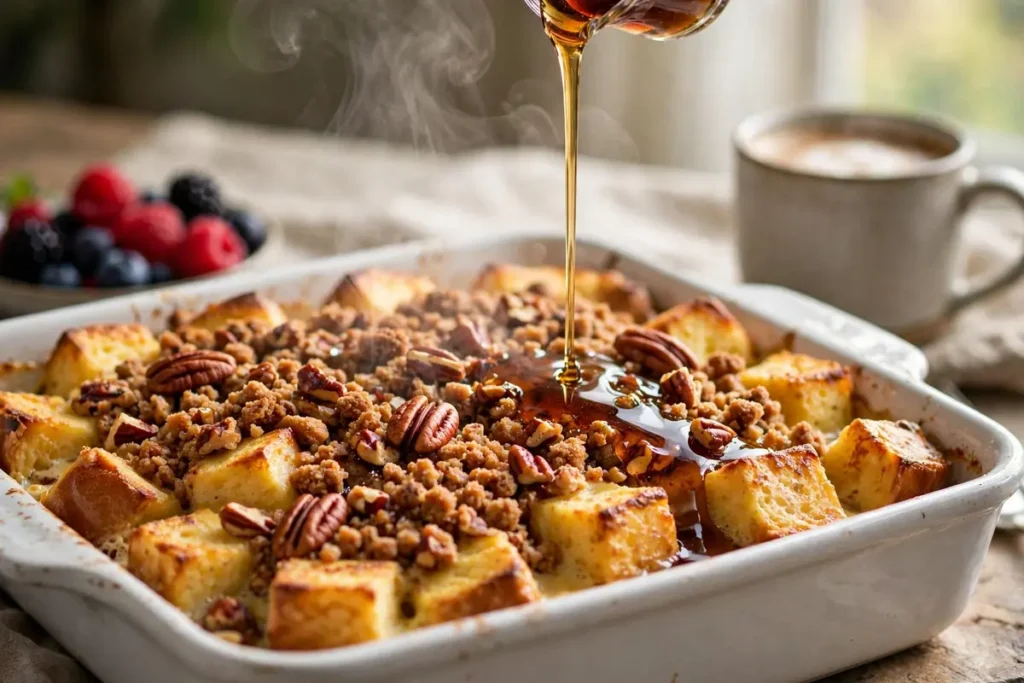
A pan of cinnamon rolls with cream cheese glaze, one being pulled apart to show the swirl.
Watch: Cinnamon Rolls
Collins Country shares an only-one-rise cinnamon roll tutorial for faster mornings.
At a Glance: Cinnamon Rolls
Dough, filling and glaze essentials for soft, gooey rolls.
| Detail | What to know |
|---|---|
| Dough | An enriched dough with milk, butter and egg stays soft |
| Rise | One good rise of about an hour is enough for fluffy rolls |
| Filling | Soft butter, brown sugar and plenty of cinnamon |
| Cutting | Dental floss or a sharp knife gives clean slices |
| Glaze | Cream cheese glaze applied while warm melts into the swirls |
| Storage | Best day one; refresh leftovers 10 seconds in the microwave |
Frequently Asked Questions
Can I make cinnamon rolls without a stand mixer?
Absolutely. Enriched dough kneads beautifully by hand in 10 to 12 minutes. Use the slap-and-fold technique: lift the dough, slap it onto the counter, fold it over, and repeat. It is a good workout and gives you excellent feel for when the dough is ready — smooth, elastic, and slightly tacky.
Why did my cinnamon rolls turn out dense?
Too much flour, under-kneading, or under-proofing — in that order of likelihood. Weigh your flour (500–560 g total) rather than scooping from the bag, knead until the dough passes the windowpane test, and do not bake until the second rise has made the rolls visibly puffy and touching.
Can I use active dry yeast instead of instant?
Yes. Dissolve it in the warm milk with a pinch of sugar and let it foam for 5 to 10 minutes before adding the remaining ingredients. Rise times will be slightly longer — add 15 to 30 minutes to each rise. Everything else stays the same.
How do I get clean spirals when slicing?
Use unflavored dental floss or thread instead of a knife: slide it under the log, cross the ends over the top, and pull. It cuts without compressing the layers. If using a knife, choose a sharp serrated one and saw gently without pressing down. Chill the log for 15 minutes before slicing if your kitchen is warm — firmer dough cuts cleaner.
Can cinnamon rolls be made gluten-free?
Yes, with a quality 1:1 gluten-free baking blend that contains xanthan gum. The dough will be softer and stickier — handle it with floured hands and expect a slightly denser crumb, since GF doughs do not trap gas as efficiently. Let the shaped rolls proof a full hour. For a complete holiday approach, see our gluten-free Thanksgiving menu.
How far in advance can I bake cinnamon rolls for Thanksgiving?
Bake them the morning of for the best result — that is the whole point of the overnight method. If you must bake ahead, bake the night before without frosting, cool completely, wrap tightly, and refresh in a 300°F (150°C) oven for 10 minutes in the morning before frosting. They will be very good, though not quite as transcendent as fresh-baked.
Conclusion
Homemade cinnamon rolls ask for your time and repay it many times over — in the smell that fills the house, in the silence that falls over the breakfast table, in the way a warm, gooey roll makes Thanksgiving morning feel like an occasion before the occasion. The overnight method removes the only real obstacle, leaving you with nothing but the pleasure of the process: soft dough under your hands, the tight spiral of the roll, frosting melting into cinnamon swirls. Make them this year, and do not be surprised when they become the tradition everyone asks about first. For more holiday morning inspiration, explore our Thanksgiving breakfast ideas and our overnight French toast casserole — and when breakfast gives way to the feast, our best Thanksgiving recipes of 2026 carry the day.