Fluffy pumpkin pancakes are the kind of breakfast that turns Thanksgiving morning from a chaotic prelude into a celebration in its own right. Golden, pillowy, and warmly spiced, they give a busy holiday household something precious: a hot, satisfying meal that practically cooks itself while the turkey waits its turn for the oven. On the morning of Thursday, November 26, 2026, when ovens across the world will be claimed by turkeys, roasts, and casseroles, these pancakes ask for nothing more than a griddle, a mixing bowl, and about thirty minutes of relaxed, joyful cooking.
This is far more than a novelty flavor. Pumpkin puree brings natural sweetness, moisture, and a gorgeous amber color to the batter, while cinnamon, nutmeg, and ginger deliver the unmistakable warmth of the season. The result is a stack of pancakes that taste like autumn feels — cozy, generous, and just a little bit special. Whether you are feeding sleepy kids, fueling a crew of volunteer cooks, or simply starting your own day with intention before the festivities begin, this complete guide covers the perfect classic recipe, the science behind truly fluffy results, eight creative variations, make-ahead strategies, troubleshooting, and answers to every question a pancake-maker could ask.
Why Pumpkin Pancakes Belong on Thanksgiving Morning
A tradition that respects the holiday schedule
Thanksgiving morning is famously hectic. There is a turkey to prep, sides to assemble, tables to set, and a parade to watch. The last thing any host needs is a complicated breakfast that competes with dinner for oven space and attention. Pumpkin pancakes solve this beautifully. They are made entirely on the stovetop, require no oven at all, and can be cooked in big batches to feed a crowd. The batter comes together in one bowl in about five minutes, and the pancakes themselves cook in roughly two to three minutes per side.
There is also something psychologically wise about serving a real breakfast on Thanksgiving. Hosts who skip breakfast often crash by mid-afternoon, right when guests arrive and the kitchen demands its most intense burst of work. A substantial, warm breakfast keeps energy steady and moods bright. Pancakes are also inherently communal — everyone gathers around the griddle, coffee in hand, and the day begins with laughter instead of logistics.
Nutrition that actually supports a long day
Pumpkin is a nutritional powerhouse hiding in plain sight. A half cup of canned pumpkin puree contains only about 40 calories, yet delivers more than 200 percent of the daily value for vitamin A, meaningful amounts of vitamin C, potassium, and fiber. That fiber is the secret weapon of Thanksgiving morning: it slows digestion, steadies blood sugar, and keeps you comfortably full for hours rather than spiking and crashing like a purely sugary breakfast would.
The fiber also earns its keep later in the day. A fiber-rich breakfast means you arrive at the holiday table hungry but not ravenous, which makes it far easier to enjoy the feast mindfully instead of overeating in the first ten minutes. Pair the pancakes with eggs or Greek yogurt for extra protein, and you have a breakfast that genuinely fuels a marathon day of cooking and hosting.
| Nutrient (per serving of 3 pancakes) | Approximate amount | Why it matters |
|---|---|---|
| Calories | 340–380 | Sustained energy without heaviness |
| Fiber | 4–5 g | Steadies blood sugar through the morning |
| Vitamin A | Over 200% DV | Supports immunity during cold season |
| Potassium | 300–400 mg | Helps balance holiday sodium intake |
| Protein | 8–10 g | Keeps you full until the big meal |
Kid-approved, crowd-approved
Few breakfasts unite a multi-generational household like pancakes. Toddlers love the soft texture and sweet flavor. Teenagers demolish tall stacks. Grandparents appreciate the gentle, familiar comfort. And because pumpkin pancakes look festive without any decoration — that burnished orange color practically glows — they photograph beautifully for the morning social media post. If you are hosting overnight guests, this is the breakfast that makes them feel the holiday started the moment they woke up.
The Science of Truly Fluffy Pumpkin Pancakes
Understanding your dry ingredients
Every great pancake starts with a well-built flour base. All-purpose flour is the standard choice, and it is genuinely the best one for this job — its moderate protein content (about 10 to 12 percent) gives pancakes structure without making them tough. Cake flour, with its lower protein, produces pancakes that are tender but fragile and prone to falling apart. Bread flour is the opposite extreme: too much gluten development makes pancakes rubbery and dense.
Leavening is where fluffiness is won or lost. This recipe uses double-acting baking powder as its sole leavener, and that choice is deliberate. Double-acting baking powder reacts twice: first when it gets wet, and again when it hits the heat of the griddle. That second reaction is what gives you the dramatic puff as each pancake cooks. Baking soda, by contrast, needs an acid to activate and can leave a soapy aftertaste if overused — the small amount of natural acidity in pumpkin puree is not reliably enough to drive the whole rise, so baking powder is the safer, more consistent choice.
Salt and sugar play supporting but essential roles. A full half teaspoon of salt per batch may sound like a lot for a sweet breakfast, but salt suppresses bitterness and amplifies both the pumpkin and the spices — pancakes made without it taste flat and one-dimensional. The sugar, beyond adding sweetness, aids browning through caramelization, giving you those gorgeous golden-brown surfaces.
The spice blend that tastes like autumn
The classic pumpkin spice quartet — cinnamon, nutmeg, ginger, and cloves — is a study in balance. Cinnamon provides the warm, sweet backbone and should be the most generous measure. Nutmeg adds depth and a faint nuttiness that reads as richness. Ground ginger contributes a gentle heat that keeps the pancakes from tasting like dessert. Cloves are the powerhouse of the group: intensely aromatic, they need only a pinch, because too much turns medicinal and overwhelms everything else.
Freshness matters enormously with ground spices. Ground spices lose potency steadily after opening, and cinnamon that has sat in a cabinet for three years will contribute almost nothing. If your spices do not smell strongly when you open the jar, it is time to replace them before Thanksgiving. For the very best flavor, grate whole nutmeg with a microplane — the difference between freshly grated and pre-ground nutmeg is genuinely dramatic.
Wet ingredients and the role of fat
Milk hydrates the flour and dissolves the sugar and salt, and its proteins contribute to browning. Whole milk produces the richest pancakes, but 2 percent works nearly as well. The egg is a multitasker: its proteins set the pancake’s structure as it cooks, its yolk adds richness and color, and its emulsifying power keeps the batter smooth and cohesive.
Melted butter versus oil is a real debate among pancake enthusiasts, and butter wins on flavor. Butter’s milk solids brown on the griddle, adding nutty, caramel notes that oil simply cannot replicate. The catch is that butter burns more easily, which is why the griddle temperature matters so much — more on that in the troubleshooting section. If dairy is a concern, a neutral oil or melted coconut oil produces perfectly good pancakes with a slightly cleaner flavor.
Canned pumpkin versus fresh: an honest comparison
Here is a truth that surprises many home cooks: for pancakes, canned pumpkin puree is usually better than fresh. Commercial pumpkin puree is made from specific squash varieties bred for smooth texture and consistent sweetness, and it is cooked down to a dense, uniform consistency with very little excess water. Fresh roasted pumpkin, while wonderful, varies wildly in moisture content — a watery batch will thin your batter and produce flat, sad pancakes.
If you do use fresh pumpkin, roast it, puree it, and then strain it through a fine-mesh sieve or cheesecloth for at least an hour to remove excess liquid. Use pie pumpkins (also called sugar pumpkins), not carving pumpkins, which are watery and stringy. And read labels carefully when buying canned: you want 100 percent pumpkin puree, not pumpkin pie filling, which comes pre-sweetened and pre-spiced and will throw off the recipe’s balance.
The Classic Fluffy Pumpkin Pancakes Recipe
This is the definitive version — tested, tweaked, and perfected for Thanksgiving morning. It makes about 12 medium pancakes, serving 4 generously, and scales beautifully (see the scaling chart later in this guide).
Ingredients
Dry ingredients:
- 1 1/2 cups (190 g) all-purpose flour
- 2 tablespoons granulated sugar
- 2 teaspoons baking powder
- 1/2 teaspoon baking soda (for extra lift with the pumpkin’s acidity)
- 1 teaspoon ground cinnamon
- 1/2 teaspoon ground nutmeg (freshly grated if possible)
- 1/4 teaspoon ground ginger
- 1/8 teaspoon ground cloves
- 1/2 teaspoon fine sea salt
Wet ingredients:
- 1 cup (240 ml) whole milk, at room temperature
- 3/4 cup (185 g) pumpkin puree (100% pumpkin, not pie filling)
- 1 large egg, at room temperature
- 3 tablespoons unsalted butter, melted and slightly cooled, plus more for the griddle
- 1 teaspoon pure vanilla extract
A note on room temperature: Cold milk and eggs cause the melted butter to solidify into little flecks when mixed, which creates uneven texture. Set the milk, egg, and pumpkin on the counter 20 to 30 minutes before you start, and your batter will be silkier and your pancakes more uniform.
Step-by-step instructions
- Whisk the dry ingredients. In a large bowl, whisk together the flour, sugar, baking powder, baking soda, cinnamon, nutmeg, ginger, cloves, and salt until thoroughly combined. Whisking aerates the flour and distributes the leavening evenly — this single step prevents the dreaded dense pancake with a bitter soda pocket.
- Mix the wet ingredients. In a second bowl or large measuring jug, whisk the milk, pumpkin puree, egg, melted butter, and vanilla until completely smooth. Take a moment here to make sure no streaks of pumpkin remain; lumps of puree in the batter become gummy spots in the finished pancake.
- Combine gently — and stop early. Pour the wet mixture into the dry and stir with a spatula or wooden spoon just until the flour disappears. The batter should be thick and lumpy — small lumps are not only acceptable, they are desirable. Overmixing develops gluten and deflates the leavening, which is the number one cause of flat, tough pancakes. Count your strokes if it helps: ten to twelve is plenty.
- Rest the batter. Let the batter sit undisturbed for 5 to 10 minutes. During this rest, the flour fully hydrates and the baking powder begins its first reaction, which translates directly into fluffier pancakes. You will notice the batter thicken slightly — that is exactly what you want. Do not stir it again after resting.
- Heat the griddle correctly. Place a griddle or large skillet over medium heat. The ideal surface temperature is about 190°C (375°F). Test it with a few drops of water: they should dance and sizzle before evaporating. If they vanish instantly, the pan is too hot; if they just sit there, it is too cool. Lightly butter the surface — you want a thin film, not a pool.
- Cook with patience. Scoop about 1/4 cup of batter per pancake onto the hot griddle, leaving space between them. Cook for 2 to 3 minutes, until bubbles appear on the surface and the edges look set and slightly dry. Flip once — just once — and cook 1 to 2 minutes more until golden brown underneath. Resist the urge to press the pancake with the spatula; pressing squeezes out the air you worked to create.
- Keep warm and serve. Transfer finished pancakes to a wire rack set over a baking sheet in a low oven (about 95°C / 200°F) while you cook the rest. The rack prevents the bottoms from steaming and going soggy. Serve warm with your favorite toppings.
Make-ahead and freezing strategy
Thanksgiving week rewards planners, and pancakes are wonderfully make-ahead friendly. The dry ingredients can be whisked together up to a month in advance and stored in a labeled jar — on the morning, you simply add the wet ingredients and cook. The full batter can be mixed the night before and refrigerated; it will thicken overnight, so stir in a tablespoon or two of milk in the morning to loosen it. (The pancakes will be marginally less fluffy than fresh batter, but still delicious — a fair trade for a calm morning.)
Cooked pancakes freeze beautifully for up to 2 months. Cool them completely, stack with small squares of parchment paper between each pancake, and seal in a freezer bag with the air pressed out. Reheat from frozen in a toaster or toaster oven for crisp edges, or microwave in 20-second bursts for softness. A host feeding a crowd can cook the entire batch two days ahead, freeze, and reheat — the griddle never even needs to come out on Thanksgiving morning.
Eight Creative Pumpkin Pancake Variations
Once you have mastered the classic, the variations below turn one recipe into a whole repertoire. Each one starts from the classic batter with a single twist.
1. Chocolate chip pumpkin pancakes
Fold 3/4 cup of semi-sweet chocolate chips into the rested batter just before cooking. The chocolate melts into pockets that contrast beautifully with the warm spices. Use mini chips for the most even distribution, and reduce the sugar in the batter by a tablespoon since the chips add sweetness.
2. Pecan praline pumpkin pancakes
Top each stack with warm praline sauce: melt 4 tablespoons of butter with 1/2 cup of brown sugar and 1/4 cup of cream, simmer two minutes, then stir in a cup of toasted chopped pecans. This is the variation that tastes like the holidays decided to show off, and it pairs naturally with chocolate pecan pie later in the day for a pecan-themed thread through the whole menu.
3. Cream cheese swirl pumpkin pancakes
Beat 120 g of softened cream cheese with 2 tablespoons of powdered sugar and a splash of milk until pourable. Drop spoonfuls onto each pancake as it cooks on the first side, then swirl lightly with a toothpick before flipping. The tangy swirls cut through the sweetness and look stunning.
4. Apple cider pumpkin pancakes
Replace half the milk with fresh apple cider and add an extra 1/4 teaspoon of cinnamon. The cider’s gentle acidity brightens the pumpkin and adds a layer of orchard flavor that feels made for late November. Serve with warm cider syrup or alongside a mug of mulled apple cider.
5. Oatmeal pumpkin pancakes (heartier and gluten-free adaptable)
Replace half the flour with old-fashioned rolled oats pulsed briefly in a blender, and let the batter rest a full 15 minutes so the oats hydrate. The result is chewier, more substantial, and higher in fiber — ideal for the marathon cooking day ahead. For a gluten-free version, use certified gluten-free oats and a 1:1 gluten-free flour blend in place of the all-purpose flour.
6. Pumpkin spice latte pancakes
Replace 1/4 cup of the milk with strongly brewed, cooled espresso or very strong coffee. The coffee deepens the spice flavors the way it does in the famous latte, adding complexity without making the pancakes taste like coffee. Top with lightly sweetened whipped cream and a dusting of cinnamon.
7. Savory pumpkin and sage pancakes
Reduce the sugar to 1 tablespoon, omit the vanilla and sweet spices, and add 2 tablespoons of finely chopped fresh sage, 1/2 cup of grated Parmesan, and plenty of black pepper. These are extraordinary topped with a fried egg and crispy bacon — a savory Thanksgiving breakfast that bridges beautifully to dinner flavors.
8. Mini pumpkin pancake bites
Use a tablespoon of batter per pancake to make silver-dollar-sized bites, perfect for little hands, appetizer-style grazing boards, or a Thanksgiving breakfast spread with multiple options. They cook in about 90 seconds per side. Serve with small bowls of maple syrup, whipped cream, and spiced butter for dipping.
| Variation | Key change | Best for |
|---|---|---|
| Chocolate chip | 3/4 cup chips folded in | Kids and chocolate lovers |
| Pecan praline | Warm praline pecan sauce | Show-off holiday brunch |
| Cream cheese swirl | Sweetened cream cheese ribbons | Tangy-sweet contrast fans |
| Apple cider | Cider replaces half the milk | Orchard-fresh autumn flavor |
| Oatmeal | Half the flour becomes oats | Hearty appetites, GF adaptable |
| Pumpkin spice latte | Espresso replaces some milk | Coffee lovers |
| Savory sage | Herbs and Parmesan, less sugar | Savory breakfast people |
| Mini bites | Tablespoon-sized pancakes | Grazing boards, small children |
Toppings and Pairings Worth Waking Up For
Beyond basic maple syrup
Pure maple syrup is the classic partner and it is genuinely hard to beat — its caramel depth harmonizes perfectly with pumpkin and spice. But Thanksgiving morning deserves options. Warm the syrup before serving (ten seconds in the microwave or a small saucepan over low heat); warm syrup soaks in rather than sitting on top, and it keeps the pancakes hotter longer.
For something more special, make spiced maple butter: mash 8 tablespoons of softened butter with 2 tablespoons of maple syrup, 1/2 teaspoon of cinnamon, and a pinch of salt. Roll it into a log in parchment paper, chill, and slice into coins to melt over hot stacks. Cinnamon honey butter follows the same formula with honey instead of syrup. Both can be made a week ahead and both will disappear fast.
Caramelized apples are the topping that turns pancakes into an event. Slice two apples thin, sauté in butter with a spoonful of brown sugar and a pinch of cinnamon until golden and tender, about 8 minutes. Spoon over the stack with a dollop of whipped cream. Toasted pecans or walnuts add crunch and richness — toast them in a dry skillet for 3 to 4 minutes until fragrant, watching closely because nuts go from perfect to burnt in seconds.
What to serve alongside
A complete Thanksgiving breakfast balances the pancakes’ sweetness with savory and fresh elements. Crispy bacon or breakfast sausage provides the salty counterpoint that makes the sweet taste sweeter. A simple fruit salad — pomegranate seeds, sliced pears, and orange segments — adds brightness and color. Scrambled eggs or a frittata bring protein that keeps everyone fueled.
For drinks, coffee is non-negotiable for most households, and this is the morning to make it special — consider setting up a small coffee bar with cinnamon sticks, whipped cream, and flavored syrups, or explore Thanksgiving coffee drinks for festive ideas. Fresh orange juice, apple cider, and hot chocolate round out the options for all ages. If you want the morning to feel truly celebratory, a bottle of sparkling wine with orange juice for mimosas never hurts.
Troubleshooting: Every Problem, Solved
Even experienced cooks hit pancake trouble. This table diagnoses the most common issues and gives you the exact fix.
| Problem | Likely cause | Fix |
|---|---|---|
| Flat, dense pancakes | Overmixed batter or dead baking powder | Stir 10–12 strokes max; test baking powder in hot water — it should fizz vigorously |
| Burnt outside, raw inside | Griddle too hot | Lower to medium; the water-drop test should show dancing drops, not instant vapor |
| Pale and anemic looking | Griddle too cool or no fat on surface | Raise heat slightly; ensure a thin film of butter on the griddle |
| Batter too thick to spread | Flour measured heavy or batter rested long | Whisk in milk one tablespoon at a time until it flows slowly off the spoon |
| Batter too thin, spreads everywhere | Too much liquid or watery pumpkin | Whisk in flour one tablespoon at a time; strain watery pumpkin next time |
| Gummy or wet center | Flipped too early or pancake too thick | Wait for bubbles and set edges; use 1/4 cup batter per pancake, not more |
| Sticking to the pan | Pan not hot enough before batter added, or worn nonstick | Heat fully before the first pancake; re-butter between batches |
| Bitter or soapy taste | Too much baking soda or uneven mixing | Measure leavening precisely; whisk dry ingredients thoroughly |
| Uneven browning | Hot spots on the griddle | Rotate pancakes to cooler spots; preheat the griddle a full 5 minutes |
The flip: technique matters
The single most common beginner mistake is flipping too early. Wait until you see bubbles forming across the surface and popping, with the edges looking dry and set — about 2 to 3 minutes on medium heat. Slide a thin spatula fully under the pancake before lifting; a half-committed flip folds the pancake and deflates it. Flip with a quick, confident wrist motion, and commit to exactly one flip. Every additional flip presses out air and toughens the texture.
Feeding a Thanksgiving Crowd: Scaling Guide
Thanksgiving mornings often mean full houses. The classic recipe serves 4, but it scales linearly — the ratios hold perfectly from a quiet breakfast for two to a houseful of twenty. Use this chart and the timing notes to plan.
| Guests | Flour | Pumpkin puree | Milk | Eggs | Batches / griddle time |
|---|---|---|---|---|---|
| 2 | 3/4 cup | 6 tbsp | 1/2 cup | 1 small | 1 batch, ~15 min |
| 4 | 1 1/2 cups | 3/4 cup | 1 cup | 1 large | 1 batch, ~25 min |
| 8 | 3 cups | 1 1/2 cups | 2 cups | 2 large | 2 batches, ~40 min |
| 12 | 4 1/2 cups | 2 1/4 cups | 3 cups | 3 large | 3 batches, ~55 min |
| 16 | 6 cups | 3 cups | 4 cups | 4 large | 4 batches, ~70 min |
| 20 | 7 1/2 cups | 3 3/4 cups | 5 cups | 5 large | 5 batches, ~85 min |
Crowd strategy: For more than 8 guests, do not try to cook everything to order on the morning. Cook the full quantity the day before, cool, and refrigerate or freeze, then reheat in a 175°C (350°F) oven on sheet pans for 8 to 10 minutes while everyone wakes up. Alternatively, set up a pancake bar: keep a big batch warm in the oven and let guests top their own from a spread of syrups, butters, fruits, nuts, and whipped cream. Assign one person to griddle duty in 20-minute shifts — it is genuinely fun, and the cook gets first pick of the toppings.
If your household includes overnight guests who celebrate the holiday across multiple days, the batter-mix jar trick shines: prepare labeled dry-mix jars as small gifts or as a standing pantry staple, so anyone can make a fresh batch on Friday or Saturday morning without hunting for the recipe.
Pumpkin Pancakes Around the World
Adapting for different kitchens
Pumpkin pancakes travel well across cuisines and kitchen setups. In the UK and Ireland, where American-style thick pancakes are less common than thin crepes, these still work beautifully — simply note in the recipe that the batter should be thick and the pancakes tall. Self-raising flour, common in British and Australian pantries, already contains leavening: if you use it, omit the baking powder and soda and reduce the salt by half.
Where canned pumpkin is hard to find — much of continental Europe, parts of Asia and Latin America — roast any sweet winter squash: butternut, kabocha, and calabaza all substitute beautifully at the same weight. In India, red pumpkin (lal bhopla) roasted and strained works well; increase the ginger slightly to complement local spice palates. In Mexico, calabaza de Castilla is the traditional choice and pairs wonderfully with piloncillo syrup instead of maple.
Metric bakers should weigh the flour (190 g for the classic batch) rather than converting cups loosely, since cup measurements of flour can vary by 20 percent depending on scooping technique. The batter’s consistency is the real guide: thick enough to mound briefly on the spoon, fluid enough to spread slowly on the griddle.
In Pictures: Pumpkin Pancakes
Fluffy, spiced and towering — pumpkin pancakes turn an ordinary morning into a fall celebration.
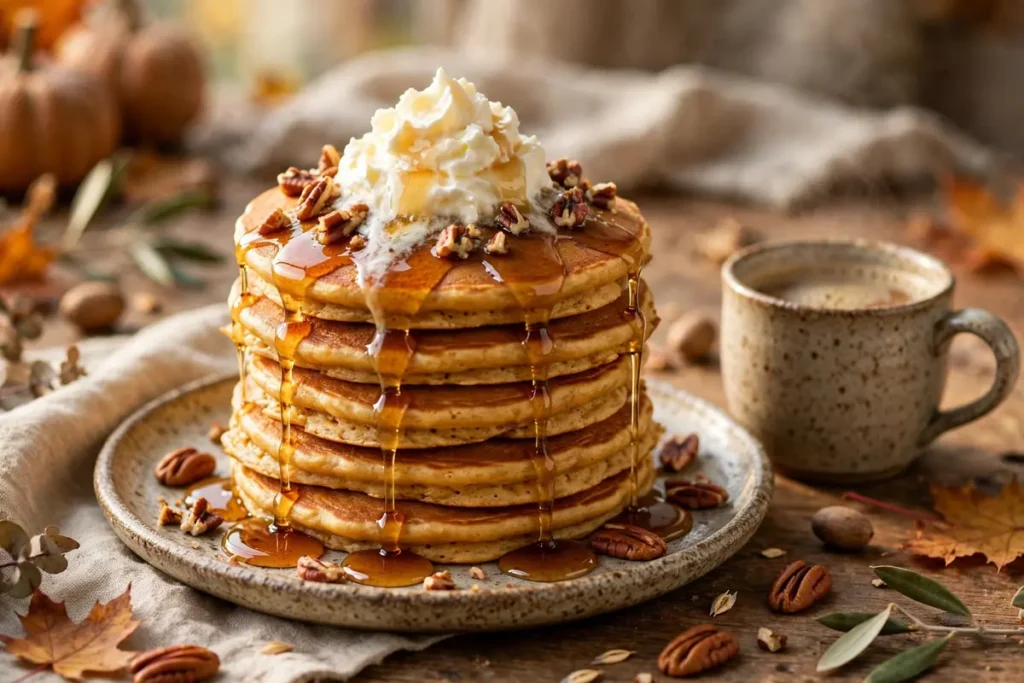
A tall stack of pumpkin pancakes with maple syrup cascading down and toasted pecans on top.
Watch: Pumpkin Pancakes
Bates Kitchen takes pancakes to the next level with fluffy pumpkin pancakes.
At a Glance: Pumpkin Pancakes
What makes pumpkin pancakes fluffy, and how to serve and store them.
| Detail | What to know |
|---|---|
| Pumpkin puree | About half a cup per batch adds flavor without heaviness |
| Spice | Pumpkin pie spice or a cinnamon-nutmeg-ginger blend |
| Fluffiness | Separate the eggs and whip the whites for extra lift |
| Cooking | Medium-low heat lets the thick batter cook through |
| Toppings | Maple syrup, toasted pecans and whipped butter |
| Freezing | Freeze between parchment; reheat in the toaster |
Frequently Asked Questions
Can I make pumpkin pancakes without eggs?
Yes. Replace the egg with 1/4 cup of unsweetened applesauce, one mashed ripe banana, or a commercial egg replacer measured for one egg. The applesauce version is the most neutral in flavor. Expect slightly denser pancakes with a touch less rise, since the egg’s proteins contribute structure — adding an extra 1/2 teaspoon of baking powder compensates nicely. For a fully vegan version, also swap the milk for oat or soy milk and use melted coconut oil or vegan butter instead of dairy butter.
Why did my pumpkin pancakes turn out gummy in the middle?
Gumminess almost always comes down to three culprits: too much pumpkin, undercooking, or overmixing. Pumpkin puree adds significant moisture, so exceeding the recipe’s 3/4 cup per batch throws off the wet-to-dry ratio. Make sure you are waiting for bubbles and set edges before flipping, and keep the heat at medium rather than rushing on high — the centers need time for their starches to set. Finally, remember that lumpy batter is correct batter; stirring until smooth develops the gluten that creates a gummy, chewy texture.
Can I use pumpkin pie filling instead of pumpkin puree?
You can in a pinch, but the results will differ. Pumpkin pie filling is pre-sweetened and pre-spiced, so reduce the sugar to 1 tablespoon and cut the cinnamon, nutmeg, ginger, and cloves in half to avoid over-spicing. The texture also tends to be looser, so you may need an extra tablespoon or two of flour. For the best flavor and full control over sweetness and spice, 100% pure pumpkin puree is strongly recommended — it is usually sold right next to the pie filling, so check the label carefully.
How do I keep pancakes warm for a crowd without them getting soggy?
The wire-rack-over-baking-sheet method in a low oven (95°C / 200°F) is the gold standard. The rack allows air to circulate so steam escapes instead of condensing under the pancakes, which is what makes the oven-direct-on-pan method produce soggy bottoms. Do not cover the sheet with foil — trapped steam is the enemy. Pancakes held this way stay excellent for up to 45 minutes, which comfortably covers cooking several batches.
Are pumpkin pancakes healthy enough for breakfast before a big dinner?
They are one of the better sweet-breakfast choices you can make. The pumpkin contributes fiber, vitamin A, and potassium; the recipe’s sugar is modest at 2 tablespoons per 12 pancakes; and the fat is moderate. To make them even more balanced, serve with Greek yogurt or eggs for protein, fresh fruit for additional fiber, and go easy on the syrup — a tablespoon of warm maple syrup per serving is plenty when the pancakes themselves are flavorful. Compared with skipping breakfast or grabbing a pastry, a plate of pumpkin pancakes with protein on the side is a genuinely solid start to a long day.
Can I prepare the batter the night before Thanksgiving?
Absolutely, and many hosts do. Whisk the full batter, cover the bowl tightly, and refrigerate overnight. The batter will thicken as the flour continues to hydrate — whisk in a tablespoon or two of milk in the morning to restore a pourable consistency, stirring as little as possible. One caveat: the baking powder loses some of its power overnight, so the pancakes will be slightly less lofty than fresh batter. Adding 1/2 teaspoon of fresh baking powder in the morning, folded in gently, restores most of the lift. Alternatively, mix only the dry ingredients ahead and combine with the wet ingredients in the morning — this takes barely five minutes and gives you the best of both worlds.
Conclusion: Start the Holiday Right
Thanksgiving is a day built around a single spectacular meal, but the hours before it deserve their own small ceremony. Pumpkin pancakes turn the busiest morning of the year into a pause — a warm, unhurried half hour where the household gathers, the coffee is hot, and the day’s work feels like anticipation rather than stress. They ask little of you: one bowl, one griddle, ingredients you likely already have, and a willingness to flip with confidence.
Make the classic version this year, or pick one of the eight variations that caught your eye. Prep the dry mix ahead, warm the syrup, set out the toppings, and let the smell of cinnamon and browning butter do what it has always done — tell everyone in the house that something wonderful is happening today. And when the turkey finally goes into the oven and the real marathon begins, you will face it the way every good host should: well-fed, warm, and already smiling.
For more ways to make the morning special, browse our Thanksgiving breakfast ideas and our make-ahead overnight French toast casserole. When you are ready to plan the main event, our Thanksgiving dinner menu for 2026 and guide to cooking a Thanksgiving turkey have you covered from first course to last slice of pie.