A perfectly executed smoked turkey breast is one of the great underrated centerpieces in American cooking: rosy smoke-kissed meat, deeply savory, juicy all the way through, and achieved with a fraction of the fuss of smoking a whole bird. The breast is the ideal cut for the smoker — it is compact, uniform, and lean enough that gentle smoke transforms it without the marathon cook times a whole turkey demands. Whether you run a pellet grill, an offset smoker, a kamado, or even a kettle grill, this guide will take you from setup to slicing with confidence.
You will learn which smoker setups work and how to configure each, the best woods for turkey (and which to avoid), a brine-and-rub formula tuned for long smoke exposure, exact temperatures and timing, how to fix rubbery skin — the classic smoked-turkey complaint — and how to rest, carve, and store the results. If you have only ever roasted, our roast turkey guide remains a fine fallback — but smoke adds a dimension no oven can touch. Let us get the fire going.
Why the Breast Is the Best Cut to Smoke
Whole smoked turkeys look magnificent in photos and disappoint in practice more often than pitmasters admit. The problem is time: a 14-pound bird needs 5 to 7 hours in the smoker, and turkey breast — lean and exposed — dries out long before the thighs finish absorbing smoke. The breast alone sidesteps every one of these issues. A 5- to 7-pound bone-in breast smokes in 3 to 4 hours, a window short enough to keep the meat juicy while still delivering genuine smoke flavor. The uniform shape cooks evenly, the bone adds flavor and structure, and you are smoking exactly the meat your guests actually want — no one fights over smoked drumsticks.
There is also a scheduling argument. Smoking a whole turkey monopolizes your smoker all day; a breast finishes by early afternoon, freeing the smoker (or your attention) for sides like smoked mac and cheese or vegetables. And if something goes sideways — a temperature spike, a stall — you have risked a $25 breast, not a $60 whole bird. For Thanksgiving especially, a smoked breast paired with oven-roasted sides is the low-stress path to a memorable meal.
Smoker Setups That Work (and How to Configure Each)
Pellet Grills: The Easiest Path
Pellet grills are the most forgiving option for beginners — set the temperature, and the controller feeds pellets to hold it. For turkey breast, set 275°F (135°C): hot enough to cook efficiently, cool enough for good smoke absorption. Use a water pan on the grate beside the meat to add humidity, which helps the smoke adhere and keeps the surface from drying. Pellet smoke is milder than stick-burner smoke, so consider a smoke tube filled with pellets for the first two hours if you want a deeper flavor.
Offset and Stick Burners: Maximum Flavor, Maximum Attention
An offset smoker burning splits produces the deepest, most complex smoke — and demands the most skill. Run a small, clean fire: thin blue smoke is the goal, thick white smoke tastes acrid. Hold 275°F at the grate level (measure where the meat sits, not at the firebox end). Add a split every 45 to 60 minutes, and resist the urge to oversmoke — turkey absorbs smoke readily, and bitter creosote is the fastest way to ruin poultry.
Kamado and Kettle Grills: Two-Zone Indirect
Both work beautifully with an indirect setup: coals banked to one side (kettle) or a heat deflector in place (kamado), wood chunks on the coals, turkey on the cool side with the lid closed and vents adjusted to hold 275°F. Add 2 to 3 wood chunks at the start and one more halfway through. A kamado’s sealed environment retains moisture exceptionally well, making it one of the best turkey smokers despite its size.
Electric and Gas Smokers
Set-and-forget convenience with decent results. The limitation is smoke intensity — electric smokers in particular produce mild smoke — so use the full wood-chip tray and refill once mid-cook. Keep the built-in water pan filled. These smokers excel at holding temperature, which matters more than smoke volume for turkey breast.
Choosing Wood: What Flavors Turkey Best
Turkey is a mild meat that takes on smoke eagerly, which means wood choice matters more than it does for beef. Fruit woods are the classic pairing:
- Apple: Mild, sweet, faintly fruity — the safest and most popular choice for turkey. Hard to oversmoke with.
- Cherry: Slightly richer than apple with a beautiful mahogany color on the skin. A favorite for holiday birds.
- Pecan: Nutty and mellow, stronger than fruit woods but still gentle — excellent middle ground.
- Oak: Medium and versatile; blends well with a handful of cherry for color.
- Hickory: Use sparingly — a little adds classic barbecue depth, too much turns turkey bitter. Mix with apple rather than using straight.
- Mesquite: Avoid for turkey. Its intense, earthy smoke overwhelms poultry and turns acrid over a multi-hour cook.
Whichever wood you choose, the rule is restraint: turkey needs 2 to 3 hours of good smoke, not 6 hours of heavy smoke. Thin, nearly invisible blue smoke flavors; thick white billows ruin. When in doubt, use less wood than you think.
Prep: Brine and Rub for the Smoker
Long smoke exposure dries surfaces, so smoked turkey breast benefits enormously from a brine. A wet brine is the traditional choice here — the extra water content gives you insurance over a 3- to 4-hour cook — though an overnight dry brine also works. If you want the full science, our dry brine vs. wet brine comparison covers the trade-offs; for the smoker, wet brine wins on moisture margin.
Simple Smoker’s Brine (per gallon of water)
- 1 gallon cold water
- 1 cup kosher salt (Diamond Crystal; use 3/4 cup if using Morton’s)
- 1/2 cup brown sugar
- 1 tablespoon black peppercorns
- 4 bay leaves
- 1 tablespoon allspice berries (optional)
Dissolve the salt and sugar in warm water, cool completely with ice, then submerge the breast (5 to 7 lbs) for 12 to 18 hours in the refrigerator. Rinse briefly, pat very dry, and rest uncovered in the fridge for at least 4 hours (or overnight) so the skin dries — dry skin absorbs smoke better and crisps better at the finish.
Smoker’s Dry Rub
- 2 tablespoons kosher salt (reduce to 1 tablespoon if the breast was wet-brined)
- 1 tablespoon coarse black pepper
- 1 tablespoon paprika (sweet, not smoked — the smoker provides the smoke)
- 2 teaspoons garlic powder
- 2 teaspoons onion powder
- 1 teaspoon dried thyme
- 1 teaspoon mustard powder
Coat the dried breast evenly on all sides about an hour before smoking. The rub builds the bark — the flavorful crust — that makes smoked meat so appealing. Our best dry rub for turkey guide has more blends if you want to experiment.
The Smoke: Temperatures, Timing, and Technique
Target a grate temperature of 275°F (135°C). This is the sweet spot for turkey breast: low enough for 2+ hours of smoke absorption, high enough to cook efficiently and render skin fat. Cooking at 225°F — the classic barbecue temperature — works but extends the cook past 5 hours, dries the surface, and leaves the skin rubbery; turkey is not brisket and does not benefit from ultra-low-and-slow.
- Preheat the smoker to 275°F with your wood of choice producing thin blue smoke. Place a water pan near the meat if your smoker allows it.
- Place the breast bone-side down on the grate, away from direct heat. Insert a leave-in probe thermometer into the thickest part of the meat, avoiding bone — you will track this cook by temperature, not time.
- Smoke undisturbed for 2 hours. Do not open the lid; every peek costs heat and extends the cook. After 2 hours, check color — you want a rich amber-mahogany. If using a stick burner, this is when you would add your last wood; the meat absorbs most smoke early, and late smoke mostly adds bitterness.
- Optional butter baste at hour 2: Brush the breast lightly with melted butter. This is not traditional barbecue mopping — it is targeted help for the lean surface, adding fat that aids browning and moisture.
- Continue to 155–160°F internal in the thickest part. Total time runs about 3 to 4 hours for a 5- to 7-pound breast at 275°F (roughly 35 to 40 minutes per pound), but trust the probe, not the clock.
- Crisp the skin: Smoked skin is the classic complaint — rubbery and pale. Fix it with a hot finish: transfer the breast to a 450°F (232°C) oven or hot grill for 8 to 12 minutes until the skin tightens and crisps. Alternatively, brush with a thin coat of oil or butter before the hot finish for extra rendering.
- Rest 20 to 30 minutes tented loosely with foil. Carryover cooking brings the internal temperature to the safe 165°F (74°C). Do not skip the rest — cutting early floods the board.
The Stall, the Skin, and Other Smoker Realities
Will Turkey Breast Stall Like Brisket?
Turkey can stall — the internal temperature plateaus, sometimes for 45 minutes, as surface evaporation cools the meat as fast as heat arrives. It is less dramatic than a brisket stall because the cook is shorter, but it happens, usually around 140–150°F. Do not raise the smoker temperature in a panic; just wait it out. Wrapping in foil (the “Texas crutch”) powers through a stall but steams the skin you worked to build — for turkey breast, patience beats foil.
Fixing Rubbery Skin
Rubbery skin has three causes: too-low cooking temperature, wet skin at the start, and no hot finish. This recipe addresses all three — 275°F cook, overnight uncovered drying after the brine, and the 450°F crisping finish. If the skin still disappoints, the nuclear option is removing it before serving and crisping it separately: lay skin pieces on a sheet pan and roast at 400°F until crackling, then serve as “turkey chicharrones” alongside the sliced meat. Guests will fight over them.
Too Much Smoke Flavor
Turkey turns acrid faster than red meat. If your breast tastes bitter or the smoke ring looks great but the flavor stings, you oversmoked — usually from thick white smoke or too many wood additions late in the cook. Next time: thinner smoke, wood only in the first half, and consider milder woods like apple. A bitter breast can sometimes be salvaged by removing the skin (where most creosote deposits) and serving with a bright homemade cranberry sauce to cut through it.
Serving, Pairing, and Presentation
Slice the rested breast across the grain in 1/4-inch slices and fan on a warm platter — the smoke ring (a pink band just under the surface) is a badge of honor, not undercooking, so point it out proudly. Smoked turkey’s assertive flavor pairs beautifully with sides that have sweetness or acidity to balance it: cranberry sauce, creamy mashed potatoes, roasted sweet potatoes, and tangy slaw all work. For gravy, use a lighter hand — the meat is already deeply flavored, so a thin jus-style gravy from turkey drippings complements better than a heavy cream gravy. Build your full spread with our Thanksgiving dinner menu planner.
For carving technique — finding the grain, stabilizing the roast, arranging the platter — our how to carve a turkey guide walks through every step with presentation tips.
Storage and Reheating Smoked Turkey
Smoked turkey breast keeps 3 to 4 days refrigerated in airtight containers, and the smoke flavor actually deepens overnight — day-two slices are a legitimate highlight. For longer storage, vacuum-seal or wrap tightly and freeze up to 3 months; smoked meat freezes exceptionally well. Reheat gently: 300°F (150°C) oven, covered, with a splash of stock, until warmed through. Avoid the microwave, which toughens smoked meat quickly. Leftover smoked turkey is elite in sandwiches (the smoke stands up to strong condiments), white-bean chili, smoked turkey pot pie, and diced into hearty soups. Save the bone for stock — smoked turkey stock makes the best split-pea or bean soup you will ever taste.
Smoked Turkey Breast Time Chart
At 275°F (135°C) grate temperature, bone-in breasts run about 35–40 minutes per pound. Boneless roasts cook a bit faster (30–35 min/lb) since heat penetrates without the bone’s insulation:
- 4 lbs (boneless): 2–2.5 hours
- 5 lbs (bone-in): 2.75–3.25 hours
- 6 lbs (bone-in): 3.25–3.75 hours
- 7 lbs (bone-in): 3.75–4.5 hours
- 8 lbs (bone-in): 4.25–5 hours
Cold weather, wind, and frequent lid-opening all extend these times — a leave-in probe thermometer eliminates the guesswork entirely. Pull at 155–160°F (68–71°C) and rest to the safe 165°F (74°C).
Pellet, Charcoal, and Stick-Burner: How Flavor Differs
Pellet Grills
Clean, mild, consistent smoke — the easiest path to good results and the hardest path to deep smokiness. Pellet-smoked turkey tastes subtly of wood without any bitter edge, which many guests actually prefer. Add a smoke tube filled with pellets for the first two hours if you want more presence.
Charcoal (Kamado/Kettle) with Wood Chunks
The sweet spot for most backyard cooks: real charcoal adds its own savory depth beneath the wood smoke, producing more complex flavor than pellets with far less babysitting than an offset. Two to three chunks of apple or cherry is plenty for a breast — charcoal cookers are efficient, and oversmoking is easy.
Offset Stick Burners
The deepest, most complex smoke — and the least forgiving. A well-run offset gives turkey a profound flavor no other cooker matches; a poorly run one (thick white smoke, smoldering fire) gives it bitterness instead. If you are still learning fire management, practice on chickens before committing a holiday breast to the offset.
Sides That Stand Up to Smoke
Smoked turkey’s assertive flavor needs sides with brightness or sweetness for balance — rich-on-rich gets monotonous fast. Homemade cranberry sauce is nearly mandatory: its acidity cuts through smoke beautifully. Tangy vinegar-based slaw, roasted sweet potatoes with maple, cornbread dressing with sage, and quick-pickled vegetables all play the same balancing role. Go lighter on the gravy — a thin jus beats a heavy cream gravy against smoked meat. And save room in your planning: smoked turkey sandwiches the next day, with sharp cheddar and cranberry mayo, might be the best leftover application in this entire collection.
Smoker Mistakes That Ruin Turkey Breast
Too Much Wood
The number one error. Turkey absorbs smoke eagerly — 2 to 3 hours of thin blue smoke is the target, not 5 hours of heavy smoke. If you can smell acrid smoke standing ten feet away, your fire needs attention: open the vents, let it burn clean, and stop adding wood.
Skipping the Water Pan
Dry smoker air desiccates the breast’s surface, which then cannot brown properly and turns leathery. A simple pan of hot water near the meat adds humidity that keeps the surface supple and helps smoke particles adhere. Refill it if it runs dry mid-cook.
No Hot Finish
Pulling the breast straight from a 275°F smoker to the table guarantees rubbery skin. The 8–12 minute blast at 450°F is not optional garnish — it is the step that makes the skin edible. Build it into your timeline from the start.
Trusting the Smoker’s Built-In Thermometer
Dome thermometers routinely read 25–50°F off from grate level, where the meat actually sits. A basic grate probe clipped next to the breast is the cheapest meaningful upgrade in barbecue — use it, and cook to the grate temperature, not the dome.
In Pictures: Smoked Turkey Breast
Smoking a turkey breast low and slow gives you Thanksgiving flavor with backyard-BBQ ease. A look at the brined, rubbed breast heading into the smoker.
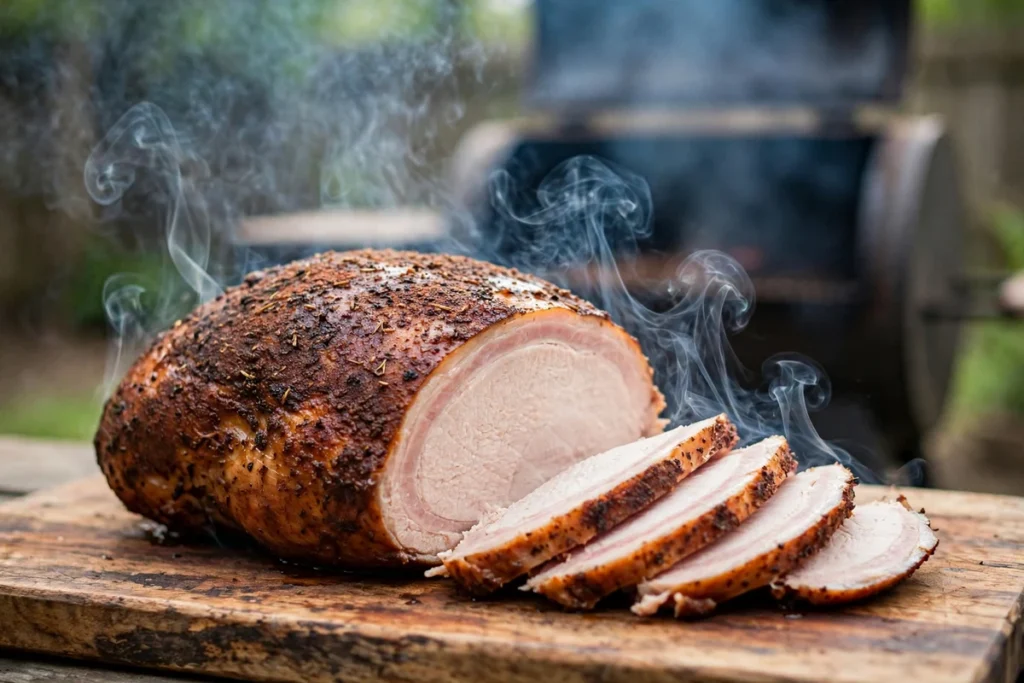
A seasoned turkey breast on the grates of a smoker, wood smoke drifting over the rubbed surface.
Watch: Smoked Turkey Breast
The Hey Grill Hey team demonstrates their cider-brined smoked turkey breast from brine to slice — a juicy, weeknight-friendly smoke that also anchors a holiday table.
At a Glance: Smoked Turkey Breast
Smoker setup, wood, and timing essentials from the guide.
| Topic | Notes |
|---|---|
| Why the breast | It is the best cut to smoke: it cooks evenly, takes on smoke cleanly, and feeds a crowd without a whole bird |
| Brine first | A cider-based brine of 8–12 hours keeps the lean breast juicy through the smoke |
| Smoker setups | Pellet grills are easiest; offset smokers give the deepest flavor; kamado and kettle grills use two-zone indirect heat |
| Wood choice | Mild fruit woods such as apple or cherry suit turkey; stronger woods can overpower it |
| Timing | About 3 to 4 hours for a 5- to 7-pound breast; cook to 165°F internal |
| Crisp the skin | Finish hot or sear briefly if the skin needs crisping before serving |
Frequently Asked Questions
How long does it take to smoke a turkey breast?
At 275°F (135°C), budget roughly 35 to 40 minutes per pound — about 3 to 4 hours for a 5- to 7-pound bone-in breast. Cook to temperature, not time: pull at 155–160°F internal and rest to the safe 165°F (74°C).
What is the best wood for smoking turkey breast?
Apple and cherry are the top choices — mild, slightly sweet, and they give beautiful color. Pecan is a great step up in intensity. Use hickory sparingly (blended with fruit wood) and avoid mesquite, which overwhelms poultry.
Why is my smoked turkey skin rubbery?
Low smoker temperatures and surface moisture are the causes. Dry the brined breast uncovered overnight, smoke at 275°F (not 225°F), and finish with 8 to 12 minutes in a 450°F oven to crisp the skin. This three-part fix solves it reliably.
Should I brine turkey breast before smoking?
Yes — it is the highest-value prep step. A 12- to 18-hour wet brine gives the lean meat a moisture buffer for the long cook. Rinse, pat dry, and air-dry uncovered afterward so the skin can still crisp.
Can I smoke a turkey breast on a gas grill?
Yes, with a two-zone indirect setup and a smoker box or foil pouch of wood chips over the lit burner. It produces lighter smoke than a dedicated smoker, but the technique — 275°F indirect, probe thermometer, hot finish — is identical.
Is the pink smoke ring raw meat?
No. The pink ring is a harmless chemical reaction between smoke gases and the meat’s pigments — it is a sign of real smoking, not undercooking. Verify doneness with a thermometer reading 165°F (74°C); color is never the test.
Conclusion
Smoked turkey breast distills everything great about barbecue into a manageable holiday centerpiece: real wood flavor, juicy meat, and a 3- to 4-hour cook that leaves your day intact. Brine it, rub it, smoke it at 275°F with fruit wood, finish hot for the skin, and rest it properly — that is the complete formula. Serve it alongside your favorite Thanksgiving sides and watch the platter empty first. Once you have tasted turkey with a proper smoke ring, the oven-only bird may never fully satisfy again.