Best Action Camera Under $200: Top Budget Picks for 2026
You don’t need $400 for thrilling action footage — the best action cameras under $200 deliver 4K video, electronic stabilization, and waterproof bodies that handle biking, surfing, skiing, and travel vlogging. The budget segment has matured dramatically: today’s sub-$200 cameras outperform flagships from a few years ago.
The trade-offs at this price are real but manageable: smaller sensors (weaker low light), less refined color science, and ecosystems with fewer accessories than GoPro. But for daylight action — which is most action — the value is undeniable. This guide compares the top budget picks honestly, so you buy the right camera for your adventures.
Whether you’re documenting mountain bike descents, family beach days, or starting a vlog, there’s a sub-$200 camera that fits. Let’s find yours.
What $200 Gets You in 2026
The budget baseline: 4K30 video (some offer 4K60), electronic image stabilization (EIS) that genuinely smooths footage, 10m-ish waterproofing without a case, WiFi and app control, and front/rear screens on the better models. What you sacrifice vs. flagships: 1-inch sensors (low-light quality), 5.3K+ resolution, the most advanced stabilization, and premium color science.
Reality check: in good light, budget action cameras produce footage most viewers can’t distinguish from flagships on phones and laptops. Differences emerge in low light, high dynamic range scenes, and heavy post-processing. For YouTube, social, and personal memories, sub-$200 cameras are more than sufficient — spend the savings on mounts and adventures.
- 4K30 baseline: Some reach 4K60; plenty for sharing.
- Real EIS: Electronic stabilization genuinely smooths footage.
- Waterproof bodies: ~10m without cases on most models.
- Daylight parity: Good-light footage rivals flagships on small screens.
- Low light gap: Smaller sensors show limits after sunset.
Related reading: Best Black Friday Mirrorless Camera Deals 2026 Guide.
Top Pick: Best Overall Budget Action Camera
The best overall sub-$200 action camera balances video quality, stabilization, usability, and reliability. Look for: 4K60 capability, 6-axis EIS that stays smooth while running, intuitive touchscreen interface, good battery life (90+ minutes of 4K), and a proven track record (check long-term reviews, not just launch hype). The current leaders in this bracket come from AKASO’s Brave series and similar challengers that iterate aggressively.
Why it wins: consistent exposure, natural colors without heavy grading, stabilization that handles mountain biking, and an accessory ecosystem (mounts, cases, filters) that actually exists. Buy the bundle with extra batteries and a dual charger — action cameras devour batteries, and the bundle premium is small. This is the camera for buyers who want flagship-like experience at half the price.
- 4K60 + 6-axis EIS: The performance baseline for top picks.
- Proven reliability: Long-term reviews over launch hype.
- Bundle value: Extra batteries + dual charger; small premium.
- Natural color: Good footage without grading gymnastics.
- Accessory ecosystem: Mounts and filters that actually exist.
Related reading: Concert Photography Tips.
Best for Vlogging and Creators
Vloggers need: front-facing screen (framing yourself), good built-in audio or mic adapter support, reliable stabilization for walking, and easy app transfer for quick posting. Some budget cameras now include front screens and mic input — features that were flagship-only recently. For talking-head and walk-and-talk content, these matter more than resolution specs.
Audio reality: built-in mics are wind-prone; a $20 external mic or even a windscreen cover transforms vlog audio. Pair the camera with a small tripod/selfie stick and you’re vlogging. The best vlogging pick at this price won’t match a GoPro Media Mod setup, but it gets creators publishing — and publishing beats perfect gear waiting.
- Front screen: Self-framing essential for vloggers.
- Mic options: External mic support or good wind handling.
- Walking stabilization: Smooth footage on the move.
- Wind protection: $20 mic or windscreen; audio transforms content.
- Publish-ready: Good enough gear beats perfect gear waiting.
Related reading: First Birthday Video Montage Ideas: 20 Concepts, Songs & Editing Guide.
Best Waterproof and Dive Option
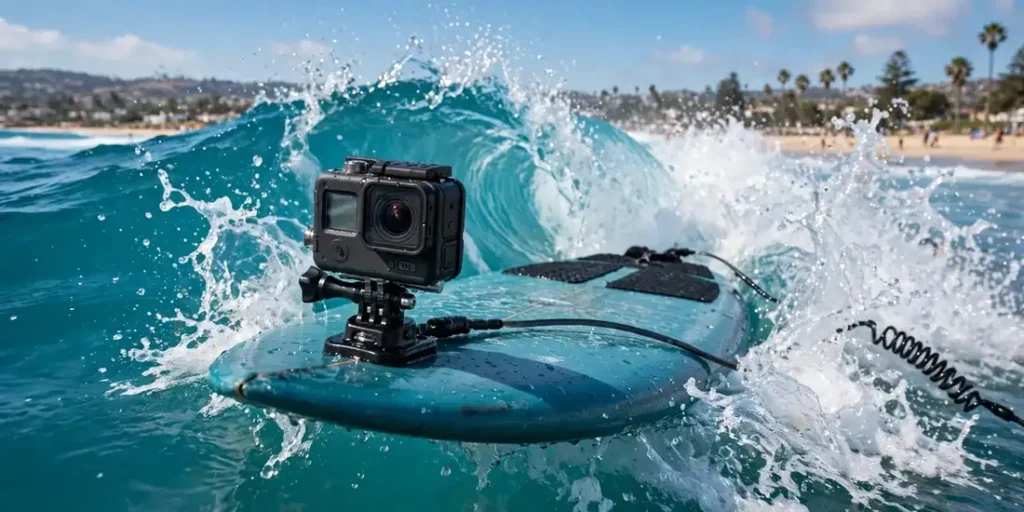
For surfing, snorkeling, and pool use, prioritize: true waterproofing depth (10m+ without case), good underwater white balance (water absorbs red; cameras with dive modes or filters correct better), and a floaty grip or tether (sunken cameras are the #1 action-cam tragedy). Most budget cameras handle snorkeling depths natively; add a dive housing for scuba.
Underwater tips: use red filters below ~5m or correct in post, rinse with fresh water after salt, and secure everything. Budget cameras’ smaller sensors struggle in deep/dark water — stay shallow and sunny for best results. For casual water use, the budget picks perform admirably; dedicated divers should consider housings and lights regardless of camera tier.
- 10m+ native: Snorkeling-ready without extra cases.
- Dive modes: Underwater white balance correction matters.
- Floaty grips: The #1 accessory; sunken cameras are common.
- Red filters: Restore warm tones below 5 meters.
- Rinse after salt: Fresh water rinse extends camera life.
Related reading: How to Capture Your Proposal on Camera: Gear, Settings & Hidden Setups.
Stabilization Compared
Electronic stabilization is the make-or-break feature: test footage at 6-axis EIS while running or biking — the best budget stabilization now rivals older GoPro HyperSmooth. Look for horizon leveling (keeps footage level during tilts), boost modes (tighter crop, smoother result), and performance at 4K (some cameras stabilize only at lower resolutions).
Understand the crop: EIS crops the frame (10–15%), so ‘wide’ becomes less wide when stabilized. For biking and running, max stabilization is worth the crop; for static tripod shots, turn it off for full sensor width. Compare real-world test footage (not marketing) for your use case — stabilization quality varies more between budget models than resolution does.
- 6-axis EIS: The smoothness benchmark; rivals older flagships.
- Horizon leveling: Keeps footage level through tilts.
- Know the crop: 10–15% frame loss; worth it in motion.
- Resolution limits: Some stabilize only below 4K; check specs.
- Test footage: Real-world tests over marketing claims.
Battery Life and Power Management
Action cameras are power-hungry: expect 60–100 minutes of 4K recording per battery, less in cold or with WiFi/GPS on. Management strategies: carry 2–3 batteries (bundles include them cheaply), use a dual charger (charge two while shooting with the third), disable WiFi/GPS when unneeded, and lower resolution for long sessions (1080p doubles runtime).
Cold-weather note: batteries die fast in winter — keep spares in warm pockets, and consider external power banks with USB-C passthrough for ski days. For timelapses and long recordings, external power is the answer. Battery anxiety disappears with spares and a charger; without them, it ruins outings. Budget for power like you budget for mounts.
- 60–100 min: Typical 4K runtime per battery.
- Carry spares: 2–3 batteries; bundles make it cheap.
- Dual charger: Charge while shooting; essential workflow.
- Cold kills: Warm pockets for spares; USB power for ski days.
- Disable extras: WiFi/GPS off when unneeded saves power.
Mounts and Accessories Worth Buying
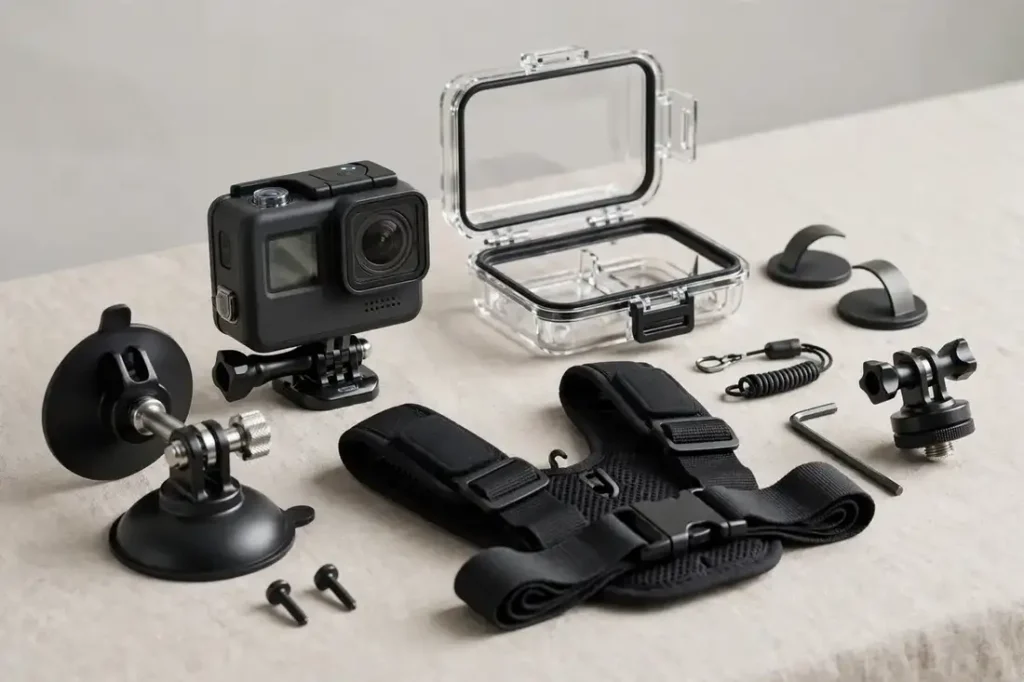
The camera is half the system; mounts are the other half. Essentials: a versatile tripod/selfie stick (vlogging, group shots, timelapses), helmet or chest mount (POV action), suction cup (cars, kayaks), floaty grip (water safety), and a protective case (transport). Most budget cameras use the GoPro-style mount standard — the vast third-party accessory market fits them.
Buy accessories as needs arise, not upfront: start with the activity mounts for your primary sport, add others as adventures diversify. Quality varies wildly in cheap accessories — read reviews, avoid no-name suction cups holding cameras over water. A $150 camera with $50 of right mounts outperforms a $400 camera with no way to attach it.
- GoPro-standard mounts: Vast third-party market fits budget cams.
- Activity-first: Buy mounts for your primary sport first.
- Floaty for water: Non-negotiable over open water.
- Tripod stick: Vlogging, timelapses, group shots; most versatile.
- Quality matters: Avoid no-name mounts in critical situations.
Used Flagships vs. New Budget
The eternal question: a used GoPro Hero 9/10 (~$150–$200) or a new budget camera? Used flagships offer: better color science, superior accessory ecosystems, proven durability, and features like better low light. Risks: battery wear, no warranty, unknown history (water damage), and older stabilization vs. new budget EIS.
Decision guide: choose used flagship if you value ecosystem and proven reliability and buy from reputable sellers with return policies; choose new budget for warranty, latest budget stabilization, and untouched batteries. For most buyers, new budget wins on peace of mind — but a well-bought used flagship is genuinely more camera. Either way, you’re getting remarkable capability under $200.
- Used pros: Better color, ecosystem, proven durability.
- Used cons: Battery wear, no warranty, unknown history.
- New pros: Warranty, fresh batteries, latest budget tech.
- Buy used carefully: Reputable sellers, return policies, test everything.
- Both win: Remarkable capability either way under $200.
Video Settings That Matter
Optimal budget settings: 4K30 for quality (or 4K60 for smooth action), EIS on for movement, native white balance or manual (avoid auto-WB shifts mid-clip), flat/log profile if available (more grading latitude; only if you’ll color correct), and high bitrate when offered. For slow motion: 1080p120/240 — budget slow-mo is decent in good light.
Shooting discipline: wipe the lens (the #1 footage killer), lock exposure for consistent clips, use ND filters in bright sun for natural motion blur (budget cameras lack adjustable aperture), and shoot short clips (easier editing, less battery/heat). Settings knowledge extracts flagship-like results from budget hardware — the camera matters less than the operator.
- 4K30/60: Quality vs. smooth action; choose per shot.
- Flat profiles: Grading latitude; only if you’ll color correct.
- Wipe the lens: The #1 footage killer; check constantly.
- ND filters: Natural motion blur in bright sun.
- Operator > camera: Skill extracts flagship results from budget gear.
When to Upgrade (and When Not To)
Upgrade signals: you’re consistently limited by low light (night/surf-dawn shooting), you need 5.3K or 4K120 for professional work, the accessory ecosystem gaps block your use case, or you’re earning from content and reliability is business-critical. Don’t upgrade for: marginally better specs you won’t notice on phones, features you haven’t outgrown, or GAS (gear acquisition syndrome) disguised as need.
The honest truth: most sub-$200 buyers never outgrow their camera — they outgrow their creativity, which no purchase fixes. Master your budget camera fully (every setting, every mount, full editing workflow) before considering flagships. When you can articulate exactly which limitation costs you shots, you’re ready. Until then, the money is better spent on experiences worth filming.
- Real limits: Low light, pro resolution needs, ecosystem gaps.
- Not GAS: Don’t buy specs you won’t notice.
- Master first: Every setting and mount before upgrading.
- Articulate limits: Name the exact limitation costing shots.
- Experiences > gear: Money better spent on adventures to film.
Mounting Your Action Camera
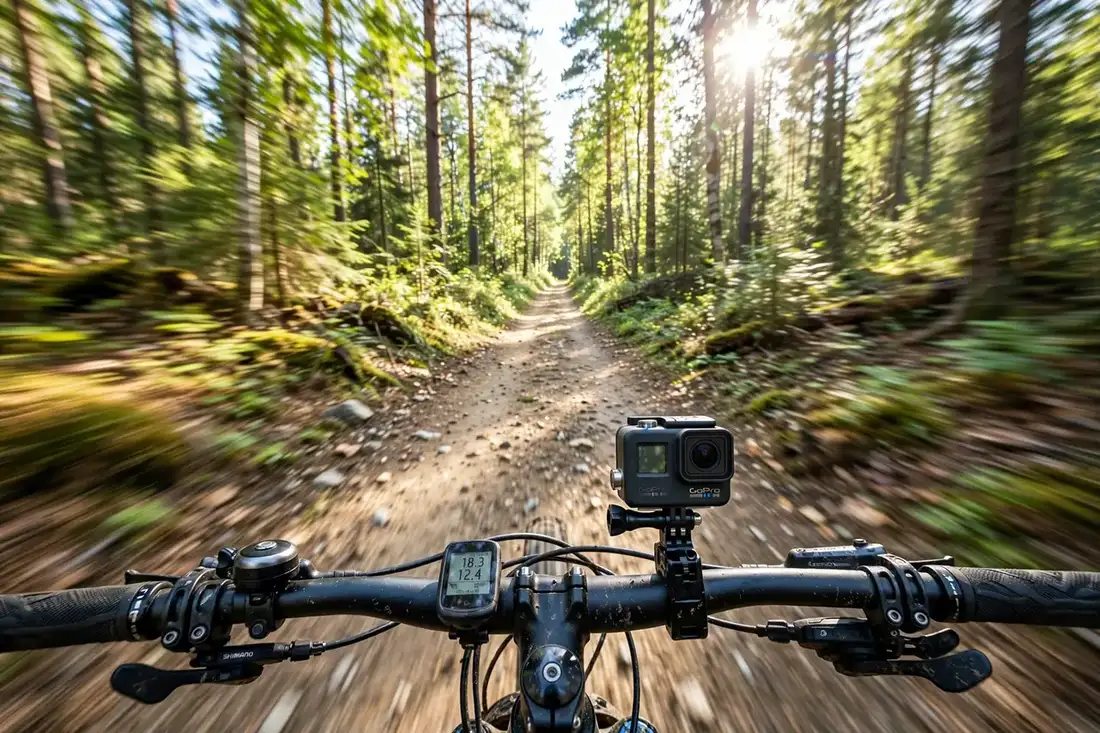
Mounts unlock the action camera’s potential: chest mounts (immersive POV for biking, skiing; stable, natural perspective), helmet mounts (true first-person; check regulations for organized sports), handlebar/seatpost (cycling dynamics; vibration isolation matters), suction cups (cars, kayaks; test hold before trusting), and tripod adapters (static shots, timelapses). The mount shapes the story — same activity, different mount, different film.
Mounting wisdom: tighten thoroughly (vibration loosens; check mid-activity), use tethers (leashes save cameras; cheap insurance), consider the angle (slight downward captures hands and action; level captures horizon), and vary mounts (edit between perspectives; visual variety). Safety: helmet mounts can snag (consider breakaway designs), and never compromise protective gear for footage.
The pro move: plan shots (not just recording everything; intentional angles), and review footage (learn what each mount delivers). Mounts are the action camera’s language — learn to speak in perspectives. A $20 mount collection transforms a $150 camera’s output.
- Chest mounts: Immersive POV; stable, natural.
- Helmet mounts: First-person; check sport regulations.
- Tethers: Leashes save cameras; cheap insurance.
- Angle down slightly: Captures hands and action.
- Vary perspectives: Edit between mounts; visual variety.
- Tighten well: Vibration loosens; check mid-activity.
- Breakaway safety: Snag risk; never compromise gear.
- Plan shots: Intentional angles beat always-recording.
Underwater Filming Basics
Action cameras’ waterproofing opens the underwater world: snorkeling (colorful reefs; shoot in bright sun), diving (depths shift colors; red filters restore), pools (practice; controlled conditions), and surf (dynamic; housing recommended). Key: water absorbs red light rapidly — without correction, everything goes blue-green.
Color solutions: red/magenta filters (snap-on; restore warmth at depth), video lights (true color; essential below 10m), and white balance (custom WB at depth; or correct in post). Shoot with the sun behind you (illuminates subjects), get close (water degrades clarity; closer is clearer), and hold steady (currents move you; brace against rocks).
Care: rinse in fresh water after salt (every time), check seals (hair or sand compromises; inspect O-rings), and dry before opening (one drop inside ruins electronics). Underwater footage is magical — and the maintenance is simple discipline. Respect the seals; they’ll respect your camera.
- Red filters: Restore warmth at depth.
- Video lights: True color below 10m.
- Get close: Water degrades; closer clearer.
- Sun behind: Illuminates subjects.
- Rinse always: Fresh water after salt; every time.
- Check seals: Hair/sand compromise O-rings.
- Dry before opening: One drop ruins electronics.
- Practice in pools: Controlled conditions first.
Editing Action Footage
Action footage needs aggressive editing — raw action is boring; edited action thrills. Principles: cut ruthlessly (keep only the best 5%; nobody watches 40 minutes of biking), match cuts to music (beats drive energy; edit rhythmically), stabilize (software stabilization smooths; but don’t overdo the crop), and color grade (punchy contrast; action looks vibrant).
Workflow: import and review (mark best moments), assemble highlights (story arc: setup, action, payoff), add music (licensed; Artlist/Epidemic), sound design (whooshes, impacts; sells the action), and export for platform (YouTube 4K, social vertical). Free editors (DaVinci Resolve; professional-grade, free) handle everything.
Storytelling: even action needs narrative (the attempt, the struggle, the landing), include failures (bails are entertaining and humanizing), and keep it short (2–5 minutes; attention is scarce). Great action edits feel effortless — that’s the editing, not the filming.
- Cut ruthlessly: Keep best 5%; raw action bores.
- Music rhythm: Beats drive energy; edit to them.
- Stabilize: Software smooths; watch crop.
- Story arc: Setup, action, payoff; narrative matters.
- Include bails: Failures entertain and humanize.
- Keep short: 2–5 minutes; attention scarce.
- DaVinci free: Professional editing; zero cost.
- Sound design: Whooshes sell the action.
Adventure Vlogging Setup
Adventure vlogging pairs action cameras with storytelling: the kit (action camera + media mod or mic adapter + wireless lav + mini tripod + spare batteries), audio priority (viewers forgive shaky video; they abandon bad audio), and the talking-head balance (action footage + to-camera narration = vlog structure).
Technique: narrate during action (voiceover or live commentary; context transforms clips), film B-roll (establishing shots, details; editing glue), keep the camera accessible (chest mount or quick-draw; missed moments don’t vlog), and batch your story (morning setup, action, evening reflection; narrative arc).
Growth: consistency (weekly uploads; algorithm and audience), authenticity (real adventures, real reactions; staged thrills read fake), and community (comments, collabs; adventure niches are tight-knit). The action camera is the tool; the adventure and personality are the content. Gear enables; you deliver.
- Audio priority: Bad audio loses viewers; invest in mics.
- Action + narration: The vlog structure; context transforms.
- B-roll glue: Establishing shots; editing material.
- Accessible camera: Quick-draw; missed moments lost.
- Narrative arc: Setup, action, reflection.
- Weekly consistency: Algorithm and audience reward.
- Authenticity: Real reactions; staged reads fake.
- You deliver: Gear enables; personality is content.
Accessories Worth Buying
Smart accessories multiply value: spare batteries (action cameras drain fast; 3+ batteries for day trips), fast memory cards (V30/U3 minimum; 4K demands speed), protective case (transport; organized), lens protectors (replaceable; scratch insurance), and a good mount kit (variety; perspectives).
Situational: floating grip (water sports; sinks are forever), head strap (hands-free POV), extension pole (selfie perspectives, group shots), and ND filters (motion blur in bright light; cinematic). Skip: gimmicky mounts you’ll use once, cheap no-name batteries (safety; swelling risks), and overpriced branded basics (third-party often equals).
Budget approach: buy as needed (not all upfront; discover your style), prioritize batteries and cards (the real limits), and maintain (clean mounts; check screws). Accessories should solve problems you’ve actually had — not hypothetical ones. The best kit is the one that matches your adventures.
- Spare batteries: 3+ for day trips; drain is fast.
- Fast cards: V30/U3; 4K demands speed.
- Floating grip: Water sports; sinks are forever.
- Lens protectors: Replaceable; scratch insurance.
- Buy as needed: Discover style before stocking.
- Skip gimmicks: Solve real problems, not hypothetical.
- Third-party OK: Basics often equal; save money.
- Maintain: Clean mounts; check screws.
Storytelling With Action Footage
Footage without story is noise: the arc (setup; the place, action; the doing, payoff; the result), the character (you; the relatable), the stakes (the attempt; the risk), and the edit (the rhythm; the music). The vlog structure: hook (the first 5 seconds; the promise), context (the where; the why), action (the meat; the varied), and the reflection (the meaning; the close).
The shooting: coverage (wide; the place, medium; the action, close; the detail), the B-roll (the glue; the cutaways), the soundbites (the voice; the story), and the restraint (the best; the short). The narration: the voiceover (the context; the recorded), the live (the energy; the raw), and the music (the emotion; the licensed).
The examples: the trip (the day; the adventure), the trick (the attempts; the land), the place (the tour; the POV), and the challenge (the goal; the journey). The principle: the audience (the feeling; the transported), the length (the tight; the 3 minutes), and the authenticity (the real; the trusted). Story first; the camera serves.
The growth: the series (the returning; the subscribed), the style (the recognizable; the yours), the community (the comments; the engaged), and the craft (the improving; the always). The storytellers with action cameras build audiences; the filers of footage don’t. Tell stories; the views follow.
- Hook 5s: Promise; the opening.
- Arc: Setup; action; payoff.
- Coverage: Wide; medium; close.
- B-roll glue: Cutaways; the edit.
- Tight 3 min: Restraint; the best.
- Authentic: Real; the trusted.
- Series: Returning; subscribed.
- Story first: Camera serves.
Slow Motion Techniques
Slow motion reveals: the frame rates (120fps; the 4x, 240fps; the 8x, the tradeoffs; the resolution), the shutter (the 180°; the 1/250; the crisp), the light (the needed; the abundant), and the subjects (the action; the water; the worthy). The technique: the stable (the tripod; the smooth), the focus (the locked; the manual), and the timing (the moment; the anticipated).
The creative: the speed ramp (the normal; the slow; the dramatic), the detail (the droplets; the expressions), the sports (the form; the analyzed), and the nature (the wings; the waves). The settings: the 2.7K/120 (the balance; the quality), the 1080/240 (the extreme; the fun), and the Protune (the flat; the graded).
The editing: the placement (the moment; the emphasis), the duration (the brief; the impact), the sound (the designed; the slow), and the music (the build; the drop). The mistakes: the overuse (the gimmick; the boring), the dark (the noisy; the light), and the shaky (the distracting; the stable). Slow motion is spice; the dish is the story.
The practice: the everyday (the pour; the jump), the action (the skate; the surf), the nature (the bird; the rain), and the eye (the moments; the trained). The slow reveals what speed hides; the camera sees what eyes miss. Shoot fast; savor slow.
- 120fps 4x: 240fps 8x; the tradeoffs.
- Light needed: Abundant; the high speed.
- Speed ramp: Normal to slow; dramatic.
- Stable: Tripod; the smooth.
- Brief impact: Placement; the moment.
- Overuse gimmick: Spice; not dish.
- 2.7K/120: Balance; the quality.
- Reveals hidden: Eyes miss; camera sees.
Sharing and Growing an Audience
The platforms: YouTube (the search; the long), Instagram (the reels; the vertical), TikTok (the viral; the short), and the strategy (the native; the each). The content: the consistent (the schedule; the expected), the niche (the focused; the known), the quality (the improving; the always), and the authentic (the you; the trusted).
The growth: the SEO (the titles; the searchable), the thumbnails (the click; the curious), the hooks (the 3 seconds; the retained), and the community (the replies; the engaged). The collaboration: the similar (the cross; the shared), the local (the together; the fun), and the brands (the later; the earned).
The analytics: the retention (the graph; the truth), the CTR (the thumbnail; the test), the comments (the signal; the listen), and the iterate (the data; the improve). The patience: the months (the compound; the slow), the videos (the 100; the skill), and the joy (the making; the first). Audiences grow from value; the consistent valuable win.
The monetization: the ads (the later; the views), the affiliates (the gear; the trusted), the sponsors (the niche; the aligned), and the products (the own; the leverage). The creator path: the hobby (the love), the side (the income), and the choice (the yours). Share generously; the audience is the reward.
- Native each: Platform; the strategy.
- Consistent: Schedule; the expected.
- Thumbnails: Click; the curious.
- Retention graph: Truth; the iterate.
- Community: Replies; the engaged.
- 100 videos: Skill; the compound.
- Value grows: Consistent; the win.
- Share generous: Audience; reward.
Best Action Camera Under $200: Quick Comparison
| Camera tier | Price | Strengths | Trade-offs |
|---|---|---|---|
| Top budget pick | $150–$200 | 4K60, 6-axis EIS, front screen | Low light, color science |
| Value runner-up | $100–$150 | Great daylight 4K, bundles | Fewer pro features |
| Ultra-budget | $50–$100 | Cheap fun, kids, risky sports | 1080p-ish real quality |
| Used flagship | $150–$200 | Proven, great ecosystem | No warranty, battery wear |
Frequently Asked Questions
Are budget action cameras any good?
Yes for daylight action — modern sub-$200 cameras shoot 4K with good stabilization that rivals older flagships. Low light and color science are where flagships pull ahead.
Which is better: AKASO or GoPro?
GoPro wins on ecosystem, color, and low light; budget brands like AKASO win on price-to-performance. For casual use, budget cameras deliver 90% of the experience at half the price.
Can cheap action cameras go underwater?
Most are waterproof to ~10m without a case — fine for snorkeling and pools. Rinse after salt water, use a floaty grip, and add housings for scuba depths.
Do I need 4K60?
Nice for action smoothness and slow-motion flexibility, but 4K30 suffices for most sharing. Prioritize stabilization quality over resolution numbers.
How long do action camera batteries last?
60–100 minutes of 4K per battery. Carry 2–3 spares and a dual charger; cold weather shortens runtime significantly.
Should I buy a used GoPro instead?
A used flagship offers better ecosystem and color with warranty risks. New budget cameras offer peace of mind. Both are valid under $200 — buy used only from reputable sellers.
Watch: Best Action Camera Under $200: Top Budget Picks for 2026 Video Guide
The best action camera under $200 is the one you’ll actually take on adventures — and at these prices, there’s no excuse to leave it home. Pick based on your primary use (vlogging, water, pure action), grab the right mounts, pack spare batteries, and go make footage worth watching. The camera is capable; the adventures are up to you. Somewhere out there is a wave, a trail, or a sunset with your name on it — go film it.