
Cornhole Rules: How to Play, Score, and Win Your Next Tournament
It looks almost too simple: toss a beanbag at a tilted wooden board with a hole in it. Yet cornhole has grown from a backyard pastime into a televised professional sport with national championships, sponsored pros, and prize pools that would make your grandfather’s horseshoes blush. The secret is that beneath the simplicity lies a game of surprising depth — strategy, spin, psychology, and a scoring system with just enough cruelty to keep every match interesting until the final bag.
This guide covers the complete official rules: board and bag specifications, setup and distance, how scoring actually works (including the cancellation system that confuses every beginner), fouls and violations, doubles and singles formats, tournament structure, and the strategies that separate casual tossers from players who win cookouts. Whether you are settling a family debate or entering your first local tournament, this is the rulebook in plain English.
Cornhole’s genius is its accessibility. A five-year-old and a seventy-five-year-old can play the same game, on the same boards, and both have a genuine chance to win. It takes thirty seconds to learn and years to master — the rare game that works equally well as background party fun and as a serious competitive pursuit.
The Basics: Objective of the Game
Cornhole is played with two boards and eight bags (four of each of two colors). Players take turns tossing bags at the opposite board, trying to land them on the board (1 point) or through the hole (3 points). The first player or team to reach 21 or more points wins — with one crucial twist: you must win by… nothing. There is no win-by-two in standard play; reaching 21 exactly or beyond ends the game immediately. (Some casual groups play “win by 2” or bust rules — more on those variations later.)
Games are played in innings (also called frames or rounds). In singles, each player throws all four of their bags, alternating with the opponent. In doubles, teammates stand at opposite boards and alternate throws with the opposing team. The player or team that scored in the previous inning throws first in the next — a small reward that matters more than it sounds.
Official Equipment Specifications
Backyard sets vary wildly, but official tournament specs are precise. Knowing them helps you buy a set that plays like the real thing — and explains why your uncle’s wobbly homemade boards play “different.”
The Boards
- Size: 2 feet by 4 feet (24″ x 48″), the regulation “tournament grade” footprint.
- Hole: 6 inches in diameter, centered 9 inches from the top edge.
- Height: the front edge sits 3–4 inches off the ground; the back edge 12 inches — creating the signature slope.
- Surface: smooth, sanded wood (typically 1/2″ or 3/4″ plywood); slick enough for bags to slide, with enough grip to hold.
- Finish: painted or stained; tournament boards have consistent slide characteristics — the “slick vs. sticky” board debate is real strategy.
The Bags
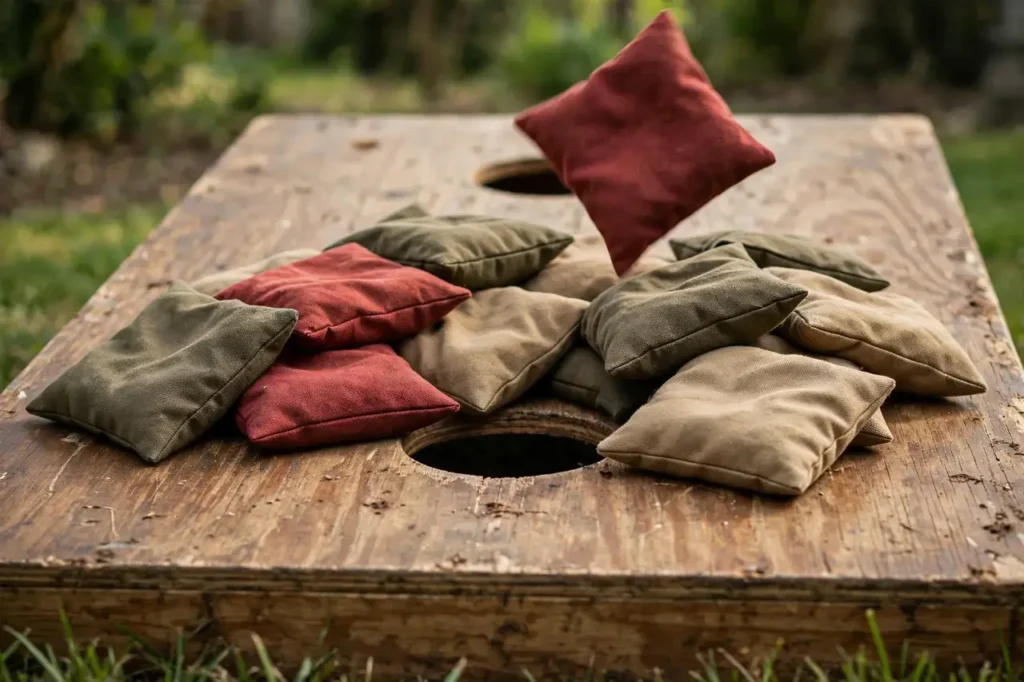
- Size and weight: 6″ x 6″ squares weighing 15–16 ounces (about a pound each).
- Fill: traditionally dried corn kernels (hence “cornhole”); modern pro bags use resin pellets, which play consistently in humidity.
- Fabric: durable duck canvas or synthetic; pro bags have a “fast side” and “slow side” for different shots.
- Colors: two contrasting colors so ownership is always clear mid-pile.
Setup and Distances
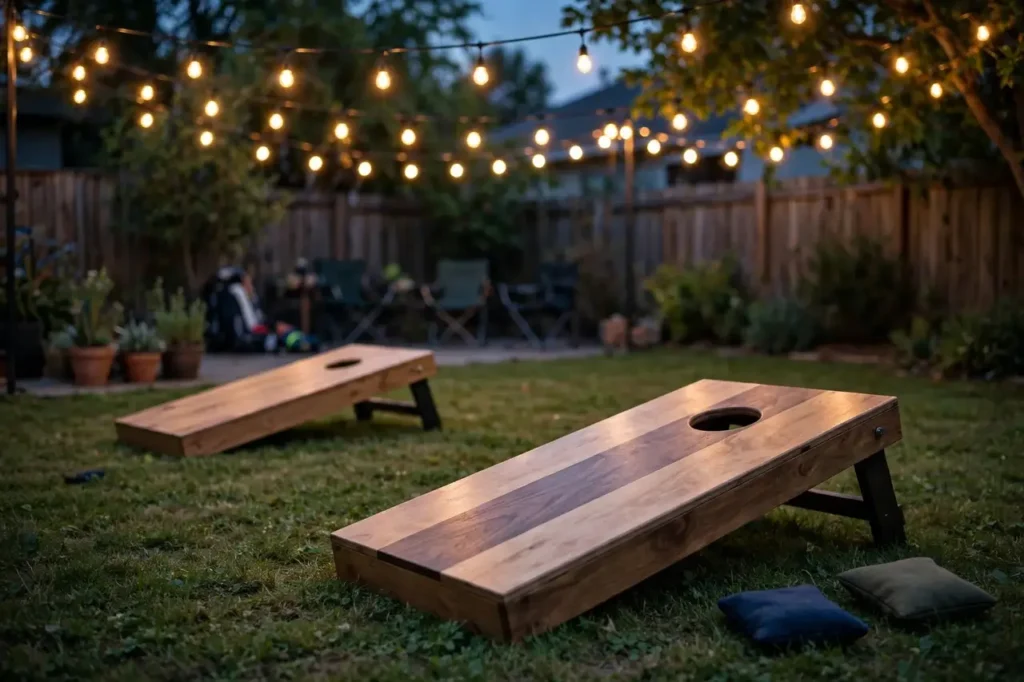
Place the boards facing each other with 27 feet between the front edges — measured front to front. That is the official adult distance, and it is farther than it looks in the backyard. For juniors (12 and under), casual family play, or smaller yards, 15–20 feet is the common friendly adjustment; just agree before the first toss.
Players stand in the pitcher’s box: the rectangular area beside the board they are throwing from. Your feet must not cross the foul line — the front edge of the board — until the bag is released. In doubles, one teammate occupies each end; teammates alternate ends each game in tournament play to keep things fair.
How Scoring Works: Cancellation Scoring Explained
This is the part that confuses every newcomer, so read it twice: cornhole uses cancellation scoring. Only one player scores per inning, and it is the net difference.
The Point Values
- In the hole (“cornhole”): 3 points per bag.
- On the board (“woody”): 1 point per bag — the bag must be touching the board, not the ground.
- Off the board or on the ground: 0 points.
- A bag knocked into the hole by another bag still counts — 3 points, no matter who knocked it.
- A bag knocked off the board scores nothing — even if it was in the hole first (a brutal, beloved rule).
Cancellation in Practice
Add up each side’s points for the inning, then subtract: only the higher total scores, and only the difference. Example: you land one bag in the hole (3) and two on the board (2) for 5; your opponent lands one in the hole (3) and one on the board (1) for 4. You score 5 − 4 = 1 point for the inning. Your opponent scores zero. This is why a “wash” (tied inning, nobody scores) is common at high levels — and why one great shot can erase an opponent’s whole inning.
Reaching 21
The first to 21+ after an inning wins. There is no bust rule in official play — if you overshoot to 24, you still win. (The “bust” or “skunk” variants, where exceeding 21 resets you, are house rules — fun, but not official.) Games typically run 15–25 minutes; a match is often best-of-three games in tournaments.
| Term | Meaning | Points |
|---|---|---|
| Cornhole / “in the hole” | Bag goes through the hole | 3 |
| Woody | Bag lands and stays on the board | 1 |
| Hanger / “dangler” | Bag hanging over the hole, touching board | 1 (until it drops: 3) |
| Wash | Inning ends tied — nobody scores | 0 |
| Skunk | Shutout win (11–0 or 7–0 variants) | — (house rule) |
| Four-bagger | All four bags in the hole in one inning | 12 (before cancellation) |
| Swish | Bag straight in the hole without touching board | 3 (style points: infinite) |
Fouls and Violations
Official rules keep the game honest with a short list of fouls. In casual play, enforce the spirit; in tournaments, these are called strictly.
- Foot foul: crossing the foul line (front edge of the board) before release. The bag is dead — remove it, no points.
- Throwing out of turn: tossing when it is not your turn; the bag is forfeited for that inning.
- Touching bags early: no player may touch bags on the board until the inning’s throws are complete — doing so forfeits remaining throws.
- Bag hits the ground first: a bag that touches the ground before the board and then bounces on is dead — it must land on the board directly (or be knocked on by a later bag… which then counts!).
- Interference: distracting a thrower deliberately is a foul; heckling lovingly is tradition.
- Time violations (tournaments): 20 seconds per throw in pro play; casual games should keep a friendly pace.
Singles vs. Doubles Format
Singles: two players, each throwing four bags per inning from the same board, alternating one throw at a time. Walk to the other end, tally the inning, throw back. Simple and intense — every bag is yours.
Doubles: four players, teammates at opposite ends. Player A (Team 1) and Player B (Team 2) throw from one end while their partners watch from the other; then the partners throw back. Partners cannot coach mid-throw in strict tournaments, which makes doubles a fascinating exercise in silent trust. Doubles is the more social format and the standard for parties — it keeps everyone involved every inning.
Winning Strategy: Beyond Just Aiming
Casual players aim at the hole. Good players play the board. Here are the concepts that win games.
The Slide Shot
The fundamental pro technique: throw with a flat, spinning trajectory so the bag lands mid-board and slides into the hole. A flat bag (achieved with a palm-down release and follow-through) slides predictably; a tumbling bag bounces unpredictably. Practice landing bags in a consistent spot — the “landing zone” just short of the hole — and let slide do the work.
The Block and the Push
Once you can reliably land on the board, play defense. A blocker bag sits just in front of the hole, daring your opponent to go around it. A push shot shoves your own bags (or the blocker’s) into the hole. High-level cornhole is largely a chess match of blockers and pushes — which is why televised matches are weirdly riveting.
The Airmail
When the board is clogged with blockers, the airmail — a high-arcing bag that drops straight into the hole without touching the board — clears the mess spectacularly. It is low-percentage for beginners but devastating when it lands. Practice it as a specialty shot, not a primary strategy.
Mental Game
- Throw your game, not theirs — chasing an opponent’s hot streak leads to forced errors.
- Embrace the wash — when behind, matching your opponent bag-for-bag to force scoreless innings stops the bleeding.
- Know when to go for it — down late, the airmail’s risk becomes rational; ahead, play safe woodies and let cancellation protect you.
- Routine matters — same stance, same grip, same breath, every throw. Pros are boring on purpose.
Game-night strategists who enjoy Valentine’s Day game night ideas for couples will find cornhole’s mix of skill and psychology scratches the same itch — easy to start, endlessly refinable.
Tournament Play: What to Expect
Local blind-draw tournaments (partners assigned randomly) are the friendliest entry point — show up alone, get paired, play. Most use double elimination: lose twice and you are out, which guarantees everyone multiple games. Bring your own bags if you have a preferred set; house bags are fine but inconsistent. Matches are timed or first-to-21; finals are often best-of-three. The tennis scoring rules explained guide shows how other sports handle competitive structure — cornhole’s double-elimination brackets work on the same fairness principles.
Pro tip for your first tournament: arrive early, throw warm-up bags on the actual boards (every board slides differently), and introduce yourself. The cornhole community is famously welcoming — today’s opponents are tomorrow’s practice partners.
Popular House Rule Variations
- Bust / bust-21: exceeding 21 resets your score to 11 or 15 — adds delicious late-game tension.
- Win by 2: must lead by two at 21+; prevents anticlimactic squeakers.
- Skunk rule: win 11–0 (or 7–0) and the game ends early — mercy with bragging rights.
- Woody counts / “no woodies”: some groups play hole-only scoring for faster, swingier games.
- Short distance: 20-foot foul lines for kids, beginners, or small yards.
- “Cornami”: slang for the dreaded 0-point game — the only trophy nobody wants.
Build Your Own Boards: A Weekend DIY Guide
Store-bought tournament boards run $150–$300. A DIY set costs $60–$100 in materials, takes a weekend, and plays just as well — plus you get custom paint. Here’s the complete build.
Materials (One Set of Two Boards)
- One 4×8 sheet of 1/2″ or 3/4″ birch plywood — cabinet-grade for a smooth surface; the single biggest quality factor.
- 2×4 lumber — four 8-foot boards for frames and legs (about 48 linear feet total).
- Wood screws (2.5″) — plus wood glue for rock-solid joints.
- 6″ hole saw — for the clean hole cut; a jigsaw works but the hole saw is cleaner.
- Sandpaper (120 then 220 grit) — the playing surface must be glass-smooth for consistent slide.
- Exterior primer + paint or polyurethane — at least two coats; tournament boards are slick for a reason.
- Folding leg hardware (optional) — hinges and braces for legs that fold flat for storage.
Build Steps
- 1. Cut the tops — two 24″×48″ rectangles from the plywood; measure twice, cut once.
- 2. Cut the hole — 6″ diameter, centered 9″ down from the top edge (measure 12″ from the top to the hole’s center); sand the rim smooth.
- 3. Build the frames — 2×4 boxes (24″×48″ outer dimension) with cross-braces; glue and screw every joint.
- 4. Attach the tops — screw the plywood to the frames from below (no screw heads on the playing surface — countersink any that poke through).
- 5. Add legs — rear legs sized so the back sits 12″ high and the front 3–4″; hinged folding legs are worth the extra hardware.
- 6. Sand everything — 120 grit, then 220; round over the frame edges so bags don’t catch.
- 7. Prime and paint — exterior primer, then your design (team colors, stripes, stencils); finish with 2–3 coats of water-based polyurethane for the slide.
- 8. Cure before play — let the finish harden 48–72 hours; fresh paint grabs bags.
Pro Build Tips
- Weight matters — regulation boards weigh 25+ lbs each; light boards bounce and shift. Don’t skimp on materials.
- Cross-brace the underside — a center brace prevents the plywood from drumming and flexing.
- Test the slide — before final clearcoat, toss bags; adjust with another polyurethane coat if too sticky or too slick.
- Drink holders are optional — but let’s be honest, they’re happening. Cup-holder add-ons are a beloved DIY extra.
Practice Drills: Getting Good Alone
Cornhole skill comes from deliberate repetition, not just games. These solo drills build the shots that win matches.
The Core Drills
- The landing-zone drill — place a towel 12″ in front of the hole; land 20 consecutive bags on it. This is the slide shot’s foundation.
- The four-bagger chase — throw four bags aiming all-in-the-hole; track your four-bagger percentage weekly. Pros sit near 40%+.
- The blocker drill — intentionally land a bag just short of the hole, then practice pushing it in with the next bag. Repeat 50 times.
- The airmail ladder — start 10 feet from the board, throw airmails until you make 5; step back 2 feet; repeat to regulation distance.
- The wash game — simulate match pressure: play against an imaginary opponent who matches your score; practice scoring when it counts.
- Weak-hand rounds — an inning with your off hand; builds coordination and humility in equal measure.
- The 21-point sprint — solo game to 21 counting only your points; tracks scoring efficiency over time.
Building a Practice Routine
- 20 minutes, 3x weekly — beats occasional marathon sessions; muscle memory needs frequency.
- Warm up with woodies — 10 bags just landing on the board; then progress to hole-seeking.
- One drill per session — deep practice on one skill beats shallow practice on five.
- Track everything — four-bagger %, airmail %, points per inning; what gets measured improves.
- Film yourself monthly — phone video reveals mechanical flaws (elbow drop, inconsistent release) you’d never feel.
- Practice tired — tournaments run long; throwing well in game 8 matters more than game 1.
Solo practice is the unglamorous engine behind every tournament player — the same truth behind tennis for beginners guide-style improvement: drills build the strokes that matches reveal. The player who practices blockers alone on Tuesdays is the player pushing them past you on Saturdays.
Cornhole Bags: Choosing, Breaking In, and Care
Boards get the glory, but bags win games. Modern cornhole bags are engineered equipment — different fabrics, fills, and speeds for different shots — and the right bags for your throw matter more than a fancier board.
Understanding Bag Speeds
Pro bags have two sides: a fast side (slick fabric) and a slow side (grippy fabric), rated on a 1–10 speed scale. The ratings describe how the bag behaves on the board:
- Fast side (7–10) — slick; slides easily into the hole, great for slide shots and pushing through piles.
- Slow side (3–6) — grippy; stops where it lands, ideal for blockers and airmail control.
- Beginners: medium speeds (5–7 / 4–5) — forgiving and versatile; extreme bags punish imprecise throws.
- Humid vs. dry — humidity slows boards dramatically; experienced players carry multiple speed sets for conditions.
- Carpet vs. slick boards — your bags should match your boards; test combinations before committing.
Fill Materials
- Resin pellets (modern standard) — consistent in all weather, the pro choice; bags feel full and break in predictably.
- Dried corn (traditional) — the original fill; can mold in humidity, inconsistent over time; nostalgic but impractical.
- Sand mixes — some bags blend fills for specific feels; specialty options for particular throwing styles.
Breaking In New Bags
- Throw them — 500+ throws is the honest break-in; the fabric softens and speeds stabilize.
- The dryer method (no heat) — 20 minutes tumbling no-heat loosens fabric; controversial but widely used.
- Hand-kneading — work the bags like dough while watching TV; slow but safe.
- Vinegar soak (advanced) — brief soak softens fabric fast; rinse thoroughly, air dry; can void warranties.
- Never use heat — dryers on heat or microwaves damage fill and fabric; patience or no-heat only.
Bag Care and Tournament Rules
- Wash occasionally — mild soap, air dry; dirty bags play inconsistently.
- Rotate sets — serious players own 3–6 sets for different conditions; start with one versatile set.
- ACL-approved bags — tournament play requires approved bag lists; check current approval before buying for competition.
- No altering — microwaving, freezing, or chemically treating bags is illegal in sanctioned play.
- Replace worn bags — blown seams or migrated fill change play; retire them to backyard duty.
Bag obsession is cornhole’s rabbit hole — players debate fabrics like golfers debate shafts. Start with one quality medium-speed set from an established maker, break them in honestly, and let your throw develop before accumulating. The tennis for beginners guide racket wisdom applies: the player matters more than the equipment, but the right equipment stops fighting the player.
7 Pro Tips From Tournament Players
These are the small edges competitive players swear by — the details that separate bracket-winners from cookout heroes.
- Develop a pre-throw routine — same stance, same breath, same number of practice swings, every throw. Pros look boring on purpose; routine inoculates against pressure. Build yours in practice so it’s automatic in competition.
- Throw the same bag — within your set of four, players develop a favorite; rotate evenly in practice so every bag feels identical. In tournaments, you can’t choose — consistency across all four matters.
- Learn to read boards — every board slides differently with humidity, finish wear, and temperature. Your warm-up throws should calibrate: how far does a normal throw slide here? Adjust landing zones accordingly.
- Master the flop shot — a high, soft bag that drops and stops dead; essential when the board is crowded and a slide would push everything off. It’s the short game of cornhole.
- Play the score, not the highlight — ahead late? Throw safe woodies and let cancellation protect you. Behind? That’s when the airmail’s risk becomes rational. Match strategy to scoreboard.
- Control your breathing — one slow exhale before release; tension ruins fine motor control. Tournament pressure lives in the shoulders — drop them consciously.
- Study opponents’ tendencies — does she always go for the hole? Does he leave blockers? Between innings, note patterns and adjust. Cornhole is chess at 27 feet.
Frequently Asked Questions
How far apart are cornhole boards?
27 feet from front edge to front edge for official adult play. For casual family games, 15–20 feet is common and perfectly fine — agree on the distance before starting. Junior players (12 and under) typically play from shorter distances in organized events.
Can you go over 21 in cornhole?
Yes, in official rules — the first to reach 21 or more wins, no bust. Many casual groups play a “bust” house rule where exceeding 21 drops you back to a lower score, so clarify before the game starts to avoid end-of-game arguments.
What happens if a bag is hanging over the hole?
A “hanger” touching the board counts as 1 point (on the board). If it later drops through — including if nudged by another bag — it becomes 3 points. If it falls off entirely, it scores zero. This is why hangers create such delicious end-of-inning drama.
Do you have to throw underhand in cornhole?
There is no strict underhand requirement in the rules, but the mechanics of the game make underhand (or sidearm) the only practical delivery — you need a flat, controlled trajectory from 27 feet. Overhand throws are legal but essentially unheard of; they cannot produce the slide shots the game rewards.
How many points is a bag on the board vs. in the hole?
On the board: 1 point. In the hole: 3 points. But remember cancellation scoring: only the net difference between players scores each inning, so a 3-pointer can be completely erased by your opponent’s matching 3-pointer.
What is the best cornhole strategy for beginners?
Aim for the middle of the board, not the hole. A flat throw that lands center-board will slide toward the hole naturally and at worst leaves you a 1-point woody. Beginners who aim directly at the hole miss everything; beginners who aim at the board score consistently. Master the woody before the swish.
Watch and Learn: How to Play Cornhole
Rules make more sense in motion. This clear video walkthrough demonstrates proper technique, scoring, and gameplay so you can hit the backyard with confidence:
Grab a Bag and Throw
Here is the beautiful truth about cornhole: you already know enough. Boards 27 feet apart, 3 for the hole, 1 for the board, cancellation scoring, first to 21. Everything else — the slide shots, the blockers, the airmails — you will absorb naturally by playing, which is exactly how every pro started: at a cookout, with a borrowed bag, missing the board entirely and laughing about it.
So settle the distance debate, agree on bust-or-no-bust, and throw the first bag. By the third inning you will be strategizing; by the third game you will be hooked. And when someone at the party asks “wait, how does scoring work again?” — you will know.