Best Binoculars for Stargazing: Top Picks for Night Sky Viewing
Binoculars are the most underrated astronomy instrument: they reveal hundreds of times more stars than naked eyes, show the Moon’s craters, Jupiter’s moons, star clusters, and nebulae — all for $75–$300, with zero setup. Experienced astronomers keep binoculars beside their telescopes; beginners should often start with binoculars instead of a telescope.
The advantages for beginners are decisive: intuitive to use (point and look), wide fields that make finding objects easy, portable enough for any dark-sky trip, and useful for daytime nature too. A telescope shows more detail on planets; binoculars show more of the universe comfortably. This guide picks the best for stargazing specifically.
Whether you’re buying your first astronomy optic or adding binoculars to a telescope setup, these picks deliver the night sky’s best binocular views.
Why Binoculars Beat Beginner Telescopes
The case for binoculars first: two-eyed viewing is comfortable and immersive (no squinting, no awkward positions), the wide field makes navigation intuitive (find objects easily, learn the sky naturally), setup is zero (grab and observe — telescopes take 20+ minutes), and they cost a fraction while showing plenty (the Moon, clusters, nebulae, galaxies, comets).
Telescopes excel at planets and small deep-sky detail — but cheap beginner telescopes frustrate (wobbly mounts, poor optics, confusing finders) while good binoculars delight immediately. Many astronomers observe primarily with binoculars for life. Start with binoculars; add a telescope later with knowledge of what you actually enjoy viewing.
- Two-eyed comfort: Immersive, no squinting or awkward positions.
- Zero setup: Grab and observe; learn the sky naturally.
- Wide fields: Finding objects is intuitive, not frustrating.
- Real targets: Moon, clusters, nebulae, galaxies, comets.
- Daytime bonus: Birding and nature by day; dual-purpose value.
Related reading: Concert Photography Tips: Capture Stunning Live Music Shots.
Understanding Binocular Specs
The numbers (10×50): magnification × objective lens diameter in mm. For astronomy: 7×50 (wide, bright, easy to hold — the classic), 10×50 (the sweet spot — more reach, still hand-holdable briefly), 15×70 (serious light grasp; needs tripod), 20×80+ (tripod mandatory; telescope-like views). Bigger objectives gather more light — the currency of night viewing.
Other specs: exit pupil (objective ÷ magnification; 5–7mm ideal for night — matches dark-adapted pupils), eye relief (15mm+ for glasses wearers), field of view (wider = easier finding), and prism type (Porro: classic, great value; roof: compact, pricier for equal quality). For stargazing, prioritize aperture and optical quality over magnification.
- 10×50 sweet spot: Reach plus hand-holdability; the default pick.
- 7×50 classic: Wide, bright, easiest to hold steady.
- 15×70 tripod: Serious aperture; mount required.
- Exit pupil 5–7mm: Matches dark-adapted eyes; key night spec.
- Aperture over power: Light grasp matters more than magnification.
Related reading: Photography Quotes to Inspire Your Next Shoot.
Top Pick: Best Overall Stargazing Binoculars
The best overall astronomy binoculars balance aperture, optical quality, and hand-holdability: 10×50 models from Celestron (SkyMaster series), Nikon (Action EX), or Oberwerk deliver bright, sharp views with fully multi-coated optics, long eye relief, and robust builds around $100–$180. These show the Moon’s craters, Jupiter’s four Galilean moons, the Orion Nebula’s glow, and hundreds of star clusters.
What separates good from great at this tier: fully multi-coated optics (brightness and contrast), smooth focus (fine adjustments at night), and comfortable ergonomics for extended sessions. Test in person if possible — eye relief and balance are personal. The best overall pick is the binocular you’ll actually carry out under dark skies regularly.
- 10×50 class: $100–$180; the proven astronomy standard.
- Fully multi-coated: Brightness and contrast; non-negotiable.
- Jupiter’s moons: Visible even in 10x50s; the thrilling proof.
- Long eye relief: 15mm+; glasses wearers need it.
- Carry factor: The best binocular is the one used regularly.
Related reading: How to Capture Your Proposal on Camera: Tips and Ideas.
Best Budget Pick Under $100
Under $100, the Celestron Cometron 7×50 and similar Porro-prism binoculars deliver genuine astronomy: wide fields, bright images, and enough aperture for the Moon, bright clusters, and the Milky Way’s star clouds. Compromises vs. premium: edge sharpness, coating quality, and mechanical refinement — but the center-field views that matter are surprisingly good.
Buy smart at this tier: stick to known brands (Celestron, Bushnell’s better lines), avoid zoom binoculars (optical compromises; fixed power is sharper), and check collimation on arrival (merged images; misaligned prisms cause eyestrain). A $75 binocular under dark skies outperforms a $300 binocular under city lights — invest in dark-sky trips too.
- 7×50 Porro: Wide, bright; genuine astronomy under $100.
- Known brands: Celestron and peers; avoid mystery optics.
- No zooms: Fixed power is sharper; zooms compromise.
- Check collimation: Merged images on arrival; reject misaligned.
- Dark skies matter: $75 under dark skies beats $300 in the city.
Best for Serious Observers (Tripod Class)
When 10x50s feel limiting, 15×70 and 20×80 binoculars on tripods open deeper skies: the Andromeda Galaxy’s dust lanes, globular clusters resolved to stars, nebulae with structure, and split double stars. The Oberwerk 15×70 and Celestron SkyMaster 15×70/20×80 class ($150–$350) are the gateways — but budget for a sturdy tripod and binocular mount (another $75–$150).
Handling: these weigh 3–5 lbs — hand-holding is brief at best. A parallelogram mount (positions binoculars while you recline) is the comfort summit for extended sessions. Image-stabilized binoculars (Canon’s IS series) offer an alternative: 10x–18x hand-holdable via stabilization, at premium prices. Tripod-class binoculars rival small telescopes on deep-sky — with two-eyed comfort telescopes can’t match.
- 15×70 gateway: $150–$350; deep-sky detail jump.
- Tripod mandatory: 3–5 lbs; budget mount too.
- Parallelogram mounts: Reclined comfort for long sessions.
- IS alternative: Canon’s stabilized; hand-holdable power, premium price.
- Rival small scopes: Deep-sky views with two-eyed comfort.
What You’ll Actually See
Realistic expectations, 10×50 under dark skies: the Moon (craters, maria, mountain shadows — spectacular), Jupiter (disk plus 4 moons in a line), Saturn (oval hint of rings at 10x; rings need 20x+), the Pleiades (dozens of stars vs. six naked-eye), the Orion Nebula (glowing cloud with Trapezium stars), the Andromeda Galaxy (elongated smudge — photons 2.5 million years old), and the Milky Way resolved into star clouds.
What you won’t see: Saturn’s rings clearly (need 25x+), planetary detail, or Hubble-like color (human night vision is monochrome-ish; cameras capture the color). The wonder is real but subtle — dark adaptation, patience, and averted vision (looking slightly aside) reveal far more. Binocular astronomy rewards the patient observer richly.
- Moon spectacular: Craters and shadows; endlessly observable.
- Jupiter’s moons: Four points in a line; thrilling at 10x.
- Andromeda smudge: Ancient photons; profound, subtle.
- Averted vision: Looking aside reveals faint objects.
- Patience rewarded: Dark adaptation + time = deeper views.
Using Binoculars Effectively
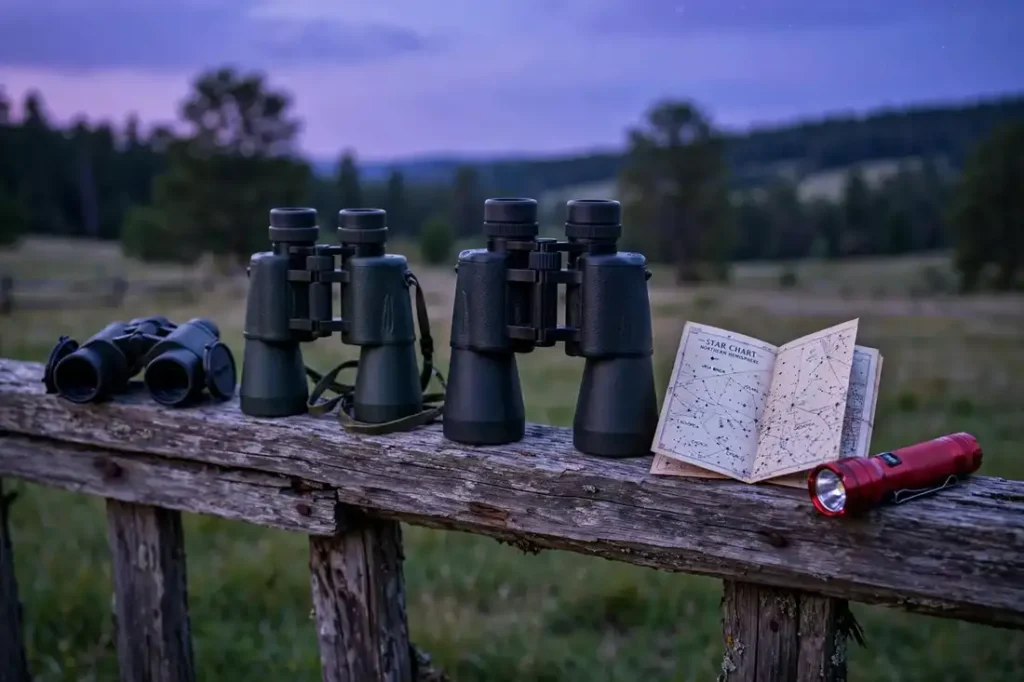
Technique multiplies binocular performance: dark adapt 20–30 minutes (no white light; red flashlights only), brace for stability (elbows on knees, lean against cars/trees, or recline in a lounge chair — the best astronomy seat), scan slowly (let your eyes settle on each field), and use a tripod adapter for extended object study ($15 accessory, transformative).
Finding objects: start with the Moon and bright planets (easy wins), learn a few bright constellations as landmarks, use phone planetarium apps (point at sky, identify targets), and work through a binocular observing list (the Messier objects visible in binoculars make a great year-long program). Star-hopping with binoculars teaches the sky deeply — skills that serve all future astronomy.
- Dark adapt: 20–30 minutes; red light only.
- Recline: Lounge chair; neck-saving comfort.
- Tripod adapter: $15; transformative for long looks.
- Start easy: Moon, planets, bright clusters first.
- Messier program: Year-long binocular observing curriculum.
Care and Maintenance
Binoculars need little care: keep lens caps on (dust and dew are the enemies), clean lenses properly (blow/brush first, then lens fluid with microfiber — never dry-wipe grit), store in a dry place (silica gel in the case; fungus etches coatings in humidity), and avoid drops (prism misalignment from impacts needs professional recollimation).
Dew management: bring binoculars inside after sessions (don’t leave in cold cars), use dew shields or simply observe with caps off only when viewing. Waterproof/fogproof models (nitrogen-purged) resist internal fogging — worth prioritizing for dew-prone climates. Quality binoculars last decades with basic care; they’re lifetime instruments.
- Caps on: Dust and dew prevention; simplest care.
- Clean properly: Blow first; fluid + microfiber, never dry grit.
- Dry storage: Silica gel; humidity grows lens fungus.
- Nitrogen-purged: Fogproof; worth it in damp climates.
- Decades-long: Basic care makes them lifetime tools.
Binoculars vs. Telescope: The Honest Comparison
Binoculars win: comfort, portability, wide-field views, ease of use, cost, daytime utility, and learning the sky. Telescopes win: planetary detail (Saturn’s rings, Jupiter’s bands), small deep-sky objects, higher magnification, and astrophotography potential. They’re complements, not competitors — most serious observers own both.
The recommended path: binoculars first (learn the sky, discover your interests), then a telescope chosen for what you actually enjoy (planetary vs. deep-sky observers need different scopes). Skipping straight to a telescope often means buying wrong; binocular-first buyers choose telescopes wisely. Start wide, then go deep.
- Binoculars: comfort: Wide fields, portable, intuitive, affordable.
- Telescopes: detail: Planets and small objects need aperture + power.
- Complements: Most serious observers own both.
- Binoculars first: Learn interests before choosing a scope.
- Informed upgrade: Experience guides the telescope purchase.
Best Picks Summary by Use
Quick recommendations: first astronomy binocular → 10×50 from Celestron/Nikon/Oberwerk ($100–$180). Tightest budget → 7×50 Porro ($60–$90). Glasses wearers → prioritize 15mm+ eye relief models. Deep-sky enthusiast → 15×70 + tripod ($250–$400 total). Travel → compact 8×42 roof prism (day-night dual use). Kids → 7×35 lightweight (fits small faces, easy holding).
Whatever you choose, the next step is the same: dark skies, dark adaptation, and a reclining chair. The universe is generous to binocular observers — thousands of objects await, no telescope required. Your first view of Jupiter’s moons through your own binoculars is a moment you’ll never forget.
- First pick: 10×50; $100–$180; the standard.
- Budget: 7×50 Porro; genuine astronomy cheap.
- Deep-sky: 15×70 + tripod; serious views.
- Kids: 7×35 lightweight; fits small faces.
- Just go: Dark skies + chair + binoculars = wonder.
Birdwatching With Binoculars
Binoculars were born for birding: 8×42 is the birder’s standard (wide field, bright, steady), close focus matters (under 6 feet for butterflies and nearby birds), and waterproofing is essential (dawn dew, rain; birding happens in weather). Technique: spot with naked eye first (then raise binoculars to the spot; chasing birds through glass frustrates), learn bird behavior (habitat and season predict sightings), and keep a life list (the birder’s scorecard; motivates).
Field craft: dress in muted colors (birds see you), move slowly (sudden motion flushes), learn calls (Merlin app identifies by sound; revolutionary), and join Audubon walks (experts find birds you’d miss). Binocular birding is meditation with a purpose — patience rewarded with wings.
Gear care in the field: lens caps on when not glassing (dust), rain guards (shower protection), harness straps (neck straps ache on long days; harnesses distribute), and cleaning (blow, brush, wipe; never shirt-tails). The birds are free; good glass makes them vivid.
- 8×42 standard: Wide, bright, steady; birder’s choice.
- Spot then raise: Naked eye first; chasing frustrates.
- Close focus: Under 6 ft; butterflies too.
- Merlin app: Identifies by sound; revolutionary.
- Muted colors: Birds see you; blend in.
- Harness straps: Long days; distribute weight.
- Life list: The scorecard; motivates.
- Join walks: Experts find what you’d miss.
Nature Observation Skills
Binoculars deepen all nature watching: wildlife (deer, foxes, marine mammals; distance respects), wildflowers (close-focus binoculars reveal stamens), insects (butterflies, dragonflies; macro-like views), and landscapes (glassing distant ridges; details emerge). The sit-spot practice (same place, regularly; nature reveals itself to the patient) pairs perfectly with binoculars.
Observation technique: scan systematically (grid patterns; don’t random-sweep), watch edges (habitat transitions concentrate wildlife), note behavior (feeding, mating, territorial; stories unfold), and journal (sketches and notes; deepens seeing). Optics extend senses; attention does the rest.
Ethics: keep distance (if animals react, you’re too close), never bait or call excessively (stress), share locations carefully (rare species need protection), and leave no trace. The best nature observers are invisible — binoculars make invisibility possible at range.
- Scan systematically: Grid patterns; not random sweeps.
- Watch edges: Habitat transitions concentrate wildlife.
- Sit-spot: Same place regularly; nature reveals.
- Journal: Sketches deepen seeing.
- Keep distance: Reaction = too close.
- Close-focus: Flowers and insects; macro-like.
- Share carefully: Rare species need protection.
- Invisible observer: Optics enable ethical distance.
Choosing Magnification
Magnification trade-offs: 8x (wider field, brighter, steadier; the versatile choice; best for most), 10x (more detail; narrower, shakier; needs steady hands or support), 12x+ (specialist; tripod territory; not for beginners). The rule: the best magnification is the highest you can hold steady — shake destroys detail.
Objective size: 42mm (the sweet spot; bright without bulk), 32mm (compact; travel-friendly; dimmer), 50mm+ (brightest; heavy; astronomy-leaning). Exit pupil (objective ÷ magnification; 5mm+ for low light; 8×42 = 5.25mm) predicts brightness. For stargazing specifically, 10×50 or 7×50 gather maximum light.
Try before buying: hold candidates (weight and balance matter), test at dusk (brightness differences reveal), check eye relief (glasses wearers need 15mm+), and compare field of view (wider finds targets easier). Specs inform; hands decide. The right binocular disappears; the wrong one reminds you constantly.
- 8x versatile: Wide, bright, steady; most people’s best.
- 10x detailed: Narrower, shakier; needs support.
- 42mm sweet spot: Bright without bulk.
- Exit pupil: 5mm+ for low light; predicts brightness.
- 10×50 astronomy: Maximum light for stars.
- Eye relief 15mm+: Glasses wearers need it.
- Try at dusk: Brightness differences reveal.
- Hands decide: Specs inform; feel confirms.
Binocular Maintenance
Binoculars are precision instruments deserving care: cleaning (blow dust, soft brush, lens cloth with fluid; circular motions; never dry-wipe grit), storage (case, dry place; silica gel in humid climates), and handling (neck strap always; drops misalign prisms).
Collimation (prism alignment): symptoms (eyestrain, double images, headaches), causes (drops, hard knocks), fixes (professional service; ~$50–$100; worth it for good glass). Waterproof models (nitrogen-purged; fog-proof) need less babying but still deserve cases. Never disassemble (factory alignment is precise; DIY destroys).
Long-term: service every few years (cleaning, checks), keep lens caps (dust is the enemy), and insure expensive pairs (riders; birding trips risk). Well-maintained binoculars last decades — they’re lifetime tools. Treat them accordingly.
- Blow then wipe: Dust first; never dry-wipe grit.
- Strap always: Drops misalign prisms.
- Dry storage: Silica gel; humid climates.
- Collimation: Double images = pro service.
- Never disassemble: Factory precision; DIY destroys.
- Lens caps: Dust is the enemy.
- Service years: Cleaning and checks.
- Decades tool: Maintained binoculars last lifetimes.
Astronomy With Binoculars
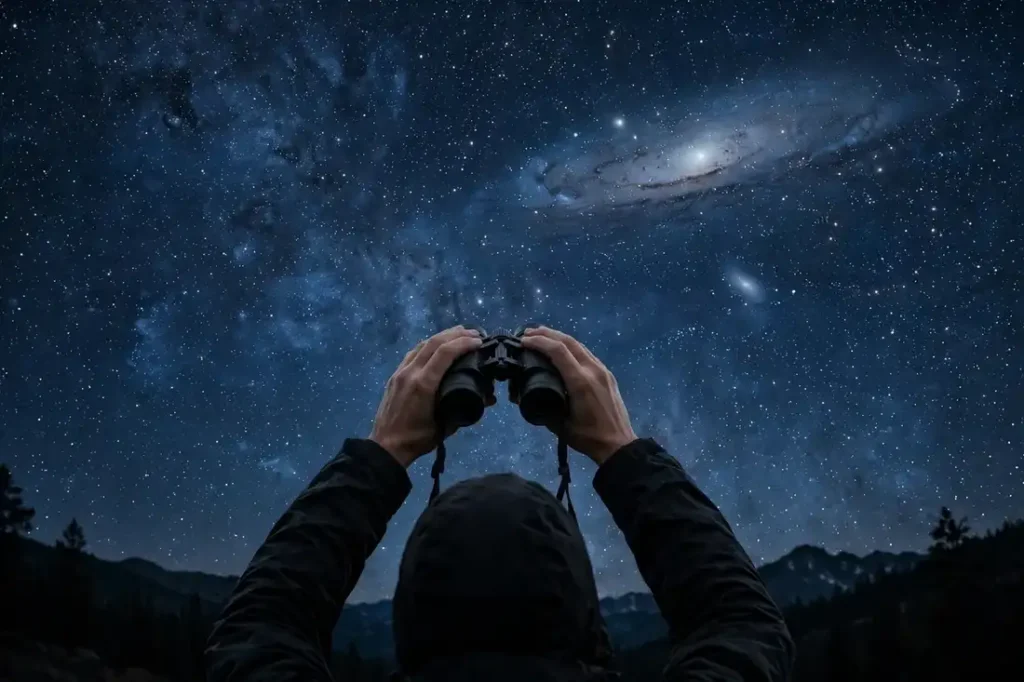
Binoculars are legitimate astronomy instruments: the Moon (craters, maria; stunning at 10x), Jupiter’s moons (four Galilean points; visible in 10×50), star clusters (Pleiades, Beehive; binoculars excel at wide clusters), the Milky Way (star clouds resolve; breathtaking), and comets (wide field ideal; tails span). Many astronomers keep binoculars beside their telescopes.
Technique: recline (lawn chair; neck comfort), brace (elbows on chest; steadiness), dark adapt (20+ minutes; red light only), and star-hop (binoculars’ wide field makes finding easy). A tripod adapter ($20) unlocks long comfortable sessions — highly recommended for astronomy.
The case for binoculars-first: cheaper than telescopes, intuitive (two eyes; natural), portable (travel anywhere), and educational (learn the sky before magnifying it). Every stargazer should own binoculars — they’re the hobby’s most-used instrument, telescopes included.
- Moon stunning: Craters and maria at 10x.
- Jupiter’s moons: Galilean points in 10×50.
- Clusters excel: Pleiades, Beehive; wide field.
- Recline: Lawn chair; neck comfort.
- Tripod adapter: $20; long comfortable sessions.
- Dark adapt: 20+ minutes; red light.
- Learn sky first: Binoculars before telescopes.
- Most-used: Astronomy’s essential instrument.
Digiscoping: Photography Through Binoculars
Digiscoping adapts: the phone (the camera; the always), the adapter (the aligned; the $30), the binocular (the telephoto; the 10x), and the results (the surprising; the good). The method: the mount (the steady; the adapter), the focus (the binocular; the sharp), the exposure (the phone; the locked), and the shoot (the burst; the many).
The subjects: the Moon (the craters; the stunning), the birds (the perched; the detailed), the wildlife (the distant; the safe), and the landscapes (the compressed; the layered). The technique: the stable (the tripod; the essential), the light (the good; the needed), the patience (the still; the waiting), and the practice (the many; the keepers).
The limits: the quality (the phone; the adequate), the shake (the magnified; the tripod), the light (the small; the exit), and the expectations (the record; the art). The upgrades: the dedicated (the camera; the later), the scope (the spotting; the 60x), and the joy (the captured; the shared). Digiscoping is the gateway; the phone meets the sky.
The sharing: the social (the posted; the wow), the records (the documented; the list), the learning (the compared; the improved), and the fun (the captured; the kept). The binocular becomes the lens; the phone becomes the camera. Adapt; capture; share.
- $30 adapter: Aligned; the phone.
- Moon stunning: Craters; the detailed.
- Tripod essential: Shake; the magnified.
- Focus binocular: Sharp; the manual.
- Burst many: Keepers; the practice.
- Birds perched: Detailed; the safe.
- Expectations: Record; the adequate.
- Gateway: Phone meets sky.
Binoculars for Kids and Families
The young observers: the compact (the 8×32; the light), the durable (the rubber; the drops), the simple (the focus; the easy), and the cheap (the first; the $50). The teaching: the Moon (the wow; the craters), the birds (the backyard; the list), the ships (the distant; the harbor), and the stars (the Pleiades; the dipper).
The activities: the scavenger (the find; the list), the journal (the draw; the record), the night (the constellations; the stories), and the trips (the zoo; the hike). The skills: the holding (the steady; the elbows), the focusing (the gentle; the clear), the sharing (the turn; the patience), and the caring (the strap; the case).
The growth: the interest (the sparked; the Moon), the hobby (the birding; the astronomy), the gear (the upgraded; the earned), and the memories (the together; the forever). The family: the outings (the planned; the fun), the discoveries (the shared; the wow), and the bonding (the sky; the together).
The choosing: the fit (the eyes; the small), the weight (the light; the carried), the warranty (the drops; the covered), and the price (the starter; the replaceable). The kid’s binocular is the invitation; the universe is the party. Invite them; the wonder does the rest.
- 8×32 compact: Light; the kids.
- Rubber durable: Drops; the expected.
- Moon wow: Craters; the hook.
- Scavenger: Find; the list.
- Elbows steady: Holding; the taught.
- Strap always: Caring; the habit.
- $50 starter: Replaceable; the first.
- Invitation: Universe; the party.
Binoculars and Conservation
The optics serve: the monitoring (the counts; the citizen), the research (the data; the contributed), the protection (the documented; the evidenced), and the advocacy (the seen; the loved). The programs: the eBird (the lists; the global), the Christmas (the count; the annual), the hawkwatch (the migration; the raptors), and the local (the chapter; the active).
The ethics: the distance (the respected; the telephoto), the nesting (the avoided; the season), the playback (the minimal; the stress), and the sharing (the careful; the sensitive). The impact: the data (the science; the real), the awareness (the public; the inspired), and the funding (the ducks; the stamps).
The personal: the patch (the local; the loved), the list (the life; the county), the journal (the notes; the years), and the giving (the back; the habitat). The binocular: the tool (the seeing; the caring), the bridge (the people; the nature), and the witness (the changes; the recorded).
The future: the young (the taught; the birders), the habitat (the saved; the acres), the climate (the watched; the shifts), and the hope (the action; the together). The conservationist with binoculars: the eyes; the voice; the hands. Watch; record; protect.
- eBird: Lists; the global.
- Christmas count: Annual; the citizen.
- Distance respected: Ethics; the nesting.
- Data science: Contributed; the real.
- Patch loved: Local; the years.
- Playback minimal: Stress; the avoided.
- Teach young: Birders; the future.
- Watch; protect: Eyes; the hands.
Best Binoculars for Stargazing: Quick Comparison
| Binoculars | Specs | Price range | Best for |
|---|---|---|---|
| Celestron SkyMaster 10×50 | 10×50 Porro | $100–$140 | Best overall value |
| Nikon Action EX 10×50 | 10×50 Porro | $150–$180 | Rugged, great optics |
| Celestron Cometron 7×50 | 7×50 Porro | $60–$90 | Budget stargazing |
| Oberwerk 15×70 | 15×70 | $250–$350 | Tripod deep-sky |
Frequently Asked Questions
What do the numbers on binoculars mean?
Magnification × objective lens diameter in mm (10×50 = 10x magnification, 50mm lenses). For astronomy, 7×50 to 10×50 suits hand-held use; larger needs tripods.
Can you see planets with binoculars?
Jupiter’s four largest moons are visible in 10x50s; Saturn shows as an oval hint. Detailed planetary views (rings, bands) need telescopes at 25x+ magnification.
Are expensive binoculars worth it for astronomy?
Up to ~$200, yes — coatings and build matter. Beyond that, spend on dark-sky trips; location improves views more than premium glass at beginner levels.
Do I need a tripod for stargazing binoculars?
10×50 and below: helpful but optional (a $15 adapter). 15×70 and above: mandatory. Even with 10x50s, a tripod transforms long observing sessions.
What’s the best binocular size for beginners?
10×50 — the sweet spot of magnification, light grasp, and hand-holdability. 7×50 if you prioritize ease of holding and widest views.
Can kids use astronomy binoculars?
Yes — 7×35 models fit small faces and are light enough to hold. Share the Moon first; it’s the ultimate kid-impressing target.
Watch: Best Binoculars for Stargazing: Top Picks for Night Sky Viewing Video Guide
The best binoculars for stargazing are the ones under dark skies — a $100 10×50 at a dark site outperforms premium glass in the city. Start with the proven 10×50 class, learn the sky’s binocular treasures, and let experience guide any upgrades. Jupiter’s moons, the Orion Nebula, ancient Andromeda photons — they’re all waiting, no telescope required. Grab the binoculars, recline the chair, and look up.