Americans say “Thanksgiving.” Germans say “Erntedankfest.” Koreans say “Chuseok.” The Chinese speak of the Mid-Autumn Festival, and the British of the Harvest Festival. Are these all the same thing? The question behind thanksgiving vs harvest festival is really a question about how the world’s cultures celebrate the same ancient impulse: gratitude for the harvest. This guide compares the two ideas head-to-head — what Thanksgiving is, what a harvest festival is, where they overlap, where they differ, and how a dozen cultures around the world mark the season of plenty.
The Core Difference in One Paragraph
Thanksgiving (capital T) refers to specific national holidays — primarily in the United States, Canada, and Liberia — with fixed dates, legal status, and shared national rituals. A harvest festival is a broader category: any community celebration of the agricultural harvest, found in nearly every farming culture on earth, usually tied to the local growing season rather than a national calendar. In short: every Thanksgiving is a kind of harvest festival, but most harvest festivals are not Thanksgiving. Thanksgiving is the American branch of a global family tree.
Thanksgiving: A Fixed National Holiday
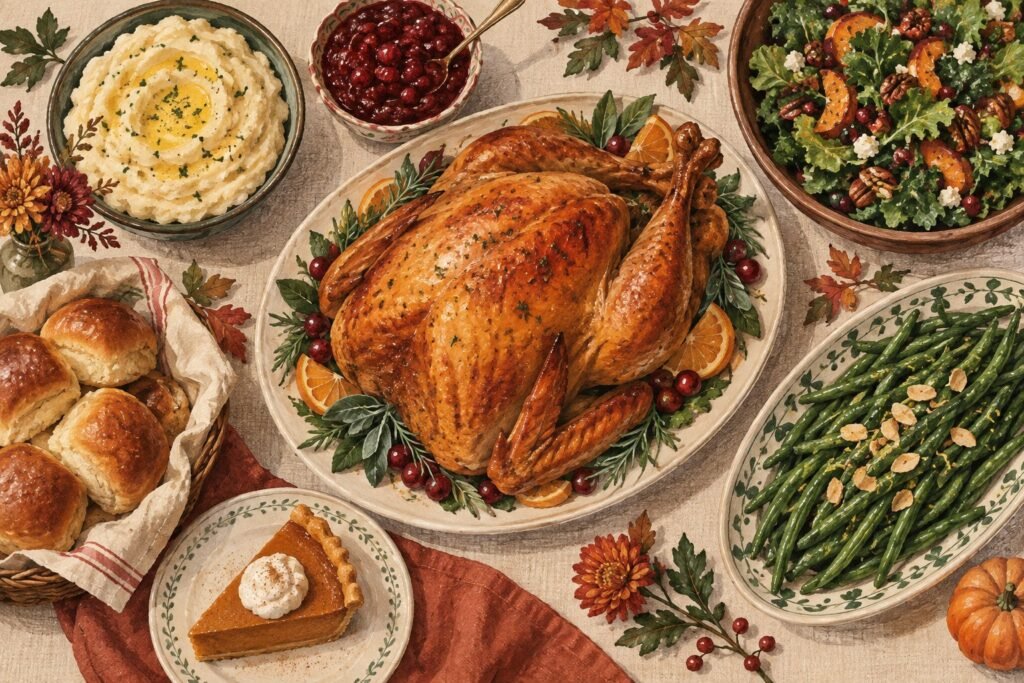
Thanksgiving as Americans and Canadians know it has three defining features: it is national (proclaimed by governments), fixed (the same rule every year), and domestic (centered on the family meal). In the United States, it falls on the fourth Thursday of November by federal law; in Canada, on the second Monday of October by parliamentary proclamation; in Liberia, on the first Thursday of November. These are days off work, with closed schools, family travel, and a shared national menu — turkey in North America, with local variations like jollof rice and pepper chicken in Liberia.
Thanksgiving’s meaning is also historically specific. The American holiday grew out of colonial New England’s days of thanksgiving, was nationalized by Lincoln in 1863 as an act of wartime unity, and was fixed to its current date by Congress in 1941. The Canadian holiday traces to Martin Frobisher’s 1578 Arctic feast and was fixed in 1957. These are civic holidays with origin stories, not just seasonal parties — they commemorate national narratives as well as the harvest.
The Domestic Ritual
What makes Thanksgiving distinctive among world harvest celebrations is its setting: the home. Most harvest festivals are public and communal — street processions, church services, village dances. Thanksgiving is overwhelmingly private: the family table, the home kitchen, the living-room football game. Even the great public rituals of American Thanksgiving — the Macy’s parade, the NFL games — are designed to be watched from home. This domestic character is part of what makes the holiday exportable: Americans abroad recreate it in apartments in London, Paris, and Tokyo, because all it requires is a table and the people you love.
Harvest Festival: The Global Category
Harvest festivals are among humanity’s oldest celebrations. Long before nations existed, farming communities marked the gathering of crops with feasting, music, dance, and ritual thanks — to gods, to ancestors, to the land itself. These celebrations share a family resemblance across continents: they happen at harvest time, they involve special foods made from the new crop, they bring the community together, and they mix gratitude with relief that the year’s labor has paid off.
Unlike Thanksgiving, harvest festivals are typically local and seasonal rather than national and fixed. Germany’s Erntedankfest falls on the first Sunday of October but varies by region and parish. Korea’s Chuseok follows the lunar calendar (September 25 in 2026). India’s Pongal follows the Tamil solar calendar in mid-January. Ghana’s Homowo is set by the Ga traditional calendar. The date moves with the harvest, the moon, or local custom — not with legislation.
Communal, Not Domestic
Where Thanksgiving turns inward to the family, harvest festivals traditionally turn outward to the community. Erntedankfest features decorated wagons, harvest crowns (Erntekrone), and church services where the altar is piled with produce. Chuseok sends millions of Koreans traveling to ancestral hometowns for memorial rites. The British Harvest Festival fills churches and schools with donated food for the needy. Sukkot, the Jewish harvest festival, is celebrated in temporary outdoor booths shared with neighbors. The emphasis is on the collective — the village, the parish, the people — rather than the household.
Side-by-Side Comparison
| Feature | Thanksgiving (U.S.) | Typical Harvest Festival |
|---|---|---|
| Legal status | Federal public holiday | Usually not a public holiday; often religious or community observance |
| Date | Fixed: fourth Thursday of November | Varies: lunar calendar, local harvest, or church calendar |
| Setting | Private home, family table | Public: streets, churches, village squares |
| Central food | Roast turkey dinner | Varies: mooncakes, songpyeon, new grain, harvest bread |
| Origin story | 1621 Plymouth feast; 1863 proclamation | Ancient agrarian ritual, often prehistoric roots |
| Religious character | Civic/secular, open to all faiths | Often explicitly religious or spiritual |
| Scale | National, simultaneous | Local or regional |
| Commercial side | Major: Black Friday, travel industry | Modest: local markets, crafts |
Harvest Festivals Around the World
To understand what Thanksgiving belongs to, tour the world’s great harvest celebrations:
Erntedankfest (Germany, Austria). The “harvest festival of thanks,” held on the first Sunday of October, is Thanksgiving’s closest European cousin. Churches are decorated with produce, harvest crowns (Erntekrone) and decorated wagons parade through villages, and communities share meals. Unlike American Thanksgiving, it is a public, communal, church-centered celebration rather than a family dinner.
Chuseok (Korea). Korea’s great harvest holiday falls on the 15th day of the 8th lunar month (September 25 in 2026). Families travel to ancestral hometowns, perform memorial rites (charye), and eat songpyeon — half-moon rice cakes steamed over pine needles. It is a three-day public holiday and one of the biggest travel periods of the Korean year.
Mid-Autumn Festival (China and East Asia). On the same lunar date as Chuseok, Chinese families gather for reunion dinners, eat mooncakes, and admire the full moon. It is an official public holiday in mainland China, Hong Kong, Macau, Taiwan, and Vietnam (as Tết Trung Thu). The festival’s themes — reunion, gratitude, the harvest moon — rhyme closely with Thanksgiving’s.
Pongal (Tamil Nadu, India). This four-day January harvest festival thanks the sun god Surya for the rice harvest. Families boil the season’s first rice in milk until it overflows — the overflow symbolizing abundance — and share it with the community.
Sukkot (Jewish tradition). The week-long Feast of Tabernacles, one of Judaism’s three pilgrimage festivals, combines harvest thanksgiving with remembrance of the Israelites’ desert journey. Families eat and sometimes sleep in temporary outdoor booths (sukkahs) decorated with harvest produce.
Homowo (Ghana). The Ga people’s festival, whose name means “hooting at hunger,” commemorates survival through famine and celebrates the yam harvest with feasting, drumming, and the sprinkling of the traditional dish kpokpoi.
British Harvest Festival. Held in churches and schools in September or October, Britain’s harvest thanksgiving centers on donating food for the needy — the charitable dimension that American Thanksgiving largely leaves implicit.
Learn more in our guides to Germany’s Erntedankfest, Chuseok, the Korean Thanksgiving, and Thanksgiving celebrations around the world.
The Shared DNA: Why They Feel the Same
For all their differences, Thanksgiving and the world’s harvest festivals run on the same emotional software. Strip away the specific dates and dishes, and every one of them expresses the same five human impulses:
1. Gratitude for survival. Every harvest festival is, at bottom, a sigh of relief: the crops came in, the winter is survivable, the community endures. Whether it’s a Kansas wheat farmer or a Tamil rice grower, the feeling is identical.
2. The feast as ritual. Special foods made from the new harvest — the first rice, the new wine, the fresh-pressed cider — turn eating into ceremony. Thanksgiving’s turkey and Chuseok’s songpyeon do the same work: they mark this meal as different from all others.
3. Gathering the scattered. Harvest festivals pull people home. Chuseok creates one of the world’s great annual migrations; Thanksgiving creates America’s busiest travel week. The harvest is the excuse; reunion is the point.
4. Honoring the source. Thanksgiving thanks God (in its traditional framing); Pongal thanks the sun; Chuseok honors ancestors; Sukkot remembers the desert journey. Every tradition points its gratitude somewhere beyond itself.
5. Marking time. The harvest festival is humanity’s original New Year — the moment the agricultural year turns. Thanksgiving’s late-November date serves the same function for Americans: the year is gathered in, accounted for, and closed with thanks.
Where the Lines Blur
The neat distinction between “Thanksgiving” and “harvest festival” gets messy in practice. Canada’s Thanksgiving is explicitly a harvest festival in its legal wording (“for the bountiful harvest with which Canada has been blessed”) — it is both at once. Liberia’s Thanksgiving blends American form with West African content. Japan’s Labor Thanksgiving Day kept the harvest ritual’s date while replacing its meaning. And American Thanksgiving itself has been drifting toward harvest-festival territory for years: pumpkin patches, corn mazes, apple picking, and “Friendsgiving” potlucks are communal, seasonal celebrations that look less like a 19th-century family dinner and more like a village harvest fair.
The blurring is the point. Thanksgiving was never really separate from the world’s harvest festivals — it was always one of them, wearing a national costume. Sarah Hale’s genius was to take the universal human harvest celebration and give it an American date, an American menu, and an American story. Underneath, the roots are the same roots that feed Erntedankfest and Chuseok and Pongal: the end of the growing season, the full barn, the gathered family, and the ancient, uncomplicated feeling of thanks.
In Pictures: Thanksgiving vs. Harvest Festival
They share the harvest, the feast, and the gratitude — but American Thanksgiving and the world's harvest festivals grew up very differently. Here's the comparison, side by side.
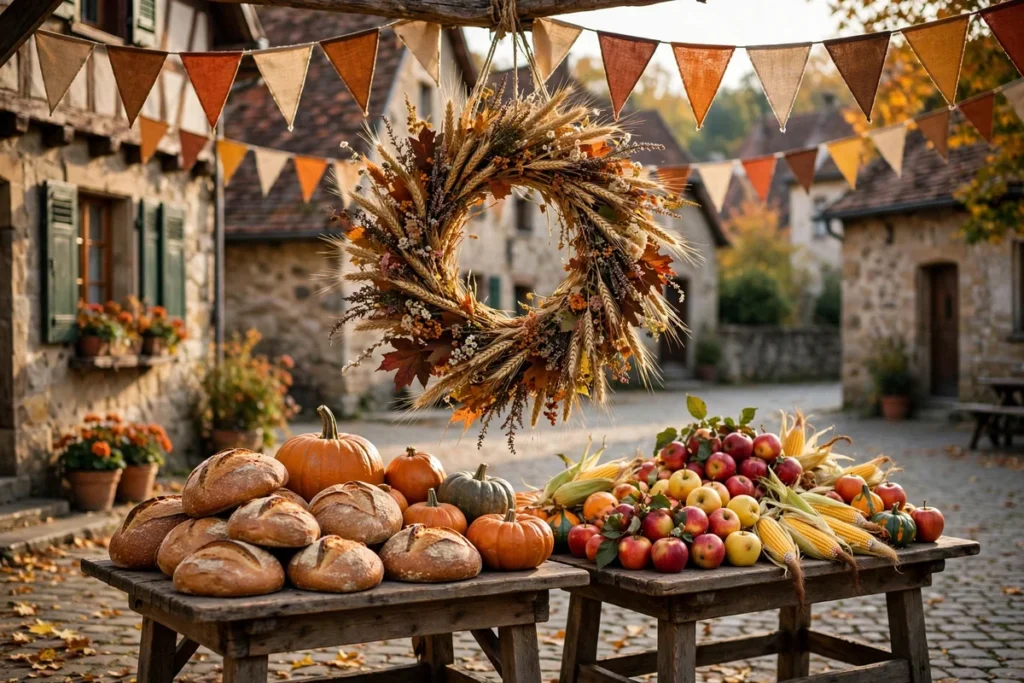
A split-style harvest scene: an American Thanksgiving table on one side and a vibrant global harvest celebration with lanterns on the other.
Watch: Thanksgiving vs. Harvest Festival
A kid-friendly tour of Thanksgiving around the world — the USA, Japan, Ghana, China, and India — showing how different cultures celebrate the harvest.
At a Glance: Thanksgiving vs. Harvest Festival
The key differences between America's Thanksgiving and traditional harvest festivals.
| Aspect | American Thanksgiving | Harvest festivals |
|---|---|---|
| Origin | The 1621 Plymouth feast, nationalized in 1863 | Ancient agrarian rites — most predate Thanksgiving by centuries |
| Date | Fixed: fourth Thursday of November | Varies: lunar calendars, solstices, and local harvest times |
| Religion | Secular national holiday | Often deeply religious — Sukkot, Pongal, Chuseok rites |
| Signature food | Roast turkey with stuffing | Mooncakes, songpyeon, sweet Pongal — each culture's harvest crop |
| Duration | One day (plus a long weekend) | Often multi-day — Chuseok spans three days, Pongal four |
| Common ground | Both are fundamentally about gratitude for the harvest and gathering the people you love | |
Frequently Asked Questions
What is the difference between Thanksgiving and a harvest festival?
Thanksgiving refers to specific national holidays (U.S., Canada, Liberia) with fixed dates and legal status, centered on the family meal. “Harvest festival” is the broader global category of community celebrations of the agricultural harvest, usually tied to the local growing season rather than a national calendar.
Is Thanksgiving a harvest festival?
In essence, yes — Thanksgiving belongs to the global family of harvest festivals. Canada’s official proclamation even describes it as thanksgiving “for the bountiful harvest.” But its fixed date, national legal status, and domestic setting make it a distinctive, American-style member of that family.
What is Erntedankfest?
Erntedankfest is Germany and Austria’s harvest festival of thanks, held on the first Sunday of October. It features church services, harvest crowns, decorated wagons, and community meals — a public, communal celebration rather than a family dinner.
What is Chuseok?
Chuseok is Korea’s major harvest holiday, held on the 15th day of the 8th lunar month (September 25 in 2026). Families travel to ancestral hometowns for memorial rites and eat songpyeon (half-moon rice cakes). It’s a three-day public holiday and one of Korea’s biggest celebrations.
Do other countries have Thanksgiving?
Yes — Canada, Liberia, Brazil, Grenada, Japan (Labor Thanksgiving Day), and Norfolk Island all have thanksgiving observances, each with its own date and character. Many more countries have harvest festivals under different names.
Which came first, Thanksgiving or harvest festivals?
Harvest festivals by thousands of years. Humans have celebrated the harvest since the dawn of agriculture; the American Thanksgiving (1863 in its national form) is a recent, nationalized expression of that ancient impulse.
Conclusion
Thanksgiving vs. harvest festival isn’t really a contest — it’s a family portrait. Thanksgiving is what happens when the universal human harvest celebration puts on a national uniform: fixed date, legal status, turkey dinner, football. The world’s harvest festivals — Erntedankfest, Chuseok, Pongal, Sukkot, Homowo — are the same impulse in local dress. Wherever you are this autumn, when you sit down to give thanks for the harvest, you’re joining the oldest party humanity throws. The Americans just gave it a Thursday.
Continue the world tour: Thanksgiving around the world, Germany’s Erntedankfest, Chuseok, the Korean Thanksgiving, China’s Mid-Autumn Festival, and Japan’s Labor Thanksgiving Day.
Case Studies: Three Harvest Festivals Up Close
Erntedankfest: Thanksgiving in Church
Visit a German village on the first Sunday of October and you’ll see Thanksgiving’s road not taken. The church altar is piled high with wheat sheaves, pumpkins, apples, and bread — the Erntealtar, a harvest altar. A crown woven from grain (the Erntekrone) hangs above. After the service, decorated wagons parade through the streets, brass bands play harvest songs (Erntedanklieder), and the community shares a meal. There’s no turkey, no football, no Black Friday. What there is: the entire village, together, in public, giving thanks — the communal dimension that American Thanksgiving mostly keeps private. For Americans curious about what their holiday might have become without the family-dinner focus, Erntedankfest is the answer.
Chuseok: Thanksgiving as Homecoming
Chuseok is what Thanksgiving would look like with three thousand years of ancestor veneration behind it. The mechanics are familiar — the year’s biggest travel crush, a feast of seasonal foods, families gathered — but the spiritual center is different: the charye memorial rite, in which families honor their ancestors with offerings of food and deep bows. The signature food, songpyeon — delicate half-moon rice cakes steamed over pine needles — is made communally, with the whole family shaping the cakes together. The holiday’s scale is staggering: in a country of 52 million, tens of millions travel during the Chuseok period. It’s Thanksgiving’s travel chaos and family intensity, amplified by a Confucian reverence for lineage that gives the gratitude a specific address: we thank those who came before us.
Pongal: Thanksgiving to the Sun
Tamil Nadu’s Pongal (mid-January) is the most theologically explicit of the great harvest festivals: it is, directly, thanksgiving to Surya, the sun god, for the rice harvest. The central ritual is the boiling of the season’s first rice in milk in a new clay pot until it overflows — the overflow is the point, a visible symbol of abundance, greeted with shouts of “Pongalo Pongal!” (a phrase whose exact celebratory meaning is roughly “may it boil over!”). The festival runs four days: honoring the sun, the cattle, the community, and family bonds. For Americans, Pongal is a useful mirror: it shows what Thanksgiving looks like when the gratitude is directed at nature itself rather than mediated through a national story.
What Thanksgiving Can Learn From Harvest Festivals
The comparison isn’t just academic — it suggests things the American holiday might reclaim. From Erntedankfest: the public, communal dimension — thanksgiving as something a community does together, not just a family does privately. From Chuseok: the deliberate honoring of ancestors and elders, giving gratitude a lineage. From Pongal: the direct acknowledgment of nature’s role — the sun, the soil, the rain — in the abundance on the table. From Britain’s Harvest Festival: the charitable impulse, turning gratitude into food for those who need it.
Some of this is already happening. Friendsgiving reclaims the communal; farm-to-table dining reclaims the agricultural; food-bank volunteering reclaims the charitable. The American Thanksgiving of the future may look less like a 1950s family dinner and more like the global harvest festival it always was underneath — and that would be a homecoming of its own.
Frequently Asked Questions (Continued)
Is American Thanksgiving the biggest harvest festival in the world?
By participation in a single country, it’s among the largest — tens of millions of Americans travel and gather. But China’s Mid-Autumn Festival and Lunar New Year travel periods, and India’s Diwali and harvest festivals, involve even larger numbers of people across Asia.
Why doesn’t Europe have Thanksgiving?
Europe has harvest festivals (Erntedankfest, British Harvest Festival) but never nationalized one into a Thanksgiving-style public holiday. The American Thanksgiving was a specific product of New England colonial culture, 19th-century nation-building, and Lincoln’s wartime proclamation — a combination Europe never replicated.
Could Thanksgiving become a global holiday?
It already is, in a quiet way: American expatriates celebrate it in dozens of countries, and its themes resonate with harvest traditions everywhere. But a formal global Thanksgiving is unlikely — the world’s cultures already have their own harvest celebrations, and they’re not giving them up.
Quick Reference: Harvest Festivals at a Glance
Bookmark this cheat sheet for the world’s major harvest celebrations:
- U.S. Thanksgiving — 4th Thursday of November — national public holiday, family turkey dinner
- Canadian Thanksgiving — 2nd Monday of October — statutory holiday (most jurisdictions), harvest long weekend
- Liberian Thanksgiving — 1st Thursday of November — national public holiday, church-centered feast
- Erntedankfest (Germany/Austria) — 1st Sunday of October — church harvest festival, parades, harvest crowns
- Chuseok (Korea) — 15th day of 8th lunar month (Sept 25, 2026) — 3-day public holiday, ancestral rites, songpyeon
- Mid-Autumn Festival (China/East Asia) — 15th day of 8th lunar month — public holiday, mooncakes, reunion dinner
- Pongal (Tamil Nadu) — mid-January — 4-day harvest festival honoring the sun, overflowing rice
- Sukkot (Jewish) — 15th of Tishrei (Sept/Oct) — week-long Feast of Tabernacles, outdoor booths
- Homowo (Ghana, Ga people) — August/September — yam harvest festival, “hooting at hunger”
- British Harvest Festival — September/October — church and school celebrations, food donations
- Labor Thanksgiving Day (Japan) — November 23 — national public holiday honoring workers
- Dia de Ação de Graças (Brazil) — last Thursday of November — officially recognized observance
Twelve celebrations, twelve cultures, one impulse: the harvest is in, the community endures, and it’s time to give thanks. Whatever you call it — Thanksgiving, Erntedankfest, Chuseok, Pongal — you’re speaking the same ancient language. The Americans just gave it a Thursday.
Final Thought: The Thursday and the Harvest Moon
An American Thanksgiving and a Korean Chuseok look nothing alike — and yet, on the night of the harvest moon, a family in Ohio carving turkey and a family in Seoul sharing songpyeon are doing the same thing humans have done since the first grain was gathered: pausing at the end of the growing season to say, together, we made it, and we’re grateful. The forms differ — Thursday or full moon, turkey or rice cakes, national law or village custom — but the impulse is one. That is the real answer to Thanksgiving vs. harvest festival: there is no vs. There is only the harvest, and the thanks.