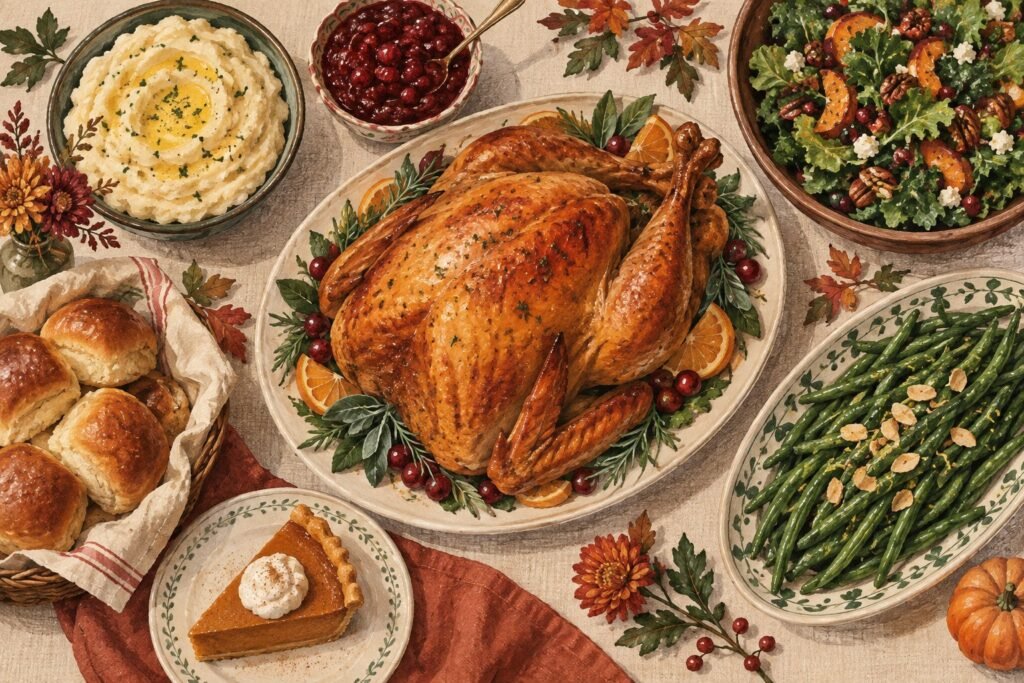
Turkey fried rice is the fastest, most satisfying answer to the day-after-Thanksgiving question of what to do with all that leftover turkey and rice. In about 20 minutes — less time than it takes to reheat a full holiday plate — you can transform cold, day-old rice and cooked turkey into a glossy, savory skillet dinner with crisp-tender vegetables, ribbons of egg, and the unmistakable wok-kissed flavor of proper fried rice. This recipe works with any leftover turkey (breast, thigh, or a mix), any cooked rice you have on hand, and whatever vegetables are lingering in the crisper drawer, making it the ultimate clean-out-the-fridge meal. It is naturally dairy-free, easy to make gluten-free with tamari, endlessly customizable with add-ins from pineapple to kimchi, and it reheats well for next-day lunches. Below you will find the complete ingredient list with metric and US measurements, the step-by-step method with the professional secrets that separate great fried rice from soggy fried rice, variations for spicy, healthy, and kid-friendly versions, USDA-based storage and reheating guidance, troubleshooting, nutrition notes, and answers to frequently asked questions.
Why Turkey Fried Rice Works So Well
Fried rice is one of the world’s great leftover dishes precisely because it was invented for leftovers. The technique — high heat, a hot oiled pan, and cold cooked rice — was developed to give new life to yesterday’s rice, and leftover turkey slots into the formula perfectly. Cold, day-old rice has firmer, drier grains that fry up distinct and chewy rather than clumping into mush, which is exactly what you want. Cooked turkey, diced small, heats through in the final minute of stir-frying without overcooking, and its mild roasted flavor absorbs the soy-ginger-sesame seasoning beautifully. The whole dish is also a masterclass in efficiency: one pan, minimal chopping, and dinner on the table in 20 minutes while the holiday dishes are still soaking. If you are working through a fridge full of Thanksgiving remnants, pair this with our leftover turkey chili for a second night of reinvention, and check our guide on how long Thanksgiving leftovers last so every ingredient you use is safely within its window.
The Golden Rules of Great Fried Rice
Before the ingredients, master these five principles — they matter more than any recipe.
1. Use Cold, Day-Old Rice
This is the non-negotiable rule. Freshly cooked rice is too moist and steamy; it will clump and turn gummy in the pan no matter how hot your stove runs. Rice that has chilled uncovered (or loosely covered) in the refrigerator for at least 8 hours — ideally overnight — loses surface moisture, and the starches firm up (a process called retrogradation). The result: grains that stay separate, fry up with lightly crisped edges, and absorb sauce without dissolving. If you only have fresh rice, spread it on a sheet pan and refrigerate uncovered for 1 to 2 hours, or even freeze it for 20 minutes — imperfect, but far better than using it hot.
2. Get the Pan Screaming Hot
Fried rice needs fierce heat. Use the largest skillet or wok you own, heat it until a drop of water evaporates on contact, then add oil with a high smoke point — avocado, peanut, or refined vegetable oil, not extra-virgin olive oil. Cook in batches if your pan is crowded; overloading the pan drops the temperature and steams the rice instead of frying it. Two smaller batches beat one soggy big batch every time.
3. Prep Everything Before You Start
Stir-frying moves fast — there is no time to chop an onion while the garlic burns. Dice the turkey, beat the eggs, mix the sauce, and line up every ingredient within arm’s reach before the burner goes on. Professional cooks call this mise en place, and for fried rice it is the difference between calm control and chaos.
4. Season in Layers
Salt the eggs lightly as they scramble, season the vegetables as they cook, and add the sauce to the hot pan (not directly onto the rice) so it sizzles and caramelizes on contact. Layered seasoning builds complexity that a single end-of-cooking splash can never achieve.
5. Don’t Skimp on the Finish
A drizzle of toasted sesame oil and a shower of sliced green onions go in off the heat, at the very end. Sesame oil’s delicate flavor compounds break down under sustained high heat, so adding it last preserves its nutty perfume. This finishing step is what makes homemade fried rice taste like the restaurant version.
Ingredients for Turkey Fried Rice
Serves 4 as a main dish (about 6 cups / 1.4 liters). Scales easily — just keep the pan uncrowded and work in batches.
Main Components
- 4 cups (about 600 g cooked weight) cold, day-old cooked rice — long-grain white, jasmine, or basmati all work; brown rice adds chew and fiber
- 2 cups (about 280 g) cooked leftover turkey, diced into 1 cm / ½-inch pieces — breast, thigh, or mixed; dark meat stays juiciest
- 3 large eggs, beaten with a pinch of salt
- 2 tablespoons (30 ml) high-smoke-point oil (avocado, peanut, or vegetable), divided
Vegetables
- 1 cup (about 130 g) frozen peas and diced carrots, thawed — or ½ cup each fresh
- ½ cup (about 75 g) frozen or fresh corn kernels (optional)
- 3 to 4 green onions, thinly sliced, whites and greens separated
- 2 cloves garlic, minced
- 1 tablespoon fresh ginger, grated (about a 2.5 cm / 1-inch piece) — or 1 teaspoon ground ginger in a pinch
- 1 small red bell pepper, diced (optional, for color and sweetness)
Sauce
- 3 tablespoons (45 ml) low-sodium soy sauce — or tamari for gluten-free
- 1 tablespoon (15 ml) oyster sauce (optional but recommended for savory depth) — use a vegetarian mushroom version if preferred
- 1 teaspoon (5 ml) toasted sesame oil, plus more to taste
- ½ teaspoon freshly ground black or white pepper — white pepper gives the classic takeout flavor
- 1 teaspoon sugar or honey (optional) — balances the saltiness
Equipment
- A large wok or 12-inch (30 cm) skillet — carbon steel or cast iron holds heat best
- A stiff spatula or wooden spoon for tossing
- Small bowls for mise en place
Step-by-Step Method
Total time: about 20 minutes (10 minutes prep, 10 minutes cooking). Read through once, prep everything, then cook without stopping.
Step 1: Scramble the Eggs (2 Minutes)
Heat 1 tablespoon of oil in your wok or skillet over medium-high heat until shimmering. Pour in the beaten eggs and let them set for 20 seconds, then scramble with your spatula into soft, bite-size curds — about 1 minute total. You want them just set, not browned. Transfer to a plate and set aside. Cooking the eggs separately keeps them tender and distinct instead of disappearing into the rice.
Step 2: Sear the Turkey (2 Minutes)
Add another teaspoon of oil to the hot pan. Spread the diced turkey in a single layer and let it sit undisturbed for 60 to 90 seconds so the pieces develop golden, lightly crisped edges. Toss once, cook 30 seconds more, then push to one side of the pan or transfer to the plate with the eggs. This quick sear adds texture and a whisper of caramelized flavor that plain reheated turkey lacks.
Step 3: Stir-Fry the Vegetables (2 to 3 Minutes)
Add the remaining oil. Toss in the white parts of the green onions, the garlic, and the ginger; stir-fry 30 seconds until fragrant. Add the bell pepper (if using), peas, carrots, and corn. Stir-fry 2 minutes until the vegetables are crisp-tender and any frost has cooked off. Season with a pinch of salt.
Step 4: Fry the Rice (4 to 5 Minutes)
Add the cold rice, breaking up any clumps with your spatula or damp hands before it hits the pan. Spread it in an even layer and let it sit undisturbed for 60 to 90 seconds — this contact with the hot pan creates the coveted lightly crisped, almost toasted grains. Then toss and stir-fry, repeating the press-and-toss cycle for 3 to 4 minutes, until the rice is heated through and you see golden bits throughout. If the rice seems dry, drizzle in a teaspoon of water or broth; the steam helps separate stubborn clumps.
Step 5: Sauce and Combine (2 Minutes)
Push the rice to the sides, leaving a well in the center. Pour the soy sauce, oyster sauce, and sugar into the hot well — it should sizzle immediately. Let it bubble for 15 seconds (this caramelizes the sugars in the sauce), then toss everything together to coat. Return the turkey and eggs to the pan, add the black or white pepper, and toss for 1 minute until everything is heated through and evenly coated.
Step 6: Finish and Serve (1 Minute)
Remove the pan from the heat. Drizzle over the toasted sesame oil and scatter the green onion greens. Toss once more, taste, and adjust — more soy for saltiness, a squeeze of lime for brightness, or a few drops of chili oil for heat. Serve immediately in warm bowls. Fried rice waits for no one; its texture is at its peak straight from the wok.
Variations
Spicy Turkey Fried Rice
Add 1 to 2 teaspoons of chili crisp, sambal oelek, or sriracha to the sauce mixture, and toss in sliced fresh red chiles with the vegetables. A drizzle of chili oil at the finish adds both heat and gloss. For a Korean-inspired twist, stir in 2 tablespoons of gochujang thinned with a teaspoon of water, and top with toasted sesame seeds and a fried egg — the runny yolk becomes a rich sauce.
Healthy and Light Version
Use brown rice or cauliflower rice (add cauliflower rice straight from the bag — it needs only 3 to 4 minutes of stir-frying), double the vegetables with additions like shredded cabbage, snap peas, or edamame, use cooking spray plus 1 teaspoon of oil instead of 2 tablespoons, and choose low-sodium tamari. Load up on breast meat for maximum protein with minimal fat. A squeeze of lime and extra ginger keep the flavors bright without added calories.
Kid-Friendly Version
Skip the ginger (or reduce to a tiny amount), omit any chile heat, and keep the vegetables familiar — peas, corn, and carrots are usually accepted. Dice everything small. Let kids choose their own finishing toppings from small bowls: extra egg, shredded cheese (untraditional but beloved), or a drizzle of mild teriyaki sauce instead of soy. Cutting the turkey into small, uniform pieces also helps cautious eaters.
Pineapple Turkey Fried Rice (Thai-Style)
Add 1 cup of diced fresh pineapple with the vegetables and 2 tablespoons of roasted cashews at the finish, plus a tablespoon of fish sauce in place of half the soy sauce and a teaspoon of curry powder bloomed with the aromatics. The sweet-sour-salty balance is irresistible, and serving it in a hollowed-out pineapple half (if you are feeling festive) turns dinner into an event.
Kimchi Turkey Fried Rice
Stir in 1 cup of chopped kimchi (squeezed dry) with the vegetables and add 1 tablespoon of gochujang to the sauce. The fermented tang cuts through the richness beautifully. Top with a fried egg, sliced green onions, toasted sesame seeds, and a drizzle of sesame oil. Reduce the soy sauce slightly, since kimchi brings its own salt.
Storage, Reheating, and Food Safety
Fried rice has a well-earned reputation in food-safety circles, and it deserves respect. Cooked rice can harbor Bacillus cereus, a bacterium whose spores survive cooking and can produce toxins if rice sits at room temperature too long. The rules are simple and non-negotiable.
Cooling and Storing
Cool leftover fried rice within 1 hour — spread it on a sheet pan to speed cooling — and refrigerate at or below 40°F (4°C) within 2 hours of cooking. Stored properly, turkey fried rice is safe for 3 to 4 days, consistent with USDA guidance for cooked meat and rice dishes. For freezing, portion into airtight containers or bags and freeze at 0°F (-18°C) for up to 3 months; the texture softens slightly on thawing but remains perfectly enjoyable. For a complete reference covering every holiday dish, see our guide on how long Thanksgiving leftovers last.
Reheating Safely
Reheat to a steaming 165°F (74°C) throughout — fried rice should be piping hot, not just warm. The best method is a hot skillet with a teaspoon of oil or a splash of water, stirring for 3 to 4 minutes; this re-crisps the grains far better than a microwave. If microwaving, sprinkle a tablespoon of water over the rice, cover, and heat in 90-second intervals, stirring between each, until steaming throughout. Reheat only once, and only the portion you will eat.
Troubleshooting Common Problems
Mushy, Clumpy Rice
The cause is almost always warm or freshly cooked rice. Next time, use rice chilled overnight. For the current batch, spread it on a sheet pan and refrigerate uncovered for an hour, then re-fry in a very hot pan with minimal oil — you can rescue a surprising amount of texture. Long-grain varieties (jasmine, basmati) also resist clumping better than short-grain or medium-grain rice.
Bland Fried Rice
Under-seasoning is the most common flavor failure. The rice needs more salt than you think — cold grains mute seasoning. Add soy sauce a teaspoon at a time, tasting as you go. White pepper adds the distinctive takeout-restaurant background note many home versions lack. And do not forget acid: a squeeze of lime or a teaspoon of rice vinegar at the end brightens everything.
Burnt Garlic or Scorched Sauce
Garlic burns in under a minute over high heat. Add it after the longer-cooking vegetables have had a head start, keep it moving, and have the next ingredient ready to cool the pan. If the soy sauce scorches when it hits the pan, your heat is too high or the pan too dry — a teaspoon of oil in the well first prevents sticking.
Dry Turkey Pieces
Breast meat can dry out if stir-fried too long. Dice it, sear quickly, and add it back only in the final minute. A teaspoon of soy sauce tossed with the turkey before searing helps it stay moist. Dark meat is more forgiving and stays succulent even with longer cooking.
Eggs Disappeared Into the Rice
This happens when eggs are added to a crowded pan or overcooked into tiny fragments. Cook them separately first, keep the curds large and soft, and fold them in at the very end off the heat.
Nutrition Notes
Per generous 1½-cup (about 350 g) serving, turkey fried rice made as written provides roughly 450 to 520 calories, 30 to 35 grams of protein, 55 to 65 grams of carbohydrates, 8 to 12 grams of fat, and 3 to 4 grams of fiber. The turkey delivers complete protein plus B vitamins (notably B6 and niacin), selenium, and zinc; the eggs add choline and vitamin D; the vegetables contribute vitamin A, vitamin C, and potassium. Sodium typically lands between 700 and 900 mg per serving — using low-sodium soy sauce and rinsing any canned additions trims this significantly. These are estimates; your exact values depend on your rice variety, oil quantity, and sauce measurements. Compared with takeout fried rice, the homemade version usually carries far less sodium and oil while delivering more protein and vegetables per bite.
Serving Ideas and Pairings
Turkey fried rice is a complete one-pan meal, but a few accompaniments elevate it. Serve with a simple cucumber salad dressed in rice vinegar for cool contrast, or a bowl of hot-and-sour or miso soup for a restaurant-style spread. Egg rolls or vegetable spring rolls make it a feast. For a brunch crossover, top each bowl with a fried egg — the runny yolk mingles with the rice luxuriously. Pack leftovers in lunch containers with a lime wedge; the flavors deepen overnight. If you are building a full week of post-holiday meals, alternate this with our turkey curry and turkey enchiladas — three completely different flavor profiles from the same starting ingredient, so nobody feels like they are eating “leftovers” twice.
Meal-Prep Strategy
Fried rice is a meal-prep hero. Cook a double batch on the weekend: portion into four airtight containers, refrigerate, and you have lunches through Wednesday (remember the 3-to-4-day rule). Keep a “finishing kit” — sliced green onions, lime wedges, chili crisp, and extra sesame oil — to refresh each portion when reheating. For freezer prep, undercook the vegetables slightly, since they will soften further on reheating; freeze in flat bags for fast thawing. Label everything with the date. A Sunday fried-rice session that also uses up the week’s lingering vegetables means less waste and faster weeknights — the exact spirit of the holiday leftovers season.
In Pictures: Turkey Fried Rice
Proper turkey fried rice is all about the wok — glossy, separate grains with crisped edges, savory turkey, and ribbons of egg throughout.
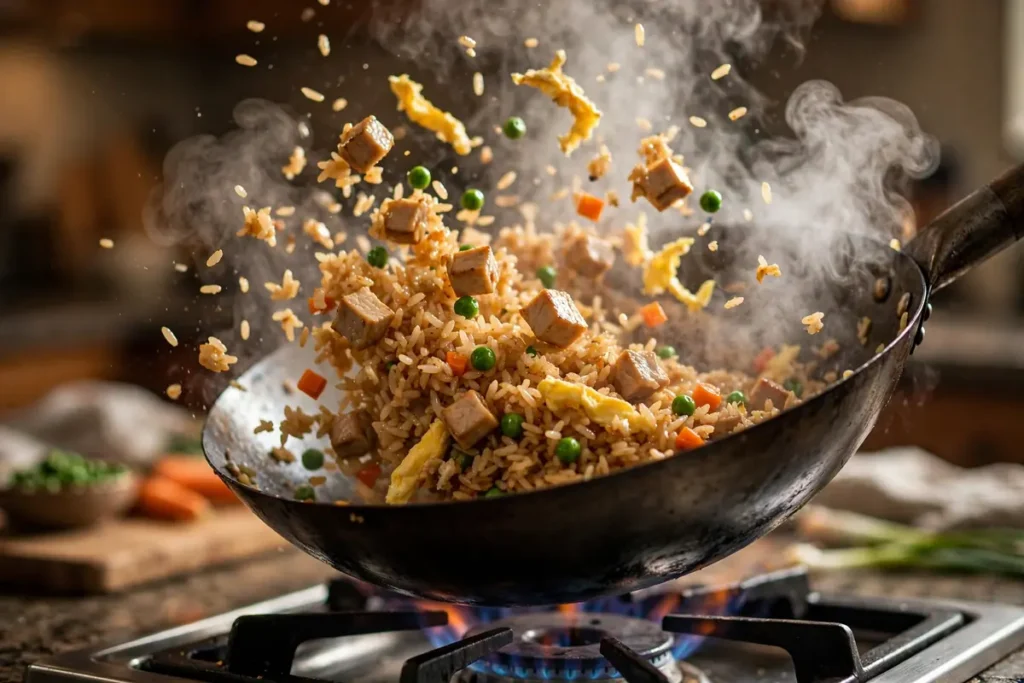
Turkey fried rice tossed in a hot wok with crisp-tender vegetables and ribbons of egg, steam rising.
Watch: Turkey Fried Rice
Chef Eitan Bernath turns leftover roasted turkey and day-old rice into a fast, savory skillet dinner with sweet soy, egg, and a peanut-scallion finish.
At a Glance: Turkey Fried Rice
The golden rules and numbers that make this 20-minute dinner work.
| Detail | What to know |
|---|---|
| Total time | About 20 minutes (10 minutes prep, 10 minutes cooking) |
| Yield | Serves 4 |
| The rice rule | Use cold, day-old rice — chilled at least 8 hours so the grains fry up separate instead of gummy |
| The turkey | Any cooked leftover turkey (breast, thigh, or a mix), diced small and added in the final minute |
| The heat | Largest skillet or wok, screaming hot, high-smoke-point oil; cook in batches rather than crowding the pan |
| Seasoning | Soy-ginger-sesame profile; swap in tamari for a gluten-free version |
| Storage | Refrigerate 3 to 4 days (USDA guidance for cooked meat and rice dishes); reheats well for next-day lunches |
Frequently Asked Questions
Can I use freshly cooked rice for fried rice?
You can, but the texture will suffer. Fresh rice is moist and steamy, so it clumps and turns gummy instead of frying into distinct grains. If you must use fresh rice, spread it on a sheet pan and refrigerate uncovered for at least 1 hour (or freeze 20 minutes) to dry the surface and firm the grains. Day-old refrigerated rice remains the gold standard.
What is the best rice for turkey fried rice?
Long-grain white rice — especially jasmine — is the classic choice: the grains stay separate and develop lightly crisped edges. Basmati works well too. Brown rice adds nutty chew and extra fiber but needs slightly longer frying. Avoid short-grain or sushi rice, which is bred to be sticky, and avoid instant rice, which turns mushy.
How do I make turkey fried rice gluten-free?
Swap the soy sauce for tamari or a certified gluten-free soy sauce, and check your oyster sauce label (or use a gluten-free mushroom oyster sauce). All other core ingredients are naturally gluten-free. Serve with rice-based sides rather than wheat noodles or soy-sauce-dressed accompaniments.
Can I add other Thanksgiving leftovers to fried rice?
Absolutely — that is the spirit of the dish. Diced roasted sweet potatoes, leftover green beans (cut into short pieces), corn, and even small amounts of stuffing crisped in the pan first all work. Add wetter leftovers like gravy only as a drizzle at serving, not during frying, to protect the rice’s texture. Cranberry sauce, surprisingly, makes a good sweet-tart garnish — see our ideas for what to do with leftover cranberry sauce.
Why does my fried rice stick to the pan?
Three usual culprits: the pan wasn’t hot enough before the oil went in, there wasn’t enough oil, or the rice was too wet. Heat the empty pan first until water dances on contact, then add oil and swirl. A well-seasoned wok or nonstick skillet helps enormously. And always start with cold, dry rice.
Is turkey fried rice healthy?
It can be a genuinely balanced meal: lean protein from turkey and eggs, complex carbs from rice, and fiber plus micronutrients from vegetables, all in one pan with modest oil. The main watch-outs are sodium (manage with low-sodium soy sauce) and portion size (restaurant portions often run double). Made at home with brown rice and extra vegetables, it is a weeknight dinner you can feel good about.
Conclusion
Turkey fried rice is proof that the smartest cooking is often the simplest: cold rice, leftover turkey, a screaming-hot pan, and twenty minutes stand between you and a dinner that tastes intentional rather than improvised. Master the golden rules — cold rice, fierce heat, mise en place, layered seasoning, and a proper finish — and this becomes a technique you will use far beyond the holidays, for any leftover protein and any half-bag of rice. Keep it classic, take it spicy with chili crisp, go Thai with pineapple, or load it with vegetables for a lighter bowl. However you fry it, you will wonder why you ever reheated plain turkey slices when this was an option. For more ways to keep the holiday flavors going, explore our full collection of Thanksgiving recipes and our guide to the season’s best Thanksgiving side dishes.