How long do Thanksgiving leftovers last? It is the most important question of the holiday weekend — and the one with the clearest answer. According to USDA guidance, most Thanksgiving leftovers, including cooked turkey, stuffing, mashed potatoes, gravy, and cooked vegetables, are safe to eat for 3 to 4 days when refrigerated promptly at or below 40°F (4°C). That means turkey carved on Thursday should be eaten, frozen, or repurposed by Sunday or Monday. This complete guide breaks down the exact safe storage times for every classic Thanksgiving dish, explains the science behind the 3-to-4-day rule, shows you how to cool, store, freeze, and reheat leftovers safely, and answers the most common questions — including whether you can still eat week-old turkey (you should not) and how to tell when leftovers have turned. Food safety is not guesswork: the timelines below follow USDA recommendations, and the thermometer temperatures cited are the official safe minimums.
The Short Answer: The 3-to-4-Day Rule
The USDA’s Food Safety and Inspection Service states that cooked meat and poultry leftovers — including Thanksgiving turkey — should be refrigerated and eaten within 3 to 4 days. This same window applies to most cooked side dishes: stuffing, mashed potatoes, sweet potato casserole, green bean casserole, mac and cheese, cooked vegetables, and gravy. The clock starts when the food is cooked, not when you first open the container. So Thursday’s turkey is on day 4 by Sunday, and it should be consumed or frozen by then. Some items last longer: cranberry sauce (7 to 10 days refrigerated, thanks to its acidity and sugar), hard cheeses, and most desserts. Pies are the notable exception among sweets — pumpkin, custard, and cream pies must be refrigerated and eaten within 3 to 4 days, while fruit pies (apple, cherry) can sit at room temperature for up to 2 days. When in doubt, the 3-to-4-day rule is your safe default, and freezing at 0°F (-18°C) pauses the clock for months.
Why 3 to 4 Days? The Science
Refrigeration slows bacterial growth; it does not stop it. Even at proper refrigerator temperatures (at or below 40°F / 4°C), cold-tolerant bacteria — including Listeria monocytogenes and various spoilage organisms — continue multiplying, just slowly. Pathogenic bacteria, the ones that cause foodborne illness, are the real concern because they are invisible: unlike spoilage bacteria, they do not change the food’s smell, taste, or appearance. You cannot see, smell, or taste your way to safety. The 3-to-4-day guideline is the USDA’s conservative safety margin, set so that even under slightly imperfect home-refrigerator conditions, bacterial populations stay below dangerous levels. After day 4, the risk climbs steeply — and no amount of reheating reliably fixes it, because some bacteria (notably Staphylococcus aureus) produce heat-stable toxins that survive boiling. The rule is simple because the biology is unforgiving: when in doubt, throw it out.
Safe Storage Times for Every Thanksgiving Dish
Turkey (Carved Meat)
Refrigerator: 3 to 4 days. Carve the turkey off the bone within 2 hours of cooking — meat left on the carcass cools slowly and stays in the bacterial danger zone longer. Store sliced or shredded meat in shallow airtight containers. Freezer: 3 to 4 months at 0°F (-18°C) for best quality; safe indefinitely while frozen, though texture degrades over time.
Turkey Carcass, Bones, and Stock
Refrigerator: 3 to 4 days for the carcass; homemade turkey stock keeps 3 to 4 days refrigerated. Freezer: stock freezes beautifully for 4 to 6 months. Make stock within a day or two of the meal for the best flavor, and cool it quickly in an ice bath before refrigerating.
Stuffing / Dressing
Refrigerator: 3 to 4 days. Stuffing cooked inside the bird must reach 165°F (74°C) at its center to be safe in the first place — this is why many food-safety experts recommend baking stuffing separately. Remove leftover stuffing from the cavity promptly; do not store the stuffed bird whole. Freezer: 1 month for best texture (it tends to dry out beyond that). For creative ways to use it up in time, see our leftover stuffing recipes.
Mashed Potatoes
Refrigerator: 3 to 4 days. Dairy-rich mashed potatoes are a hospitable environment for bacteria, so refrigerate promptly and keep them tightly covered. Freezer: up to 1 year for plain mashed potatoes, though texture is best within 2 to 3 months; dairy-heavy versions may separate slightly on thawing but stir back together. Use them up deliciously with our leftover mashed potato recipes.
Gravy
Refrigerator: 3 to 4 days. Gravy is one of the more perishable leftovers because of its rich, low-acid, protein-containing profile. Bring it to a rolling boil when reheating. Freezer: 3 to 4 months. Freeze in portion-size containers; whisk well when reheating to restore smoothness.
Sweet Potato Casserole and Other Vegetable Casseroles
Refrigerator: 3 to 4 days. Marshmallow or streusel toppings get soggy but remain safe within the window. Freezer: 2 to 3 months for most casseroles; topping texture suffers, so consider freezing before adding toppings when possible.
Green Bean Casserole
Refrigerator: 3 to 4 days. The creamy sauce and fried-onion topping follow the same rules as other casseroles. Reheat covered to keep the topping from burning; add fresh crispy onions after reheating for crunch.
Cranberry Sauce
Refrigerator: 7 to 10 days (homemade) — the high acidity and sugar content are natural preservatives. Canned cranberry sauce, once opened, keeps 7 to 10 days refrigerated. Freezer: 2 months for homemade. Put the extra to delicious use with our ideas for what to do with leftover cranberry sauce.
Dinner Rolls and Bread
Room temperature: 2 to 3 days in a bread bag or airtight container; refrigerator: not recommended (refrigeration accelerates staling). Freezer: 3 months. Refresh day-old rolls in a 350°F (175°C) oven for 5 minutes.
Pies and Desserts
Pumpkin, custard, cream, and pecan pies: refrigerate and eat within 3 to 4 days. These are egg- and dairy-rich and follow the same rules as other perishable foods. Fruit pies (apple, cherry): 2 days at room temperature, then refrigerate for up to 4 more days. Freezer: fruit pies freeze well for 6 to 8 months; cream and custard pies freeze poorly (they weep and separate on thawing).
Raw Vegetables and Salads
Refrigerator: 3 to 5 days for cut raw vegetables; dressed salads are best within 1 to 2 days as dressing wilts greens. Undressed salad components kept separate last longer.
The 2-Hour Rule: Cooling Leftovers Safely
The 3-to-4-day clock only works if food gets into the refrigerator quickly. The USDA’s 2-hour rule states that perishable food must not sit at room temperature for more than 2 hours — and if the ambient temperature is above 90°F (32°C), that window shrinks to 1 hour. The danger zone between 40°F and 140°F (4°C and 60°C) is where bacteria double every 20 minutes. Practical steps: carve the turkey within 2 hours of it coming out of the oven; divide large quantities into shallow containers (no more than 2 inches / 5 cm deep) so they chill fast; do not stack hot containers; and refrigerate gravy, stuffing, and casseroles promptly rather than “letting them cool on the counter for a while.” A common myth says hot food must cool fully before refrigerating — modern refrigerators handle warm (not steaming) food fine, and the USDA explicitly says to refrigerate promptly. If a dish is steaming heavily, let it sit 20 to 30 minutes, then refrigerate; do not leave it out for hours.
Refrigerator Best Practices
- Verify the temperature. Keep the fridge at or below 40°F (4°C) — use an appliance thermometer, since built-in dials are often inaccurate. The freezer should hold 0°F (-18°C).
- Store smart. Place ready-to-eat leftovers on upper shelves, above any raw meat. Keep containers airtight to prevent cross-contamination and moisture loss.
- Label everything. Write the dish name and the date it was cooked on every container. After four days of identical-looking tubs, labels are the only reliable system.
- Don’t overpack. Cold air must circulate. A crammed refrigerator develops warm spots — leave space between containers for the first few hours.
- Cool large batches fast. A whole pot of stock or a deep container of mashed potatoes can take 6+ hours to chill through at the center. Divide into shallow containers, use an ice bath, or stir occasionally to speed cooling.
Freezing Thanksgiving Leftovers: The Pause Button
Freezing at 0°F (-18°C) stops bacterial growth entirely — frozen food is safe indefinitely, though quality declines over months. Day 3 or 4 is the ideal moment to freeze anything you will not eat immediately; do not freeze food that is already past its safe refrigerated window. Best practices: portion into meal-size servings before freezing; use freezer bags with air pressed out or rigid containers with 1 inch (2.5 cm) of headspace for expansion; label with contents and date; and freeze flat in bags for fast thawing and neat stacking. Quality timelines: turkey 3 to 4 months, gravy 3 to 4 months, mashed potatoes 2 to 3 months (best), casseroles 2 to 3 months, cranberry sauce 2 months, stock 4 to 6 months, dinner rolls 3 months. Thaw safely: overnight in the refrigerator (best), in cold water changed every 30 minutes (for same-day use), or in the microwave if cooking immediately after. Never thaw perishable food on the counter.
Reheating Leftovers Safely
Reheat all leftovers to an internal temperature of 165°F (74°C), measured with a food thermometer — the USDA’s safe minimum for reheated leftovers. Sauces, soups, and gravies should be brought to a rolling boil. Practical guidance: reheat only the portion you plan to eat; stir microwaved food midway and let it stand covered for 2 minutes to even out hot and cold spots; bring gravy and sauces to a full boil, stirring; crisp toppings (fried onions, streusel) are best added fresh after reheating rather than before; and reheat leftovers only once — each cooling-reheating cycle degrades both safety margins and quality. Slow cookers are not safe for reheating leftovers, because they warm food too slowly through the danger zone; use the stovetop, oven, or microwave instead.
How to Tell If Leftovers Have Gone Bad
First, the critical warning: pathogenic bacteria that cause foodborne illness generally do not affect taste, smell, or appearance. Food can be dangerous while seeming perfectly fine — which is why the date-based rules above matter more than your senses. That said, obvious spoilage signs mean immediate disposal: off or sour smells, slimy texture on meat, mold (do not just cut it off soft foods — mold roots penetrate), unusual colors, or bulging/swollen packaging. The golden rule: when in doubt, throw it out. A container of turkey is never worth a case of food poisoning. This is especially important for vulnerable people — pregnant women, young children, older adults, and anyone immunocompromised should be extra strict about the 3-to-4-day limit, since Listeria (which grows even at refrigerator temperatures) poses severe risks to these groups.
The Day-by-Day Leftover Timeline
Thursday (Day 0–1): The Feast
Eat, enjoy, and refrigerate everything within 2 hours of serving. Carve leftover turkey off the bone; portion sides into shallow containers; label and date everything.
Friday (Day 1–2): Peak Leftovers
The golden window. Build the classic leftover sandwich, make leftover turkey chili, or start a pot of stock from the carcass. Everything is at peak quality.
Saturday (Day 2–3): Cook or Freeze Decision Day
Transform what remains into new dishes — turkey fried rice, turkey curry, turkey enchiladas — or freeze it. Do not leave the decision for tomorrow.
Sunday (Day 3–4): Last Safe Day
Eat or freeze the remaining perishables today. After today, cooked turkey, stuffing, potatoes, and gravy should be discarded if still refrigerated. Cranberry sauce and hard cheeses carry on.
Monday and Beyond (Day 5+)
Refrigerated turkey, stuffing, mashed potatoes, gravy, and casseroles from Thursday are no longer safe — discard them, no matter how good they look or smell. Enjoy your frozen portions over the coming months instead.
Special Situations
Taking Leftovers to Work or School
Pack in insulated bags with ice packs; food should not sit unrefrigerated more than 2 hours total. Reheat to 165°F (74°C) — microwaves at work are fine if you stir midway and check that the food steams throughout.
Shipping or Traveling with Leftovers
Perishable leftovers traveling more than 2 hours need a cooler with ice packs maintaining 40°F (4°C) or below. For flights or long drives, freezing portions solid before travel buys extra safe time — they act as their own ice packs.
Power Outages
A full freezer keeps food safe for about 48 hours without power (24 hours if half-full) as long as the door stays closed; a refrigerator keeps food safe for about 4 hours. After that, perishable leftovers must be discarded. When in doubt — especially with turkey and dairy-rich sides — throw it out.
Feeding a Crowd from Leftovers
If reheating leftovers for guests, keep hot foods above 140°F (60°C) with chafing dishes or slow cookers on warm, and do not leave the buffet out more than 2 hours. Cold dishes should sit on ice. The 2-hour rule applies to serving time just as it does to cooling time.
Reducing Waste: Plan for Leftovers Before You Cook
The safest leftovers are the ones you planned for. Before the holiday, stock up on airtight containers, freezer bags, and masking tape with a marker for labels — running out of storage on Thursday night is how food ends up sitting out too long. Cook with repurposing in mind: roast an extra turkey breast specifically for Friday’s meals, make a little more mashed potato than the table needs, and save the carcass for stock. Portion sides into meal-size containers as you clear the table rather than refrigerating giant serving dishes that cool slowly. And share generously: sending guests home with properly packed containers on Thursday night is the most delicious form of food safety, because leftovers eaten promptly never approach the danger zone at all. A little planning turns the 3-to-4-day window from a constraint into a creative brief.
In Pictures: How Long Thanksgiving Leftovers Last
The fridge after the feast tells the story — neatly packed containers of turkey, sides, and sauces, each with its own safe window.
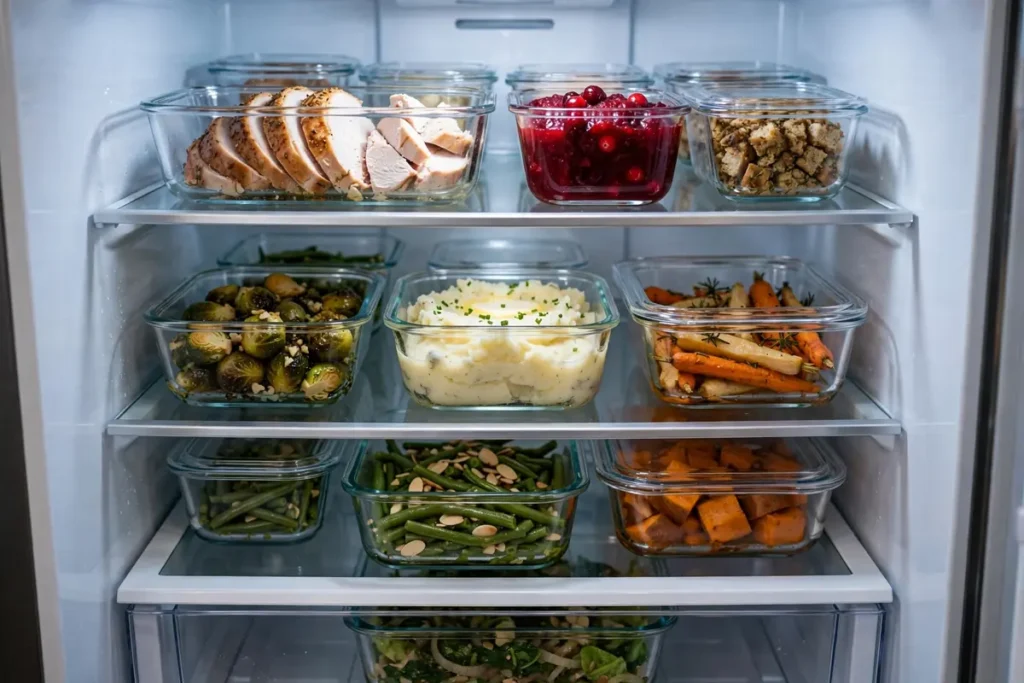
A refrigerator stocked with neatly packed Thanksgiving leftover containers, each ready for its safe storage window.
Watch: How Long Thanksgiving Leftovers Last
The Kitchen Today breaks down exactly how long cooked turkey and trimmings stay safe — the 3-to-4-day fridge rule, the two-hour rule, and when to freeze instead.
At a Glance: How Long Thanksgiving Leftovers Last
The USDA-backed timelines every host should know.
| Food | Fridge | Key detail |
|---|---|---|
| Cooked turkey, stuffing, mashed potatoes, gravy | 3 to 4 days | USDA Food Safety and Inspection Service guidance; eat or freeze by the Monday after Thanksgiving |
| Homemade cranberry sauce | 7 to 10 days | High acidity and sugar extend its safe window well beyond the turkey |
| The two-hour rule | Refrigerate within 2 hours | Perishable food in the 'danger zone' (40–140°F) for longer should be discarded |
| Reheating | 165°F internal | Reheat leftovers to 165°F as measured with a food thermometer; bring sauces, soups, and gravies to a rolling boil |
| Freezer | Best quality 2 to 6 months | Frozen food stays safe indefinitely, though quality declines; cooked turkey keeps up to 4 months at best quality |
| Cooling tip | Shallow containers | Divide large quantities into small, shallow containers so they chill quickly and evenly |
Frequently Asked Questions
Can you eat Thanksgiving leftovers after 5 days?
No — not safely. The USDA advises discarding refrigerated cooked turkey, stuffing, mashed potatoes, gravy, and casseroles after 3 to 4 days. Pathogenic bacteria do not change the food’s smell or appearance, so week-old leftovers can be dangerous while seeming fine. Freeze leftovers by day 3 or 4 if you want to keep them longer.
Does reheating kill all bacteria in old leftovers?
No. Reheating to 165°F (74°C) kills most live bacteria, but some bacteria produce heat-stable toxins (notably Staphylococcus aureus) that survive boiling and still cause food poisoning. Reheating cannot make spoiled or over-age food safe — this is why the time limits matter more than the thermometer.
How long can Thanksgiving turkey sit out on the table?
No more than 2 hours at room temperature (1 hour if the room is above 90°F / 32°C). The buffet hours are part of this window — if the turkey sat out during a long afternoon of grazing, that time counts. Carve and refrigerate promptly after the meal.
Can I freeze leftover turkey on day 4?
Yes, if it has been continuously refrigerated at or below 40°F (4°C) and shows no spoilage signs. Freezing pauses bacterial growth but does not reverse it — so day 4 is the last safe moment. Freeze in portion-size airtight packaging at 0°F (-18°C) for 3 to 4 months of best quality.
How long does homemade turkey stock last?
3 to 4 days refrigerated at or below 40°F (4°C), or 4 to 6 months frozen. Cool stock quickly — use an ice bath or divide into shallow containers — because a large hot pot can linger in the danger zone for hours. Bring refrigerated stock to a rolling boil before using.
Is it safe to eat cold leftover turkey without reheating?
Yes, provided it has been stored safely (refrigerated within 2 hours, eaten within 3 to 4 days). Cold turkey in sandwiches and salads is perfectly safe — the 165°F reheating rule applies when you choose to reheat, not as a requirement for all consumption. Keep cold servings chilled until eaten.
Quick-Reference Storage Chart
All refrigerator times assume prompt refrigeration (within 2 hours) at or below 40°F (4°C); all freezer times assume 0°F (-18°C).
- Cooked turkey (carved): fridge 3–4 days; freezer 3–4 months
- Turkey stock / carcass: fridge 3–4 days; freezer 4–6 months
- Stuffing / dressing: fridge 3–4 days; freezer 1 month
- Mashed potatoes: fridge 3–4 days; freezer 2–3 months (best)
- Gravy: fridge 3–4 days; freezer 3–4 months
- Casseroles (sweet potato, green bean): fridge 3–4 days; freezer 2–3 months
- Cranberry sauce: fridge 7–10 days; freezer 2 months
- Dinner rolls: room temp 2–3 days; freezer 3 months
- Pumpkin / custard / cream pies: fridge 3–4 days; freezing not recommended
- Fruit pies: room temp 2 days, then fridge up to 4 more days; freezer 6–8 months
Conclusion
How long do Thanksgiving leftovers last? Three to four days refrigerated for the turkey, stuffing, potatoes, gravy, and casseroles that make up the heart of the meal — longer for cranberry sauce, shorter for nothing if you refrigerate promptly and reheat to 165°F (74°C). The rules are simple, but they are worth following precisely, because the bacteria that cause foodborne illness are invisible and reheating cannot undo days of unsafe storage. Label your containers, freeze what you cannot eat by Sunday, transform the rest into new dishes like chili, fried rice, curry, and enchiladas, and when in doubt, throw it out. Handled with this much care, your Thanksgiving feast safely feeds your household twice — first as the celebration itself, then as a week of delicious second acts. For recipe ideas that use every last safe bite, browse our Thanksgiving recipes collection and our guide to the season’s best Thanksgiving side dishes.