Best Karaoke Machine: Top Picks for Epic Home Parties
The best karaoke machine turns any gathering into a legendary night — and today’s options range from $50 portable boxes to $500 party powerhouses with light shows, vocal effects, and streaming song libraries. The right pick depends on your crowd: kids’ parties, adult sing-alongs, or serious vocal practice all want different machines.
What matters: sound quality (the #1 factor — bad speakers kill the fun), microphone quality and count (two mics minimum for duets), song source (built-in, Bluetooth, app-based), ease of setup (parties don’t wait for troubleshooting), and portability (backyard to living room). This guide covers the picks that deliver unforgettable nights.
Whether you’re hosting monthly parties or gifting a music-loving kid, here’s how to choose the karaoke machine that gets used, not shelved.
What Makes Karaoke Fun (The Real Criteria)
Karaoke fun factors, ranked: sound quality (full, clear speakers — thin audio embarrasses singers), mic quality (no dropouts, no harshness; wireless freedom), song selection (the songs your crowd actually wants), ease of use (drunk-proof interfaces; big buttons, simple pairing), and atmosphere (disco lights, vocal effects like echo/reverb that flatter voices).
The insight: karaoke is 80% psychology — people sing when they feel safe and sound good. Machines with vocal effects (echo, reverb) make everyone sound better and sing braver. Prioritize the experience over specs: a $150 machine everyone uses beats a $500 machine that intimidates. Fun is the spec sheet.
- Sound first: Full speakers; thin audio kills courage.
- Two mics: Duets double the fun; wireless freedom.
- Vocal effects: Echo/reverb flatter voices; braver singers.
- Drunk-proof UI: Big buttons, simple pairing.
- Fun > specs: Used machines beat shelved flagships.
Related reading: Best Black Friday Sewing Machine Deals 2026.
Top Pick: Best Overall Home Karaoke
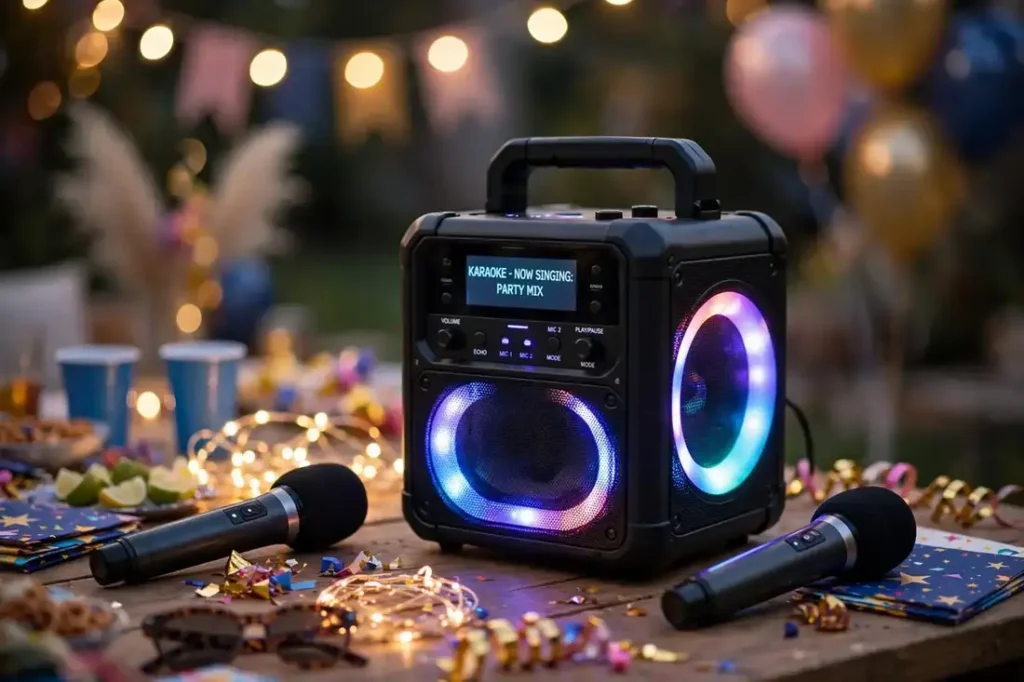
The best overall home machine balances: powerful clear speakers (PA-style output that fills a living room), two quality wireless mics, Bluetooth + multiple inputs (TV, phone, tablet), vocal effects (echo, reverb, pitch), disco lighting (atmosphere matters), and battery or AC flexibility. The $150–$300 range holds the sweet spot — machines like the Karaoke USA, Singing Machine, and Tonor systems compete here.
Why it wins: it handles 10-person parties without strain, sets up in minutes, survives enthusiastic use, and the mics don’t cut out mid-chorus (the cardinal karaoke sin). Look for: 50W+ speakers, UHF wireless mics (not Bluetooth mics — latency), and simple EQ. This is the machine for hosts who throw real parties.
- $150–$300: The home-party sweet spot.
- 50W+ speakers: Fills living rooms without strain.
- UHF wireless mics: No latency, no dropouts mid-chorus.
- Vocal effects: Echo and reverb; everyone sounds better.
- Minutes setup: Parties don’t wait for troubleshooting.
Related reading: Best Karaoke Bars in the USA.
Best Budget Pick Under $100
Under $100, portable karaoke mics and small speaker systems deliver surprising fun: Bluetooth speaker + mic combos, all-in-one mic-speakers (sing into the mic, music plays from it), and compact PA boxes. Honest limits: smaller speakers (fine for 2–6 people, not 20), basic effects, and shorter battery life.
Best for: kids, small gatherings, travel, and testing whether karaoke sticks before investing. The all-in-one mic-speakers ($30–$60) are genuinely delightful gifts — surprisingly decent sound, ultimate portability. For under-$100 systems, prioritize: mic quality (cheap mics screech), Bluetooth reliability, and battery life. Small but mighty beats big and broken.
- $30–$100: Portable fun; small gatherings.
- All-in-one mics: Delightful gifts; surprising quality.
- Mic quality first: Cheap mics screech; prioritize.
- Test the waters: Prove karaoke sticks before investing.
- 2–6 people: Intimate scale; know the limits.
Related reading: Christmas Karaoke Songs Playlist: 100+ Hits.
Best for Kids
Kids’ karaoke needs: durability (drops happen), simplicity (big buttons, minimal menus), fun lights and effects (the show matters), volume limits (protect young ears — or at least parental sanity), and songs they know (app connectivity for current hits). Dedicated kids’ machines ($50–$120) with Disney/pop song options and rugged builds fit perfectly.
Parental wisdom: wireless mics prevent cord disasters, rechargeable batteries beat constant AA purchases, and machines that connect to tablets (YouTube karaoke tracks) never run out of songs. The best kids’ machine is the one they’ll use independently — setup simplicity for small hands matters more than audio fidelity.
- Durable build: Drops happen; rugged survives.
- Simple controls: Big buttons; independent use.
- App connectivity: Current hits via tablet; endless songs.
- Wireless mics: No cord disasters.
- Volume sanity: Loud enough for fun, limits for ears.
Related reading: Family Karaoke Night.
Song Sources: Where the Music Comes From
Modern karaoke songs come from: YouTube (millions of free karaoke tracks; search ‘[song] karaoke’ — quality varies, ads interrupt), dedicated apps (Smule, KaraFun — curated libraries, lyrics sync, subscriptions $5–$10/month), Bluetooth streaming (play any karaoke track from your phone through the machine), and built-in songs (older machines; limited but reliable).
The winning setup: a machine with Bluetooth/display output + a KaraFun subscription or YouTube Premium (no ads) on a tablet connected to the TV. Lyrics on the big screen, music through the machine, mics in hands — the complete system. Test your song pipeline before the party; nothing kills momentum like 10 minutes of ‘why isn’t it connecting.’
- YouTube: Millions free; quality varies, ads interrupt.
- KaraFun/Smule: Curated libraries; $5–$10/month.
- Bluetooth: Stream anything from your phone.
- TV lyrics: Big-screen lyrics; the complete system.
- Test pre-party: Pipeline working before guests arrive.
Setting Up for Party Success
Party setup: position the machine centrally (sound reaches everyone), TV for lyrics at readable height and distance, mics charged/paired before guests arrive, and a song queue system (phone passed around, or a sign-up list — structure prevents the same three people hogging). Lighting: dim the overheads, let the disco lights work; atmosphere is half the fun.
Test everything 30 minutes before: Bluetooth pairs, lyrics display, mic levels (check for feedback spots), and volume balance (music under vocals, not over). Prepare a starter song list (crowd-pleasers across eras) to break the ice — the host singing first badly and joyfully gives everyone permission. Then get out of the way; the machine runs the night.
- Central position: Sound reaches everyone; lyrics TV readable.
- Pre-party test: 30 minutes before; pairing, levels, feedback check.
- Song queue: Sign-up list; prevents mic hogging.
- Host goes first: Joyful bad singing gives permission.
- Dim lights: Let disco lights create atmosphere.
Hosting Unforgettable Karaoke Nights
Great karaoke hosting is facilitation: warm up the crowd (group songs first — no one is exposed), mix skill levels (alternate confident singers with shy ones; never two ballads in a row), celebrate effort over talent (the loudest cheers for the bravest beginners), and keep momentum (dead air kills energy; always have the next singer ready).
Themes elevate nights: decades parties (80s night!), duets night, guilty pleasures, costumes. Prizes for categories (best performance, bravest attempt, best duo) add playful stakes. End with a group anthem — everyone singing together is the memory. The host’s job isn’t singing best; it’s making everyone feel like a star.
- Group songs first: Warm up; no one exposed early.
- Mix the order: Alternate confident and shy; pace energy.
- Cheer bravery: Loudest applause for bravest beginners.
- Themes: Decades, duets, costumes; elevate the night.
- Group finale: Everyone together; the lasting memory.
Karaoke for Practice and Improvement
Beyond parties, karaoke machines are legitimate vocal practice tools: pitch display (some machines score pitch — instant feedback), key control (adjust songs to your range), tempo control (slow difficult passages), and recording (hear yourself objectively; the fastest improvement tool). Regular singers improve noticeably — breath control, pitch accuracy, confidence.
Practice approach: warm up (humming, lip trills), work one song at a time (master it fully), record and review (objectivity beats feeling), and sing daily (15 minutes beats weekly marathons). Karaoke practice is joyful repetition — the rare vocal exercise that feels like play. The party singer who practices becomes the party legend.
- Pitch scoring: Instant feedback; gamified improvement.
- Key control: Fit songs to your range.
- Record yourself: Objective review; fastest progress.
- One song at a time: Mastery over variety.
- Daily 15 min: Joyful repetition builds skill.
Maintenance and Longevity
Karaoke machines are party equipment — they take abuse. Care basics: store mics properly (drops kill wireless mics; use the case), charge batteries after use (don’t store dead), clean mic grilles (hygiene matters with shared mics — removable windscreens wash), update apps/firmware (song libraries and features improve), and protect speakers (don’t redline volume; distortion damages drivers).
Hygiene note: shared mics + singing = germ exchange; keep sanitizing wipes handy and wash windscreens between parties. A well-kept machine lasts years of parties; a neglected one dies mid-chorus at the worst moment. Treat it like the party MVP it is.
- Mic care: Cases prevent drop deaths; #1 longevity factor.
- Charge after use: Don’t store batteries dead.
- Clean grilles: Wash windscreens; sanitizing wipes handy.
- Update software: Libraries and features improve.
- Protect speakers: No redlining; distortion damages drivers.
When to Go Bigger: Pro-Level Options
For the truly committed: professional PA speakers ($300–$600; the sound quality jump is dramatic), dedicated karaoke mixers (vocal processing, multiple mic channels), wired professional mics (Shure SM58 — indestructible, industry standard), and large displays or projectors (lyrics everyone can read). This tier serves: frequent hosts, event planners, and venues.
The honest assessment: pro gear sounds incredible but needs storage space, setup knowledge, and an audience worth it. Most home hosts never need beyond the $150–$300 sweet spot. Go pro when you’re hosting monthly+ and the machine is the bottleneck — not before. The party is the point; gear serves it.
- PA speakers: $300–$600; dramatic quality jump.
- Pro mics: SM58; indestructible industry standard.
- Mixers: Vocal processing, multiple channels.
- Monthly+ hosts: Upgrade when machine bottlenecks.
- Party first: Gear serves the gathering, not vice versa.
Hosting Karaoke Night
Hosting transforms karaoke from activity to event: setup (machine + TV + mics + lighting; the stage), songbooks (physical or app; browsing), rotation (sign-up list; fairness; the host manages), and atmosphere (lights, decorations; the vibe). The host’s job: energy (enthusiasm; first singer courage), pacing (mix fast/slow; energy arcs), and inclusion (shy singers; duets help).
Logistics: sound check (levels; before guests), food and drinks (fuel; social), timing (start early; momentum), and themes (80s night; costumes; fun). The golden rule: the host sings first (breaks ice; permission), and nobody mocks (the sacred rule; courage celebrated).
Scaling: small groups (living room; intimate), parties (20+; rotation matters), and regular nights (tradition; the best). Great karaoke nights become legends — the host makes them. Energy is contagious; bring it.
- Host sings first: Breaks ice; permission.
- Sign-up rotation: Fairness; management.
- Nobody mocks: The sacred rule.
- Sound check: Levels before guests.
- Mix pacing: Fast/slow; energy arcs.
- Duets help: Shy singers; inclusion.
- Themes fun: 80s night; costumes.
- Energy contagious: Bring it.
Karaoke Singing Tips
Singing better (without lessons): song choice (your range; familiar; the 80% rule), breathing (diaphragm; phrases; support), mic technique (close for quiet; pull back loud; consistent), and confidence (commitment beats perfection; perform).
Performance: know the song (lyrics; melody; cold), stage presence (move; eye contact; energy), crowd work (chorus participation; fun), and recovery (missed notes; smile; continue). The audience wants you to succeed — they’re rooting, not judging.
Improvement: record yourself (hear truth; adjust), practice (shower concerts; car rehearsals), expand range (gradually; comfort edges), and have fun (the point; joy audible). Karaoke isn’t American Idol; it’s joyful noise. Courage over chops, always.
- Your range: Familiar; 80% rule.
- Mic technique: Close quiet; back loud.
- Commit: Beats perfection.
- Know cold: Lyrics and melody.
- Crowd choruses: Participation; fun.
- Smile through: Missed notes; continue.
- Rooting not judging: Audience wants success.
- Joy audible: Fun is the point.
Karaoke Equipment Guide
Beyond the machine: microphones (wired reliable; wireless freedom; quality matters), speakers (PA or party speakers; karaoke needs punch), displays (TV; lyrics visible; large), lighting (LED strips; disco ball; atmosphere), and mixers (vocal effects; echo; the karaoke sound).
Setup: speaker placement (facing singers; feedback avoidance), mic levels (vocals over music; balance), echo (tasteful; the karaoke signature), and testing (full song; before party). Troubleshooting: feedback (move mics; lower gain), latency (wired; Bluetooth lags), and lyrics sync (app settings; timing).
Upgrades: second mic (duets; essential), subwoofer (bass; party), and dedicated room (the dream; regulars). Equipment serves the singing; don’t overthink. Good enough gear + great energy beats perfect gear + awkward silence.
- Wireless mics: Freedom; quality matters.
- PA speakers: Karaoke needs punch.
- Big lyrics: TV; visible to all.
- Echo tasteful: The karaoke signature.
- Feedback fix: Move mics; lower gain.
- Second mic: Duets; essential.
- Wired < lag: Bluetooth latency.
- Energy > gear: Good enough + fun wins.
Song Selection Strategy
Song choice determines nights: crowd-pleasers (‘Don’t Stop Believin’,’; ‘Sweet Caroline’; ‘Livin’ on a Prayer’; the canon), range-appropriate (know limits; transpose apps help), energy-matched (read room; fast/slow balance), and personal (songs you love; authenticity performs).
Building repertoire: 5 go-to songs (reliable; varied), stretch songs (growth; challenge), duets (shared; fun), and group numbers (‘Bohemian Rhapsody’; everyone). Avoid: obscure deep cuts (crowd disconnects), marathon songs (10 minutes; ‘American Pie’ exception debated), and vocal impossibilities (Whitney; unless you’re Whitney).
Discovery: karaoke apps (browsing; previews), friends’ picks (expand taste), and genres (country, musicals, hip-hop; variety). The best karaoke song is one the room sings together — communal joy. Choose for the room, not the ego.
- Canon songs: Journey; Neil Diamond; Bon Jovi.
- Range-appropriate: Know limits; transpose.
- Read room: Energy-matched; balance.
- 5 go-tos: Reliable; varied.
- Group numbers: Bohemian; everyone sings.
- Avoid marathons: 10-min songs; debated.
- Choose room: Not ego; communal joy.
- Expand genres: Variety; discovery.
Karaoke Apps and Software
Apps expand libraries infinitely: Karafun (subscription; huge library; offline), Smule (social; duets; community), Yokee (phone-based; casual), and YouTube (free; search ‘[song] karaoke’; vast). Software: KaraFun Player (PC; professional), and PCDJ (DJ+karaoke; events).
Features: pitch shifting (range matching; key changes), offline mode (parties; wifi fails), queue management (rotation; fairness), and recording (memories; sharing). Subscriptions vs. free: serious hosts subscribe (reliability; library); casual uses YouTube (free; ads).
The digital advantage: infinite songs (vs. disc limits), updates (new hits; current), and portability (phone + speaker; anywhere). The machine + app combo: hardware reliability, software breadth. Modern karaoke is software-powered; the machine is the stage.
- Karafun: Subscription; huge; offline.
- Smule social: Duets; community.
- YouTube free: Search karaoke; vast.
- Pitch shift: Range matching; key.
- Offline mode: Parties; wifi fails.
- Queue mgmt: Rotation; fairness.
- Subscribe serious: Reliability; library.
- Software-powered: Machine = stage.
Building a Home Karaoke Setup
The room: the dedicated (the dream; the spare), the living (the shared; the setup), the sound (the treated; the rugs), and the vibe (the lights; the LED). The gear: the machine (the core; the $200), the speakers (the PA; the 12-inch), the mics (the 2; the wireless), and the screen (the TV; the 55-inch).
The audio: the mixer (the voices; the echo), the levels (the balanced; the tested), the feedback (the avoided; the positioned), and the bass (the sub; the party). The library: the subscription (the Karafun; the 50k), the YouTube (the free; the backup), and the requests (the app; the queue).
The atmosphere: the lighting (the disco; the LED), the seating (the facing; the stage), the drinks (the bar; the social), and the decor (the theme; the fun). The hosting: the rotation (the fair; the app), the energy (the first; the host), and the inclusive (the duets; the shy).
The investment: the $500 (the solid; the starter), the $1500 (the serious; the room), the $3000 (the dream; the dedicated), and the joy (the priceless; the nights). The home karaoke: the parties; the memories. Build; the singing starts.
- PA 12-inch: Speakers; the punch.
- 2 wireless: Mics; the duets.
- 55-inch TV: Lyrics; the readable.
- Karafun 50k: Library; the subscription.
- LED vibe: Lighting; the party.
- $500 starter: Solid; the beginning.
- Host first: Energy; the ice.
- Memories: Priceless; the nights.
Overcoming Karaoke Stage Fright
The fear: the normal (the 90%; the felt), the judgment (the imagined; the kind), the voice (the ‘bad’; the enough), and the courage (the 3 minutes; the borrowed). The truth: the audience (the rooting; the drunk), the bar (the low; the fun), and the secret (the everyone; the nervous).
The tactics: the group (the safety; the first), the duet (the shared; the brave), the familiar (the anthem; the known), and the liquid (the 1 drink; the loose). The mindset: the fun (the goal; the not-perfect), the participation (the trophy; the tried), and the story (the laughed; the later).
The preparation: the practice (the car; the shower), the key (the lowered; the comfortable), the lyrics (the known; the glanced), and the breathing (the deep; the calm). The performance: the commit (the 100%; the sell), the smile (the contagious; the forgiven), and the bow (the owned; the proud).
The after: the high (the real; the endorphins), the hooked (the regular; the converted), and the growth (the confidence; the transferred). The stage fright: the faced; the shrunk. Sing; the fear fades.
- 90% feel it: Normal; the shared.
- Group first: Safety; the brave.
- Anthem known: Familiar; the comfort.
- Fun goal: Not perfect; the tried.
- Lower key: Comfortable; the sung.
- Commit 100%: Sell; the forgiven.
- Endorphins: High; the real.
- Fear fades: Faced; the shrunk.
Karaoke Around the World
The cultures: the Japan (the boxes; the private), the Korea (the noraebang; the food), the Philippines (the videoke; the home), and the Finland (the championships; the serious). The boxes: the private (the friends; the hourly), the food (the ordered; the sung), and the freedom (the loud; the judged-never).
The styles: the American (the bar; the public), the British (the pub; the anthems), the Latin (the rancheras; the passion), and the Chinese (the KTV; the lavish). The songs: the local (the anthems; the known), the global (the ‘My Way’; the everywhere), and the language (the sung; the attempted).
The travel: the seek (the local; the joined), the respect (the customs; the observed), the participate (the brave; the welcomed), and the memories (the best; the stories). The etiquette: the rotation (the honored; the waited), the applause (the given; the generous), and the gratitude (the host; the thanked).
The universal: the joy (the shared; the human), the courage (the admired; the everywhere), and the connection (the music; the beyond-words). The karaoke: the global; the human. Sing anywhere; the world sings back.
- Japan boxes: Private; the origin.
- Noraebang: Korea; the food.
- Videoke: Philippines; the home.
- Championships: Finland; the serious.
- Seek local: Joined; the travel.
- Respect customs: Observed; the welcomed.
- Applaud generous: Given; the kind.
- World sings: Universal; the joy.
Karaoke Duets and Group Numbers
The duets: the chemistry (the paired; the fun), the harmony (the attempted; the laughed), the classics (the ‘Islands’; the ‘Summer Nights’), and the courage (the shared; the halved). The choosing: the balanced (the parts; the both), the known (the both; the sung), and the fun (the first; the always).
The group: the anthems (the ‘Bohemian’; the all), the choreography (the attempted; the hilarious), the sections (the divided; the loud), and the finale (the planned; the epic). The hosting: the suggested (the list; the duets), the paired (the shy; the brave), and the celebrated (the all; the cheered).
The practice: the car (the rehearsed; the parts), the harmony (the YouTube; the learned), and the fun (the kept; the priority). The performance: the eye (the contact; the partner), the energy (the doubled; the fed), and the bow (the together; the proud).
The memories: the weddings (the first dance; the sung), the parties (the finale; the all), and the friendships (the bonded; the harmonized). The duet: the shared; the courage doubled. Pair up; the fun multiplies.
The list: the ‘Don’t Go Breaking’ (the classic; the Elton), the ‘Ain’t No Mountain’ (the soul; the duet), and the ‘Shallow’ (the modern; the Gaga). The group: the ‘We Are’ (the anthem; the all). Sing together; the joy compounds.
- Islands in Stream: Classic; the duet.
- Summer Nights: Grease; the fun.
- Bohemian all: Anthem; the group.
- Paired shy: Brave; the hosted.
- Car rehearsed: Parts; the practiced.
- Eye contact: Partner; the energy.
- Weddings: First dance; the sung.
- Shallow: Modern; the Gaga.
- Courage halved: Shared; the duet.
- Joy compounds: Together; the multiplied.
Best Karaoke Machine: Quick Comparison
| Machine tier | Price range | Best for | Key features |
|---|---|---|---|
| All-in-one mic | $30–$60 | Gifts, travel, kids | Portable, simple, fun |
| Budget system | $60–$120 | Small gatherings | Bluetooth, basic effects |
| Home party | $150–$300 | Real parties | 50W+, UHF mics, lights |
| Pro setup | $400+ | Frequent hosts | PA speakers, mixers, pro mics |
Frequently Asked Questions
What should I look for in a karaoke machine?
Sound quality first, then two wireless mics (UHF, not Bluetooth), vocal effects, easy setup, and song source flexibility (Bluetooth + app). $150–$300 is the home-party sweet spot.
Where do karaoke songs come from?
YouTube (free, variable quality), apps like KaraFun/Smule ($5–$10/month, curated), or Bluetooth streaming from your phone. Test your pipeline before the party.
Can I use a karaoke machine outdoors?
Yes — battery-powered models work great outdoors. Protect from rain, keep volume neighbor-considerate, and bring power banks for long sessions.
What’s the difference between UHF and Bluetooth mics?
UHF wireless mics have near-zero latency and reliable range; Bluetooth mics can lag and drop. For singing, UHF is strongly preferred.
How do I connect a karaoke machine to my TV?
Most machines output lyrics via HDMI or connect through your phone/tablet to the TV. Bluetooth audio to the machine + HDMI lyrics to TV is the standard setup.
Are karaoke machines good for kids?
Excellent — dedicated kids’ machines ($50–$120) are durable, simple, and fun. Wireless mics, app song access, and volume awareness make them ideal gifts.
Watch: Best Karaoke Machine: Top Picks for Epic Home Parties Video Guide

The best karaoke machine is the one that gets the shyest guest singing — great sound, forgiving vocal effects, simple setup, and the songs your crowd loves. Buy for your actual parties ($150–$300 sweet spot for hosts), test the pipeline before guests arrive, sing first and badly, and let the night run itself. Somewhere between the group opener and the finale anthem, strangers become friends and friends become legends. That’s not a machine; that’s magic with a microphone.