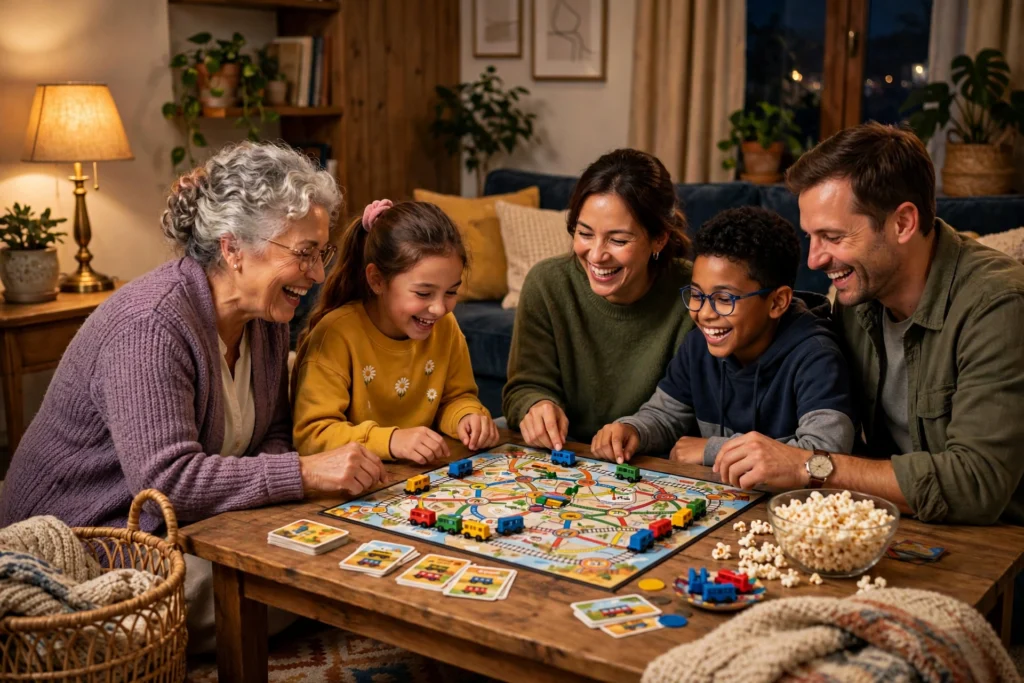
A family karaoke night is the rare activity that gets a five-year-old, a teenager, and a grandparent all cheering for each other within the same hour. It costs almost nothing to set up, works in any living room, and produces the kind of joyful, slightly embarrassing memories families talk about for years. This guide covers everything: the gear you actually need (and the gear you do not), how to build playlists by age, games and themes that keep the night moving, tips for shy singers, and hosting ideas for birthdays and holidays.
Why Karaoke Works for Every Age
Most family activities have an age problem: too babyish for the teens, too hard for the little ones, too boring for the adults. Karaoke dodges all of it because everyone participates at their own level. A toddler can shout the chorus of a song they love. A teen can show off. A grandparent can finally perform the oldies they have been humming for decades. The format is infinitely adjustable — solos, duets, full-family choruses — so nobody is ever stuck as a spectator unless they want to be.
There is also something disarming about singing badly on purpose. Karaoke gives kids (and adults) a low-stakes way to be brave: the whole point is enthusiasm over talent. Families report that karaoke night becomes the evening when the shy kid surprises everyone, when dad’s hidden talent gets revealed, and when the usual sibling dynamics dissolve into a cheering section. It is team-building disguised as goofing off.
The Gear You Actually Need
You can spend $20 or $500 on karaoke. Here is the honest breakdown of what matters at each level.
The free starter setup (you probably own this already)
A TV or laptop, a phone, and YouTube. Search any song title plus “karaoke” and you will find lyric videos — millions of them, free. Connect the laptop to the TV with an HDMI cable (or cast wirelessly), prop up the phone as a “microphone,” and you are in business. Sound quality is whatever your TV speakers produce, which is honestly fine for a first night. Total cost: $0.
The sweet-spot setup (under $100)
Add two things: a Bluetooth karaoke microphone (or a pair — duets are half the fun) and a small Bluetooth speaker if your TV audio is weak. Karaoke mics with built-in speakers run $25–50 and are endlessly entertaining for kids even outside karaoke night. A dedicated karaoke app subscription (options like KaraFun or Singa run a few dollars a month) gives you a proper lyric interface, key adjustment, and no ads interrupting the chorus.
The enthusiast setup ($150+)
A karaoke machine with dual wireless mics, a mixer for vocal effects (echo is non-negotiable for dramatic ballads), and a soundbar or PA speaker. This is worth it if karaoke becomes a monthly tradition or you host parties. Look for machines with a “vocal remover” or guide-vocal feature — it lets shy singers hear the original artist quietly underneath, which is genuinely confidence-boosting.
What you do not need
A disco ball (fun once, annoying forever), a fog machine (your smoke alarm disagrees), professional lighting, or a dedicated karaoke room. Enthusiasm and a working speaker beat equipment every time. Upgrade only after you have done three karaoke nights and know the tradition is sticking.
Setting Up Your Space
- The stage: clear a rug-sized area facing the TV. A “stage” can be a bath mat with tape X marks — kids take it very seriously.
- The lyrics screen: the biggest screen you have, at eye level for the singer. If singers have to crane their necks, energy drops fast.
- Lighting: dim the overheads, turn on a couple of lamps or string lights. Low light makes everyone braver. A $10 LED strip behind the TV adds concert vibes.
- The audience zone: couch and floor cushions facing the stage, close enough to cheer. Audience participation — clapping, chorus singalongs — is what makes it a night instead of a recital.
- The queue: a whiteboard or paper list where singers sign up. It prevents mic-hogging arguments and builds delicious anticipation.
Building Playlists by Age
The wrong song kills momentum; the right song makes a star. Build a family songbook with sections for each age group, and let everyone add to it over time.
Little stars (ages 3–7)
Short songs, simple choruses, big energy. Disney and animated-movie songs dominate for a reason — kids already know every word.
- “Let It Go” — Frozen (the gateway karaoke song; every kid knows it)
- “We Don’t Talk About Bruno” — Encanto (the ensemble energy is perfect for group numbers)
- “Baby Shark” — Pinkfong (toddlers will perform this with total commitment)
- “You’ve Got a Friend in Me” — Toy Story (sweet duet for parent and child)
- “Hakuna Matata” — The Lion King (impossible not to smile through)
- “Can’t Stop the Feeling!” — Justin Timberlake (Trolls made it a kid anthem)
Tweens (ages 8–12)
They want songs that feel cool, not babyish — current pop, musical theater, and songs with a little attitude.
- “Dynamite” — BTS (upbeat, clean, universally known)
- “Golden” — HUNTR/X (the KPop Demon Hunters phenomenon; tweens are obsessed)
- “A Whole New World” — Aladdin (the classic duet; surprisingly beloved by this age)
- “Shake It Off” — Taylor Swift (crowd-pleaser with an easy chorus)
- “Surface Pressure” — Encanto (lets strong singers show off)
- “We Will Rock You” — Queen (stomp-stomp-clap; the whole room joins in)
Teens (ages 13+)
Let them own this section completely. Teens engage when they control the picks — current chart hits, throwback bangers, and songs with emotional range.
- Current pop hits they already stream (let them curate; tastes change monthly)
- “Bohemian Rhapsody” — Queen (the theatricality is the point; great group number)
- “Shallow” — Lady Gaga & Bradley Cooper (the duet every teen pair attempts)
- “Flowers” — Miley Cyrus (empowerment anthem energy)
- “Vampire” or “drivers license” — Olivia Rodrigo (for the dramatic solo)
Parents and grandparents (the classics)
This is where karaoke night becomes cross-generational. The oldies are often the night’s highlight — kids love watching grandma own the stage.
- “Sweet Caroline” — Neil Diamond (the “bah bah bah” is mandatory audience participation)
- “Don’t Stop Believin'” — Journey (the ultimate group finale)
- “Dancing Queen” — ABBA (grandparents’ secret weapon)
- “Here Comes the Sun” — The Beatles (gentle, everybody-knows-it warmth)
- “Girls Just Want to Have Fun” — Cyndi Lauper (mom’s moment to shine)
- “Stand by Me” — Ben E. King (beautiful slow-down number mid-evening)
Karaoke Games That Keep the Night Moving
Straight rotation singing is fun for an hour; games stretch it to a full evening.
Mystery mic
Write song titles on slips of paper, toss them in a bowl. Singers draw randomly and must perform whatever they get — no swaps. Watching dad attempt a K-pop song is worth the entire evening.
Duets roulette
Draw names to form random duet pairs — grandpa with the seven-year-old, teen with toddler. The unlikely pairings produce the best moments and the funniest photos.
Decades battle
Split into teams by generation: kids take the 2020s, parents the 90s/2000s, grandparents the 60s–80s. Each team performs one song per round; the audience votes. Keep score across the night and award a ridiculous trophy.
Lip-sync showdown
For singers who are not ready for the real mic: full choreography, air guitar, dramatic gestures, zero actual singing required. Often funnier than the real thing, and a great on-ramp for shy kids.
Finish the lyric
Pause the music mid-song; the singer must continue a cappella. Get it right, earn a point; get it wrong, the audience roars the correct lyric. Works brilliantly with songs everyone half-knows.
Genre roulette
Spin a wheel (a phone app works) to assign a genre — country, rock, Disney, 80s — and the singer must pick a song from that genre on the spot. Forces everyone out of their comfort zone in the best way.
Getting Shy Singers to Grab the Mic
Every family has one. The strategies that actually work:
- Start with a group number. Nobody is exposed when eight people sing together. “We Will Rock You” or “Sweet Caroline” melts resistance fast.
- Duets before solos. Pair the shy singer with the family’s most confident performer. Shared spotlight, half the pressure.
- The host goes first — and goes big. Whoever organizes should open with something enthusiastic and imperfect. It sets the bar at “fun,” not “good.”
- Guide vocals on. If your app supports it, keep the original artist’s voice faintly in the mix. It is training wheels for pitch and timing.
- Never force it. The audience is a legitimate role — official cheerleader, scorekeeper, DJ. Many shy kids join in by night three once they see how much fun everyone is having.
- Lower the key. Most karaoke apps let you drop a song a step or two. A song in a comfortable range feels completely different from one that strains.
Themed Karaoke Nights
Disney night
Costumes encouraged, movie clips between songs, themed snacks (mermaid tail pretzels, anyone?). The singalong sections of Disney films on streaming services make perfect intermissions. Ideal for ages 3–10, but do not be surprised when the teens stay for the whole thing.
Decades night
Pick a decade, dress for it, sing only its songs. 80s night (neon, big hair, synth-pop) is the crowd favorite; 90s night hits parents’ nostalgia perfectly. Thrift-store costume boxes make this nearly free.
Movie soundtrack night
Songs only from movie soundtracks — Grease, The Greatest Showman, Frozen, Guardians of the Galaxy. Play a 30-second clip of the movie scene before each performance for full dramatic effect.
Holiday karaoke
Christmas carols with echo effects, Halloween spooky songs in costume, Fourth of July patriotic singalongs. Holiday karaoke slots perfectly into existing celebrations — set up the mic after dinner and let the evening run itself.
Birthday star night
The birthday kid is the headliner: they pick the setlist, open and close the show, and everyone else performs songs dedicated to them. For kids’ birthday party ideas beyond karaoke, we have a full guide.
Karaoke Night Snacks and Drinks
Singing is thirsty work. Set up a simple concession stand: a popcorn machine or big bowls of popcorn, a “mocktail bar” with sparkling cider and fruit garnishes (kids feel fancy; it costs almost nothing), and finger foods that do not require utensils. Theme the snacks to the night — star-shaped cookies for a pop-star theme, “microphone” cake pops (a cake ball on a pretzel stick). Keep drinks away from the electronics; one knocked-over soda near the laptop ends the night early.
Taking It Beyond the Living Room
Once your family has the karaoke bug, there are great ways to level up. Many cities have family-friendly karaoke venues with private rooms — perfect for birthdays, where each family gets a soundproof room, a song catalog, and food service. Outdoor summer karaoke (a portable speaker and a projector sheet in the backyard) turns a regular evening into an event the neighbors will remember. And for families who love performing together, look into community theater or children’s choir programs — karaoke confidence transfers surprisingly well to the stage. If your crew enjoys shared creative nights at home, our family game night ideas guide pairs perfectly with karaoke for alternating Friday traditions.
Karaoke for Every Ability
Karaoke is one of the most adaptable family activities for kids with different needs — with small tweaks, everyone gets a starring role.
- Shy or anxious singers: beyond duets and group numbers, try “karaoke DJ” as a real job — choosing the next song, running the queue, controlling the echo. Many kids DJ for three sessions, then grab the mic on the fourth.
- Kids with speech or language delays: songs with repetitive choruses (“We Will Rock You,” “Baby Shark”) build confidence because the words repeat. Sing the same 2–3 songs across multiple nights rather than constantly introducing new ones — mastery feels great.
- Sensory sensitivities: keep volume moderate, skip the echo effects (they can be startling), and offer noise-reducing earplugs for audience members. A daytime karaoke session with natural light feels very different from a loud nighttime one.
- Wheelchair users or limited mobility: the “stage” works at any height — a rug on the floor is as much a stage as a raised platform. Handheld wireless mics (not mic stands) keep everything accessible.
- Non-readers: very young kids memorize songs they love astonishingly fast. Picture-based song cards (a shark picture for “Baby Shark,” a snowflake for “Let It Go”) let preschoolers “choose” their own songs from a menu.
Recording the Night: Keepsakes Worth Keeping
Karaoke nights produce moments you will want to remember — plan for it lightly so recording does not kill the vibe.
- The annual compilation: record one song per person per karaoke night (phone video is fine) and save them in a shared album. After a year, you have a time capsule of changing voices and growing confidence. Kids love watching last year’s performances.
- The trophy shelf: keep a running “karaoke champion” photo wall — a printed photo of each night’s standout moment on the fridge. The categories can be gloriously silly: best dance moves, most dramatic ballad, bravest song choice.
- Share with far-away family: grandparents who cannot attend love receiving a 30-second clip. Set up a shared family album so the extended family can cheer from afar — and start requesting songs for next time.
- House rule: agree as a family that performances stay inside the family unless everyone in the video says yes. Kids perform more freely when they know a bad note will not end up on social media.
Frequently Asked Questions
What equipment do I need for family karaoke night?
The bare minimum is a TV or laptop and YouTube’s free karaoke lyric videos — total cost $0. For a better experience, add a Bluetooth karaoke microphone ($25–50) and consider a karaoke app subscription ($3–8/month) for ad-free lyrics, key adjustment, and curated family playlists.
What are the best karaoke songs for kids?
For ages 3–7: Disney songs like “Let It Go,” “We Don’t Talk About Bruno,” and “You’ve Got a Friend in Me.” For tweens: current pop (BTS, Taylor Swift), “A Whole New World,” and “We Will Rock You.” Let teens curate their own section — ownership keeps them engaged.
How do I get my shy child to sing karaoke?
Start with whole-group numbers so nobody is exposed, offer duets with a confident family member, keep guide vocals on, and never force a solo. Give them a real non-singing role (DJ, scorekeeper) and most shy kids volunteer for the mic by the second or third karaoke night.
Can I do karaoke without a karaoke machine?
Absolutely. YouTube has karaoke versions of nearly every popular song with on-screen lyrics — just search the song title plus “karaoke.” Connect a laptop to your TV, use a phone as a pretend mic (or buy a cheap Bluetooth mic), and you have everything you need.
How long should a family karaoke night last?
Ninety minutes to two hours is ideal: 10 minutes of setup and warm-up, about an hour of singing and games, and a group finale. End with everyone singing one big song together (“Don’t Stop Believin'” is the classic closer) while energy is still high.
Is karaoke too loud for apartments?
It can be — be a good neighbor. Keep the bass down, close windows, end by 9 p.m., and consider giving neighbors a heads-up (or an invitation). Alternatively, go full silent-disco style: everyone wears headphones connected to the music source and sings along — hilarious to watch, completely silent to the building.