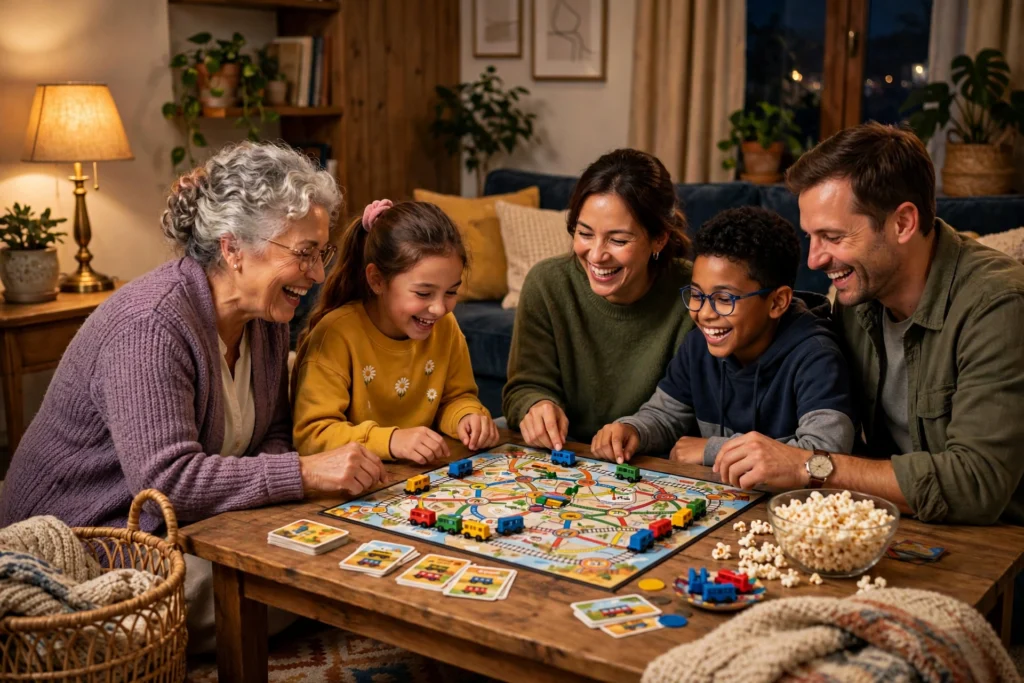
Rain is tapping the windows and the kids are already bouncing off the walls. Here are 50 indoor activities for kids that actually hold attention — no-prep games, creative projects, high-energy play, learning activities, classic family games, and calm wind-down ideas. Every activity lists ages, time, cost, and materials, so pick one and start.
What are fun indoor activities for kids? The best indoor activities for kids mix quick wins and longer projects: blanket forts, scavenger hunts, freeze dance, and Simon Says for instant fun; crafts and science experiments for focused afternoons; obstacle courses and balloon games to burn energy; and puzzles and audiobooks for quiet time. Choose based on your kids’ ages, your energy level, and how much mess you can handle today.

Quick Picks
- Best overall: Blanket fort — free, fits almost every age, and becomes base camp for reading, snacks, or pretend play.
- Best no-prep: Indoor scavenger hunt — zero materials, ready in one minute, endlessly repeatable with new clue lists.
- Best for burning energy: Indoor obstacle course — cushions, chairs, and tape turn any living room into an action course that tires kids out.
- Best creative: Salt-and-glue painting — cheap materials, magical-looking results, manageable mess.
- Best quiet/calming: Sensory bin — rice, scoops, and small toys buy real quiet time with toddlers and preschoolers.
- Best for toddlers: Treasure basket — baby-safe household items in a basket for open-ended exploring.
- Best for older kids: Design-your-own board game — planning, building, and playtesting can fill a whole day.
Activity Comparison Table
| Activity | Best Age | Cost | Indoor/Outdoor | Time Needed | Setup Level |
|---|---|---|---|---|---|
| Blanket fort | 3–10 | Free | Indoor | 30–60 min | Easy |
| Indoor scavenger hunt | 4+ | Free | Indoor | 20–40 min | Easy |
| Freeze dance | 3+ | Free | Indoor | 15–30 min | Easy |
| Salt-and-glue painting | 5–12 | $ | Indoor | 45–60 min | Moderate |
| Indoor obstacle course | 4–12 | Free | Indoor | 30–60 min | Moderate |
| Baking soda volcano | 4–12 | $ | Indoor | 20–30 min | Easy |
| Cardboard city | 4–10 | Free | Indoor | 1–2 hours | Moderate |
| Balloon keep-it-up | 3+ | $ | Indoor | 15–30 min | Easy |
| Jigsaw puzzles | 4+ | $ | Indoor | 30 min+ | Easy |
| Sensory bin | 2–5 | $ | Indoor | 20–40 min | Easy |
| Indoor bowling | 4+ | Free | Indoor | 20–40 min | Easy |
| Treasure basket | 1–3 | Free | Indoor | 20–30 min | Easy |
No-Prep Instant Indoor Fun
No buying, no setup — start any of these in under two minutes.
1. Blanket Fort
Drape blankets over chairs or the couch, pile pillows inside, and let kids claim their hideout — a reading den, snack spot, or headquarters. Ages 3–10 · 30–60 min · Free · blankets, pillows, chairs. Small-apartment tip: build it over a coffee table.
2. Indoor Scavenger Hunt
List household items to find — something round, something blue, something starting with B. Searching feels like an adventure even in a familiar space. Ages 4–12 · 20–40 min · Free · paper, pencil. Make it a challenge: older kids race the clock or solve riddle clues instead of plain lists.
3. Hide and Seek (Flashlight Twist)
The seeker hunts with a flashlight in dim rooms. Kids think harder about hiding spots, and the dark-house setting makes a familiar game feel brand new. Ages 4–10 · 20–45 min · Free · flashlight. Safety note: agree on off-limits areas (stairs, anywhere with breakables) before the first round.
4. Freeze Dance
Dance wildly, freeze when the music stops — last to freeze does a silly forfeit. Burns energy fast; rules take ten seconds. Ages 3+ · 15–30 min · Free · music.
5. Simon Says
One player calls out actions; everyone follows only commands starting with “Simon says.” Zero prep, endlessly repeatable, and it secretly practices listening skills. Ages 4–8 · 10–20 min · Free · none. Make it easier: skip the trick commands at first for little kids.
6. Would You Rather
Take turns posing silly dilemmas: “Would you rather fly or be invisible?” No winner, no setup, and answers get funnier as kids get older. Ages 5+ · 15–30 min · Free · none.
7. Shadow Puppets
Aim a flashlight at a blank wall and make animal shapes with your hands. Kids get hooked trying to make a convincing rabbit or bird. Ages 4–10 · 15–30 min · Free · flashlight, blank wall. Make it more fun: stage a five-minute “shadow show” with stuffed animals as the audience.
8. Twenty Questions
One player thinks of an object; everyone else asks yes-or-no questions to guess it within twenty tries. It teaches reasoning with zero equipment. Ages 6+ · 15–30 min · Free · none. Make it easier: announce the category (animal, food, object) up front.
9. Dress-Up Parade
Kids raid closets and dress-up bins, then stage a fashion show with music. Old costumes, grown-up shoes, and scarves become raw material for characters. Ages 3–8 · 30–60 min · Free · clothes, accessories.
Creative Indoor Activities
For slow afternoons: cheap, mostly-recycled materials, and a finished product kids are proud of.
10. Salt-and-Glue Painting
Draw with white glue on thick paper, sprinkle salt over the wet lines, shake off the excess, then touch watercolor paint to the salted glue and watch color travel. Ages 5–12 · 45–60 min · $ · white glue, salt, watercolors, thick paper. Safety note: use non-toxic glue, salt over a tray, and keep salt away from toddlers.
11. Sticker Storybooks
Hand each kid a blank notebook and sticker sheets, and ask them to build a story using stickers as characters, drawing or writing alongside. Storytelling, drawing, and decision-making with zero skill barrier. Ages 4–8 · 30–60 min · $ · notebook, stickers, crayons. Educational twist: older kids write full sentences for each scene.
12. Washable Window Art
Let kids paint windows with washable tempera paint and sponges. Painting glass feels wonderfully forbidden, and it wipes off with a damp cloth. Ages 3–10 · 30–60 min · $ · washable tempera paint, sponges.
13. Cardboard City
Build a mini city, castle, or zoo from boxes, markers, and tape. The planning is half the fun, and the finished city becomes a playset for toy cars. Ages 4–10 · 1–2 hours · Free · cardboard boxes, tape, markers.
14. Homemade Playdough
Mix 1 cup flour, 1/2 cup salt, 1/2 cup water, and food coloring for soft, moldable dough. Kids love that they made it themselves — making it is as much fun as playing with it. Ages 3–8 · 20 min to make, 30+ to play · $ · flour, salt, water, food coloring. Budget tip: pennies per batch — make multiple colors and store extras in sealed bags.
15. Sock Puppets and Puppet Show
Decorate old socks or paper bags, then stage a show behind the couch. Inventing voices and stories stretches imagination like few toys can. Ages 4–10 · 45–90 min · Free–$ · old socks or paper bags, craft supplies. Make it more fun: let kids “sell tickets” and perform a full show with an intermission.
16. Origami
Start with simple folds — paper boats, fortune tellers, jumping frogs — using any square paper. It teaches patience, and a finished figure brings real pride. Ages 6–12 · 20–45 min · Free–$ · square paper. Make it easier: fold the first one together.
17. Family Comic Book
Each person draws one panel of a story, passing the paper along so it grows unpredictably. The results are always hilarious, and reluctant writers enjoy storytelling when drawing leads. Ages 6–12 · 30–60 min · Free · paper, markers. Make it a challenge: older kids plan a real story arc across six panels.
18. Junk-Model Robots
Hand kids clean recycling — boxes, tubes, bottle caps, foil — plus tape, and challenge them to build robots or vehicles. Ages 5–12 · 45–90 min · Free · clean recyclables, tape, glue. Safety note: check pieces for sharp edges; keep small caps away from kids under 3.
Active Indoor Play
Rainy days trap energy indoors. These activities burn it off safely inside the house. The American Academy of Pediatrics recommends at least 60 minutes of physical activity a day for children — these ideas help you hit that target even when it’s pouring.
19. Indoor Obstacle Course
Use cushions as stepping stones, chairs to crawl under, pillows to jump over, baskets to weave around. Time each run — racing the clock keeps kids going far longer. Ages 4–12 · 30–60 min · Free · cushions, chairs, tape, pillows. Safety note: clear breakables and keep landings on carpet or rugs.
20. Balloon Keep-It-Up
Keep a balloon from touching the floor, each player tapping it with a set body part. Balloons move slowly enough for young kids to stay in the game. Ages 3+ · 15–30 min · $ · balloons. Safety note: balloons are a choking hazard — supervise kids under 3 and discard popped pieces immediately.
21. Hallway Bowling
Line up empty plastic bottles at the end of a hallway and roll a soft ball to knock them down. Keep score across rounds or play in teams — scoring adds structure that holds attention. Ages 4+ · 20–40 min · Free · plastic bottles, soft ball.
22. Animal Yoga
Take turns inventing animal poses — crouching tiger, flying bird, curled-up cat — with matching sounds. It stretches kids out and calms rowdy energy. Ages 3–8 · 15–25 min · Free · none.
23. Follow the Leader
Take turns inventing movements everyone copies — hopping on one foot, spinning, marching like a soldier, crawling like a bear. Exercise disguised as silliness, and it works for wide age gaps. Ages 3–8 · 15–30 min · Free · none. Best for: apartments — all movement stays in one room.
24. Pillow Mountain Relay
Pile couch pillows into a “mountain” and race to carry soft toys over it and back. Gloriously physical — and kids repeat it endlessly. Ages 4–10 · 20–35 min · Free · pillows, small soft items. Make it a challenge: carry the item on your head or with one hand behind your back.
25. Masking-Tape Floor Roads
Lay painter’s tape roads, parking lots, and highways for toy cars, with traffic rules you invent together. Routinely holds attention for an hour or more. Ages 3–8 · 30–90 min · $ · painter’s tape, toy cars.
26. Paper Airplane Races
Fold paper airplanes, then hold distance and accuracy contests down the hallway — the folding is the calm buildup, the racing the payoff. Ages 6–12 · 30–60 min · Free · paper. Educational twist: change one fold at a time and record which design flies farthest — the scientific method in disguise.
Educational Indoor Activities
Kids are a captive, curious audience on rainy days. These teach real concepts without feeling like school.
27. Kitchen Science: Baking Soda Volcano
Build a volcano from a mound of baking soda, then pour in vinegar with dish soap and food coloring for an eruption. The fizz never fails to delight — and opens the door to “why did that happen?” Ages 4–12 · 20–30 min · $ · baking soda, vinegar, dish soap, food coloring. Low-mess tip: run the eruption in a baking tray or the sink.
28. Sink-or-Float Discovery
Fill a tub with water and have kids guess whether household objects will sink or float before testing each one. Toddlers love the splashing; older kids start spotting patterns. Ages 3–8 · 20–30 min · Free · bowl of water, household objects. Educational twist: sort results into two columns and count — early data skills.
29. Reading Challenge
Set a family goal — 100 pages, five picture books, one chapter book — with a small reward at the finish. Reluctant readers often just need a target and a little competition. Ages 5–12 · 30–60 min per session · Free · books or a library app.
30. Drawing Tutorials
Follow free step-by-step drawing tutorials online. Kids who say they “can’t draw” surprise themselves when drawings break into simple shapes. Ages 5–12 · 20–45 min · Free · paper, pencils or markers.
31. Design Your Own Board Game
Kids invent rules, draw the board, make pieces, then the family plays. Expect “revised editions” — playtesting teaches what works. Ages 7–12 · 1–3 hours · Free · cardboard, markers, dice, small toys as pieces. Best for: full-day rain or snow weekends needing one big anchor activity.
32. Letter Hunt for Little Ones
Tape uppercase letters on the wall and hide matching lowercase letters around the room to find and pair up. Letter practice disguised as a treasure hunt. Ages 3–5 · 15–25 min · $ · painter’s tape, marker or printed letters. Make it easier: start with five letters and add more as they master them.
33. Rain Gauge and Weather Journal
Place a clear container outside to collect rain, then measure and record the level each day with drawings of the sky. A real science project that fits the weather perfectly. Ages 5–10 · 10 min daily · Free · clear jar, ruler, notebook. Educational twist: after a week, graph the results and compare rainy vs. dry days.
34. Audiobook Listening Hour
Pick an audiobook, dim the lights, hand out coloring pages, and listen together for an hour. It feels like an event, and stories hold attention differently when voices do all the work. Ages 4–12 · 45–75 min · Free (library apps) · audiobook, coloring supplies optional.
Classic Indoor Games
Time-tested games that need almost no explanation and work for the whole family at once.
35. Board Game Afternoon
Each kid picks a game; play all of them. Rotating the chooser keeps everyone invested; mix short games with one longer strategy game. Ages 4+ · 1–2 hours · $ (once owned) · board games.
36. Card Games
Teach Go Fish, War, Slap Jack, or Crazy Eights — one deck holds dozens of games for every age. Cheap, portable, easy to learn but hard to master. Ages 5+ · 20–60 min · $ · deck of cards. Make it easier: remove face cards for younger kids so matching stays simple.
37. Jigsaw Puzzles
Work a puzzle together on the dining table. Genuinely absorbing for all ages at once — everyone finds their own corner of the picture. Ages 4+ · 30 min to several days · $ · jigsaw puzzle. Best for: multi-day bad-weather stretches — leave it out and return between other activities.
38. Charades
Act out movies, animals, or characters without speaking while everyone guesses. Shy kids warm up fast once they see parents being ridiculous. Ages 5+ · 20–40 min · Free · slips of paper with prompts. Make it easier: let little kids make animal sounds; only older players stay silent.
39. Pictionary
Draw clues while your team shouts guesses against the clock. Bad drawing is the whole point — the worse the sketch, the funnier the guessing. Ages 6+ · 20–40 min · Free · paper and markers or a small whiteboard.
40. Indoor Bingo
Make bingo cards with pictures or words (animals, colors, household objects) and call them out with beans as markers. Homemade cards match the game to any age or theme. Ages 4–8 · 20–30 min · Free · paper, markers, beans.
41. Memory Matching Game
Lay matching cards face down and take turns flipping pairs. Calm, quiet, genuinely good for concentration — and young kids often beat adults. Ages 3–8 · 15–25 min · Free–$ · matching cards (or index cards you decorate). Make it a challenge: add more pairs or require naming each card before flipping.
42. Storytelling Round-Robin
One person starts a story with a sentence; the next adds a sentence, around the circle. The story veers in absurd directions, everyone contributes, and nobody can lose. Ages 6+ · 20–30 min · Free · none.
Quiet and Calm Indoor Time
Every indoor day needs a gear-down phase. These calm activities recharge kids — and give parents a breather.
43. Sensory Bin
Fill a shallow bin with rice, beans, or kinetic sand; add scoops and small toys for digging and pouring. The repetitive motions soothe, and this buys the longest independent-play stretch for little ones. Ages 2–5 · 20–40 min · $ · bin, rice or beans, scoops. Safety note: skip small beans with kids under 3; set the bin on a sheet for easy cleanup.
44. Coloring Pages
Print free coloring pages or hand out a coloring book with fresh crayons. Focused coloring calms busy minds — many kids who resist “quiet time” will happily color for half an hour. Ages 3–10 · 20–45 min · $ · coloring pages, crayons.
45. At-Home Spa Day
Put on robes, do face masks, paint nails, give hand massages. It feels like a special event, and the pampering routine naturally slows everyone down. Ages 5–12 · 45–90 min · $ · face masks, nail polish, towels.
46. Bubble Bath Play
Turn a bath into an activity with bath crayons, foam letters, or washable tub finger paint. Kids play happily for ages — and cleanup is built in. Ages 2–8 · 20–40 min · $ · bath-safe toys or paints. Safety note: never leave young children unattended in the bath.
47. Cloud Dough
Mix 2 parts flour with 1 part baby oil (or coconut oil) for a soft dough that holds shapes like wet sand but stays dry to the touch. Endlessly squeezable and less crumbly than regular homemade playdough. Ages 3–7 · 30–45 min · $ · flour, baby oil or coconut oil.
48. Kids’ Journaling
Give each kid a notebook to draw or write about their day, dreams, or an invented story. Journaling gives big feelings a private outlet — and old entries are a delight months later. Ages 6–12 · 15–30 min · $ · notebook, pens.
49. Rainy-Day Window Watch
Set up cushions by the biggest window with a “spotter’s list” — birds, squirrels, passing cars, raindrop races down the glass. Watching the storm becomes the entertainment. Ages 3–10 · 20–40 min · Free · cushions, binoculars optional.
50. Indoor Picnic
Spread a blanket on the living room floor and eat “picnic style.” Eating somewhere unusual turns an ordinary meal into an occasion. Ages 2–10 · 30–45 min · Free · blanket, food you have.
Indoor Activities by Age
- Toddlers (1–3): Treasure baskets, sensory bins, bubble bath play, simple freeze dance, tape roads with chunky cars — 15–25 minute sessions, rotating often.
- Preschoolers (3–5): Blanket forts, dress-up parades, sock puppets, playdough, sink-or-float, picture-clue scavenger hunts. They follow two-step rules but need you alongside.
- School-age (6–9): Cardboard cities, kitchen science, timed obstacle courses, paper airplane tournaments, board-game design. Add a challenge or scoreboard and they’ll run with it.
- Tweens (10–12): Origami, comic books, weather journals, drawing tutorials, riddle-clue scavenger hunts. Let them lead — tweens stay engaged when they’re the expert.
Mixed ages? Let older kids help younger ones: big kids hide the scavenger hunt for little kids, or build one obstacle course with easy and hard lanes.
Want Screen-Free Indoor Ideas?
Many activities above already keep screens out — but for a full zero-screen day, try screen-free crafts, offline games, and family challenges built to replace the tablet. See screen-free activities for kids for the complete playbook.
Free Indoor Fun
Almost everything in the no-prep and classic games sections costs nothing — forts, scavenger hunts, card games, shadow puppets, charades. For more, see free things to do with kids.
Indoor Outings Near You
Sometimes the best indoor activity is leaving the house. These outing types work in almost any US town:
- Public libraries — story times and craft hours are free, and a fresh stack of books resets the week.
- Children’s museums — built for hands-on play; one visit can fill half a day.
- Indoor play spaces and trampoline parks — built for burning energy when your living room can’t take more.
- Bowling alleys and skating rinks — classic family outings with bumpers and skate aids for little kids.
- Community recreation centers — many offer open gym hours, indoor pools, and low-cost drop-in programs for families.
- Aquariums and indoor nature centers — calm, fascinating, and easy at a toddler’s pace.
Looking for Even More Ideas?
This list is all about staying inside — but great weekends mix indoor and outdoor time. Our pillar guide to things to do with kids covers outdoor adventures, seasonal events, and day trips, and our family activities collection has everyday inspiration.
How to Find Family Activities Near You
- Your library’s event calendar — most libraries post story times and kids’ clubs online, many free with no registration.
- City parks-and-recreation websites — look for open gym, indoor pool schedules, and drop-in programs.
- Community calendars — local parenting sites and city events pages list museum special days and seasonal events.
- Museum websites — check for free or discounted admission days before you go; many offer them monthly.
- National Park Service — nps.gov lists indoor visitor centers, museums, and ranger programs at parks across the country.
Search by activity type (“children’s museum,” “indoor playground”) rather than business names from old posts — hours change, so confirm details on the venue’s own site before heading out.
FAQ
What’s the best indoor activity for a rainy day with no preparation?
An indoor scavenger hunt — a scrap of paper for clues, ages 4 and up, 20 minutes a round. Blanket forts are a close second: blankets and chairs become a base for reading, snacks, or pretend play all day.
How do I keep kids entertained indoors all day?
Rotate through energy levels: start active (obstacle course, freeze dance), shift to a focused project (crafts, science experiment), break for lunch, then go calm (puzzles, reading, audiobooks). Three to four blocks with free play between them fill a rainy day.
What are good indoor activities for small apartments?
Pick small-footprint ideas: freeze dance in one corner, tape roads on a hallway floor, tabletop crafts, card games, puzzles, drawing tutorials, shadow puppets. Build the fort over a coffee table and skip running or throwing games.
How can I burn off kids’ energy indoors without breaking anything?
Move furniture from the action zone and use soft equipment: balloons instead of balls, pillows instead of climbing, tape instead of cones. Obstacle courses, balloon games, animal yoga, and dance parties burn serious energy with minimal collision risk — set ground rules up front.
What are the best low-mess indoor activities for kids?
Stick to dry or contained materials: coloring pages, sticker storybooks, card and board games, puzzles, playdough on a tray. For paint-level fun without the cleanup, try washable window art or salt-and-glue painting over a tray.
How do I entertain siblings of different ages at the same time?
Choose activities with built-in roles: older kids hide the scavenger hunt for younger kids; everyone runs the same obstacle course on easy or hard lanes; the family builds one cardboard city where big kids engineer and little kids decorate. Cooperative games bridge age gaps better than complex rules.
What can toddlers do indoors on a rainy day?
Toddlers need sensory input and movement in short bursts: treasure baskets, sensory bins, bubble bath play, simple freeze dance, tape roads for chunky cars. Keep each activity to 15–25 minutes, rotate often, and always supervise water play.
How do I make a rainy weekend feel special instead of just stuck inside?
Give the weekend a theme: a “camp-in” with forts and flashlight stories, a “science lab” weekend with three experiments, or a “film festival” with tickets and popcorn.
The Bottom Line
Being stuck inside doesn’t have to mean a lost day. With 50 indoor activities for kids covering every energy level, age, and mess tolerance, you’ve got a plan for rainstorms, snow days, and slow weekends. Bookmark this list and pick two or three ideas for today. For days you do get out, see things to do with kids — and when screens call, the screen-free activities playbook is ready.