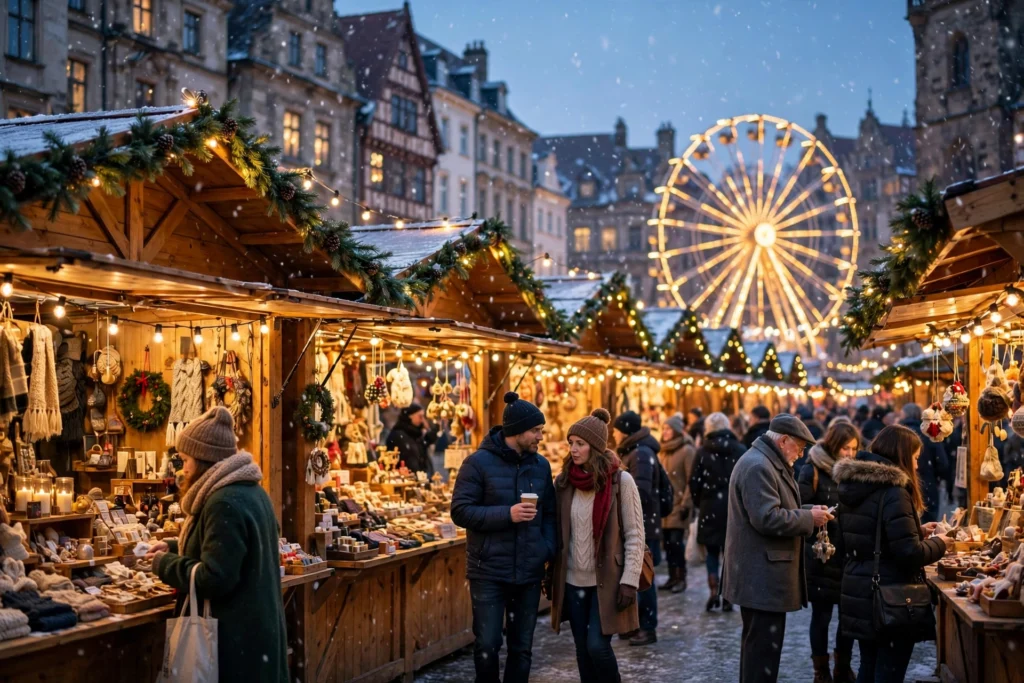
Every December, Europe transforms into the world’s most enchanting holiday destination. From medieval town squares strung with thousands of lights to riverside chalets serving steaming mulled wine, the best Christmas markets in Europe turn an ordinary winter trip into something genuinely magical. Whether you are planning a once-in-a-lifetime holiday journey or simply dreaming from your couch, this guide ranks the continent’s finest festive markets for 2026 — what makes each one special, what to eat, what to buy, and how to plan the perfect visit.
European Christmas markets are not just shopping stalls. They are centuries-old traditions where entire cities slow down for Advent, where locals gather after work for a cup of glühwein, and where handcrafted ornaments, regional sweets, and candlelit concerts create an atmosphere no mall or online store can reproduce. Germany alone hosts hundreds of markets, France crowns one city the official “Capital of Christmas,” and Austria’s imperial cities add classical music to the mix. Choosing among them can feel overwhelming, so we did the legwork for you.
How We Ranked the Best Christmas Markets in Europe
To keep this list honest and useful, we judged each market on six criteria: history and authenticity, the quality and originality of the stalls, the setting and atmosphere, signature food and drink, family-friendliness, and overall value for international visitors. We weighted authenticity heavily — markets dominated by mass-produced trinkets scored lower than those with genuine artisans, regional specialties, and traditions locals actually participate in. We also factored in how easy each market is to reach from major airports and how well it works for first-time European travelers.
One important note before we begin: exact 2026 dates for most European Christmas markets are not yet announced as of this writing. Traditionally, the majority open in the last week of November and run through December 23 or 24, with a few (like London’s Winter Wonderland and Brussels’ Winter Wonders) continuing into early January. Always confirm dates on the official city or market website before booking flights and hotels.
The 12 Best Christmas Markets in Europe for 2026
Here is our ranked rundown of the twelve European Christmas markets most worth your time, money, and jet lag in 2026.
1. Strasbourg, France — The Capital of Christmas
Strasbourg does not just host a Christmas market; it hosts the Christmas market that arguably started them all in France. The Christkindelsmärik was first authorized in 1570, making it the oldest documented Christmas market in France and one of the oldest in Europe. In 1992 the city officially branded itself the Capitale de Noël (Capital of Christmas), and it has earned the title: more than 300 wooden chalets spread across eight themed market sites on the Grande Île, the historic island center that is itself a UNESCO World Heritage site.
What makes Strasbourg unbeatable is scale combined with soul. The original market still occupies Place Broglie, where you pass under a famous illuminated arch to browse Alsatian handicrafts, wooden toys, and gingerbread. Place Kléber hosts the Grand Sapin — a towering great Christmas tree that anchors the whole city — while the cathedral quarter, Petite France’s canalside chalets, and the OFF market for independent creators each offer a different mood. This is not one market; it is a citywide festival.
Don’t miss: bredele (Alsatian Christmas cookies), mannele (brioche figures for St. Nicholas Day), tarte flambée, and vin chaud blanc made with white wine. The Galeries Lafayette window displays opposite Place Broglie are elaborately decorated every year and free to enjoy.
Typical season: late November through December 24. For a full deep-dive on every square and what to buy, see our Strasbourg Christmas Market Capitale de Noël guide.
2. Nuremberg, Germany — The Legendary Christkindlesmarkt
If there is a single market that defines the German Christmas market tradition worldwide, it is Nuremberg’s Christkindlesmarkt. Held on the Hauptmarkt beneath the Gothic Frauenkirche, it draws around two million visitors each year. The oldest written record of the market dates to 1628, though historians suspect it stretches back to at least 1530, and its opening ceremony is pure theater: on the Friday before the first Advent, the square goes dark, a spotlight hits the balcony of the Frauenkirche, and the Christkind — a young woman in a golden robe and crown — delivers the famous prologue inviting everyone to the market.
Nuremberg is fiercely protective of its authenticity. Only traditional goods are permitted in the main market’s roughly 180 wooden stalls — no plastic trinkets — which is why the shopping here feels genuinely special. The specialties are the stuff of legend: Nürnberger Lebkuchen (the city’s spiced gingerbread, baked here since the 14th century) and “drei im Weggla,” three tiny Nuremberg sausages in a bun with mustard.
Don’t miss: the Children’s Christmas Market on Hans-Sachs-Platz, the Sister Cities market with goods from Nuremberg’s twin towns, and a bag of original Elisenlebkuchen to take home. Our Germany Christmas markets guide compares Nuremberg with Dresden and Cologne in detail.
3. Vienna, Austria — Imperial Elegance Meets Christmas Magic
Vienna does Christmas the way it does everything: with imperial grandeur and impeccable taste. The Viennese Christmas Market in front of the neo-Gothic Rathaus (city hall) is the city’s flagship, with around 150 stalls set in a floodlit park, plus an ice-skating trail that winds through the trees. But Vienna’s real strength is its portfolio of markets: Schönbrunn Palace hosts one of Europe’s most beautiful markets in the palace courtyard, Belvedere offers an elegant baroque backdrop, Spittelberg charms with its Biedermeier lanes, and Karlsplatz focuses on Austrian handicrafts.
The Viennese market culture is distinctively relaxed. Locals treat the markets as an extended Advent social season — meeting friends for punsch (the Austrian take on mulled wine, often made with rum or amaretto) after work, nibbling on roasted chestnuts and Vanillekipferl crescent cookies. Classical concerts in the city’s churches and the famous New Year’s season add a cultural layer no other market city quite matches.
Don’t miss: the Rathausplatz ice skating, a Bratwurst and Maroni (roasted chestnut) combo, and the Schönbrunn market at dusk when the palace glows. Read our full Vienna Christmas Markets Guide for market-by-market details.
4. Dresden, Germany — The World’s Oldest Christmas Market
Dresden’s Striezelmarkt holds the title that matters most in Christmas market history: first held for a single day in 1434, it is the oldest documented Christmas market in Germany and among the oldest in the world. The name comes from “Striezel,” the old Saxon word for the fruitcake now known as Dresdner Christstollen — the buttery, powdered-sugar loaf the entire market is named after, still baked to a protected recipe and stamped with a special seal.
Today the Striezelmarkt fills the Altmarkt with more than 200 stalls and draws over 2.5 million visitors a year. Its landmarks are genuinely record-breaking: the world’s largest Erzgebirge step pyramid (over 14.6 meters tall, in the Guinness Book of Records), the largest walk-in Schwibbogen candle arch, and the annual Stollen Festival, where a giant Christstollen weighing several tons is paraded through the city and cut for visitors. The surrounding Ore Mountains folk-art tradition — nutcrackers, smoking men, and hand-carved pyramids — makes Dresden the best market in Europe for traditional wooden crafts.
Don’t miss: authentic Dresdner Christstollen from a licensed bakery, Pulsnitzer Pfefferkuchen (the region’s gingerbread), and the Stollen Festival if your dates align. Dresden pairs perfectly with Nuremberg and Cologne — see our three-city Germany guide for a rail itinerary.
5. Cologne, Germany — Seven Markets Along the Rhine
Cologne takes a different approach: instead of one giant market, it spreads seven themed markets across the city center, each with its own personality. The showpiece sits beneath the twin spires of the Cologne Cathedral, a UNESCO World Heritage site, with around 160 stalls arranged around a towering Christmas tree. A short walk away you’ll find the Harbour Market at the Chocolate Museum with a nautical theme, the angels’ market on Neumarkt, the gnome-themed market, and the medieval-style market — each distinct enough that market-hopping becomes the activity.
Cologne is also one of the most welcoming markets for international visitors. The city’s cathedral quarter is compact and walkable, the Rhine promenade adds a romantic evening stroll, and the market culture is famously gemütlich. Kölsch beer flows alongside glühwein, and the local specialty to try is the kölner Printen-influenced gingerbread and hearty Rhineland fare like Reibekuchen (potato pancakes) with apple sauce.
Don’t miss: the cathedral market after dark, the harbor market’s maritime stalls, and the view of the illuminated Hohenzollern Bridge. Cologne typically closes its markets on December 23, so plan accordingly.
6. Prague, Czech Republic — A Fairytale Old Town Square
Few Christmas market settings on earth rival Prague’s Old Town Square: a massive decorated tree glowing in front of the Gothic Týn Church, the medieval Astronomical Clock chiming nearby, and wooden huts selling Czech crafts beneath centuries of spires. The markets on Old Town Square and Wenceslas Square are the city’s centerpieces, running daily with Czech carols, traditional foods, and an undeniably romantic atmosphere — especially after a dusting of snow.
Prague’s markets are also among Europe’s best values. Trdelník (the sweet chimney cake, whatever its contested origins), klobása sausages, svařák (Czech mulled wine), and medovina (hot honey wine) cost a fraction of what you’d pay in Vienna or Zurich. The Czech craft tradition shows in hand-blown glass ornaments, wooden toys, and garnet jewelry — and the city’s beer halls offer a warm refuge when the evening chill sets in.
Don’t miss: the tree-lighting ceremony on Old Town Square, a cup of medovina, and the smaller markets at Prague Castle and Náměstí Míru for a more local feel. Our Prague Christmas markets guide covers both main squares in depth.
7. Budapest, Hungary — Thermal Baths and Market Lights
Budapest offers a Christmas market experience with a twist no other city can match: after browsing the stalls, you can soak in a steaming outdoor thermal bath while snow falls around you. The city’s two headline markets are the long-running fair on Vörösmarty Square — with its famous giant advent calendar projected on the Gerbeaud House facade — and the market in front of St. Stephen’s Basilica, where evening light shows dance across the basilica’s facade above an ice-skating rink.
Hungarian market food is hearty and distinctive: kürtőskalács (chimney cake) roasted over coals, lángos (fried dough with sour cream and cheese), goulash served in bread bowls, and forralt bor (Hungarian mulled wine). Prices remain refreshingly reasonable compared with Western Europe, and the city’s ruin bars and thermal baths (Széchenyi is the classic) make Budapest an outstanding value city break.
Don’t miss: the Basilica light show after dark, chimney cake fresh off the spit, and an evening session at the Széchenyi baths. See our Budapest Christmas markets guide for the full Vörösmarty Square walkthrough.
8. Brussels, Belgium — Winter Wonders on the Grand Place
Brussels’ Winter Wonders (Plaisirs d’Hiver) is one of Europe’s great free spectacles: some 200 chalets stretch from the Grand Place — often called the most beautiful square in Europe — along the Bourse and Place Sainte-Catherine, with a sound-and-light show projected onto the gilded guildhalls, a Ferris wheel, an ice rink, and a towering Christmas tree. It typically runs from late November into the first days of January, making it one of the longest-running markets on this list.
Belgian market food is a strong argument for visiting on its own: gaufres (waffles) in every variety, frites with a dozen sauces, moules, cuberdons, and Belgian beer alongside vin chaud. The Grand Place light show, usually staged several evenings a week, turns the already-stunning square into something unforgettable. And Bruges — barely an hour away by train — offers a second, more intimate market in one of Europe’s best-preserved medieval cities, making this an easy two-for-one trip. Our Brussels and Bruges guide covers both cities.
Don’t miss: the Grand Place sound-and-light show, a Liège waffle with speculoos spread, and the Ferris wheel at Place Sainte-Catherine for the skyline view.
9. Zurich, Switzerland — The Singing Christmas Tree
Zurich brings Swiss precision to the Christmas market format, with several distinct markets across the city. The headline act is the Singing Christmas Tree at Werdmühleplatz: a tiered, tree-shaped stage filled with choirs that have performed daily carol concerts since 1998, surrounded by a compact market specializing in local produce and a cozy fondue chalet. The Christkindlimarkt inside Zurich’s main train station claims the title of Europe’s largest indoor Christmas market, anchored by a 15-meter tree decorated with Swarovski crystals.
Beyond the markets, Zurich at Christmas is a feast of light: around 12,000 “Lucy” crystals glow above the Bahnhofstrasse shopping street, and the Lichterschwimmen ceremony sends hundreds of floating lanterns down the Limmat River. Swiss prices are famously steep — budget accordingly — but the quality of the chocolate, cheese, and craftsmanship is unmatched. Our Zurich and Basel guide has the full two-city breakdown.
Don’t miss: a choir performance at the Singing Christmas Tree (typically early evening), raclette from a market stall, and the Bahnhofstrasse lights after dark.
10. Valkenburg, Netherlands — Christmas Underground
Valkenburg hosts the most unusual Christmas market in Europe: its main markets are held underground, inside historic marlstone caves quarried since Roman times. The town rebrands itself “Kerststad” (Christmas Town) for nearly two months, with markets in the Municipal Cave (Gemeentegrot) and the Velvet Cave (Fluweelengrot), a Christmas parade through the illuminated town center, and related attractions like the MergelRijk cave experience. The Gemeentegrot market is widely described as the oldest, largest, and most visited underground Christmas market in Europe.
The cave setting is the whole point — thousands of lights strung through ancient tunnels, stalls selling decorations and gifts in constant cool air — and timed-entry tickets are typically required on busy days, so book ahead. Pair it with nearby Maastricht, a lovely Dutch city with its own above-ground market, for a perfect long weekend. See our Valkenburg and Maastricht guide for tickets, caves, and planning tips.
Don’t miss: the Velvet Cave’s wall paintings and hidden chapel, the Wednesday/Saturday evening parade, and oliebollen (Dutch New Year doughnuts) from a street stall.
11. London, United Kingdom — Winter Wonderland and Beyond
London’s Christmas market scene is anchored by Winter Wonderland in Hyde Park — a sprawling festive theme park with markets, rides, ice skating, circus shows, and Bavarian-style beer halls, typically running from late November into early January. But the capital’s real charm is its constellation of smaller markets: the Southbank Centre Winter Market along the Thames with its wooden chalets and global street food, Greenwich’s arts-and-crafts market in a World Heritage setting, Leicester Square’s film-themed fair, and the gourmet stalls of Borough Market dressed for the season.
London does spectacle better than anyone, though you’ll pay for it — Winter Wonderland entry to the grounds is free, but headline attractions are ticketed and book out early. Mulled wine and mince pies are the order of the day, and the city’s Christmas lights (Oxford Street, Regent Street, Covent Garden) are a free attraction in their own right. Our London Christmas markets guide maps the whole festive circuit.
Don’t miss: the Southbank market at sunset over the Thames, ice skating at Somerset House, and the Covent Garden lights.
12. Tallinn, Estonia — The Medieval Dark Horse
Tallinn’s Christmas market on the Town Hall Square is the list’s best-kept secret — and, by local tradition, the site of one of Europe’s very first public Christmas trees, erected in 1441. The setting is pure medieval: the Gothic town hall, merchant houses, and cobbled square look made for December, and the market leans hard into Estonian craft — woolens, juniper-wood kitchenware, handmade candles — with a stage program of folk choirs and dancers.
Estonian market food is hearty northern fare: black pudding, sauerkraut, roasted pork, gingerbread, and hõõgvein (Estonian mulled wine) or the local Vana Tallinn liqueur. Tallinn is also superb value and pairs beautifully with a Helsinki ferry hop or a Riga extension. It closes the list because it’s smaller than the giants above — but for atmosphere per square meter, few markets compete.
Don’t miss: the Town Hall Square tree, Estonian gingerbread (piparkoogid), and a warming glass of hõõgvein while snow falls on the medieval rooftops.
European Christmas Markets at a Glance: Comparison Table
| Market | Typical Season | Signature Experience | Must-Try Food | Budget Level |
|---|---|---|---|---|
| Strasbourg | Late Nov – Dec 24 | 8 themed markets across a UNESCO island | Bredele, tarte flambée, vin chaud | $$ |
| Nuremberg | Late Nov – Dec 24 | Christkind opening ceremony | Lebkuchen, drei im Weggla | $$ |
| Vienna | Mid Nov – Dec 26 | Rathausplatz + palace markets | Punsch, Vanillekipferl, Maroni | $$$ |
| Dresden | Late Nov – Dec 24 | Oldest market (1434), giant pyramid | Dresdner Stollen, Pfefferkuchen | $$ |
| Cologne | Late Nov – Dec 23 | 7 themed markets, cathedral backdrop | Reibekuchen, glühwein | $$ |
| Prague | Late Nov – early Jan | Old Town Square fairytale setting | Trdelník, svařák, medovina | $ |
| Budapest | Late Nov – early Jan | Basilica light show + thermal baths | Kürtőskalács, lángos, forralt bor | $ |
| Brussels | Late Nov – early Jan | Grand Place light show | Waffles, frites, Belgian beer | $$ |
| Zurich | Late Nov – Dec 24 | Singing Christmas Tree choirs | Raclette, fondue, Swiss chocolate | $$$$ |
| Valkenburg | Mid Nov – early Jan | Underground cave markets | Oliebollen, Dutch treats | $$ |
| London | Late Nov – early Jan | Winter Wonderland spectacle | Mince pies, mulled wine | $$$ |
| Tallinn | Late Nov – early Jan | Medieval square, 1441 tree tradition | Piparkoogid, hõõgvein | $ |
Typical seasons are based on historical patterns; always verify 2026 dates on official sites before booking.
What to Eat and Drink at Europe’s Christmas Markets
Half the joy of a Christmas market is grazing, and each country brings its own edible traditions. Here is a field guide to the essentials:
- Glühwein / vin chaud / svařák / forralt bor: mulled wine by many names, served in collectible mugs (you pay a small deposit, refunded when you return the cup — or keep the mug as a souvenir, which most visitors do).
- Lebkuchen & gingerbread: Nuremberg’s Elisenlebkuchen, Dresden’s Pulsnitzer Pfefferkuchen, Tallinn’s piparkoogid, and Strasbourg’s bredele each deserve their own tasting.
- Stollen: Dresden’s Christstollen is the original and still the benchmark; buy from a licensed Dresdner Stollen bakery for the real thing.
- Savory staples: Nuremberg’s drei im Weggla sausages, Cologne’s Reibekuchen potato pancakes, Budapest’s lángos and chimney cake, Brussels’ frites and waffles, Prague’s klobása.
- Swiss specialties: raclette scraped tableside and cheese fondue in a wooden chalet at Zurich’s markets are worth the premium prices.
- Sweet finishes: roasted chestnuts (Maroni) in Vienna, trdelník in Prague, oliebollen in the Netherlands, and mince pies in London.
If you are hosting your own festive feast back home, our Christmas dinner ideas and Christmas decoration ideas will help you bring the market magic indoors.
How to Plan Your European Christmas Market Trip
When to go
The sweet spot is the first two weeks of December: all markets are open, the Advent atmosphere is at its peak, and crowds are thinner than the final pre-Christmas weekend. Weekday evenings are magical and far less crowded than Saturdays. Note that most German markets close on December 24 (many by early afternoon), so do not plan market visits for Christmas Day itself — though markets in Prague, Budapest, Brussels, and London often run into early January.
Getting between markets
Europe’s rail network makes multi-market trips easy and scenic. Classic combinations: Strasbourg + Colmar (30 minutes by train), Nuremberg + Dresden (about 3 hours), Cologne + Düsseldorf, Vienna + Bratislava (under an hour), Brussels + Bruges (about an hour), and Zurich + Basel (about an hour). Booking trains a few weeks ahead usually cuts fares significantly.
Budgeting
Prague, Budapest, and Tallinn deliver the best value; Zurich and London are the priciest. A realistic daily budget for two (mid-range hotel, market grazing, one sit-down meal, local transport) runs roughly €150–200 in Prague or Budapest, €200–280 in Strasbourg, Vienna, or Cologne, and €300+ in Zurich or London. Market entry is free almost everywhere (Valkenburg’s caves and some Winter Wonderland attractions are the notable exceptions), so your spending goes to food, drink, and gifts.
Where to stay
Book early — hotels near the main squares sell out months ahead for December weekends. Staying within walking distance of the old town is worth a premium: you’ll be able to pop back to the hotel to drop off purchases and warm up. Apartment rentals work well for groups and families who want kitchen access for market leftovers.
Tips for First-Time Christmas Market Visitors
- Bring cash and small bills. Many stalls are cash-only, especially at smaller markets.
- Dress warmer than you think. You’ll be standing outside for hours; thermal layers, waterproof boots, gloves, and a hat are non-negotiable.
- Keep the mug. The Pfand (deposit) system means your first glühwein costs a euro or two extra — returning the cup gets it back, but the annual collector mugs make great souvenirs.
- Go hungry, pace yourself. Share portions so you can sample more stalls.
- Shop the craft stalls early in the trip. Handmade ornaments and gifts sell out of the best pieces, and you’ll avoid carrying fragile items all day.
- Check local customs. In Germany, markets are quieter on Sundays mornings and some stalls close for church hours; in France, lunch hours still matter even at markets.
- Traveling with kids? Our 75 best Christmas activities for families, kids, and couples has ideas for keeping little ones happy between markets.
Frequently Asked Questions
What is the best Christmas market in Europe?
There is no single winner — it depends on what you value. For history and scale, Strasbourg (1570) and Dresden (1434) lead. For romance, Prague’s Old Town Square is unmatched. For food, Brussels and Budapest shine. For a unique experience, Valkenburg’s underground cave markets are one of a kind. Our top overall pick for first-time visitors is Strasbourg, for its combination of history, variety, and sheer festive immersion.
When do European Christmas markets open in 2026?
Most European Christmas markets traditionally open in the last week of November and run through December 23 or 24. Markets in Prague, Budapest, Brussels, London, and Valkenburg often continue into early January. Exact 2026 dates are typically announced in autumn — confirm on each city’s official tourism website before booking travel.
Which European Christmas market is the oldest?
Dresden’s Striezelmarkt, first held in 1434, is the oldest documented Christmas market in Germany and among the oldest in the world. Strasbourg’s Christkindelsmärik (1570) is the oldest in France, and Nuremberg’s market has written records dating to 1628. Tallinn claims one of Europe’s first public Christmas trees, erected in 1441.
Are European Christmas markets free to enter?
Almost all of them, yes — strolling the stalls costs nothing. Exceptions include Valkenburg’s cave markets (timed-entry tickets) and ticketed headline attractions inside London’s Winter Wonderland (the grounds themselves are free). You’ll spend money on food, mulled wine, and gifts, of course.
What should I buy at a European Christmas market?
Look for items with genuine local roots: hand-blown glass ornaments in Prague, Ore Mountains woodcraft (nutcrackers, pyramids, smoking men) in Dresden, bredele cookie tins in Strasbourg, Lebkuchen in Nuremberg, and lace or ceramics in Bruges. Avoid generic stalls selling identical mass-produced goods you could find anywhere — the craft markets (like Vienna’s Karlsplatz or Strasbourg’s OFF market) are the best hunting grounds.
Can I visit multiple Christmas markets in one trip?
Absolutely — it’s one of the best ways to do it. Europe’s trains make pairings easy: Strasbourg + Colmar, Nuremberg + Dresden, Cologne + Aachen, Vienna + Bratislava, Brussels + Bruges, Zurich + Basel, and Budapest + Vienna are all classic combinations. Allow at least one full evening per market; they are best after dark.
Start Planning Your 2026 Christmas Market Adventure
The best Christmas markets in Europe share one thing: they turn the darkest month of the year into the brightest. Whether you choose the centuries-old traditions of Strasbourg, Dresden, and Nuremberg, the imperial elegance of Vienna, the fairytale squares of Prague and Tallinn, or the underground magic of Valkenburg, you will come home with more than souvenirs — you’ll come home with the feeling that Christmas, done properly, is a place you can visit. If you’re weighing a European trip against staying stateside, compare with our guide to the best Christmas markets in the USA, or browse our best places to spend Christmas for more holiday inspiration. Frohe Weihnachten, Joyeux Noël, Veselé Vánoce — see you at the markets.