Budapest at Christmas offers something no other European market city can: after browsing the stalls, you can sink into a steaming outdoor thermal bath while snow falls around you. The Budapest Christmas markets — led by the historic fair on Vörösmarty Square and the spectacular market before St. Stephen’s Basilica — pair Hungarian comfort food, dazzling light shows, and unbeatable value. This guide covers both headline markets in depth, the essential Hungarian foods, a perfect 2-day itinerary, and practical planning for 2026.
Hungary’s capital has quietly become one of Europe’s smartest Christmas market destinations. The markets are genuinely good — Vörösmarty Square’s fair is among the continent’s oldest, and the Basilica market’s evening light show is world-class — but the supporting cast is what seals it: thermal baths, ruin bars, a stunning Danube panorama, and prices roughly half of Vienna’s. For travelers who want the full Central European Christmas experience without the premium price tag, Budapest is the answer.
Vörösmarty Square: Budapest’s Historic Christmas Fair
The grand old market of Pest
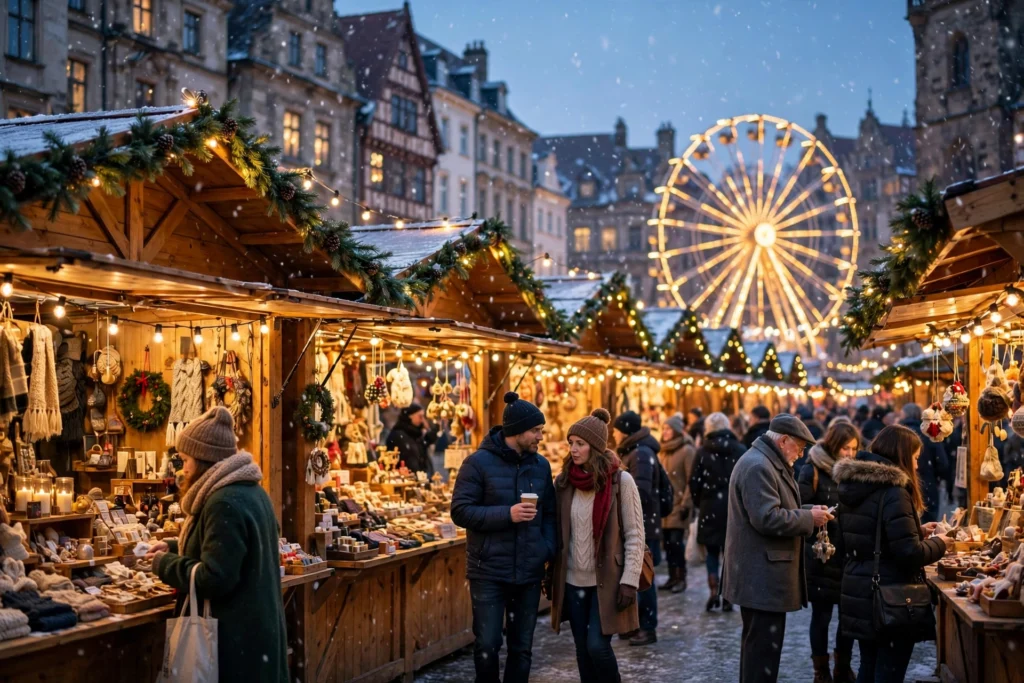
The Vörösmarty Classic Xmas fair on Vörösmarty Square (Vörösmarty tér) is Budapest’s oldest and most traditional Christmas market, held at the end of the famous Váci utca shopping street in the heart of Pest. For weeks each winter, the elegant square fills with wooden stalls selling Hungarian crafts, folk art, and comfort food, centered on a towering Christmas tree.
The square’s signature spectacle is the giant advent calendar projected onto the facade of the historic Gerbeaud House — the legendary 19th-century café that anchors the square. Each evening, a new “window” of the calendar illuminates the building in a light show that draws crowds to the square’s center. It’s a uniquely Budapest moment: coffee-house grandeur meets Christmas magic, best enjoyed with a forralt bor (mulled wine) in hand.
The Vörösmarty market leans traditional: Hungarian artisans selling embroidery, ceramics, leather goods, and folk-art pieces, alongside food stalls serving the hearty classics. The atmosphere is bustling and joyful rather than hushed — this is a market for grazing, socializing, and soaking up the season.
What to eat at Vörösmarty Square
- Kürtőskalács: chimney cake roasted over coals and rolled in cinnamon sugar, walnut, or cocoa — get it fresh and hot.
- Lángos: deep-fried dough topped with sour cream, cheese, and garlic — gloriously indulgent market fuel.
- Gulyás: Hungarian goulash served in bread bowls at several stalls — the definitive winter warmer.
- Töltött káposzta: stuffed cabbage rolls, a Hungarian Christmas-table staple available at food stalls.
- Forralt bor: Hungarian mulled wine, often with a local twist of honey or fruit.
- Rétes: Hungarian strudel in apple, cherry, and poppy-seed varieties.
St. Stephen’s Basilica: The Light-Show Market
Budapest’s most spectacular evening
If Vörösmarty Square is Budapest’s traditional heart, the Advent Feast at St. Stephen’s Basilica (Szent István Bazilika) is its showstopper. Set on the square before Hungary’s greatest church, this market centers on a 3D light show projected onto the basilica’s facade every evening — a dazzling mapping display that turns the neoclassical front into a canvas of Christmas imagery. Beneath it: an ice-skating rink (free with skate rental nearby), a towering tree, and rows of high-quality craft and food stalls.
The Basilica market has a more curated, upscale feel than Vörösmarty — the crafts skew toward designer Hungarian goods, and the food stalls emphasize quality over quantity. The light show runs multiple times each evening (typically every half hour after dark), and the square fills for each performance. Arrive before sunset to browse the stalls, then claim a viewing spot as the sky darkens.
Don’t miss: going inside the basilica itself — the interior is magnificent, and the panoramic terrace offers winter views over the city. Advent concerts in the basilica are among Budapest’s finest seasonal events.
Budapest’s Other Christmas Markets
Városháza Park (City Hall Park)
A short walk from Deák Square, this market offers a Ferris wheel with winter views, an ice rink, and a good mix of crafts and food — a lively, family-friendly alternative to the two big markets.
Erzsébet Square & Fashion Street
The downtown squares host smaller pop-up markets and light installations along Deák Ferenc utca (Fashion Street), worth a stroll between the main markets.
Buda side: Fő utca & the Castle District
Cross the Chain Bridge for a quieter, more romantic market experience beneath Buda Castle. The Castle District in December — Fisherman’s Bastion dusted with snow, Matthias Church glowing — is breathtaking, and the small markets here are refreshingly calm.
Óbuda Christmas Market
In Budapest’s oldest district, a charming local market with a village feel — worth the trip for travelers staying more than two days.
Hungarian Christmas Food: The Essential Tasting Guide
Hungarian market food is hearty, paprika-scented, and deeply satisfying in cold weather. Beyond the Vörösmarty list above, prioritize:
- Halászlé: Hungarian fisherman’s soup — paprika-rich and fiery; a Christmas Eve tradition you’ll find at sit-down restaurants.
- Bejgli: the rolled poppy-seed and walnut cake that is the Hungarian Christmas dessert — buy a whole roll from a bakery.
- Szaloncukor: the foil-wrapped Christmas candies hung on Hungarian trees — pick up a bag as an edible souvenir.
- Pálinka: Hungarian fruit brandy — the apricot (barack) version is the classic winter warmer. Sip, don’t shoot.
- Unicum: the bitter herbal liqueur — an acquired taste, but a Hungarian rite of passage.
- Chimney cake variations: beyond the classic, try the ice-cream-filled and chocolate-coated versions.
- Roasted chestnuts & candied nuts: universal market fare, done well here.
For a proper sit-down Hungarian Christmas dinner, book a traditional restaurant for dishes like stuffed cabbage, fish soup, and bejgli. Our Christmas dinner ideas include Central European inspiration for your own table.
Budapest Beyond the Markets: Thermal Baths, Ruin Bars & the Danube
Budapest’s Christmas appeal goes far beyond its markets — the city’s signature experiences are actually better in winter:
- Széchenyi Thermal Baths: the essential Budapest winter experience — soaking in 38°C outdoor pools while steam rises into the cold air, ideally at dusk. Go on a weekday morning for fewer crowds; bring flip-flops and a towel (rentals available).
- Gellért Baths: the Art Nouveau alternative — staggeringly beautiful interiors, calmer than Széchenyi.
- Ruin bars: the Jewish Quarter’s ruined-building bars (Szimpla Kert is the original) are cozy winter hangouts — mulled wine among the eclectic decor.
- Parliament & the Danube: the Hungarian Parliament glowing across the river at night is one of Europe’s great sights; walk the Danube promenade from the Chain Bridge.
- Fisherman’s Bastion: the fairytale terrace above the Danube — magical in snow, with Matthias Church beside it.
- Great Market Hall: the magnificent 19th-century hall is perfect for food souvenirs — paprika, salami, Tokaji wine, and bejgli.
- Ice skating in Városliget: the City Park ice rink, one of Europe’s largest and oldest, sits before the fairytale Vajdahunyad Castle.
For the broader European market scene, see our best Christmas markets in Europe ranking — Budapest holds its own against far pricier rivals.
The Perfect 2-Day Budapest Christmas Itinerary
Day 1: Pest — markets, baths, and ruin bars
Morning: Start at the Great Market Hall for breakfast lángos and souvenir scouting (paprika, salami, Tokaji). Walk up Váci utca to Vörösmarty Square — browse the market in the relatively calm late morning.
Afternoon: Thermal baths. Széchenyi for the classic outdoor soak (2–3 hours is perfect), then warm up with coffee and cake at Gerbeaud on Vörösmarty Square — the 19th-century coffee house is an attraction in itself.
Evening: Head to St. Stephen’s Basilica as darkness falls. Browse the market stalls, skate the rink if you like, then watch the facade light show. Dinner of goulash and bejgli nearby, then ruin bars in the Jewish Quarter.
Day 2: Buda, the Danube, and the light show encore
Morning: Cross the Chain Bridge to Buda. Explore the Castle District — Fisherman’s Bastion, Matthias Church — in morning light, with far fewer crowds than the Pest side.
Afternoon: Gellért Baths for a calmer soak, or the Városliget ice rink before Vajdahunyad Castle. Afternoon cake stop at a traditional cukrászda (pastry shop).
Evening: Return to Vörösmarty Square for the advent-calendar illumination on Gerbeaud House, final souvenir shopping, and a farewell forralt bor. Night walk along the Danube promenade for the Parliament views.
What to Buy: Budapest Souvenir Guide
- Hungarian paprika: the real thing, in decorative tins from the Great Market Hall — sweet (édes) and hot (csípős).
- Tokaji wine: Hungary’s legendary dessert wine — the “wine of kings” makes a superb gift.
- Herend & Zsolnay porcelain: Hungary’s great porcelain traditions; market stalls carry smaller affordable pieces.
- Embroidered textiles: Kalocsa and Matyó embroidery — table runners and blouses with distinctive floral patterns.
- Bejgli & szaloncukor: poppy-seed rolls and tree candies — edible souvenirs that travel well.
- Unicum & pálinka: miniature bottles of Hungary’s signature spirits.
For general holiday gift inspiration, our best Christmas gifts guide covers everyone on your list.
Practical Planning Guide
Getting to Budapest
Budapest Ferenc Liszt International Airport connects to most European hubs; the 100E airport bus reaches the center in about 40 minutes. Budapest is a major rail hub: direct trains run from Vienna (2.5 hours — the classic pairing), Prague (7 hours), and Bratislava. The Vienna–Budapest combination is one of Europe’s great Christmas market trips — imperial elegance plus Hungarian warmth. See our Vienna Christmas markets guide for the Austrian half.
Where to stay
Stay in central Pest — Districts V, VI, or VII — to walk to both main markets, the baths, and the ruin bars. The area around St. Stephen’s Basilica is ideal. Buda offers quieter, more residential stays with views. Book 2–3 months ahead for December; Budapest’s Christmas popularity has grown sharply. Apartments offer excellent value for families.
Budget guide
Budapest is the value champion of this list. Comfortable central hotels run roughly €70–130 per night in December. Market food is a bargain: lángos €3–5, chimney cake €3–4, forralt bor €2–3, a hearty goulash €6–9. Thermal bath entry runs €20–30. A couple can have a magnificent long weekend — markets, baths, ruin bars, fine dining — for less than a single night in a Zurich hotel.
When to visit
Budapest’s markets traditionally open in mid-to-late November and run through early January — the Basilica market usually runs longest, often to January 1st or beyond. The Vörösmarty fair typically closes around New Year’s. Exact 2026 dates are usually confirmed in autumn; check the official Budapest tourism site before booking. Visiting between Christmas and New Year works well here — unlike German markets, Budapest stays festive.
Money
Hungary uses the forint (HUF), not the euro. Market stalls often accept euros at poor rates — pay in forints. Cards are widely accepted, but carry cash for market stalls. ATMs are plentiful; avoid airport and tourist-area currency exchanges with bad rates.
Tips for Budapest’s Christmas Markets
- Do the baths: it’s not optional — the Széchenyi soak in falling snow is the Budapest Christmas experience.
- Time the light shows: the Basilica facade show runs multiple times nightly; the Gerbeaud advent calendar illuminates each evening — plan your market route around both.
- Eat the bejgli: the poppy-seed roll is Hungary’s Christmas soul; buy from a bakery, not just a stall.
- Layer up: Budapest Decembers are cold and damp; thermal layers and waterproof boots are essential.
- Try the ruin bars: Szimpla Kert in December — mulled wine among the fairy lights — is a highlight, not just a nightlife stop.
- Cross to Buda: most visitors never leave Pest; the Castle District in snow is worth the bridge crossing.
- Traveling with family? The Basilica ice rink, Városliget skating, and the zoo’s winter program are great with kids — see our Christmas activities for families.
Budapest Christmas Market Prices: Europe’s Best Value
Budapest’s prices are a big part of its appeal. Typical ranges in Hungarian forints (HUF):
- Forralt bor (mulled wine): 800–1,200 HUF (€2–3).
- Kürtőskalács (chimney cake): 1,200–1,800 HUF (€3–4.50).
- Lángos: 1,500–2,500 HUF (€4–6).
- Goulash in a bread bowl: 2,500–3,500 HUF (€6–9).
- Thermal bath entry (Széchenyi): 8,000–11,000 HUF (€20–28) depending on day and ticket type.
- Ruin bar drinks: 1,500–2,500 HUF (€4–6) for beer or mulled wine.
- Restaurant dinner: 8,000–15,000 HUF (€20–38) per person for excellent Hungarian food.
- Hungarian crafts: embroidery, ceramics, and folk art at a fraction of Western European prices.
A couple can do markets, baths, ruin bars, and a fine dinner for €120–150 a day — all in. Budapest delivers a luxury-feeling Christmas trip at a mid-range budget.
Széchenyi vs. Gellért: Choosing Your Thermal Bath
The thermal bath decision matters — here’s the honest breakdown:
- Széchenyi: the iconic yellow palace with steaming outdoor pools — the classic Budapest winter image. Bigger, livelier, more social. Go on a weekday morning for the best experience; weekends get crowded. The outdoor pools in falling snow are bucket-list material.
- Gellért: the Art Nouveau jewel — staggeringly beautiful mosaic interiors, calmer atmosphere, more locals. The outdoor wave pool in winter is bracing and wonderful. Better for architecture lovers and those who prefer tranquility.
- Rudas: the Ottoman-era option with a rooftop hot tub overlooking the Danube — spectacular at night, and Friday/Saturday night bathing sessions are a unique experience.
Practical tips: bring flip-flops, a towel, and a swim cap (required in some lap pools); rent what you forget. Buy tickets online to skip queues. Stay hydrated — the hot water and cold air combination is deceptively draining. And yes, the baths are absolutely worth doing in December; winter is when they’re at their most magical.
Budapest After Dark: Ruin Bars & Winter Nightlife
Budapest’s famous nightlife doesn’t hibernate in December — it puts on fairy lights. The Jewish Quarter’s ruin bars are at their coziest in winter: Szimpla Kert (the original, in a derelict building strung with eclectic decor), Instant-Fogas (the massive complex), and Élesztő (the craft-beer garden) all glow with heaters, mulled wine, and December crowds. It’s the perfect after-markets plan — an hour of ruin-bar hopping warms you better than any coat.
Beyond the ruins: the New York Café — often called the most beautiful café in the world — does a spectacular Christmas afternoon tea; the city’s thermal bath parties (Sparty at Széchenyi on Saturday nights) combine the soak with DJs; and the Hungarian State Opera and Erkel Theatre run Nutcracker season through December. Budapest’s Christmas Eve is quiet (family night), but the days around it buzz.
Hungarian Christmas Traditions Explained
- Szenteste (December 24th evening): the main celebration — families decorate the tree that evening, sing carols, and exchange gifts brought by the Jézuska (Baby Jesus).
- Fisherman’s soup & bejgli: the traditional Christmas Eve dinner is meatless — halászlé (fish soup) followed by bejgli (poppy-seed/walnut roll).
- Szaloncukor on the tree: the foil-wrapped candies aren’t just sweets — they’re tree decorations, hung by the hundred.
- Luca Day (December 13th): St. Lucy’s Day traditions include the Luca chair folklore and wheat-planting for Christmas greenery.
- New Year’s: Budapest’s New Year’s Eve street parties and Danube fireworks are legendary — consider extending your trip.
Getting Around Budapest in Winter
Budapest’s public transport is excellent and cheap — the metro, trams, and buses connect every market, bath, and ruin bar. The vintage Tram 2 along the Danube is one of Europe’s great scenic rides, especially at night with the Parliament lit up. A 72-hour travel card covers unlimited rides and is superb value. The Buda Castle Hill Funicular runs in winter with beautiful views, and river cruises operate special Christmas and New Year sailings — book ahead for the holiday evenings. Taxis and rideshares are affordable for late nights after the ruin bars; agree on fares or use apps to avoid tourist pricing. Walking is underrated in winter Budapest — the lit-up Chain Bridge, the Danube promenade, and Andrássy Avenue are all best experienced on foot, and most market-to-market walks are 15–20 minutes. Just dress for it: the wind off the Danube is the coldest thing in the city. And keep some forints in small denominations — market stalls, thermal bath lockers, and ruin-bar cloakrooms all run smoother with exact change.
Frequently Asked Questions
Which Budapest Christmas market is the best?
Vörösmarty Square is the most traditional and historic; St. Stephen’s Basilica has the spectacular facade light show and ice rink. Visit both — they’re a 10-minute walk apart and complementary. Vörösmarty for crafts and grazing, the Basilica for the evening spectacle.
When do Budapest’s Christmas markets open in 2026?
Traditionally, Budapest’s markets open in mid-to-late November and run through late December or early January (the Basilica market usually runs longest). Exact 2026 dates are typically announced in autumn — confirm on Budapest’s official tourism website before booking.
What is kürtőskalács?
Kürtőskalács (chimney cake) is a Hungarian spit-roasted sweet — dough wrapped around a cylinder, baked over coals, and rolled in cinnamon sugar, walnut, or cocoa. It’s roasted fresh at market stalls across Budapest and best eaten hot. (You’ll also meet it as trdelník in Prague — same family, friendly rivalry.)
Are Budapest’s Christmas markets free?
Yes — entry to all of Budapest’s Christmas markets is free. You’ll spend on food, forralt bor, and shopping, all at very reasonable prices by European standards.
Can I combine Budapest with Vienna’s Christmas markets?
Absolutely — it’s one of Europe’s classic Christmas market pairings. Direct trains connect Vienna and Budapest in about 2.5 hours. Do 2 days in each for the perfect imperial-plus-Hungarian holiday.
Is Budapest good for Christmas market shopping?
Excellent — Hungarian crafts (embroidery, porcelain, paprika, Tokaji wine) are distinctive and affordable, and the Vörösmarty market’s artisan stalls are genuinely good. The Basilica market skews toward higher-end designer Hungarian goods.
Boldog Karácsonyt from Budapest
The Budapest Christmas markets on Vörösmarty Square deliver the complete Central European Christmas — historic fair, dazzling light shows, paprika-scented comfort food, thermal baths in the snow — at prices that feel like a gift in themselves. Come for the markets, stay for the baths and ruin bars, and leave with paprika, Tokaji, and the feeling that you discovered Europe’s best Christmas value. For the continental context, see our best Christmas markets in Europe ranking, and pair it with imperial Vienna via our Vienna guide. Boldog karácsonyt!