There is no Christmas market setting on earth quite like Prague’s Old Town Square in December. The Prague Christmas markets on Old Town Square — with a towering tree glowing before the Gothic spires of the Týn Church, the medieval Astronomical Clock chiming the hours, and wooden huts scenting the air with cinnamon and roasting chestnuts — deliver the fairytale that other markets only promise. This guide covers the Old Town Square and Wenceslas Square markets in depth, plus the city’s hidden-gem markets, essential Czech food and drink, and everything you need to plan a 2026 visit.
Prague has two enormous advantages as a Christmas market destination. First, the setting: the city’s astonishingly preserved medieval and baroque center needs no decoration to feel magical — the markets simply light what is already there. Second, the value: Prague remains one of Europe’s most affordable capital cities, so you can graze, sip, and shop your way through December without the sticker shock of Vienna or Zurich. Add some of the continent’s best beer halls as warming stations, and you have a near-perfect winter city break.
Old Town Square: Prague’s Christmas Heart
The most beautiful market square in Europe?
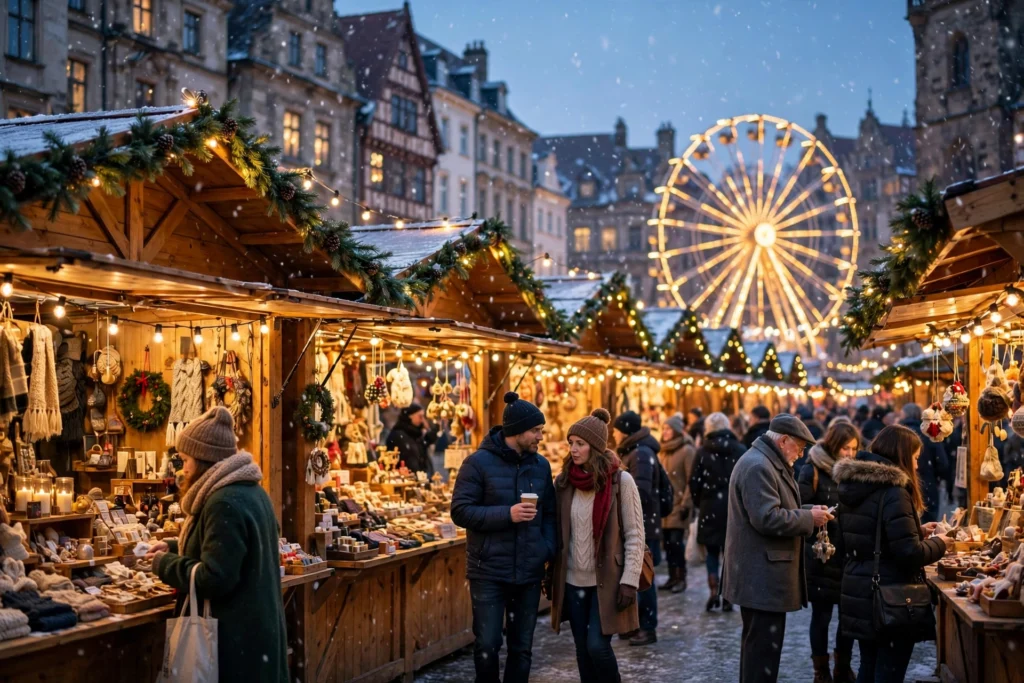
The Staroměstské náměstí (Old Town Square) market is Prague’s undisputed centerpiece. Rows of decorated wooden huts fill one of Europe’s great medieval squares, arranged around a massive Christmas tree — traditionally a towering spruce from the Czech mountains, strung with thousands of lights. Behind it rise the twin Gothic spires of the Church of Our Lady before Týn; to one side, the Old Town Hall with its famous Astronomical Clock (the Orloj), which has marked the hours since 1410.
The tree-lighting ceremony, traditionally held on the first weekend of Advent, is one of Prague’s signature winter moments — arrive early for a viewing spot, as the square fills quickly. Throughout the season, the square hosts a stage program of Czech carols, folk dancing, and school choirs, and a small petting zoo and children’s workshops keep families entertained. At night, with snow dusting the baroque facades and the tree glowing against the Týn Church, the square achieves a kind of perfection that photographs can’t quite capture — though you’ll certainly try.
What to eat at Old Town Square
The Old Town Square huts run the full Czech market menu. Trdelník — the sweet “chimney cake” of dough wrapped around a spit, roasted, and rolled in cinnamon sugar — is the square’s most photographed food (its exact origins are debated across Central Europe, but in Prague it’s simply delicious). Klobása (grilled Czech sausages), pražská šunka (Prague ham roasted on the spit), and smažený sýr (fried cheese) cover the savory side. For drinks: svařák (Czech mulled wine), medovina (hot honey wine — the sleeper hit of Prague’s markets), and grog (hot rum with water and lemon).
What to buy at Old Town Square
Look for hand-blown Czech glass ornaments — Bohemian glassmaking is a centuries-old art, and the market stalls carry beautiful, affordable pieces. Wooden toys, hand-painted ceramics, garnet jewelry (Czech garnets are a national specialty), and traditional straw ornaments all make excellent gifts. As with any major tourist market, quality varies: the stalls facing the tree tend toward souvenirs, while the side rows hold more genuine craft.
Wenceslas Square: The Grand Boulevard Market
A ten-minute walk from the Old Town Square, Václavské náměstí (Wenceslas Square) — actually a long, grand boulevard rather than a square — hosts Prague’s second major market. Framed by the monumental National Museum at its head and lined with grand 19th-century buildings, it has a more spacious, boulevard feel than the medieval intimacy of the Old Town.
The Wenceslas market is slightly more local in character: fewer tour groups, more Praguers grabbing svařák after work. The food huts here are excellent — this is a fine place for klobása and trdelník without the Old Town crowds — and the craft stalls lean practical (woolens, leather goods, wooden kitchenware) alongside the ornaments. The square’s Christmas tree and light displays are impressive in their own right, and the whole boulevard glows beautifully after dark.
Local tip: do Old Town Square in the morning (fewer crowds, best light for photos) and Wenceslas Square in the late afternoon as a warm-up to the evening — then walk back to the Old Town for the night spectacle.
Prague’s Hidden-Gem Christmas Markets
Beyond the two giants, Prague rewards explorers with smaller markets that locals actually prefer:
Náměstí Míru (Peace Square)
In the elegant Vinohrady district, this is many Praguers’ favorite market: a neighborhood fair before the neo-Gothic Church of St. Ludmila, with quality crafts, excellent food stalls, and a fraction of the Old Town crowds. The atmosphere is genuinely local — families, couples, after-work crowds — and the svařák is just as good.
Prague Castle & Hradčany
Small markets on the castle grounds offer the most spectacular setting of all — stalls with panoramic views over the city’s red rooftops and church spires. Combine with a castle visit (St. Vitus Cathedral is breathtaking in winter light) for a half-day that pairs culture with Christmas.
Náměstí Republiky & Tylovo náměstí
These smaller squares host compact, authentic markets — Tylovo náměstí in particular is a local secret with a strong food game. If you want to experience a Prague market the way Praguers do, these are the ones.
Kampa Island
Below the Charles Bridge on the Malá Strana side, Kampa’s small market offers riverside romance — stalls along the Čertovka channel with views of the bridge. Lovely at dusk.
Czech Christmas Food & Drink: The Complete Guide
- Svařák: Czech mulled wine — red wine heated with cinnamon, cloves, citrus, and sugar. The market standard; quality varies, so find a stall with a queue.
- Medovina: hot honey wine — sweet, warming, and dangerously drinkable. Prague’s signature market drink.
- Trdelník: chimney cake rolled in cinnamon sugar; get it fresh off the spit, optionally filled with ice cream or Nutella (purists take it plain).
- Klobása & párek v rohlíku: grilled sausages and the Czech hot dog — essential market fuel.
- Pražská šunka: Prague ham roasted on giant spits, carved to order — the square’s great savory spectacle.
- Bramboráky: crispy garlic potato pancakes, served hot with sour cream.
- Vánočka: the traditional Czech Christmas braided bread — buy a loaf from a bakery to take home.
- Cukroví: Czech Christmas cookies — dozens of varieties; market stalls sell mixed boxes.
- Czech beer: even in December, a Pilsner in a heated beer hall is non-negotiable. U Fleků and U Zlatého Tygra are historic institutions.
For your own holiday feast inspiration, our Christmas dinner ideas include Central European festive dishes.
Beyond the Markets: Prague in December
Prague’s winter magic extends well past the stalls:
- Charles Bridge at dawn: cross it early, before the crowds, with mist on the Vltava — one of Europe’s great travel moments.
- Prague Castle: the world’s largest ancient castle complex is magnificent in winter; St. Vitus Cathedral’s stained glass glows in the low sun.
- The Astronomical Clock: the hourly show draws crowds, but the real pleasure is the Old Town Hall tower view over the market square.
- Beer halls: Prague’s historic pivnice are the perfect warming stations — hearty Czech food (svíčková, goulash, duck) and legendary lagers.
- Classical concerts: Advent concerts in the city’s baroque churches (St. Nicholas in Malá Strana is superb) are affordable and atmospheric.
- Vyšehrad: the ancient fortress above the Vltava offers sweeping views and peaceful winter walks away from the center.
Comparing Prague with other fairytale market cities? Our best Christmas markets in Europe ranking puts it in continental context, and our best places to spend Christmas guide covers more winter destinations.
The Perfect 2-Day Prague Christmas Itinerary
Day 1: Old Town — the fairytale core
Morning: Cross Charles Bridge at dawn (before the crowds), explore Malá Strana’s baroque streets, then climb to Prague Castle for St. Vitus Cathedral and the panoramic views. Browse the castle’s small Christmas market.
Afternoon: Descend to the Old Town Square. Browse the market huts in daylight — this is prime shopping time — lunch on klobása and trdelník, and visit the Astronomical Clock tower for the square panorama.
Evening: Stay for the square’s transformation after dark: the tree glowing against the Týn Church, carols from the stage, medovina in hand. Dinner in a historic beer hall (U Fleků for the full tourist-classic experience, or a local pivnice in Vinohrady).
Day 2: Local Prague — markets and neighborhoods
Morning: Visit Náměstí Míru’s neighborhood market in Vinohrady — the local favorite — then explore the district’s cafés and Art Nouveau architecture.
Afternoon: Walk Wenceslas Square’s market end to end, from the National Museum down to Na Příkopě. Warm up with svařák, shop the boulevard stalls, and visit the museum if the cold bites.
Evening: An Advent concert in St. Nicholas Church (Malá Strana), then a final Old Town Square nightcap — the square at 10 PM, snow falling, crowds thinned, is the Prague you’ll remember forever.
What to Buy: Prague Souvenir Guide
- Bohemian glass ornaments: hand-blown baubles in traditional and contemporary designs — the single best Prague market souvenir.
- Czech garnet jewelry: the deep-red Bohemian garnet is a national gemstone; buy from reputable jewelers rather than market stalls for fine pieces.
- Wooden toys & marionettes: Czech puppetry is a UNESCO-recognized tradition; a hand-carved marionette is a heirloom gift.
- Cukroví & vánočka: mixed cookie boxes and Christmas bread travel well.
- Becherovka: the herbal bitters liqueur from Karlovy Vary — the Czech national spirit.
- Straw ornaments: delicate traditional decorations, cheap and beautiful.
Shopping for the holidays more broadly? Our best Christmas gifts guide has ideas for everyone on your list.
Practical Planning Guide
Getting to Prague
Václav Havel Airport connects to most European hubs; the Airport Express bus reaches the center in about 30 minutes. Prague is also a superb rail hub: direct trains run from Vienna (4 hours), Dresden (2.5 hours — a natural market pairing), Nuremberg, and Budapest. The Dresden–Prague combination is one of Europe’s great Christmas market double-headers — see our Germany Christmas markets guide for the Dresden side.
Where to stay
Stay in the Old Town (Staré Město) or Malá Strana for maximum atmosphere — you’ll walk to everything. Vinohrady and Nové Město offer better value a short metro ride away. Book 2–3 months ahead for December; Prague’s Christmas popularity means central hotels fill fast. Apartments are excellent value for families and groups.
Budget guide
Prague is the best-value capital on this list. Comfortable December hotels run roughly €80–150 per night centrally. Market food is delightfully cheap: svařák €2–4, trdelník €3–5, a hearty sausage €4–6. A beer hall dinner runs €15–25 per person. You can have a magnificent Prague Christmas weekend for half the cost of Vienna or Zurich.
When to visit
Prague’s markets traditionally open in late November or early December and run into early January — longer than most German markets, which is convenient for post-Christmas trips. The tree-lighting on the first Advent weekend is the ceremonial peak. Exact 2026 dates are typically confirmed in autumn; check the official Prague tourism site before booking. Note that many Czechs celebrate Christmas on December 24th, so the 25th–26th are quiet family days — but the markets usually stay open.
Money and safety
The Czech Republic uses the koruna (CZK), not the euro — though many market stalls accept euros at poor rates, so pay in koruna. Cards are widely accepted, but market stalls appreciate cash. Prague is very safe for tourists; standard precautions against pickpockets in crowded squares apply.
Tips for Prague’s Christmas Markets
- Morning markets, evening magic: shop in daylight, soak the atmosphere after dark — the Old Town Square transforms completely.
- Try medovina: visitors fixate on svařák, but hot honey wine is Prague’s sleeper hit.
- Eat in the beer halls: market food is fun, but a proper Czech dinner (svíčková, duck, goulash) in a pivnice is essential.
- Go beyond the two big squares: Náměstí Míru and Tylovo náměstí show you how Praguers actually do Christmas markets.
- Watch for the trdelník debate: locals will tell you it’s Hungarian, not Czech — smile, eat it anyway.
- Dress warmly: Prague Decembers hover around freezing with biting wind off the Vltava; layers and waterproof boots are mandatory.
- Traveling with kids? The Old Town Square’s workshops, petting zoo, and stage program are made for families — plus our Christmas activities for families guide.
Prague Christmas Market Prices: The Best Value in Europe
Prague’s markets are famously affordable — here’s what to expect, in Czech koruna (CZK) with rough euro equivalents:
- Svařák (mulled wine): 60–100 CZK (€2.50–4).
- Medovina (hot honey wine): 80–120 CZK (€3–5).
- Trdelník: 70–130 CZK (€3–5), more with fillings.
- Klobása (sausage): 100–160 CZK (€4–6.50).
- Pražská šunka (Prague ham): 150–220 CZK (€6–9) for a generous portion.
- Beer in a beer hall: 60–90 CZK (€2.50–3.50) for a half-liter — among the cheapest in Europe.
- Hand-blown glass ornaments: 150–500 CZK (€6–20).
- Beer hall dinner: 350–600 CZK (€14–24) per person for hearty Czech classics.
A couple can graze through the markets all day on €40–60 total — less than a single raclette portion costs in Zurich. This is the fundamental Prague advantage: you can say yes to everything.
Prague at Night: The Evening Itinerary
Prague’s markets transform after dark, and the city rewards night owls. Here’s the ideal evening arc:
- 5 PM — Wenceslas Square: start here as the lights come on; the boulevard glows and the after-work crowds give it energy.
- 6:30 PM — Old Town Square: walk over for the full nighttime spectacle — the tree, the Týn Church, carols from the stage. Find a medovina stall and claim a spot with a view.
- 8 PM — Beer hall dinner: escape the cold into a historic pivnice for svíčková or duck, with a dark Czech lager.
- 9:30 PM — Charles Bridge: walk the bridge at night — floodlit, quieter than daytime, with the castle glowing above.
- 10:30 PM — Castle views: the viewpoint below Prague Castle offers the city’s great nighttime panorama — red rooftops, spires, and the market glow below.
Czech Christmas Traditions: Carp, Cookies & the Golden Pig
Prague’s markets make more sense when you know the traditions behind them:
- The Christmas carp: the Czech Christmas Eve dinner centers on fried carp — and in December, live carp appear in tanks on Prague streets, sold for the holiday table. Many families keep the carp in the bathtub for a day or two before Christmas (a beloved national quirk).
- Cukroví marathons: Czech families bake dozens of varieties of Christmas cookies through December — market stalls sell mixed boxes, but the homemade tradition is the real thing.
- The golden pig: folklore says that if you fast all day on Christmas Eve, you’ll see a golden pig at dusk — a charm against hunger and a fun story for kids.
- St. Nicholas Day (December 5th): Mikuláš, accompanied by an angel and a devil, visits Czech children — markets often host Mikuláš events in early December.
- Mistletoe & the first star: Czech Christmas Eve dinner traditionally begins when the first star appears — another reason the markets empty early on the 24th.
Prague Castle at Christmas: The Winter Visit
Don’t skip Prague Castle in December — the world’s largest ancient castle complex is arguably more beautiful in winter. St. Vitus Cathedral’s stained glass glows in the low winter sun, the courtyards host a small Christmas market with panoramic city views, and the crowds are thinner than in summer. The Golden Lane’s tiny colorful houses look storybook-perfect with lights, and the castle gardens offer peaceful snow-dusted walks. Go in the morning for the calmest experience, then descend through Malá Strana’s baroque streets to the riverside markets below. The castle’s evening illuminations, viewed from across the river, are a fitting end to any Prague December day.
Frequently Asked Questions
Where are the Prague Christmas markets?
The two main markets are on Old Town Square (Staroměstské náměstí) and Wenceslas Square (Václavské náměstí), a ten-minute walk apart. Smaller, more local markets dot Náměstí Míru, Prague Castle, Tylovo náměstí, Náměstí Republiky, and Kampa Island.
When do Prague’s Christmas markets open in 2026?
Prague’s markets traditionally open in late November or early December and run into the first week of January — longer than most German markets. Exact 2026 dates are typically announced in autumn; confirm on the official Prague tourism website before booking travel.
What is trdelník?
Trdelník is a sweet spit-roasted cake — dough wrapped around a cylinder, baked over coals, and rolled in cinnamon sugar. It’s sold across Central Europe with debated origins (Hungarian kürtőskalács is the likely ancestor), but in Prague it’s simply the market’s most popular sweet. Get it fresh and plain, or filled.
Is Prague expensive at Christmas?
No — Prague is one of Europe’s best-value Christmas market destinations. Market food and drinks cost a fraction of Vienna or Zurich prices, hotels are reasonable, and beer hall dinners are famously affordable. It’s the ideal choice for a festive trip on a budget.
Can I combine Prague with other Christmas markets?
Easily. Dresden is 2.5 hours by direct train (a classic pairing), Vienna 4 hours, Nuremberg about 4.5 hours. The Dresden–Prague double-header is one of Europe’s great Christmas market trips.
Do Prague’s markets stay open on Christmas Day?
Usually yes — unlike German markets, which mostly close on December 24th, Prague’s main markets traditionally run into early January. Czechs celebrate on the evening of December 24th, so expect a quieter, more local atmosphere on the 25th and 26th.
Veselé Vánoce from Prague
The Prague Christmas markets on Old Town Square deliver what so many destinations promise and so few achieve: a Christmas that actually looks like the dream. Gothic spires, a glowing tree, medovina warming your hands, Bohemian glass glittering in the stalls — and all of it at prices that let you say yes to everything. Whether it’s your first European Christmas market or your fifteenth, Prague earns its place. For the wider continental picture, see our best Christmas markets in Europe ranking — and to pair it with Germany’s oldest market, read our Nuremberg, Dresden & Cologne guide. Veselé Vánoce!