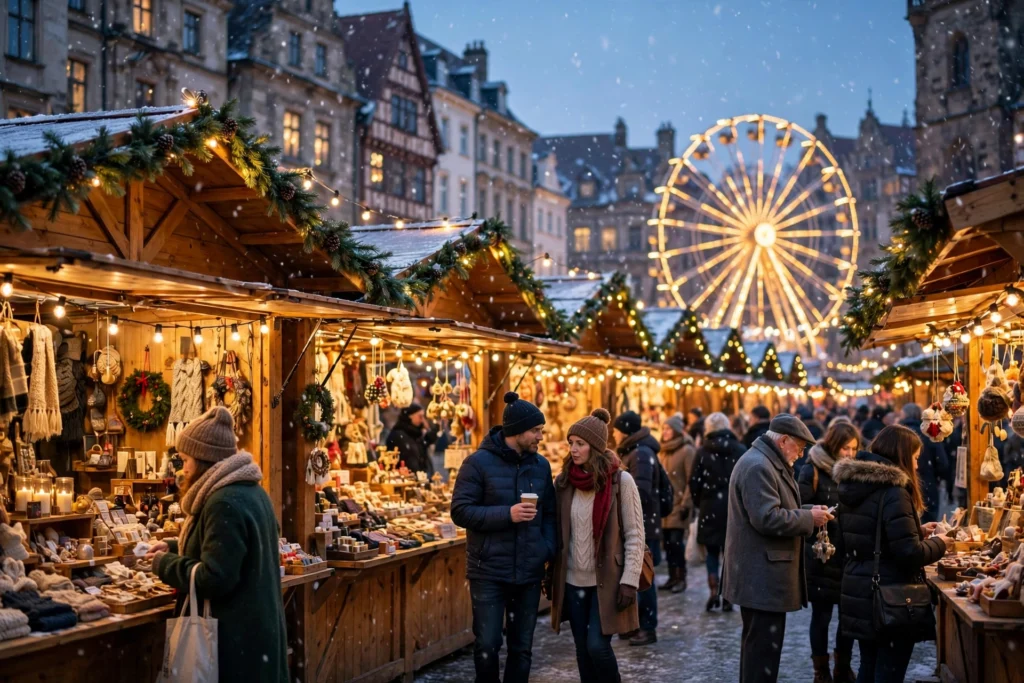
Germany invented the Christmas market as the world knows it — and three cities guard its traditions more fiercely than anywhere else. The Christmas markets in Germany’s Nuremberg, Dresden, and Cologne each claim a piece of the holiday’s soul: Nuremberg has the legendary Christkindlesmarkt, Dresden has the oldest documented market on earth, and Cologne has seven themed markets beneath a Gothic cathedral. This guide compares all three head-to-head and lays out a practical rail itinerary so you can experience the holy trinity of German Christmas in a single trip.
Together, these three cities span the full spectrum of what a German Weihnachtsmarkt can be. Nuremberg is the purist’s choice — tradition protected by strict rules. Dresden is the historian’s choice — nearly 600 years of continuous market culture and the finest woodcraft in Europe. Cologne is the romantic’s choice — riverside lights, seven distinct markets, and the most magical skyline of the three. Most travelers can only pick one or two, but with Germany’s superb rail network, visiting all three in four to five days is not just possible — it’s one of Europe’s great winter journeys.
Nuremberg vs. Dresden vs. Cologne: The Head-to-Head Comparison
Before we dive into each city, here is how the three stack up on the factors that actually matter to visitors:
| Factor | Nuremberg | Dresden | Cologne |
|---|---|---|---|
| Market age | Written record from 1628 (likely older) | 1434 — oldest documented in Germany | Medieval origins; modern markets since 1820s |
| Number of markets | 1 main + children’s + sister-cities markets | 11 markets citywide | 7 themed markets |
| Signature moment | Christkind opening prologue | Stollen Festival & giant pyramid | Cathedral market at night |
| Signature food | Lebkuchen, drei im Weggla | Dresdner Christstollen, Pfefferkuchen | Reibekuchen, Kölsch |
| Best for shopping | Traditional-only stalls | Ore Mountains woodcraft | Variety across 7 themes |
| Crowd level | Very high | High | High |
| Budget | $$ | $$ (best value of the three) | $$ |
| Typical season | Late Nov – Dec 24 | Late Nov – Dec 24 | Late Nov – Dec 23 |
Typical seasons reflect historical patterns; confirm exact 2026 dates on each city’s official tourism site before booking.
Nuremberg: The Legendary Christkindlesmarkt
A market protected like a national treasure
Nuremberg’s Christkindlesmarkt on the Hauptmarkt is arguably the most famous Christmas market in the world, drawing around two million visitors a year. Its fame rests on authenticity enforced by rules: the market’s organizers permit only traditional goods in the main market’s roughly 180 red-and-white striped wooden stalls. That means handcrafted ornaments, wooden toys, candles, and regional foods — no mass-produced novelties. The result is a market that feels genuinely old-world rather than commercially staged.
The market’s history runs deep. The oldest surviving written record dates to 1628, though historians believe the market stretches back to at least 1530, and possibly into the 1500s. Its opening ceremony is the most theatrical in Germany: on the Friday before the first Advent, the Hauptmarkt goes completely dark, a spotlight strikes the balcony of the Frauenkirche, and the Christkind — a young woman chosen every two years, dressed in a golden robe and crown — recites the famous prologue inviting all to the market. It is worth timing your trip to witness it.
What to eat in Nuremberg
Nuremberg’s food traditions are the stuff of legend. Nürnberger Lebkuchen — the city’s spiced gingerbread — has been baked here since the 14th century; the finest grade, Elisenlebkuchen, is made with a high proportion of nuts and minimal flour, and it is worth seeking out from a traditional bakery rather than a generic stall. Drei im Weggla (“three in a bun”) — three small grilled Nuremberg sausages in a bread roll with mustard — is the definitive market snack. Wash it down with glühwein served in the market’s collectible annual mug.
What to buy in Nuremberg
Beyond Lebkuchen tins, look for Zwetschgenmännle — whimsical little figures made from dried prunes, a Nuremberg specialty — as well as hand-carved wooden ornaments, beeswax candles, and Rauschgoldengel (gold-foil angels). The Children’s Christmas Market on Hans-Sachs-Platz is a delight for families, with a merry-go-round, a steam train, and hands-on craft activities. The Sister Cities Market on Rathausplatz offers goods from Nuremberg’s twin towns around the world — a unique souvenir stop.
Practical Nuremberg tips
The Hauptmarkt is a 10-minute walk from the main train station (Nürnberg Hbf). The market is most magical after dark but also most crowded on weekend evenings — visit on a weekday if you can. The Nuremberg Card covers public transport and major museums, including the Albrecht Dürer House and the Imperial Castle, both worth a daylight hour between market sessions. For the full European context, see our ranking of the best Christmas markets in Europe.
Dresden: The Oldest Christmas Market in the World
Nearly 600 years of Christmas
Dresden’s Striezelmarkt is the heavyweight champion of Christmas market history. First held for a single day in 1434 under Elector Friedrich II of Saxony — originally as a one-day meat market before the Advent fast — it is the oldest documented Christmas market in Germany and among the oldest anywhere. It now fills the Altmarkt with more than 200 stalls and draws over 2.5 million visitors annually, and Dresden markets itself, with some justification, as a Christmas capital of Europe.
The name “Striezelmarkt” comes from “Striezel,” the old Saxon word for the fruitcake now famous as Dresdner Christstollen. True Dresdner Stollen is still produced in the city under a protected recipe, distinguished by a special seal — and the market’s annual Stollen Festival is one of Germany’s great food spectacles: a giant Christstollen weighing several tons is paraded through the city on a special wagon and ceremonially cut for visitors.
Landmarks you won’t see anywhere else
The Striezelmarkt is home to genuine world records: the world’s largest Erzgebirge step pyramid (over 14.6 meters tall, listed in the Guinness Book of Records), the largest walk-in Schwibbogen (candle arch), and a huge traditional nativity scene. The pyramid, with its rotating candle-lit tiers, is the market’s beating heart — stand beneath it at dusk with a glühwein and you will understand why people return year after year.
What to eat in Dresden
Beyond the essential Stollen (buy from a licensed bakery displaying the official seal), try Pulsnitzer Pfefferkuchen — the region’s traditional gingerbread, distinct from Nuremberg’s Lebkuchen — plus Saxon bratwurst, roasted almonds, and glühwein in the market’s annually changing collector mugs, which keep visitors coming back year after year. For a sit-down break, Saxon potato soup or Sauerbraten in a nearby Altmarkt restaurant is the local move.
What to buy in Dresden
Dresden is the single best Christmas market in Europe for Ore Mountains (Erzgebirge) folk art: hand-carved nutcrackers, Räuchermännchen (smoking men incense figures), Schwibbogen candle arches, and Christmas pyramids. This craft tradition comes from the old mining region south of the city, and the Striezelmarkt hosts dozens of certified folk-art stalls. It is also the place to buy authentic Dresdner Stollen in decorative tins that travel well.
Dresden beyond the Striezelmarkt
Dresden hosts around 11 Christmas markets in total. The medieval-themed market in the Stallhof courtyard is a favorite for its torch-lit atmosphere, jugglers, and craftspeople in period dress. The Neumarkt market before the reconstructed Frauenkirche is elegant and slightly calmer than the Altmarkt. And the city’s baroque architecture — the Zwinger, the Semperoper, the Frauenkirche itself — makes Dresden the most beautiful of the three cities by day. Our best places to spend Christmas guide has more on pairing markets with sightseeing.
Cologne: Seven Markets Beneath the Cathedral
A market for every mood
Cologne’s genius is variety. Rather than one mega-market, the city spreads seven themed Christmas markets across the walkable city center, each with its own character — and market-hopping between them is the essential Cologne experience. The flagship sits directly beneath the twin spires of the Cologne Cathedral, a UNESCO World Heritage site: around 160 stalls arranged around a towering Christmas tree, with the illuminated Gothic facade as the most dramatic market backdrop in Germany.
From there, the trail leads to the Harbour Market at the Chocolate Museum with its nautical theme, the Angels’ Market on Neumarkt, the Gnome Market, the old-town market on Alter Markt and Heumarkt, and the medieval market — each distinct enough that you could spend an entire trip without repeating an atmosphere. Cologne’s markets are famously gemütlich and welcoming, and the city’s Rhineland warmth makes it arguably the friendliest of the three for international visitors.
What to eat in Cologne
The essential Cologne market snack is Reibekuchen — crispy potato pancakes served with apple sauce — best eaten standing at a stall with glühwein in hand. Sample Kölsch, the city’s light signature beer (served in small 0.2-liter glasses called Stangen), in a traditional Brauhaus between markets. Local gingerbread specialties, roasted chestnuts, and hearty Rhineland dishes like Himmel un Ääd (black pudding with mashed potatoes and apple sauce) round out the menu. The Harbour Market’s fish sandwiches are a fun nautical twist.
What to buy in Cologne
Each market’s theme shapes its shopping: the cathedral market for classic ornaments and nativity figures, the Harbour Market for maritime gifts, the Angels’ Market for delicate decorations. Cologne is also the home of Eau de Cologne — the original 4711 fragrance house near the cathedral makes a quintessentially local gift. The city’s chocolate tradition (the Chocolate Museum anchors the Harbour Market) means excellent chocolate gifts are everywhere.
Practical Cologne tips
All seven markets sit within easy walking distance of the cathedral and the main train station (Köln Hbf) — you genuinely do not need transport between them. Note that Cologne’s markets traditionally close on December 23, a day earlier than most German markets, so plan your itinerary accordingly. The illuminated Hohenzollern Bridge with its thousands of love locks makes a perfect evening stroll between the cathedral market and the old town.
The Ultimate 4-Day Rail Itinerary: All Three Cities
Visiting all three Christmas markets in Germany’s great trio is one of Europe’s finest winter journeys. Here is a practical day-by-day plan using Germany’s excellent rail network. Book long-distance trains a few weeks ahead for the best fares; a German Rail Pass can also make sense for this route.
Day 1: Arrive in Nuremberg — the Christkind’s city
Fly into Nuremberg or arrive by train and drop your bags at a hotel near the old town. Spend the afternoon exploring the Hauptmarkt stalls in daylight — this is the best time for serious shopping, when the craft stalls are calm. Climb to the Imperial Castle for sunset views over the old town’s red rooftops. Return to the Hauptmarkt after dark for the full illuminated spectacle, dinner of drei im Weggla and Lebkuchen, and glühwein beneath the Frauenkirche. If your dates align with the opening Friday before the first Advent, the Christkind prologue ceremony is unmissable.
Day 2: Morning in Nuremberg, afternoon train to Dresden
Use the morning for the Children’s Christmas Market and the Sister Cities Market, plus a visit to the Albrecht Dürer House or the Documentation Center for a sobering dose of history. Catch a mid-afternoon direct train to Dresden (roughly 3 hours). Check into your Altmarkt-area hotel and head straight to the Striezelmarkt for your first evening beneath the giant pyramid — try the Stollen and a collector-mug glühwein.
Day 3: Full day in Dresden
Dedicate this day to Dresden’s markets and baroque beauty. Morning: the Striezelmarkt’s craft stalls (best selection before the crowds). Midday: the Frauenkirche and Zwinger Palace. Afternoon: the medieval market in the Stallhof for torch-lit atmosphere and craftspeople in period dress. Evening: the Neumarkt market before the illuminated Frauenkirche, dinner of Saxon specialties, and a final stroll through the Striezelmarkt at night. If the Stollen Festival falls during your visit, plan your day around the parade.
Day 4: Train to Cologne — seven markets in one evening
The Dresden–Cologne train takes about 4.5 hours, so take a morning departure and arrive by early afternoon. Drop bags near the cathedral and spend the late afternoon at the cathedral market — the single most photogenic market of the three. As evening falls, walk the market trail: Neumarkt’s Angels’ Market, the old-town markets on Alter Markt and Heumarkt, and the Harbour Market by the Chocolate Museum. Dinner in a traditional Brauhaus (Kölsch and Himmel un Ääd), then a nightcap glühwein on the Hohenzollern Bridge with the cathedral glowing across the Rhine.
Extension option: with a fifth day, add Aachen’s charming market (45 minutes by train) or Düsseldorf’s markets along the Königsallee. Both pair naturally with Cologne.
German Christmas Market Food: The Definitive Tasting Guide
Eating your way through these three cities is a trip in itself. Here is what to prioritize in each:
- Gingerbread showdown: Nuremberg’s Elisenlebkuchen (nutty, refined) vs. Dresden’s Pulsnitzer Pfefferkuchen (spicier, rustic) vs. Aachen-style Printen near Cologne. Try all three and pick a winner.
- Sausage tour: Nuremberg’s tiny drei im Weggla, Dresden’s Saxon bratwurst, Cologne’s currywurst and bratwurst variations.
- The Stollen question: buy one authentic Dresdner Christstollen (look for the official seal) to take home — it keeps for weeks and improves with age.
- Potato pancakes: Cologne’s Reibekuchen with apple sauce is the benchmark; Dresden’s Quarkkeulchen (sweet potato pancakes) is the Saxon answer.
- Drinks: glühwein everywhere (keep the collector mugs), plus Feuerzangenbowle (flaming rum-soaked sugar over mulled wine) at select stalls, Kölsch beer in Cologne’s Brauhäuser, and hot chocolate at Dresden’s stalls for the kids.
- Sweet extras: roasted almonds (gebrannte Mandeln), chocolate-covered everything, and Baumstriezel-style chimney cakes at modern stalls.
Hosting your own German-inspired feast when you get home? Our Christmas dinner ideas include European holiday menus worth borrowing.
Practical Planning Guide
When to visit
The sweet spot is the first two weeks of December. All three cities’ markets are traditionally open from late November through December 23 or 24, the Advent atmosphere is at full strength, and you’ll avoid the crush of the final weekend before Christmas. Note Cologne’s earlier closing date (traditionally December 23). Exact 2026 dates are usually confirmed in autumn — check each city’s official tourism website before booking non-refundable travel.
Getting around
Germany’s Deutsche Bahn connects all three cities comfortably: Nuremberg–Dresden is about 3 hours direct, Dresden–Cologne about 4.5 hours (usually with one change). Within each city, the markets cluster in the walkable old town — you will barely need public transport once you arrive. If you’re flying in, Nuremberg and Cologne both have international airports; Dresden is easily reached by train from Berlin.
Budget guide
Dresden is the best value of the three, Nuremberg and Cologne slightly pricier. Expect roughly €120–180 per night for a comfortable hotel near the old town in December (book 2–3 months ahead — Christmas market weekends sell out). Market grazing runs €25–40 per person per day if you’re enthusiastic; a sit-down restaurant dinner adds €30–50. Market entry is free everywhere, so your budget goes to food, drink, and souvenirs.
What to pack
German December weather means temperatures around freezing, short days, and the possibility of snow or sleet. Thermal base layers, a warm waterproof coat, insulated waterproof boots, gloves, scarf, and hat are essential — you will be standing outdoors for hours. Bring a small backpack or tote for purchases, and cash in small bills: many market stalls are cash-only.
Tips for the Perfect German Christmas Market Trip
- Learn the mug system: your first glühwein includes a Pfand (deposit) of a few euros for the mug. Return the mug for your deposit back — or keep it; the annual designs are beloved souvenirs.
- Visit markets twice: once in daylight for shopping, once after dark for atmosphere. They are two different experiences.
- Eat like a local: stand at the stall, eat with your hands, and don’t rush. Market food is social food.
- Weekdays beat weekends: Saturday evenings at Nuremberg’s Hauptmarkt can be shoulder-to-shoulder; a Tuesday evening is magical and calm.
- Bring gifts home smartly: Lebkuchen and Stollen travel beautifully; delicate ornaments need careful packing — many craft stalls will wrap purchases for travel.
- Traveling with family? Nuremberg’s Children’s Christmas Market and Dresden’s fairy-tale touches make both cities excellent with kids — see our Christmas activities for families for more ideas.
Frequently Asked Questions
Which German Christmas market is the best: Nuremberg, Dresden, or Cologne?
It depends on your priorities. Choose Nuremberg for the most traditional, authenticity-protected market and the famous Christkind ceremony. Choose Dresden for history (1434), the Stollen Festival, and the finest woodcraft shopping. Choose Cologne for variety — seven themed markets — and the most romantic riverside setting. If you can only visit one and want the “classic” German market experience, Nuremberg edges it.
Can I visit Nuremberg, Dresden, and Cologne in one trip?
Yes — the 4-day rail itinerary above covers all three comfortably. Nuremberg to Dresden is about 3 hours by direct train, and Dresden to Cologne about 4.5 hours. Allow at least one full evening per city, since the markets are at their best after dark.
When do the German Christmas markets open in 2026?
Traditionally, all three open in the last week of November and run through December 23 (Cologne) or December 24 (Nuremberg, Dresden). Exact 2026 dates are typically announced in autumn — confirm on the official city tourism websites before booking flights and hotels.
What is the oldest Christmas market in Germany?
Dresden’s Striezelmarkt, first held in 1434, is the oldest documented Christmas market in Germany. Nuremberg’s Christkindlesmarkt has written records dating to 1628 and is among the oldest and most famous.
Are German Christmas markets free?
Yes — entry to the markets themselves is free in all three cities. You pay for food, drinks (plus a refundable mug deposit), and souvenirs. Some special events, like concerts or the Stollen Festival parade viewing areas, may have separate arrangements, but strolling the stalls costs nothing.
What should I buy at German Christmas markets?
Nuremberg: Elisenlebkuchen, Zwetschgenmännle prune figures, beeswax candles. Dresden: Ore Mountains woodcraft (nutcrackers, pyramids, smoking men), authentic Dresdner Stollen. Cologne: Eau de Cologne 4711, chocolate, ornaments from the themed markets. Everywhere: the annual glühwein collector mugs.
Three Cities, One Unforgettable Christmas
The Christmas markets in Germany’s Nuremberg, Dresden, and Cologne are more than a holiday outing — they are a journey through six centuries of European Christmas tradition, from Dresden’s medieval meat market to Nuremberg’s golden-robed Christkind to Cologne’s riverside lights. Whether you pick one city or ride the rails through all three, you’ll taste gingerbread perfected over hundreds of years, shop from artisans carrying on generations-old crafts, and understand why the whole world copies what Germany invented. For the broader European picture, explore our best Christmas markets in Europe ranking — and if you’re also considering an American holiday trip, compare with the best Christmas markets in the USA. Frohe Weihnachten!