Belgium serves up one of Europe’s great Christmas market double-headers: Brussels’ Winter Wonders — a sprawling festival of 200 chalets crowned by the sound-and-light show on the Grand Place — and Bruges’ intimate medieval market, barely an hour away by train. This guide covers both cities’ Brussels Winter Wonders and Bruges Christmas markets in full: what makes each special, the essential Belgian food and drink, a perfect two-city itinerary, and practical planning for 2026.
The pairing works because the two cities are opposites. Brussels is grand, buzzing, and cosmopolitan — its Winter Wonders (Plaisirs d’Hiver in French, Winterpret in Dutch) is one of Europe’s biggest and longest-running festive events, typically stretching from late November into the first days of January. Bruges is small, hushed, and impossibly preserved — a medieval city where the Christmas market feels like it was arranged for a film set, complete with horse-drawn carriages and canalside lights. Together, they deliver the full Belgian Christmas in two to three days.
Brussels Winter Wonders: The Grand Place Spectacle
One of Europe’s great free shows
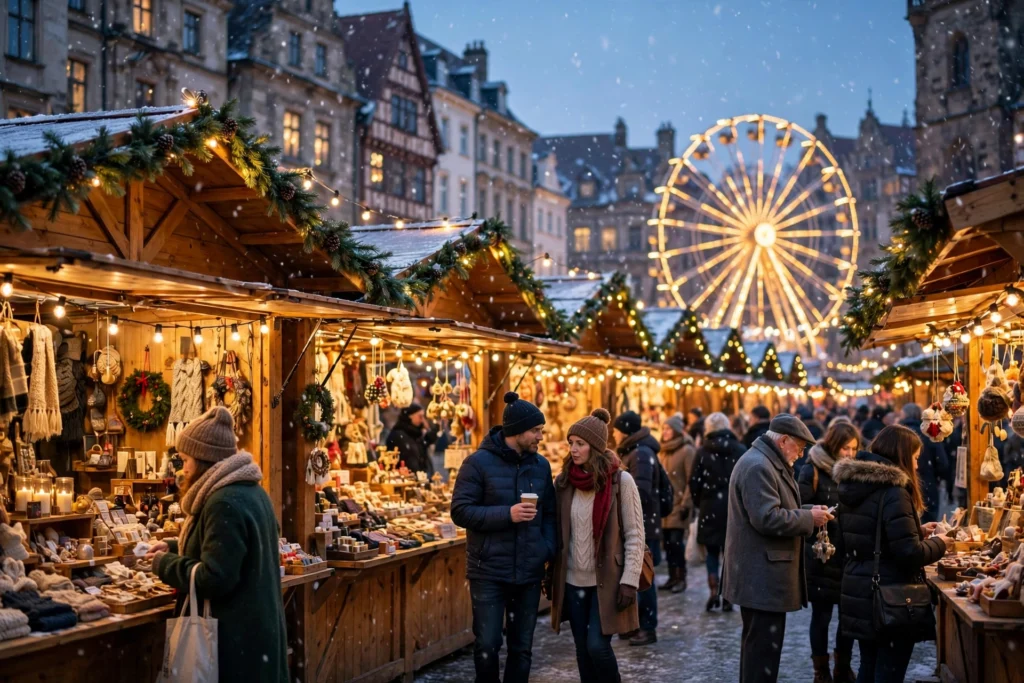
Winter Wonders sprawls across central Brussels: some 200 wooden chalets wind from the Grand Place — often called the most beautiful square in Europe, with its gilded baroque guildhalls — through the Bourse and down to Place Sainte-Catherine, where a Ferris wheel, ice rink, and towering Christmas tree anchor the festivities. The whole route glows with light installations, and the atmosphere builds from elegant (Grand Place) to lively (Sainte-Catherine) as you walk it.
The crown jewel is the sound-and-light show on the Grand Place, typically staged several evenings a week through the season. Music, narration, and projected imagery wash across the guildhalls’ golden facades while the great tree — traditionally a towering spruce — glows at the square’s center. It is genuinely spectacular, completely free, and the single best reason to put Brussels on your Christmas market itinerary. Arrive 20 minutes early for a good viewing spot; the square fills fast.
Walking the Winter Wonders route
The natural route runs Grand Place → Bourse → Place Sainte-Catherine, about a 15-minute stroll strung with chalets the whole way. Highlights along the route:
- Grand Place: the light show, the tree, the most beautiful square — start here at dusk.
- Bourse: the former stock exchange hosts exhibitions and the route’s elegant middle stretch.
- Place Sainte-Catherine: the festival’s lively heart — Ferris wheel, ice rink, carousel, and the densest concentration of food chalets.
- Place de la Monnaie & side streets: additional chalets and light installations branch off the main route.
Ride the giant Ferris wheel at Sainte-Catherine for the best nighttime view of the illuminated city — the Grand Place glowing in the distance is unforgettable.
What to eat at Winter Wonders
Belgian market food is a headline attraction in itself:
- Gaufres (waffles): Brussels waffles (light, rectangular) and Liège waffles (denser, caramelized sugar) — try both, with speculoos spread or chocolate.
- Frites: twice-cooked Belgian fries with a dozen sauces — the Andalouse and samurai sauces are local favorites.
- Moules & fish: the Sainte-Catherine quarter is Brussels’ old fish market district — seafood stalls are excellent.
- Cuberdons: the cone-shaped raspberry candies called “neuzekes” (little noses) — a Belgian specialty.
- Speculoos: the spiced biscuits — buy them by the bag.
- Stoofvlees: Flemish beef stewed in beer — the hearty sit-down dish of the season.
- Belgian beer: winter and Christmas beers (often spiced, higher alcohol) appear at market bars — try a local brune or a Christmas ale.
- Vin chaud & jenever: mulled wine alongside Belgium’s juniper spirit, served warm with sugar.
Bruges: The Medieval Christmas Market
A fairytale in miniature
If Brussels is the blockbuster, Bruges is the art film. The Bruges Christmas market centers on the Markt (Market Square) beneath the medieval Belfry tower, with wooden chalets arranged around the ice rink at its heart. The setting does the heavy lifting: step-gabled guildhalls, the 13th-century Belfry, horse-drawn carriages clipping over cobblestones, and canals reflecting the lights. In snow — which Bruges gets more often than Brussels — it is close to perfect.
The market itself is smaller and calmer than Brussels’ — a few dozen chalets rather than hundreds — which is precisely its charm. Browse at leisure, skate the rink (or watch the skaters with a vin chaud), and let the medieval city work its magic. The Burg square, a short walk away, hosts additional stalls before the Gothic town hall, and the whole center glows with tasteful illuminations.
What makes Bruges special at Christmas
- The Belfry at night: climb the 366 steps by day for the panorama; admire it floodlit by night from the market.
- Canal lights: the Rozenhoedkaai viewpoint — the most photographed spot in Bruges — is ethereal after dark in December.
- Chocolate: Bruges is Belgium’s chocolate capital, with legendary chocolatiers (try the pralines at the family-run shops on Breidelstraat). The market’s hot chocolate is superb.
- Horse-drawn carriages: touristy? Yes. Magical on a December evening? Also yes.
- Minnewater: the “Lake of Love” park is a peaceful winter walk, ten minutes from the center.
What to eat in Bruges
Beyond the market staples: Bruges lace cookies (dentelles — delicate butter biscuits), chocolate in all its forms, moules-frites in a Grand Place bistro, and Brugse Zot (the local blonde beer) or a Trappist ale in a candlelit estaminet. The market’s glühwein huts and jenever bars keep hands warm.
The Perfect 2–3 Day Brussels & Bruges Itinerary
Day 1: Brussels — the grand spectacle
Morning: Grand Place in daylight (fewer crowds, best photos of the guildhalls), the Galeries Royales Saint-Hubert for chocolate shopping, and Manneken Pis in its Christmas costume.
Afternoon: Atomium or the Magritte Museum for culture, then waffles and frites as you walk the Winter Wonders route from the Bourse toward Sainte-Catherine.
Evening: Back to the Grand Place for the sound-and-light show, then the Ferris wheel at Sainte-Catherine and dinner of stoofvlees with a Christmas beer. The route at night is the essential Brussels experience.
Day 2: Bruges — the medieval idyll
Take the morning train (about an hour, direct, frequent). Morning: climb the Belfry, browse the Markt’s chalets in the calm late morning. Afternoon: canal walk to Rozenhoedkaai, chocolate shopping, Minnewater park. Evening: the market and ice rink after dark, dinner of moules-frites, and the last train back — or stay overnight in a canal-house hotel for the full fairytale (highly recommended).
Day 3 (optional): Ghent or Antwerp
Belgium’s other cities host fine markets too: Ghent’s medieval center is stunning at Christmas, and Antwerp’s market on the Grote Markt is excellent. Both are easy day trips from Brussels.
For the wider European picture, our best Christmas markets in Europe ranking places the Belgian pair in continental context.
Belgian Chocolate & Beer: The Essential Guide
No Belgian Christmas market trip is complete without taking the country’s two great crafts seriously:
Chocolate
Belgian pralines — the filled chocolates invented in Brussels in 1912 — are the souvenir to beat. In Brussels, the Galeries Royales arcade houses the great historic chocolatiers; in Bruges, family-run shops along Breidelstraat and Wollestraat offer tastings. Buy pralines as close to your departure as possible (they’re best fresh), and consider the hot chocolate at market stalls — Belgian hot chocolate is famously thick and rich.
Beer
Belgium’s beer culture is UNESCO-recognized, and Christmas is its finest season. Market bars pour Christmas and winter ales — typically stronger, maltier, and sometimes spiced. In Brussels, the historic taverns around the Grand Place (À la Mort Subite, Le Cirio) are institutions; in Bruges, candlelit estaminets serve Trappist ales in their proper glassware. A beer-tasting flight is the perfect warming break between markets.
What to Buy: Belgian Souvenir Guide
- Chocolate: pralines from a master chocolatier — the definitive Belgian gift.
- Speculoos: spiced biscuits in decorative tins, plus speculoos spread.
- Bruges lace: handmade lace from the Markt stalls — look for the real thing, not imports.
- Belgian beer: Christmas ales and Trappist beers in gift packs (check airline liquid rules).
- Cuberdons: the raspberry “little noses” — a uniquely Belgian candy.
- Comic art: Brussels is the home of Tintin and the Smurfs — the Comic Strip Museum shop has great gifts.
- Tapestries & ceramics: from the Grand Place area craft stalls.
For broader holiday gift ideas, see our best Christmas gifts guide.
Practical Planning Guide
Getting there & between the cities
Fly into Brussels Airport (20 minutes to the center by train) or take the Eurostar from London (2 hours) or Thalys from Paris, Amsterdam, or Cologne. Brussels to Bruges is about an hour by direct intercity train, running at least hourly — no booking needed, just turn up. The trains are comfortable and the journey crosses flat Flemish countryside.
Where to stay
In Brussels, stay near the Grand Place or Sainte-Catherine to walk the whole Winter Wonders route — book 2–3 months ahead for December weekends. In Bruges, a canal-house hotel in the center is worth the splurge for one night; the city after the day-trippers leave is a different, quieter place. Many visitors base in Brussels and day-trip to Bruges, but an overnight in Bruges is the connoisseur’s move.
Budget guide
Belgium is mid-range by Western European standards. Brussels hotels run roughly €120–180 per night centrally in December; Bruges similar for canal-house charm. Market grazing runs €25–40 per person per day (waffles €4–6, frites €4–5, beer €4–7, vin chaud €3–5). A bistro dinner runs €25–40. Market entry is free everywhere, including the Grand Place light show.
When to visit
Winter Wonders traditionally runs from late November into the first days of January — one of Europe’s longest seasons, which makes post-Christmas visits viable. Bruges’ market typically runs late November through early January as well. The Grand Place light show usually runs several evenings per week rather than nightly — check the schedule on arrival. Exact 2026 dates are announced in autumn; confirm on the official Brussels tourism site before booking.
Tips for Belgium’s Christmas Markets
- Time the light show: the Grand Place sound-and-light show is the trip’s centerpiece — check which evenings it runs and plan around it.
- Ride the wheel at night: the Sainte-Catherine Ferris wheel after dark offers the best illuminated-city panorama.
- Eat the waffles properly: Liège waffles need nothing; Brussels waffles take toppings. Both are best hot from the iron.
- Overnight in Bruges: the day-trip crowds leave by 6 PM; the city’s evening calm is worth a hotel night.
- Try the Christmas beers: winter ales appear only in season — ask market bars what’s pouring.
- Bring cash: many smaller stalls are cash-only, though Belgium is broadly card-friendly.
- Combine with Lille or Aachen: both are easy cross-border additions — Lille’s market is lovely, Aachen’s famous for Printen. Our Germany guide covers the German side.
- Traveling with family? The Sainte-Catherine rides, Bruges’ rink, and the chocolate shops are kid heaven — see our Christmas activities for families.
Ghent & Antwerp: Extending the Belgian Christmas Trip
With a third day, Belgium’s other great cities deserve attention — both host excellent Christmas markets:
Ghent
Halfway between Brussels and Bruges by train, Ghent’s medieval center — the Gravensteen castle, the Graslei waterfront, St. Bavo’s Cathedral — is stunning with Christmas lights. The city’s Christmas market fills the historic core with chalets, and Ghent’s food scene (some of Belgium’s best restaurants) makes it a gourmet stop. The illuminated Graslei at night, with medieval guildhalls reflected in the Lys river, rivals anything in Bruges.
Antwerp
An hour north of Brussels, Antwerp’s Christmas market spreads across the Grote Markt (with its magnificent Renaissance town hall), Groenplaats, and Steenplein by the Scheldt river. The diamond capital’s market leans stylish — fashion, design, and excellent food — and the Cathedral of Our Lady’s spire presiding over the stalls is a spectacular backdrop. Antwerp’s shopping (the fashion district around Nationalestraat) is Belgium’s best.
The three-city Belgian loop
Ambitious travelers can do Brussels → Ghent → Bruges in three days by rail — each leg under an hour. It’s the densest concentration of great Christmas markets in Europe, and the train connections make it effortless.
Belgian Winter Beer: A Drinker’s Guide
Belgium’s Christmas beer season deserves its own section. Each winter, Belgian brewers release Christmas and winter ales — typically stronger (8–12% ABV), maltier, and often spiced with cinnamon, orange peel, or coriander. What to look for:
- Trappist Christmas ales: the great Trappist breweries release winter specials — rich, complex, and age-worthy.
- Local brunes: ask market bars what’s pouring; the seasonal taps change through December.
- Where to drink: Brussels’ historic taverns (À la Mort Subite, Le Cirio, Delirium) and Bruges’ candlelit estaminets (De Garre, ‘t Brugs Beertje) are institutions — go for the atmosphere as much as the beer.
- Pace yourself: Belgian Christmas ales are significantly stronger than standard lagers — the 8%+ ABV sneaks up fast, especially in the cold.
- Gifts: brewery gift packs and Trappist assortments make superb presents (check your airline’s liquid rules).
Brussels Beyond Winter Wonders: A December City Guide
Winter Wonders is the headline, but Brussels in December rewards exploration:
- The Sablon: the elegant antiques quarter hosts its own small Christmas market and some of the city’s best chocolate shops — a refined counterpoint to the Winter Wonders bustle.
- Galeries Royales Saint-Hubert: Europe’s oldest shopping arcade glows with Christmas decorations; its chocolatiers and bookshops are superb for gifts.
- Mont des Arts: the hilltop viewpoint offers the classic Brussels panorama — the town hall spire rising above the rooftops — beautiful at dusk in December.
- Comic Strip Route: Brussels’ building-sized comic murals (Tintin, the Smurfs, Lucky Luke) make a fun daytime treasure hunt between markets.
- Belgian fries pilgrimage: beyond the market stalls, the great fritkots (Maison Antoine, Frit’ Flagey) are institutions — join the queue like a local.
- Atomium at night: the 1958 World’s Fair icon is illuminated after dark and makes a striking evening excursion.
Winter Wonders Practicalities: Hours, Crowds & Getting Around
The details that smooth out a Brussels trip: entry to Winter Wonders is free across the whole route. Chalets typically open late morning and run until late evening, with the Grand Place light show staged several evenings per week (not nightly — check the schedule on arrival and plan your evenings around it). The route is walkable end to end in about 15 minutes, but allow two to three hours with grazing stops.
Crowds peak on weekend evenings — the Grand Place on a Saturday night is shoulder-to-shoulder. Weekday evenings offer the same spectacle with room to breathe. Brussels’ metro and trams connect the center to the EU quarter and outer neighborhoods quickly; the center itself is compact on foot. For day trips, Brussels-Midi station sends direct trains to Bruges, Ghent, and Antwerp — buy tickets at the station or via the SNCB app; no advance booking needed for intercity trains. Language is rarely an issue: Brussels is officially bilingual (French/Dutch) and nearly everyone in the tourist center speaks English. Cards are widely accepted across the city, though market stalls appreciate cash.
Frequently Asked Questions
What is Winter Wonders in Brussels?
Winter Wonders (Plaisirs d’Hiver / Winterpret) is Brussels’ annual Christmas festival: around 200 chalets stretching from the Grand Place to Place Sainte-Catherine, with a Ferris wheel, ice rink, light installations, and a famous sound-and-light show projected onto the Grand Place’s guildhalls. It traditionally runs from late November into early January.
Can I visit Brussels and Bruges Christmas markets in one trip?
Easily — it’s one of Europe’s classic Christmas market pairings. Direct trains connect Brussels and Bruges in about an hour, running at least hourly. Do Brussels on day one (including the evening light show) and Bruges on day two, with an optional overnight in Bruges.
When are the Brussels and Bruges Christmas markets in 2026?
Both traditionally run from late November into the first days of January — among Europe’s longest market seasons. Exact 2026 dates are typically announced in autumn; confirm on the official Brussels and Bruges tourism websites before booking.
Is the Grand Place light show free?
Yes — the sound-and-light show on the Grand Place is completely free, as is entry to Winter Wonders itself. It typically runs several evenings per week during the season; arrive early for a good spot.
What food is Belgium famous for at Christmas markets?
Waffles (Brussels and Liège styles), frites, moules, cuberdons, speculoos, stoofvlees (Flemish beef stew), chocolate in all forms, Belgian Christmas beers, vin chaud, and jenever. The Sainte-Catherine food chalets are the place to graze.
Is Bruges worth visiting in winter?
Absolutely — Bruges may be at its best in December. The medieval center with Christmas lights, the Markt’s chalets and ice rink, the chocolate shops, and the canal reflections create an unmatched atmosphere. Stay overnight if you can; the evening calm after day-trippers leave is magical.
Is English widely spoken at the Brussels and Bruges Christmas markets?
Yes — Brussels is officially bilingual (French/Dutch) and nearly everyone in the tourist center speaks English fluently. Bruges is equally easy for English speakers. Learning a few words (merci/dank je wel) is appreciated but never required.
What is the best Belgian beer to try at Christmas?
Ask market bars for their seasonal taps — Belgian brewers release special Christmas and winter ales (typically stronger, maltier, sometimes spiced) that appear only in season. Trappist winter specials and local brunes are the connoisseur’s picks.
Two Cities, One Perfect Belgian Christmas
Brussels Winter Wonders and the Bruges Christmas markets are the ideal pair: the grand, glowing spectacle of the Grand Place plus the hushed medieval magic of Bruges, connected by an hour of comfortable rail. Eat waffles, drink Christmas ale, watch light dance across 400-year-old gold facades, and skate beneath a Belfry — Belgium does Christmas with a warmth and flavor all its own. For the continental ranking, see our best Christmas markets in Europe, and for the German markets an easy train ride east, our Nuremberg, Dresden & Cologne guide. Joyeux Noël — or as they say in Flanders, Vrolijk Kerstfeest! Two cities, one train line, and a December you’ll never forget.