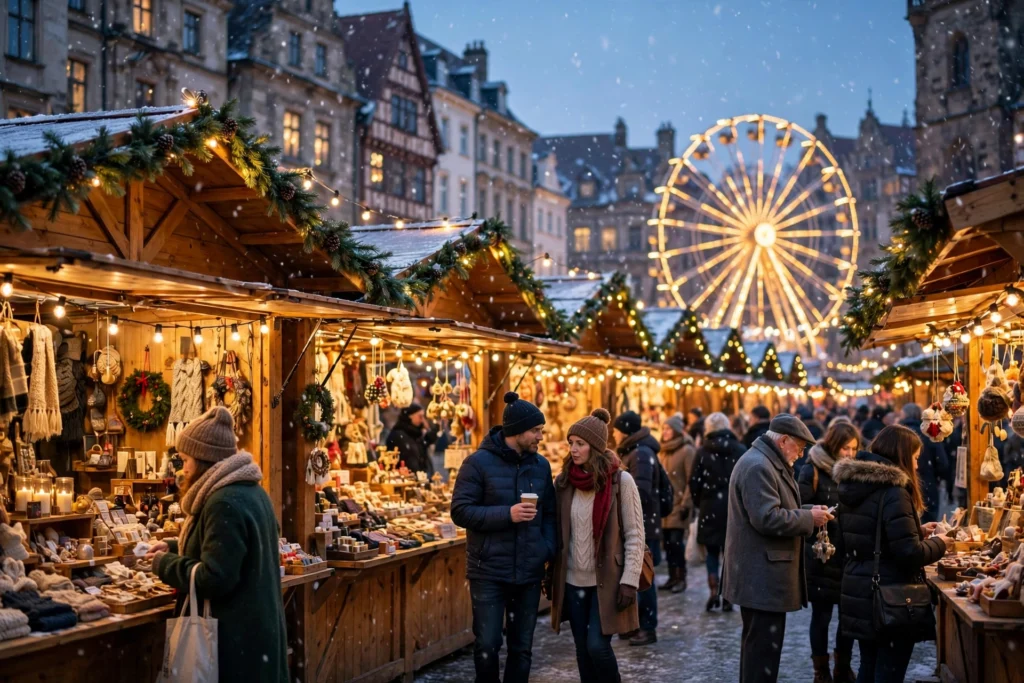
Europe’s most unusual Christmas market isn’t in a square, a palace courtyard, or a medieval old town — it’s underground. The Dutch Christmas markets of Valkenburg and Maastricht offer a one-of-a-kind festive double-header: Valkenburg’s Christmas markets held inside ancient marlstone caves quarried since Roman times, paired with Maastricht’s elegant above-ground market in one of the Netherlands’ oldest and loveliest cities. This guide covers both in depth — the caves, the tickets, the food, a perfect 2-day itinerary, and practical planning for 2026.
Valkenburg rebrands itself Kerststad (Christmas Town) for nearly two months each winter, and the title is earned: markets in two separate cave systems, a Christmas parade through the illuminated town center, and a whole town wrapped in lights. It’s widely described as the oldest, largest, and most visited underground Christmas market in Europe — and genuinely unlike anything else on the continent. Pair it with Maastricht, 15 minutes away by train, and you have the perfect Dutch Christmas long weekend.
Valkenburg: Christmas Underground
The caves
Valkenburg sits atop a labyrinth of marlstone caves (mergelgrotten) — not natural caves, but centuries-old quarries cut into soft limestone, worked since Roman times. The stone built the town’s castle and churches; the tunnels later served as hiding places in wartime. Each winter, two of these cave systems transform into Christmas markets:
- Gemeentegrot (Municipal Cave): the largest and most famous — a vast network of tunnels filled with stalls selling Christmas decorations, gifts, and crafts, all strung with thousands of lights. The cave’s history (Roman quarry, WWII hiding place, Cold War shelter) adds layers to the visit; charcoal drawings and ancient inscriptions still mark the walls.
- Fluweelengrot (Velvet Cave): a 5-kilometer labyrinth directly beneath the castle ruins, with its own market plus remarkable wall paintings, sculptures, and a hidden chapel carved into the stone. The setting is more intimate and historic than the Municipal Cave.
Beyond the two market caves, Kerststad Valkenburg includes MergelRijk — a cave attraction telling the story of marlstone through sculptures, films, and interactive displays in a Christmas setting — and Winter Wonderland at the Wilhelmina Cave, known for its sand sculptures. The whole town center glows with lights, and the Landal Christmas Parade winds through the streets on Wednesday and Saturday evenings with music, costumes, and dancers.
Tickets and practical cave tips
Unlike almost every other European Christmas market, Valkenburg’s cave markets require tickets — and on busy weekends, timed-entry slots. Key things to know:
- Book ahead: each cave is run by a separate organization with its own ticketing — the Municipal Cave, Velvet Cave, and MergelRijk each sell separate tickets. Weekend slots sell out; book online before your trip.
- Allow 1–2 hours per cave: the tunnels are extensive; rushing defeats the purpose.
- Dress for constant cool: caves hold steady cool temperatures year-round — a warm layer is wise even if the day is mild.
- Footwear: the cave floors can be uneven and damp in places — wear sturdy, non-slip shoes.
- Photography: the light-strung tunnels are incredibly photogenic; a phone handles it fine, but a small tripod helps in the dimmer passages.
- Combine caves smartly: do the Municipal Cave (largest) and Velvet Cave (most historic) as your core pair; add MergelRijk if you love the storytelling angle.
The town above
Don’t skip Valkenburg’s surface. The town center — with its castle ruins on the hill, the old Grendelpoort gate, and streets strung with lights — is charming, and the Christmas parade (Wednesday and Saturday evenings) is a highlight. The castle ruins themselves are worth the climb for the views. Street stalls sell oliebollen (Dutch New Year doughnuts), roasted chestnuts, and glühwein to keep you warm between caves.
When Valkenburg runs
Kerststad Valkenburg traditionally runs from mid-November into early January — one of Europe’s longest Christmas seasons, and notably earlier-opening than most German markets. The extended season means you can visit in late November with thinner crowds or between Christmas and New Year when most German markets have closed. Exact 2026 dates are announced well ahead on the official Kerststad Valkenburg channels — confirm before booking, as the cave ticketing is date-specific.
Maastricht: The Elegant Above-Ground Pairing
One of the Netherlands’ oldest cities, dressed for Christmas
Fifteen minutes by train from Valkenburg, Maastricht is among the oldest cities in the Netherlands — a handsome university city of medieval churches, fortified walls, and lively squares, with a distinctly Burgundian (southern, food-loving) character. Its Christmas market centers on the Vrijthof, the city’s great square, with a Ferris wheel, ice rink, and rows of chalets beneath the twin churches of Saint Servatius and Saint John.
Maastricht’s market is the perfect complement to Valkenburg’s caves: traditional, above-ground, and set in a genuinely beautiful city. The Vrijthof glows after dark, the food stalls run from Dutch classics to Belgian-influenced treats (Maastricht sits near the Belgian border), and the city’s shopping streets — some of the Netherlands’ best — handle the gift list. The ice rink on the Vrijthof with the churches floodlit behind it is one of the prettiest skating settings in Europe.
Maastricht beyond the market
- The Vrijthof & the churches: Saint Servatius Basilica (with its treasury) and Saint John’s Church frame the square.
- Boekhandel Dominicanen: a bookshop inside a 13th-century Dominican church — one of the world’s most beautiful bookstores.
- The city walls & Helpoort: the oldest surviving city gate in the Netherlands, and lovely wall walks.
- Wyck district: across the Maas river — hip boutiques, cafés, and restaurants in a historic quarter.
- Maastricht’s caves too: the city’s own marlstone cave systems (the Casemates and Zonneberg caves) offer guided tours year-round — a fascinating complement to Valkenburg’s market caves.
- Shopping: the Stokstraatkwartier and Entre Deux are excellent for fashion and design gifts.
Dutch Christmas Food: What to Eat
- Oliebollen: the deep-fried doughnut balls dusted with powdered sugar — the essential Dutch winter treat, best hot from a street stall.
- Poffertjes: tiny fluffy pancakes with butter and powdered sugar — a market-stall classic.
- Stroopwafels: caramel-syrup waffles — get them fresh and warm from a market iron, not the packaged kind.
- Erwtensoep (snert): thick Dutch pea soup with sausage — the winter warmer sold at hearty market stalls.
- Kibbeling: battered fried fish bites with remoulade — a Dutch street-food staple.
- Glühwein & warme chocomel: mulled wine and thick Dutch hot chocolate.
- Speculaas: Dutch spiced biscuits — buy tins for gifts.
- Banketstaaf: the almond-paste-filled pastry log — a Sinterklaas-season classic that lingers into Christmas.
- Belgian-border influence: in Maastricht, expect frites, waffles, and excellent beer alongside the Dutch classics.
For your own holiday baking, our Christmas dinner ideas include European festive inspiration.
The Perfect 2-Day Valkenburg & Maastricht Itinerary
Day 1: Valkenburg — underground Christmas
Morning: Arrive in Valkenburg (train from Maastricht, ~15 minutes). Start with the Gemeentegrot (Municipal Cave) — book the first timed slot of the day for the calmest experience. Allow up to 2 hours for the tunnels, the stalls, and the cave’s remarkable history.
Afternoon: Lunch in the town center (erwtensoep and poffertjes), climb to the castle ruins for the views, then descend into the Fluweelengrot (Velvet Cave) for the wall paintings, sculptures, and hidden chapel. If time allows, add MergelRijk’s storytelling caves.
Evening: The town center after dark — lights, street stalls, oliebollen — and the Christmas parade if it’s a Wednesday or Saturday. Dinner in a cozy Limburg restaurant (try the local Limburgse vlaai fruit pie for dessert).
Day 2: Maastricht — the elegant market city
Morning: Train to Maastricht. Explore the Vrijthof market in the calm late morning — prime shopping time — then visit the Boekhandel Dominicanen bookshop-church and the Basilica of Saint Servatius.
Afternoon: Walk the city walls to the Helpoort, explore the Wyck district’s boutiques, and warm up with warme chocomel. The Stokstraatkwartier handles serious gift shopping.
Evening: Back to the Vrijthof as darkness falls — the Ferris wheel, the ice rink, the floodlit churches — for the definitive Maastricht Christmas moment. Farewell dinner of moules-frites or a Limburg brasserie meal.
Extension: with a third day, add Aachen, Germany (30 minutes by train) — its famous Christmas market and Printen gingerbread pair beautifully. See our Germany Christmas markets guide for the German side of the border.
What to Buy: Dutch Souvenir Guide
- Cave-market crafts: the Valkenburg cave stalls sell Christmas decorations and gifts you won’t find elsewhere — buy here for originality.
- Stroopwafels & speculaas: fresh tins from market stalls and Maastricht shops.
- Delftware: the blue-and-white ceramics — Maastricht’s shops carry fine pieces.
- Dutch cheese: aged Gouda and Limburg specialties from market delis (check customs rules).
- Limburgse vlaai: the regional fruit pie — buy whole to take home if traveling nearby.
- Design gifts: Maastricht’s boutiques carry excellent Dutch design — a cut above typical souvenirs.
For more gift inspiration, our best Christmas gifts guide covers every recipient.
Practical Planning Guide
Getting there
Fly into Maastricht Aachen Airport (small, limited routes), Brussels (~1.5 hours by train), Düsseldorf, or Amsterdam Schiphol (~2.5 hours by direct train to Maastricht). Valkenburg has its own station, 15 minutes from Maastricht by local train. The region is also an easy drive from Germany’s Rhineland and Belgium — many visitors combine Valkenburg with Aachen or Liège.
Where to stay
Base in Maastricht for the best hotels, restaurants, and nightlife — it’s the livelier, more beautiful city — and day-trip to Valkenburg (15 minutes each way). Alternatively, stay in Valkenburg itself for maximum Christmas immersion; the town’s hotels lean cozy and festive. Book cave tickets before booking hotels, since timed entry determines your schedule. Reserve 2–3 months ahead for December weekends.
Budget guide
The Netherlands is mid-range by Western European standards. Maastricht hotels run roughly €110–170 per night in December; Valkenburg slightly less. Cave tickets run about €10–20 per cave for adults (each cave sells separately — budget for two or three). Market food is reasonable: oliebollen €3–4, poffertjes €5–7, erwtensoep €6–8, glühwein €4–5. A bistro dinner runs €25–40. The above-ground markets are free; only the caves are ticketed.
When to visit
Kerststad Valkenburg traditionally runs from mid-November into early January — opening earlier and closing later than most German markets, which makes it ideal for late-November trips (thinner crowds) or the days between Christmas and New Year (when alternatives have closed). Maastricht’s Vrijthof market typically runs from late November/early December into early January. Exact 2026 dates and cave ticket release dates are announced on the official Kerststad Valkenburg channels — confirm before booking, since cave entry is date- and time-specific.
Tips for the Dutch Christmas Markets
- Book caves first, plan around them: timed-entry tickets are the trip’s constraint — secure your slots, then build the itinerary.
- Do both market caves: the Municipal Cave for scale, the Velvet Cave for history and art — they’re different experiences.
- Go underground on weekdays: weekend cave slots sell out and the tunnels get crowded; a Tuesday visit is serene.
- Eat the oliebollen hot: they deteriorate fast — buy from a stall with a queue and eat immediately.
- Layer for the caves: constant cool underground, then back to winter air — easy-on layers work best.
- Combine with Aachen: 30 minutes by train, and its market is one of Germany’s most beautiful — the cross-border double-header is superb.
- Try the vlaai: Limburg’s fruit pie is a regional treasure most visitors miss.
- Traveling with family? The caves are pure magic for kids — plus Maastricht’s rink and our Christmas activities for families guide.
Aachen: The Cross-Border Extension
Thirty minutes by direct train from Maastricht, Aachen (Aix-la-Chapelle) hosts one of Germany’s most beautiful Christmas markets — and pairs perfectly with the Dutch trip. The market fills the square around the Aachen Cathedral (Charlemagne’s 1,200-year-old church, a UNESCO World Heritage site) and the Gothic town hall, with the city’s thermal-spring warmth giving it a slightly milder microclimate.
Aachen’s signature is Printen — the city’s famous spiced gingerbread, baked here since the 19th century and available in dozens of varieties (plain, chocolate-covered, with nuts). The market’s crafts lean German-traditional, the glühwein is excellent, and the cathedral-and-town-hall backdrop is magnificent after dark. As a day trip from Maastricht, it adds a German chapter to your Dutch Christmas — and the Printen alone justifies the train ride. For more German market inspiration, see our Nuremberg, Dresden & Cologne guide.
Limburg Beyond Christmas: Caves, Castles & Countryside
The Dutch province of Limburg rewards travelers who look beyond the markets:
- Maastricht’s own caves: the Casemates and Zonneberg caves — vast marlstone tunnel networks with guided tours covering 2,000 years of history, from Roman quarrying to WWII shelters. A fascinating complement to Valkenburg’s market caves.
- Valkenburg castle ruins: the only hilltop castle in the Netherlands — the climb is worth it for the views over the Geul valley.
- Limburg’s hills: the rolling countryside around Valkenburg — unusual in flat Holland — offers lovely winter walks through orchards and along the Geul river.
- Thorn: the “white village” — a tiny historic town of whitewashed houses, 30 minutes away, magical with Christmas lights.
- Liège, Belgium: 30 minutes by train — its Christmas market and famous Liège waffles (denser and sweeter than Brussels’) make an easy cross-border addition.
Sinterklaas vs. Christmas: Dutch Holiday Traditions
The Netherlands does December differently — understanding Sinterklaas enriches your market visit:
- Sinterklaas (December 5th): the Dutch gift-giving holiday predates Christmas in importance — St. Nicholas arrives by steamboat in mid-November, and children set out shoes with carrots for his horse. The December 5th pakjesavond (presents evening) is the year’s biggest family celebration.
- Two Decembers: Sinterklaas season (mid-November to December 5th) brings pepernoten, speculaas, and chocolate letters; Christmas season (December 6th onward) brings the kerstmarkten, oliebollen, and gourmetten.
- Chocolate letters: the Dutch give chocolate initials for Sinterklaas — market stalls sell them through December, and they make fun personalized gifts.
- Gourmetten: the beloved Dutch Christmas dinner tradition — tabletop grilling where everyone cooks their own mini-pans of meat and vegetables. It’s social, chaotic, and delicious.
- Christmas Day & Second Christmas Day: the Dutch celebrate both December 25th and 26th (Tweede Kerstdag) — the 26th is a full public holiday, and markets and restaurants stay lively.
Where to Eat in Maastricht: A Food Lover’s Shortlist
Maastricht’s Burgundian reputation is deserved — the city eats well. Beyond the market stalls:
- Vrijthof brasseries: the grand cafés on the square do excellent moules-frites and Limburgse vlaai with a view of the market lights.
- Wyck district: across the river — the city’s foodie quarter, with wine bars, bistros, and innovative restaurants in historic buildings.
- Limburg specialties: try zuurvlees (sweet-sour beef stew), asperges (in season), and the region’s fruit pies.
- Belgian influence: Trappist beers and stoofvlees appear on menus — Maastricht’s border position shows on every plate.
- Coffee culture: the city’s brown cafés (bruine kroegen) are cozy winter refuges — order a warme chocomel with slagroom (whipped cream).
Valkenburg Tickets & Timing: The Essential Recap
Because the caves are the trip’s constraint, here’s the booking logic in one place: reserve cave tickets online before anything else — the Municipal Cave and Velvet Cave each sell separate timed-entry tickets through their own channels, and weekend slots in December sell out weeks ahead. Weekday visits are calmer and often cheaper. Pair the caves on the same day (morning + afternoon) to keep your schedule tight, and leave Maastricht for day two when you’re free of timed commitments. The Christmas parade runs Wednesday and Saturday evenings — if your dates flex, align a Valkenburg overnight with a parade night. Finally, confirm 2026 dates and ticket-release timing on the official Kerststad Valkenburg channels as soon as you start planning; the caves announce their seasons well ahead, and early bookers get the best slots. Sign up for their newsletter if dates aren’t out yet — cave tickets for December weekends are among the first Christmas travel items to sell out each year.
Frequently Asked Questions
What makes Valkenburg’s Christmas market special?
It’s held underground — inside historic marlstone caves quarried since Roman times. The Gemeentegrot (Municipal Cave) and Fluweelengrot (Velvet Cave) host Christmas markets in light-strung ancient tunnels, making Valkenburg’s the oldest, largest, and most visited underground Christmas market in Europe. The whole town becomes “Kerststad” (Christmas Town) for nearly two months.
Do I need tickets for Valkenburg’s Christmas caves?
Yes — unlike most European Christmas markets, the cave markets require tickets, and timed-entry slots on busy days. Each cave (Municipal, Velvet, MergelRijk) is run separately with its own ticketing, so book each in advance online, especially for weekends.
When are the Valkenburg and Maastricht Christmas markets in 2026?
Kerststad Valkenburg traditionally runs from mid-November into early January; Maastricht’s Vrijthof market typically runs late November/early December into early January. Exact 2026 dates are announced on the official channels — confirm before booking, as cave tickets are date-specific.
Can I visit Valkenburg and Maastricht in one trip?
Easily — they’re 15 minutes apart by direct local train. Base in Maastricht (better hotels and restaurants) and day-trip to Valkenburg, or stay in Valkenburg for full Christmas immersion. Two days covers both comfortably.
What is Kerststad Valkenburg?
“Christmas Town Valkenburg” — the town’s festive identity from mid-November to early January, encompassing the two cave markets, MergelRijk, the Wilhelmina Cave Winter Wonderland, the illuminated town center, and the Wednesday/Saturday evening Christmas parade.
What Dutch food should I try at the Christmas markets?
Oliebollen (hot doughnut balls), poffertjes (mini pancakes), fresh stroopwafels, erwtensoep (pea soup), kibbeling (fried fish), speculaas biscuits, banketstaaf (almond pastry), and Limburgse vlaai (fruit pie) — plus warme chocomel (thick hot chocolate) and glühwein.
Christmas, Underground and Over
The Dutch Christmas markets of Valkenburg and Maastricht offer what no other destination on this list can: a Christmas celebrated beneath the earth in Roman-quarried tunnels, paired with one of the Netherlands’ most beautiful cities glowing above ground. Book the caves, eat the oliebollen hot, skate the Vrijthof at dusk — and consider the Aachen extension for a cross-border finale. For the continental ranking, see our best Christmas markets in Europe, and for Switzerland’s very different premium take, our Zurich & Basel guide. Vrolijk kerstfeest!