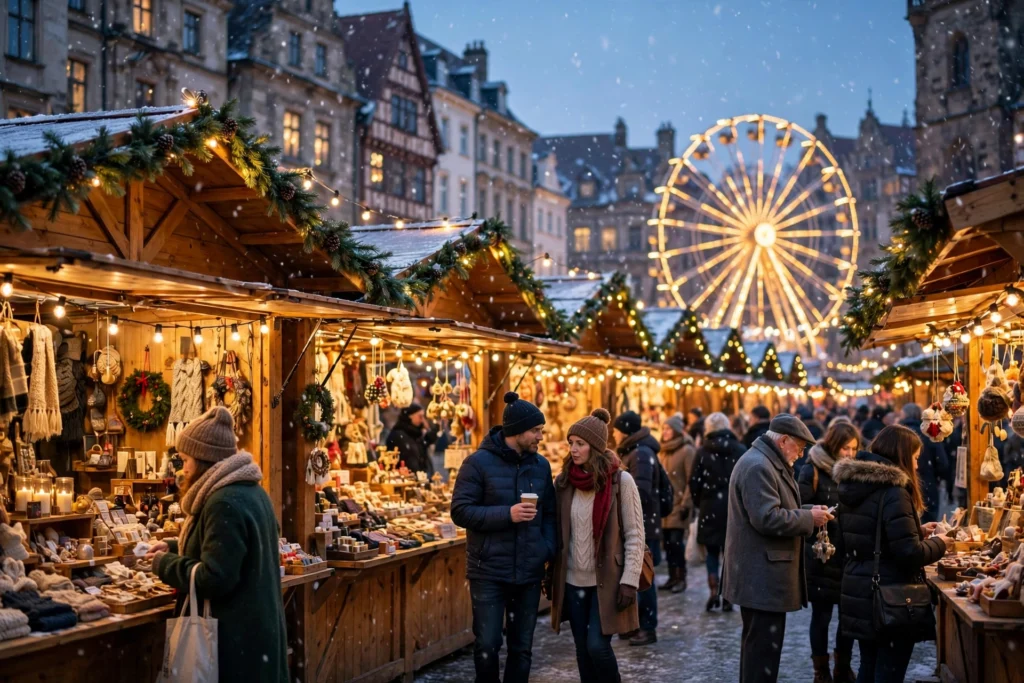
There is a moment, usually around five in the evening in December, when Krakow’s Main Market Square does something no other Christmas market in Europe quite manages. The light drains from the sky over the twin towers of St. Mary’s Basilica, the wooden stalls flicker on one by one, someone is grilling oscypek cheese two stalls down, and the whole largest medieval square in Europe smells of cinnamon, woodsmoke, and mulled wine. That is the Krakow Christmas market in Poland — and once you have stood in it, the glossy German mega-markets start to feel a little overproduced.
Krakow is the thinking traveler’s Christmas market pick. It is one of the most atmospheric old towns on the continent, the prices are a fraction of what you would pay in Vienna or Munich, and the market itself is built around traditions you will not find anywhere else — most famously the szopka, Krakow’s wildly elaborate handmade nativity cribs that look like miniature Gothic cathedrals and have earned a place on UNESCO’s Intangible Cultural Heritage list. This is not a market that imports its Christmas from somewhere else. It grew here, over centuries, and it shows.
This guide covers everything you need to plan a trip: when to go and what the 2026 season looks like, how to get to Rynek Główny from anywhere, what to eat and what to buy, where to stay within earshot of the hejnał trumpet call, the day trips that turn a market visit into a full winter holiday, a realistic budget planner, and tips for visiting with kids. If you are weighing Krakow against the bigger-name markets, start with our roundup of the best places to spend Christmas — then come back, because Krakow tends to win people over.
When to Go: Krakow Christmas Market Dates, Hours & Best Days
The Krakow Christmas market takes place in Rynek Główny — the Main Market Square — and in a typical year it opens on the last Friday of November and runs through the Christmas season into early January. For the 2026 season, organizers have announced a run from late November (around November 27) into the first days of January, with the core market winding down around December 26 and some stalls lingering into the new year. Exact closing arrangements can shift from year to year, so confirm the dates on the city’s official tourism channels before you book non-refundable travel.
Opening hours generally run from about 10:00 AM to 8:00 PM, stretching later — toward 10:00 PM — on Fridays and Saturdays when the square is at its liveliest. Christmas Eve and Christmas Day operate on reduced or partial hours, as Polish families traditionally spend Wigilia (Christmas Eve) at home, so plan your heaviest market time for the days before December 24 rather than the holiday itself.
The best week to visit
If you can choose, aim for the first or second week of December. The market is fully stocked and decorated, the szopka competition (more on that below) has just taken place on the first Thursday of December, the crowds are thinner than the pre-Christmas rush, and hotel prices have not yet hit their late-December peak. Weekday mornings are the quietest time to browse the stalls; weekday and Sunday evenings are when the square looks its best, all lit up, with a manageable buzz.
One date deserves special attention: the first Thursday of December, when the annual szopka competition and procession takes place beside the Adam Mickiewicz monument on the square. Craftsmen parade their towering, glittering cribs across Rynek Główny before the judging — it is one of the great free spectacles of the European Christmas season, and it only happens once a year.
Getting There: Reaching Rynek Główny
Krakow is one of the easiest Christmas market cities in Europe to reach. John Paul II International Airport (KRK) sits about 20 minutes west of the Old Town, with direct connections from most major European cities and a growing number of transatlantic routes. From the airport, the train to Krakow Główny (the main station) takes around 20 minutes and costs only a few euros; taxis and ride-shares run roughly four to five times that.
The market itself could not be more central. Rynek Główny anchors the Old Town, and virtually every tram line in the city stops at points around the Planty — the green ring that replaced the old city walls. If you are staying anywhere in the Old Town or Kazimierz, you will walk to the market. That walkability is a genuine advantage over markets in spread-out cities: you can dip in for a morning browse, retreat to your hotel to warm up, and return after dark for the lights without ever touching public transport.
Coming from elsewhere in Europe? Overnight and daytime trains connect Krakow with Warsaw (under three hours), Vienna, Budapest, and Prague. If you are building a multi-market winter trip, Krakow pairs beautifully with the medieval-square market in Tallinn or with Prague — similar fairytale-old-town energy, very different traditions.
What to Eat: A Food Lover’s Tour of the Stalls
Polish Christmas food is hearty, smoky, and built for cold weather, and the market stalls are the best possible introduction. Eat your way through this list and you will understand why food writers keep calling Krakow one of Europe’s great underrated food cities.
The non-negotiables
Oscypek — the star of the market. This is smoked sheep’s milk cheese from the Podhale region, grilled on the spot until the outside crisps and served with a spoonful of cranberry sauce. It is salty, smoky, squeaky, and completely addictive. Expect to pay roughly 8–15 PLN per piece depending on size and toppings. You will smell it before you see it; follow your nose.
Grzaniec galicyjski — Polish mulled wine, typically made with red wine, honey, cloves, orange, and sometimes a splash of something stronger. It costs around 10–18 PLN a cup, and many stalls sell it in a souvenir ceramic mug you can keep for a small deposit — one of the cheapest and most charming keepsakes in the market.
Pierogi — Poland’s famous dumplings appear at multiple stalls with Christmas-season fillings: cabbage and mushroom (the traditional Wigilia filling), potato and cheese (ruskie), and sweet versions with blueberries or strawberries. A plate of six to eight runs about 15–25 PLN, making it one of the best-value hot meals in the square.
Kiełbasa — grilled Polish sausage, served in a roll with mustard, sauerkraut, or bigos (hunter’s stew). Simple, smoky, perfect market food at roughly 12–20 PLN.
Sweet things and warming drinks
Pierniki — Polish gingerbread, often elaborately decorated and sold as both snack and ornament. Toruń gingerbread has been famous since the Middle Ages, and the market versions range from soft honey cakes to crisp spiced biscuits.
Prażone kasztany — roasted chestnuts, sold in paper cones by street vendors around the square. Gorąca czekolada — thick Polish hot chocolate, closer to a drinkable dessert — is the non-alcoholic warming drink of choice, and kompot z suszu, the traditional dried-fruit compote of Christmas Eve, appears at more traditional stalls.
If you want to go deeper on the food culture, the stalls around the Cloth Hall (Sukiennice) in the center of the square tend to skew more traditional, while the outer rows mix in international options. For the full sit-down version of everything above, Kazimierz — the historic Jewish quarter, a 15-minute walk south — holds Krakow’s best restaurants at prices that will make Western Europeans blink. Our Christmas dinner ideas can inspire your own Wigilia-style feast back home, but in Krakow, let the market feed you first.
What to Buy: Souvenirs and the Szopka Tradition
Krakow’s market is one of the best Christmas shopping stops in Central Europe, not because it is the biggest, but because so much of what is sold here is genuinely local. The stall mix leans heavily toward Polish artisans rather than imported trinkets, and prices are kind.
The szopka: Krakow’s one-of-a-kind Christmas art
The szopka krakowska — the Krakow nativity crib — is the single most distinctive Christmas craft in Poland. These are not simple manger scenes. Krakow’s craftsmen build soaring, kaleidoscopic structures modeled on the city’s own architecture: St. Mary’s towers, Wawel Castle, the Cloth Hall, rendered in colored foil, tissue paper, and wood, sometimes two meters tall, glittering like jeweled cathedrals. The tradition grew from 19th-century craftsmen making seasonal decorations for extra income, and it has been formalized since 1937 in an annual competition held every year on the first Thursday of December at the Main Market Square.
In 2018, UNESCO inscribed the szopka tradition on its Representative List of the Intangible Cultural Heritage of Humanity — the first Polish tradition to receive the honor. You can watch the competition entries parade across the square in December, see the winning cribs displayed afterward at the Historical Museum of Krakow, and buy small szopka-inspired ornaments and miniatures at the market stalls. A small handcrafted szopka ornament is the definitive Krakow Christmas souvenir; nothing else you can buy in Europe looks quite like it.
Other things worth your suitcase space
- Baltic amber jewelry — sold inside the Cloth Hall’s permanent arcades as well as at market stalls. Look for certificates of authenticity on larger pieces; small silver-and-amber pendants start at very reasonable prices.
- Polish pottery — the blue-and-white patterned stoneware from Bolesławiec is famous worldwide and far cheaper at the source.
- Hand-blown glass ornaments — Poland has a deep glassmaking tradition; the baubles here are intricate and inexpensive.
- Woolens and sheepskin — slippers, hats, and gloves from Podhale highland craftspeople, built for actual Polish winters.
- Pierniki (decorated gingerbread) — beautiful, edible, and packable.
- Oscypek to take home — the smoked cheese travels well for a day or two; vacuum-packed versions last longer.
A note on bargaining: prices at the market stalls are generally fixed, but buying multiple items from the same artisan will often earn you a small discount if you ask politely. If you are shopping for people back home, our Christmas gifts for foodies guide has ideas for pairing market finds with a proper Polish food hamper.
Where to Stay Near the Market
Location matters more than luxury in Krakow at Christmas, because the best experience is being able to walk to the square in minutes — ideally more than once a day. The Old Town (Stare Miasto) puts you within a five-to-ten-minute stroll of Rynek Główny. Expect mid-range hotels here to run roughly 350–700 PLN per night in December, with genuine bargains still available in early December before the holiday peak.
Kazimierz, the historic Jewish quarter just south of the Old Town, is the connoisseur’s choice: slightly cheaper, packed with Krakow’s best restaurants and bars, and a pleasant 15-minute walk (or short tram ride) to the market. Kleparz and the streets just north of the Planty offer good-value apartments — worth considering if you want a kitchen for market leftovers and mulled-wine supplies.
Book early December stays by October if you want the best-located rooms; the city’s hotel stock is large but the streets immediately around the square fill up. One delightful detail of staying central: at the top of every hour, you can hear the hejnał mariacki — the famous trumpet call played from St. Mary’s taller tower, which famously breaks off mid-melody in memory of the 13th-century trumpeter legend says was shot mid-call during the Mongol invasion. Hearing it drift over the market stalls at dusk is pure Krakow.
Day Trips That Turn a Market Visit Into a Winter Holiday
Krakow’s Christmas market is wonderful, but the city sits in the middle of one of Europe’s richest day-trip regions. Two or three extra days transform the trip.
Wieliczka Salt Mine (half day)
About 30 minutes southeast of Krakow, the Wieliczka Salt Mine is a UNESCO World Heritage site: 800 years of salt mining turned into an underground wonderland of chapels, chandeliers, and sculptures — all carved from rock salt. The Chapel of St. Kinga, 100 meters underground, is one of the most astonishing rooms in Europe. At Christmas the mine runs special seasonal programming, and the constant 14°C underground temperature feels balmy after the square. Book timed-entry tickets in advance; December slots sell out.
Zakopane and the Tatra Mountains (full day)
Two hours south by bus or train, Zakopane is Poland’s winter capital — a highland town of wooden architecture at the foot of the Tatras. December brings proper snow, sleigh rides, the Krupówki street market (a second Christmas market, highland-style), and oscypek at its source. If you only take one day trip and you love winter, make it this one.
Kazimierz and Schindler’s Factory (in the city)
Kazimierz deserves a full day on its own: seven historic synagogues, atmospheric cafés in former prayer houses, and the Galicia Jewish Museum. The former Oskar Schindler enamel factory in nearby Zabłocie now houses an outstanding museum of Krakow under Nazi occupation — sobering, essential, and best visited in the morning before an afternoon back at the market’s lights.
A note many guides skip: the Auschwitz-Birkenau Memorial and Museum at Oświęcim is about 90 minutes west and is open through the winter. It is a profoundly moving visit that many travelers pair with a Krakow trip; allow a full half day and book entry tickets well ahead, as numbers are capped.
Krakow Christmas Market Budget Planner
This is where Krakow quietly embarrasses Western Europe. A long weekend here — flights aside — routinely costs half what the same trip would in Vienna, Munich, or Strasbourg. Poland uses the złoty (PLN); as a rough rule of thumb, divide by four for a ballpark euro equivalent.
| Expense | Budget traveler | Mid-range | Comfortable |
|---|---|---|---|
| Hotel, per night (Old Town) | 150–250 PLN (hostel/private room) | 350–600 PLN | 700–1,200 PLN |
| Mulled wine (grzaniec) | 10–18 PLN per cup | ||
| Oscypek with cranberry | 8–15 PLN | ||
| Plate of pierogi at the market | 15–25 PLN | ||
| Restaurant dinner (Kazimierz) | 40–60 PLN | 70–120 PLN | 150 PLN+ |
| Airport train | ~15 PLN | ||
| Wieliczka Salt Mine ticket | ~100–130 PLN (book ahead) | ||
| Souvenir szopka ornament | 20–80 PLN depending on size | ||
A couple can comfortably do three days — market grazing, one museum, one day trip, mid-range hotel — for roughly what a single night in a decent Munich hotel costs in December. That is the core of Krakow’s appeal: you are not compromising. You are getting one of Europe’s great old towns, a UNESCO-listed craft tradition, and world-class day trips, at Central European prices.
Visiting the Krakow Christmas Market With Kids
Krakow is a genuinely good Christmas market for families. The square is pedestrianized and flat, the stalls are dense enough that little legs do not have far to walk between points of interest, and the food — pierogi, sausages, gingerbread, hot chocolate — is about as kid-approved as market food gets.
Specific family wins: the szopka competition parade on the first Thursday of December is free street theater that mesmerizes children; the horse-drawn carriages clip-clopping around the square are a hit (agree the price before boarding); the Rynek Underground museum beneath the square — a high-tech archaeological exhibit of medieval Krakow — gives kids a warm, fascinating hour out of the cold; and the annual Christmas crib displays in churches around the Old Town make a lovely scavenger hunt.
Practical notes: December in Krakow averages around 0–3°C by day and below freezing at night, so dress children in full winter layers with waterproof boots — the square’s cobbles get slick. Public toilets are available in the Cloth Hall and nearby shopping centers. And build in warm-up breaks: the cafés on the square’s north side do excellent hot chocolate with a view of the stalls.
How Krakow Compares to Europe’s Other Great Markets
Travelers often ask whether to choose Krakow, Prague, or Vienna. Honestly, all three are superb — but they offer different things. Vienna is imperial and polished, with the highest prices. Prague is romantic but increasingly crowded. Krakow is the most authentically local-feeling of the three: the market serves Krakowians first and tourists second, the traditions (szopka, hejnał, Wigilia foods) are specific to this city, and your money goes roughly twice as far. If you want the fairytale-medieval-square experience with a distinctive national character and a sane budget, Krakow is the pick. For a second opinion from the other side of the Atlantic, see how it stacks up against the best Christmas markets in the USA — most American markets are charming imitations; this is the thing itself.
Frequently Asked Questions
When is the Krakow Christmas market 2026?
The market typically opens on the last Friday of November and runs through the Christmas season into early January. For 2026, organizers have announced a season starting around November 27 and extending into the first days of January, with the fullest stall lineup before December 26. Hours are generally 10:00 AM to 8:00 PM, later on weekends. Always confirm exact dates before booking, as they are finalized closer to the season.
Is the Krakow Christmas market free to enter?
Yes — entry to the market in Rynek Główny is completely free. You only pay for what you eat, drink, and buy. This is one of its advantages over ticketed market experiences elsewhere in Europe.
What is a szopka and where can I see one?
A szopka krakowska is Krakow’s traditional elaborate nativity crib — a tall, glittering architectural fantasy modeled on the city’s churches and landmarks. See the finest examples at the annual competition on the first Thursday of December at the Main Market Square, and the winning entries afterward at the Historical Museum of Krakow. Smaller versions are sold as souvenirs at market stalls.
Is Krakow expensive at Christmas?
By European Christmas market standards, no — it is one of the most affordable major market cities. Market food runs a few euros per item, mid-range Old Town hotels are very reasonable by Western European standards, and even the day trips (Wieliczka, Zakopane) are modestly priced. It is arguably the best value Christmas market trip in Europe.
Does it snow in Krakow in December?
Sometimes — December averages hover around freezing, and snow is common but not guaranteed in the city itself. The market looks magical with or without snow thanks to the lighting. For guaranteed snow, head to Zakopane in the Tatras, about two hours south, where December snow cover is the norm.
Can I do Krakow’s Christmas market as a day trip from Warsaw?
Technically yes — fast trains connect Warsaw and Krakow in under three hours — but you would miss the market at its best, which is after dark. Stay at least one night, ideally two or three, to see the square lit up in the evening and to fit in Wieliczka or Kazimierz.
Krakow at Christmas is the rare European city break that overdelivers on every axis: atmosphere, authenticity, food, value, and things to do beyond the market itself. Come for the szopka and the oscypek; stay for the trumpet call echoing over the square at dusk, the salt chapels underground, and the snow in the Tatras. Few Christmas trips offer this much, for this little, with this much soul.