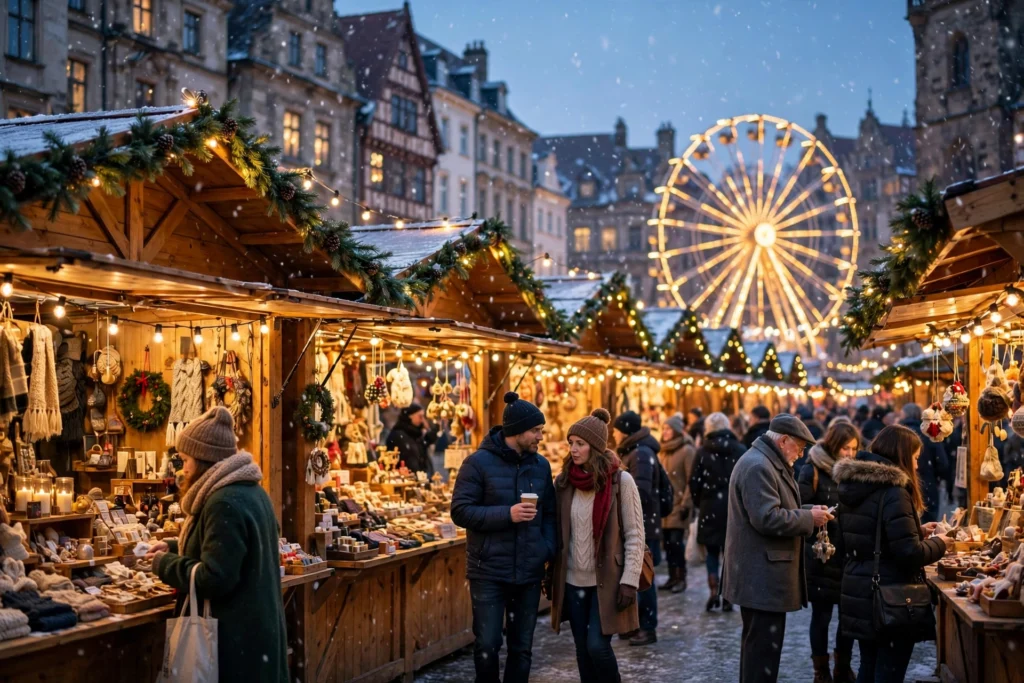
Here is the delightful paradox at the heart of this guide: the best Christmas markets in Italy barely feel Italian at all. In South Tyrol — the autonomous, German-speaking province tucked into the Dolomites — December smells of glühwein and cinnamon rather than panettone, the stalls sell stollen alongside strudel, and the town criers might greet you with “Frohe Weihnachten” before switching effortlessly to Italian. The Italian Christmas markets of Bolzano and Merano are the originals — South Tyrol claims the copyright on the alpine Christmas market — and they offer something no German or Austrian market can: Alpine tradition served with Italian warmth, world-class food, and the Dolomites as a backdrop.
Bolzano and Merano are only about 30 minutes apart by train, and every serious Christmas traveler does both. But they are very different experiences, and choosing how to split your time matters. This guide breaks down the Bolzano vs. Merano decision head-to-head, details each market, lays out a perfect two-day itinerary, covers the food you must try, and answers the practical questions — trains, hotels, and the smaller South Tyrolean markets worth your time. If Italy in winter has caught your imagination, our best places to spend Christmas guide puts South Tyrol in its full European context.
Bolzano vs. Merano: Which Market Is Right for You?
The short answer is both — but in what proportion depends on your travel style. Here is the honest comparison:
| Bolzano (Bozen) | Merano (Meran) | |
|---|---|---|
| Scale & energy | The biggest Christmas market in Italy; lively, bustling, festive chaos | Smaller, spread along the river; elegant, relaxed, romantic |
| Setting | Piazza Walther in the medieval old town, beneath the Gothic cathedral | The Passer river promenade, spa gardens, and medieval arcades |
| 2026 season | Typically late November to January 6 | Typically late November to January 6 |
| Signature vibe | The classic big-city Christmas market experience | Christmas meets wellness — markets plus thermal spas |
| Best for | First-timers, shoppers, families who want buzz | Couples, slow travelers, spa lovers |
| Food highlight | Huge variety; Zelten fruit bread, roasted chestnuts | Refined stalls; apple strudel by the river |
| Evening scene | Packed and glowing; concerts in the square | Quieter; lights reflecting on the Passer river |
| Crowds | Can be very busy on December weekends | Noticeably calmer, even on weekends |
The classic strategy, endorsed by just about everyone who knows the region: base yourself in Bolzano, spend a full day there, and give Merano a slow half-to-full day with an evening soak in the thermal baths. Or flip it — sleep in elegant Merano and day-trip to Bolzano’s buzz. Either way, the train between them is cheap, frequent, and scenic.
Bolzano’s Christkindlmarkt: Italy’s Biggest, in Piazza Walther
Bolzano’s market fills Piazza Walther (Piazza Walther von der Vogelweide), the city’s main square, with around 80 wooden stalls arranged beneath a towering Christmas tree and the spire of the Gothic Duomo. It has been running since the early 1990s and has grown into Italy’s largest Christmas market — and the anchor of the entire South Tyrolean market circuit.
What strikes you first is the quality control. South Tyrol’s markets are juried: vendors are selected for authentic regional crafts, which means fewer stalls of mass-produced trinkets and more woodcarvers, felt-makers, candle-pourers, and glassblowers actually demonstrating their work. The food stalls are equally serious — this is a region with more Michelin stars per capita than almost anywhere in Italy, and it shows even at street level.
For the 2026 season, expect the market to run from late November through January 6, typically open from around 10:00 AM to 7:00 PM for crafts and later — until 9:00 or 10:30 PM on weekends — for food and drink. Note that December 25 is usually a quiet or closed day, and Christmas Eve sees early closing; the days between Christmas and Epiphany are actually a lovely, calmer time to visit.
Don’t miss in Bolzano
- The big tree and the daily atmosphere in Piazza Walther — arrive at dusk when the lights come on against the cathedral.
- Ötzi the Iceman — the South Tyrol Museum of Archaeology, a short walk from the market, houses the 5,300-year-old mummy. A superb rainy-day or warm-up detour.
- The Ritten (Renon) railway — ride the historic narrow-gauge railway up to Soprabolzano for panoramic Dolomite views and the small mountain Christmas market at the top.
- Walther Square concerts — brass bands and choirs perform regularly through the season; the Tyrolean brass sound is pure Alpine Christmas.
Merano’s Meraner Weihnacht: Elegance on the River
If Bolzano is the life of the party, Merano is the intriguing guest everyone wants to talk to. The Merano Christmas market stretches along the Passer river promenade and through the spa quarter — the Kurhaus, Thermenplatz, Sandplatz, and the medieval arcades of the old town. Instead of one dense square, you wander: from stall to stall along the water, with the lights reflecting off the river and the mountains pressing in on all sides.
Merano was the spa town of the Austro-Hungarian aristocracy — Empress Sisi came here — and that belle-époque elegance still shapes the market. The stalls skew refined: fine woodwork, high-quality textiles, artisan foods. There is an ice rink at Thermenplatz with skate rental, a popular meeting point for families, and the program leans cultural: concerts in the Kurhaus, storytellers for children, and a distinctly relaxed pace.
The 2026 season runs from late November to January 6, with stalls generally open 10:00 AM to 7:00 or 8:00 PM and food stands later into the evening. As in Bolzano, expect early closing on December 24 and closure on December 25.
The thermal baths: Merano’s secret weapon
No other major Christmas market in Europe lets you do this: browse snowy stalls in the afternoon, then sink into steaming outdoor thermal pools as snow falls around you in the evening. Terme Merano, right in the town center, has 25 pools and a large sauna area; the outdoor pools in winter, with the cold air and hot water, are genuinely magical. Book tickets online a few days ahead in December — it is popular. Budget roughly €20–45 depending on the ticket type and duration. This alone justifies the Merano day trip.
The Perfect Two-Day Bolzano-Merano Itinerary
Two days is the sweet spot — one full day per town, with the train doing the heavy lifting. Here is how to spend them:
Day 1 — Bolzano: the big market day
Morning: Arrive and head straight to Piazza Walther. Do a full loop of the stalls before the midday crowds — this is your serious shopping window for crafts and gifts. Pop into the Duomo to see its patterned roof tiles up close.
Midday: Lunch at a traditional stube near the square — knödel (bread dumplings) with goulash, or speck and cheese boards. Then the Ötzi museum for an hour out of the cold.
Afternoon: Ride the cable car to Soprabolzano and the Ritten railway for Dolomite panoramas and the little mountain market. Back down by 4:30 PM.
Evening: The market at dusk is the main event — glühwein in hand, brass band if you are lucky, dinner at a wine-focused restaurant in the old town. South Tyrolean wines (Lagrein reds, Gewürztraminer whites) are superb and cheap at the source.
Day 2 — Merano: the slow elegant day
Morning: Train to Merano (about 30–40 minutes, a few euros). Walk the Tappeiner Promenade above the town for sweeping views, then descend into the old town’s medieval arcades — some of the longest and best-preserved in the Alps.
Midday: Wander the riverside market stalls at your own pace — this is browsing, not hunting. Lunch along the Passer: apple strudel is non-negotiable.
Afternoon: The Kurhaus and the Christmas stalls around Thermenplatz; kids will want the ice rink. Pick up food gifts — speck, mountain cheese, Zelten.
Evening: Terme Merano for a two-to-three-hour thermal session as darkness falls, then a relaxed dinner. Train back to Bolzano, or stay the night in Merano if you have booked it.
Have a third day? Add Bressanone (Brixen), 25 minutes north of Bolzano by train — its smaller market in the cathedral square is a local favorite, and the town itself is a jewel. Our Christmas activities guide has more ideas for filling winter days with family-friendly fun.
What to Eat: A South Tyrolean Christmas Food Guide
South Tyrolean cuisine is the happy collision of Alpine heartiness and Italian finesse. At the markets, prioritize these:
- Apfelstrudel — apple strudel, served warm with vanilla sauce or cream. The region’s apples (Val Venosta) are famous; this is strudel at its source.
- Krapfen — jam-filled doughnuts, a market staple across South Tyrol, dusted with sugar and eaten hot.
- Zelten — the traditional South Tyrolean Christmas fruit bread, dense with dried fruit, nuts, and spices. Buy a loaf to take home; it keeps for weeks.
- Speck — lightly smoked cured ham, the region’s signature charcuterie. Market stalls sell it by the cone or the vacuum pack.
- Knödel — bread dumplings in all forms: speckknödel, kaspressknödel (cheese), sweet apricot ones. The ultimate Alpine comfort food.
- Glühwein & heißer Apfelsaft — mulled wine and hot spiced apple juice, sold in collectible market mugs (usually €3–5 including the drink, with a deposit system for the mug).
- Roasted chestnuts (gebratene Kastanien) — from the Eisack Valley chestnut groves, sold in paper cones.
- Strauben — funnel-cake-like fried dough with cranberry sauce, a market-day treat.
For sit-down meals, look for restaurants advertising cucina tipica altoatesina — the fixed-price lunch menus (often €15–25 for multiple courses) are one of Italy’s great dining bargains. If the market food inspires your own holiday cooking, our Christmas dinner ideas include Alpine-friendly showstoppers.
Getting There & Getting Around
Bolzano is the gateway. By train, it is about 2.5 hours from Verona, 3.5 from Milan, and just over 4 from Munich — the Brenner line runs straight through, making this an easy add-on to a northern Italy or southern Germany trip. The nearest airports are Verona and Innsbruck (each roughly 90 minutes to two hours by train or bus); Bolzano’s own small airport has limited service.
Between Bolzano and Merano, regional trains run roughly every 30 minutes and take 35–45 minutes, costing only a few euros each way. The South Tyrol Guest Pass, included free with many hotel stays, covers all regional trains and buses — ask your hotel. Within each town, everything market-related is walkable; Bolzano’s center is compact and Merano’s market is a riverside stroll.
Driving is possible but unnecessary for the markets themselves — both old towns restrict cars, and December parking is tight. If you are touring the Dolomites beyond the markets, a car earns its keep; for a Bolzano-Merano market weekend, the train wins.
Where to Stay: Bolzano, Merano, or the Mountains?
Bolzano offers the most choice: family-run guesthouses in the old town, modern design hotels near the station, and excellent value overall — expect roughly €90–180 per night for a good mid-range double in December, climbing on weekends. Staying within the old town means the market is your evening stroll.
Merano skews more upscale and romantic — belle-époque grand hotels along the promenade, spa hotels with their own thermal pools, and charming B&Bs. Prices run a little higher than Bolzano, roughly €110–220 for mid-range, but the atmosphere rewards it, especially for couples.
The mountains — villages like Soprabolzano, Avelengo, or the Val Gardena — offer snow-guaranteed stays with market day-trips. This is the play if you want skiing plus markets: many Dolomiti Superski areas open from late November.
Book December weekends by October. Midweek stays in early December are the value sweet spot — lower prices, thinner crowds, fully decorated markets.
Beyond the Big Two: South Tyrol’s Smaller Markets
The Bolzano-Merano corridor is the headline act, but South Tyrol’s smaller markets are where locals actually go — and they are easy to add:
- Bressanone/Brixen — 25 minutes north of Bolzano by train. A jewel-box market in the cathedral square (Piazza Duomo), running late November to early January, with a beloved light-and-music show projected on the bishop’s palace. Arguably the prettiest small market in the region.
- Brunico/Bruneck — in the Puster Valley, about an hour northeast. A charming market along the medieval town walls with a strong crafts focus; pairs well with the Plan de Corones ski area.
- Vipiteno/Sterzing — a tiny, perfectly preserved medieval mining town between Bolzano and the Brenner Pass. Its market is small and deeply traditional — the anti-tourist-trap.
- Trento — technically in Trentino rather than South Tyrol, but on the same rail line south of Bolzano. Its market in Piazza Fiera is lively and very Italian in flavor, a nice contrast if you want both cultures.
- San Candido/Innichen — far east in the Dolomites, a storybook village market for those touring the eastern valleys.
If you have four or five days, the “five markets” tour — Bolzano, Merano, Bressanone, Brunico, Vipiteno — is one of Europe’s great Christmas road or rail trips, all within about an hour of each other.
Budget: What a South Tyrol Market Trip Costs
South Tyrol is not the cheapest Christmas destination in Italy, but it is fair value for the quality — roughly on par with Austria, cheaper than Switzerland, and the food quality per euro is exceptional.
- Mid-range hotel: €90–180/night (Bolzano), €110–220 (Merano)
- Glühwein at the market: €3.50–5 per mug
- Market snacks (strudel, krapfen, sausages): €3–8 each
- Traditional lunch (fixed menu): €15–25
- Dinner at a good restaurant: €30–55 per person with wine
- Bolzano–Merano train: a few euros each way
- Terme Merano: roughly €20–45 depending on ticket
- Ötzi museum: around €10–13
Money-saving moves: stay midweek, eat your main meal at lunch (fixed menus), use the free Guest Pass transport, and buy food gifts at the markets rather than in shops — the Zelten, speck, and apple products are both better and cheaper at the stalls. For pairing your edible souvenirs with presents from home, browse our Christmas gifts for coworkers — a Zelten loaf plus a small gift beats any generic hamper.
South Tyrolean Christmas Traditions Beyond the Stalls
The markets are the centerpiece, but South Tyrol’s Advent traditions run deeper — and timing your visit around them adds a layer most tourists miss.
St. Nicholas Day (December 6) is the region’s biggest pre-Christmas event. In villages across South Tyrol, St. Nicholas parades with angels distributing treats to children — while the Krampus, his horned, fur-clad companions, rattle chains and chase the crowds. The Krampus runs (Krampusläufe) in towns like Toblach/Dobbiaco and Brunico are thrilling, slightly wild folk theater, and a genuine centuries-old Alpine tradition rather than a tourist show. If you are in the region in early December, ask your hotel about the local Krampuslauf — it is unforgettable.
Advent concerts fill the region’s churches through December: Tyrolean brass ensembles, mountain choirs, and organ recitals in Bolzano’s Duomo and Merano’s St. Nicholas church. Many are free or donation-based. The Christkindl processions and living nativity scenes (lebende Krippen) in smaller villages offer a quieter, candlelit counterpoint to the market buzz.
And then there is New Year’s in the mountains: since both markets run through January 6, the week between Christmas and Epiphany is a local secret — snow-assured villages, torch-lit ski descents, and New Year’s Eve fireworks over the Dolomites, all without the pre-Christmas crowds. If your schedule allows a late-December trip, this is South Tyrol at its most magical.
Frequently Asked Questions
When do the Bolzano and Merano Christmas markets open in 2026?
Both markets typically open in late November and run through January 6 (Epiphany). For 2026, expect Bolzano’s Christkindlmarkt to run from around November 27 to January 6, and Merano’s Meraner Weihnacht from around November 26 to January 6. Stalls generally open around 10:00 AM; food stands stay open later, especially on weekends. Confirm exact dates on the official market websites before booking.
Is one day enough for Bolzano and Merano?
You can see both in a day if you must — they are 30–40 minutes apart by train — but it would be rushed. Two days (one per town) is the sweet spot, and three lets you add Bressanone or the thermal baths properly. The markets themselves are free, so the constraint is your energy, not tickets.
Do people speak Italian or German at the markets?
Both — South Tyrol is officially bilingual. In Bolzano and Merano you will hear German, Italian, and the local dialects interchangeably; virtually all stallholders and hospitality staff speak both languages plus English. Menus and signs are bilingual. It is part of the charm.
What should I buy at the Bolzano and Merano Christmas markets?
Zelten fruit bread, speck, mountain cheeses, apple products (juice, dried apples, strudel mixes), hand-carved wooden ornaments, felt goods, candles, and blown-glass decorations. The juried vendor selection means quality is consistently high — buy the crafts here rather than at generic souvenir shops.
Can I ski and visit the Christmas markets in the same trip?
Absolutely — this is one of South Tyrol’s great combinations. Many Dolomiti Superski areas open from late November. Ski in the morning at Val Gardena, Alta Badia, or Plan de Corones, and be at a market by late afternoon. Base yourself in Bolzano or Bressanone for the easiest ski-plus-market logistics.
Are the markets open on Christmas Day?
Generally no — December 25 is typically a closed or very quiet day, and Christmas Eve sees early closing (often mid-afternoon). The days between Christmas and January 6 are open and pleasantly calm. If Christmas Day itself matters to your trip, plan a thermal bath session, a mountain excursion, or a long Italian lunch instead.
Bolzano and Merano offer the rare Christmas market trip with no compromises: the Alpine authenticity of Austria, the food culture of Italy, the Dolomites on the horizon, and thermal water waiting at the end of the day. Come hungry, pack layers, and leave room in your suitcase for Zelten. South Tyrol does Christmas the way Christmas was meant to be done — slowly, deliciously, and with mountains. Few places in Europe reward a December visit quite like it.