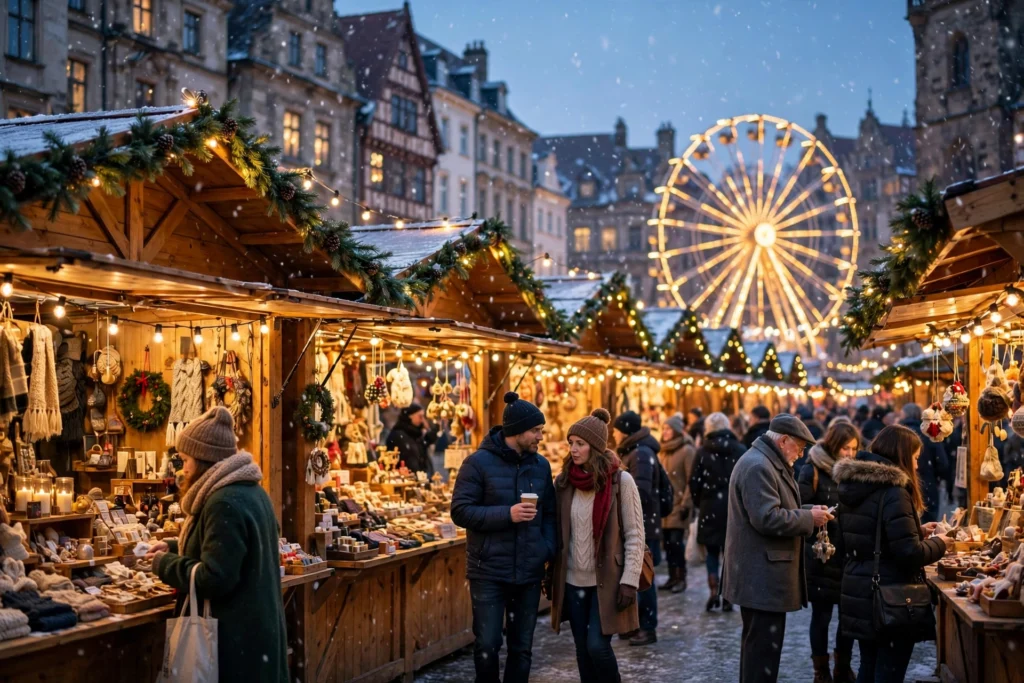
Spain does Christmas differently — and that is exactly why its markets deserve a place on your winter itinerary. While northern Europe leans into snow and solemnity, the Christmas markets in Spain, from Madrid to Barcelona, are sunlit, social, and built around one of the world’s great festive obsessions: the belén, the nativity scene. Here, Christmas shopping is less about woolen hats and more about finding the perfect tiny clay shepherd for the family nativity, arguing over turrón varieties, and dodging the joke-shop stalls that appear for Holy Innocents’ Day. Add mild December weather — often 10–15°C in the afternoons — and you have southern Europe’s most joyful festive shopping.
This guide covers the two essential markets — Madrid’s historic Plaza Mayor market and Barcelona’s centuries-old Fira de Santa Llúcia — plus the cities worth adding, the foods you must try, and how to combine Madrid and Barcelona into one seamless Christmas trip. If you are still choosing your December destination, our best places to spend Christmas guide compares Spain with the snowy heavyweights.
Madrid: The Plaza Mayor Christmas Market Since the 1800s
Madrid’s Mercado de Navidad in Plaza Mayor is the beating heart of Christmas in the Spanish capital — and one of the oldest Christmas markets in southern Europe. The market has been held in various forms since the 19th century (1860 is the date most histories cite, though festive trading in the square has roots stretching back to the 1600s), and it remains defiantly traditional: around 104 uniform red wooden stalls arranged in neat rows across the grand arcaded square, run by individual vendors organized through the market’s own association.
The season typically runs from late November through December 31 — in recent years opening around November 27 and closing on New Year’s Eve. Opening hours are generally 10:00 AM to 9:00 PM Sunday through Thursday, extending to 10:00 PM on Fridays, Saturdays, and holiday eves. Entry is free, and the market sits five minutes’ walk from Puerta del Sol, so it slots effortlessly into any Madrid sightseeing day.
What makes Plaza Mayor special
- The belenes: entire rows of stalls are devoted to nativity figures and accessories — hand-painted clay shepherds, moss, cork bark for grottos, miniature wells and campfires. For Spanish families, building the belén is the central Christmas ritual, and this is where the pieces come from.
- Artículos de broma: the joke and costume stalls, which do their roaring trade around Día de los Santos Inocentes (Holy Innocents’ Day, December 28) — Spain’s answer to April Fools’ Day. Expect whoopee cushions, fake lottery tickets, and wigs.
- The scale of the square: Plaza Mayor’s frescoed facades and the equestrian statue of Felipe III make this one of Europe’s most beautiful market settings — especially after dark, when the square glows.
- Free entertainment: puppet shows, choirs, and storytelling for children run through the season, keeping the market genuinely family-oriented rather than purely commercial.
Local tip: visit on a Tuesday or Wednesday morning for the calmest browsing; weekend evenings pack with madrileños doing their Christmas shopping. And do not eat dinner at the square’s terrace restaurants — they are famously overpriced. Walk five minutes in any direction for better food at half the price.
Madrid’s other markets
Plaza Mayor is the historic anchor, but Madrid’s Christmas scene is bigger: the Feria-Mercado de Artesanía de la Comunidad de Madrid at Plaza de España specializes in handmade crafts from Madrid-region artisans — better for unique gifts than Plaza Mayor. The Paseo de Recoletos artisan market and the design markets at Matadero Madrid skew contemporary. If you want crafts rather than nativity figures, prioritize these.
Barcelona: Fira de Santa Llúcia, Running Since 1786
Barcelona’s Fira de Santa Llúcia is one of the oldest Christmas markets in Europe — it has been held in front of Barcelona Cathedral since 1786, making it older than most of the famous German markets. Around 300 stalls fill Plaça de la Seu and surrounding streets from late November until December 23, selling crafts, decorations, Christmas trees, and — overwhelmingly — everything for the Catalan nativity tradition.
Catalan Christmas, explained
To understand Santa Llúcia, you need to know two characters. The caganer is a small figurine of a peasant with his trousers down, traditionally hidden somewhere in the nativity scene — a symbol of good luck and fertility that Catalans place in their belenes with completely straight faces. Modern caganers depict everyone from footballers to politicians, and the stalls selling them are half the fun. Then there is the Tió de Nadal, the Christmas log: a hollow log with a painted face that children “feed” through December and then beat with sticks on Christmas Eve while singing, until it “poops” out sweets and small gifts. Both are sold everywhere at the fair, and both make gloriously un-boring souvenirs.
Beyond Santa Llúcia, Barcelona adds the Fira de Nadal at Port Vell — a newer waterfront market with a big Christmas tree, light shows, and food stalls, open into early January — and the Sagrada Família Christmas market in front of Gaudí’s basilica, smaller and more neighborhood in feel. The city’s Christmas lights, especially along Passeig de Gràcia, are among Spain’s best.
Madrid vs. Barcelona: Which Spanish Christmas Market Wins?
| Madrid — Plaza Mayor | Barcelona — Santa Llúcia | |
|---|---|---|
| History | Since 1860 (roots to the 1600s) | Since 1786 — one of Europe’s oldest |
| Scale | ~104 stalls, one grand square | ~300 stalls, cathedral quarter streets |
| 2026 season | Late Nov – Dec 31 | Late Nov – Dec 23 |
| Signature buys | Belén figures, joke-shop items, turrón | Caganers, Tió de Nadal logs, Catalan crafts |
| Weather | Cold, crisp (0–10°C), occasional frost | Mild (8–15°C), often sunny |
| Evening scene | Grand and glowing; huge lit tree | Cathedral floodlit; Gothic Quarter buzz |
| Best for | Classic market purists, families | Culture vultures, quirky souvenirs |
The verdict? They are different enough to do both — and the high-speed AVE train connects them in about 2.5 hours, city center to city center. Do Madrid first (its market runs longer), then Barcelona. Three nights in each makes a superb Christmas week.
Beyond Madrid and Barcelona: Spain’s Other Christmas Markets
Spain’s festive map is far richer than its two biggest cities. If you are touring, these are worth knowing:
- Seville — the Feria del Belén on Avenida de la Constitución, beside the great Gothic cathedral, is devoted entirely to nativity ornaments — one of the great specialist markets in Europe. A separate Mercado Navideño de Artesanía offers around 80 wooden chalets of Andalusian crafts. December in Seville is gloriously mild.
- Granada — an intimate market around Plaza Bib-Rambla with local ceramics and taracea (inlaid marquetry) crafts, all with the snow-capped Sierra Nevada as a backdrop.
- Málaga — famous less for its market than for its spectacular Christmas light show on Calle Larios, with music-synchronized illuminations that draw crowds nightly. The port city’s market stalls cluster around the historic center.
- Valencia — a large traditional market with a strong artisan focus, plus the city’s famous Christmas lights and a generally festive old town.
- Bilbao and San Sebastián — northern Spain’s markets lean more central-European in feel, with excellent food stalls reflecting Basque culinary culture.
What to Eat at Spain’s Christmas Markets
Spanish Christmas food is a category unto itself — and the markets are the tasting menu:
- Turrón — the definitive Spanish Christmas sweet: almond nougat in hard (Alicante) and soft (Jijona) versions, plus endless modern flavors (chocolate, coconut, yolk). Market stalls let you sample before buying; a good tablet costs €5–12.
- Polvorones and mantecados — crumbly shortbread made with lard (or olive oil), dusted with cinnamon. The Andalusian town of Estepa is the historic capital; the individually wrapped ones are dangerously easy to eat by the dozen.
- Churros con chocolate — thick hot chocolate with fried churros for dunking. Madrid’s Chocolatería San Ginés (open since 1894, near Plaza Mayor) is the pilgrimage site — go at midnight with the locals.
- Castañas asadas — roasted chestnuts from street vendors, sold in paper cones for a couple of euros.
- Bocadillo de calamares — Madrid’s beloved fried-squid sandwich, the correct fuel for a Plaza Mayor shopping session (find it in the bars around the square, not the market stalls).
- Vino caliente / glühwein — mulled wine appears at the more tourist-facing stalls, but locals are likelier to warm up with a café con leche or a glass of vermouth on tap.
Spain’s Christmas Eve and New Year’s food rituals are worth planning around: the twelve grapes at midnight on New Year’s Eve — eaten one per bell chime at Puerta del Sol, broadcast live across the country — is Spain’s most famous tradition, and the square fills with thousands of revelers. If you are in Madrid on December 31, join them (buy seedless grapes; the chimes are faster than you think). For hosting your own Spanish-inspired holiday table back home, our Christmas dinner ideas round up festive menus worth borrowing from.
Understanding the Belén: Spain’s Nativity Obsession
In most of Europe, the Christmas tree is the centerpiece. In Spain, it is the belén — and the big cities mount monumental public ones. Madrid installs a giant municipal nativity scene each year (recent editions have drawn long queues), Barcelona’s is in the Gothic Quarter, and churches and town halls compete for the most elaborate displays. The tradition of the belén viviente (living nativity) sees whole villages dress up and stage the nativity in the streets.
This is why the markets skew so heavily toward nativity figures: for many Spanish families, December shopping means adding this year’s shepherd, angel, or tiny clay pig to a belén that has been growing for generations. As a visitor, a hand-painted belén figure from Plaza Mayor or Santa Llúcia is the most authentically Spanish Christmas souvenir you can buy — small, packable, and steeped in meaning. Pair it with a box of turrón and you have a gift with a story, which is the whole point; our Christmas gifts for neighbors and hosts guide has more ideas for presents that travel well.
How to Do Both Cities in One Christmas Trip
The classic Spain Christmas itinerary runs 6–7 days:
Days 1–3 — Madrid: Plaza Mayor market (go twice — once by day, once lit at night), the San Ginés churros run, the Royal Palace and Prado by day, the artisan market at Plaza de España, and a day trip to Toledo (30 minutes by train) — a walled medieval city that is spectacular with Christmas lights.
Days 4–6 — Barcelona: AVE train in the morning (2.5 hours, book early for €25–60 fares). Santa Llúcia market, the Gothic Quarter lights, Sagrada Família, the Port Vell Christmas fair on the waterfront, and tapas crawls in El Born. Add Montserrat as a day trip if you have time — the mountain monastery’s boys’ choir is a Christmas-season highlight.
Where to stay: in Madrid, the streets around Plaza Mayor, Sol, and Huertas put everything walkable (€90–180/night mid-range in December). In Barcelona, the Gothic Quarter and El Born keep you near Santa Llúcia and the cathedral (€100–200/night). Book early — both cities fill up between Christmas and Three Kings’ Day (January 6), which in Spain is a bigger gift-giving holiday than Christmas Day itself.
Budget Planner: Christmas Markets in Spain
Spain is mid-range by European Christmas standards — cheaper than France or the UK, pricier than Poland or Portugal. Markets themselves are free; the money goes to food, hotels, and trains.
| Expense | Typical range |
|---|---|
| Mid-range hotel, Madrid or Barcelona (December) | €90–200/night |
| AVE train Madrid–Barcelona (booked early) | €25–60 each way |
| Turrón tablet at the market | €5–12 |
| Churros con chocolate at San Ginés | €5–7 |
| Belén figure (hand-painted) | €3–20 depending on size |
| Caganer figurine | €5–15 |
| Menu del día lunch | €14–22 |
| Dinner with wine | €25–50 per person |
Spain’s Christmas Markets With Kids
Spain is one of Europe’s easiest Christmas market countries for families. The weather is mild enough that small children stay comfortable, the markets are free and stroller-friendly (Plaza Mayor is flat; Santa Llúcia’s streets are mostly level), and the entertainment skews young — puppet shows, choirs, carousels, and the sheer comedy of the caganer stalls.
The calendar favors families too: December 28 (Holy Innocents’ Day) is pure silliness, and January 5–6 — the Three Kings (Reyes Magos) — is Spain’s real children’s holiday, with spectacular evening parades (cabalgatas) in every city and markets in some cities running into early January for last-minute gifts. If your kids are old enough to stay up, the January 5 parade in Madrid or Barcelona — floats, music, sweets thrown to the crowds — is one of Europe’s great family spectacles. The Christmas activities guide has more ways to keep young travelers happy through the season.
After Dark: Christmas Lights, Night Markets & Evening Plans
Spanish Christmas markets wind down earlier than northern Europe’s — most stalls close around 9:00 or 10:00 PM — but the evening is when Spanish Christmas truly starts. Madrid’s Christmas lights are a citywide art installation: the Gran Vía, Serrano, and the Plaza Mayor tree draw evening crowds, and the Naviluz Christmas lights bus — an open-top tour of the illuminated city — sells out every year, so book as soon as tickets release. Madrid’s bars and tascas then take over: the pre-dinner vermut hour, late dinners starting at 9:30 PM, and the Chocolatería San Ginés queue at midnight are all part of the festive furniture.
Barcelona counters with the Gothic Quarter at night — the cathedral floodlit behind the Santa Llúcia stalls, the Passeig de Gràcia light canopy, and the Port Vell Christmas fair, which runs later into the evening with its light shows over the water. The city’s Sant Jaume square light-and-music show and the Tibidabo amusement park’s Christmas programming give families evening options beyond the markets. In both cities, the week between Christmas and New Year’s is peak evening atmosphere: terraces still busy, lights at full power, and the countdown to the Puerta del Sol grapes building. If you only have energy for one late night, make it December 30 or 31 — the cities practically vibrate.
For Málaga day-trippers or Costa del Sol extensions, the Calle Larios light show (music-synchronized, several times nightly) is worth the train ride alone — southern Spain’s answer to the great northern illuminations, performed in a T-shirt.
The Three Kings Season: Spain’s Secret Second Christmas
Here is what most foreign visitors miss: in Spain, Christmas does not end on December 25. The Reyes Magos — the Three Kings — arrive on the night of January 5, and for Spanish children this is the main gift-giving morning, bigger than Christmas Day. The season builds through early January: the cabalgatas (Three Kings parades) on the evening of January 5 are among the most spectacular street events in Europe — Madrid’s parade draws hundreds of thousands, Barcelona’s arrives by sea at Port Vell — with floats, music, and sweets raining into the crowds.
Practically, this extends the festive shopping season. While Barcelona’s Santa Llúcia closes on December 23, other markets and the big department stores (El Corte Inglés runs legendary Reyes window displays) trade hard into early January. The traditional Roscón de Reyes — a ring-shaped cake with candied fruit hiding a small figurine (find it and you are crowned; find the bean and you buy next year’s cake) — appears in every bakery from late December. If your winter travel window is early January rather than December, Spain is one of the few European countries where the Christmas season is still in full swing — a genuine alternative to the post-Christmas shutdown you will find in Germany or Austria.
Frequently Asked Questions
When are the Madrid and Barcelona Christmas markets open in 2026?
Madrid’s Plaza Mayor market typically runs from late November (around November 27 in recent years) through December 31, open daily roughly 10:00 AM to 9:00 or 10:00 PM. Barcelona’s Fira de Santa Llúcia runs from late November to December 23 in front of the cathedral. Barcelona’s Port Vell Christmas fair runs longer, into early January. Exact 2026 opening dates are confirmed closer to the season.
Are Spain’s Christmas markets free?
Yes — entry to the Plaza Mayor market, Santa Llúcia, and the other major Spanish markets is free. You pay only for food, drinks, and shopping, which makes Spain one of the most budget-friendly Christmas market countries for families.
What is a caganer?
The caganer is a traditional Catalan nativity figurine depicting a peasant with his trousers down — a symbol of good luck and fertility that Catalans hide in their nativity scenes. Stalls at the Fira de Santa Llúcia sell hundreds of versions, from traditional peasants to modern celebrities. It is the definitive Barcelona Christmas souvenir.
Is it cold at Christmas markets in Spain?
It depends on the city. Madrid gets properly cold (0–10°C, frosty mornings), Barcelona is mild (8–15°C, often sunny), and Seville or Málaga can feel like spring. You will not need Arctic gear anywhere in Spain, but Madrid evenings demand a real winter coat.
What should I buy at Spanish Christmas markets?
Turrón and polvorones (edible, packable, universally loved), hand-painted belén figures from Madrid, a caganer or Tió de Nadal from Barcelona, local ceramics, and artisan crafts from the Madrid artisan fair or Seville’s craft market. Food gifts travel best — they never gather dust.
Can I visit both Madrid and Barcelona’s markets in one trip?
Easily — the AVE high-speed train connects the two city centers in about 2.5 hours, with advance fares from around €25. Three nights in each city makes an ideal Christmas week, and the markets’ different characters (Madrid’s grand tradition, Barcelona’s Catalan quirk) complement each other perfectly.
Spain’s Christmas markets will not give you snow — and that is precisely their charm. They offer something the northern markets cannot: Christmas as a street party, nativity culture at its most joyful, food worth traveling for, and December days warm enough to linger. Come for the belenes and the turrón; stay for the grapes at midnight in Puerta del Sol.