Sooner or later, every American abroad faces the moment: a colleague, a friend, or a partner’s parent asks, with genuine curiosity, “So… what is Thanksgiving?” And you open your mouth and discover that the holiday you have celebrated your entire life is surprisingly hard to describe. Learning how to explain Thanksgiving to non Americans is one of the most useful cultural skills an expat can develop — it comes up at work, at dinner parties, in classrooms, and every November when you try to explain why you need Thursday off. This guide gives you the explanation at every length — the 30-second version, the two-minute version, and the honest history — plus how to handle the awkward questions with honesty and grace, how to explain it to kids and colleagues, and how to make non-American guests feel at home at your table.
The 30-Second Version: Your Elevator Pitch
Memorize this simple version: “Thanksgiving is America’s harvest festival and biggest family holiday. On the fourth Thursday of November, families gather for an enormous meal — traditionally roast turkey with all the trimmings — and everyone says what they’re grateful for. It’s secular, there are no gifts, and it’s the one day a year when the whole country cooks the same dinner.” That covers the essentials: when, what, where, and why it matters. For most casual questions — the colleague at the coffee machine, the taxi driver, the new neighbor — this is all you need, and it is accurate. If they want more, you have the longer versions below — each calibrated for a different audience and a different depth of curiosity.
The Two-Minute Version: What Actually Happens
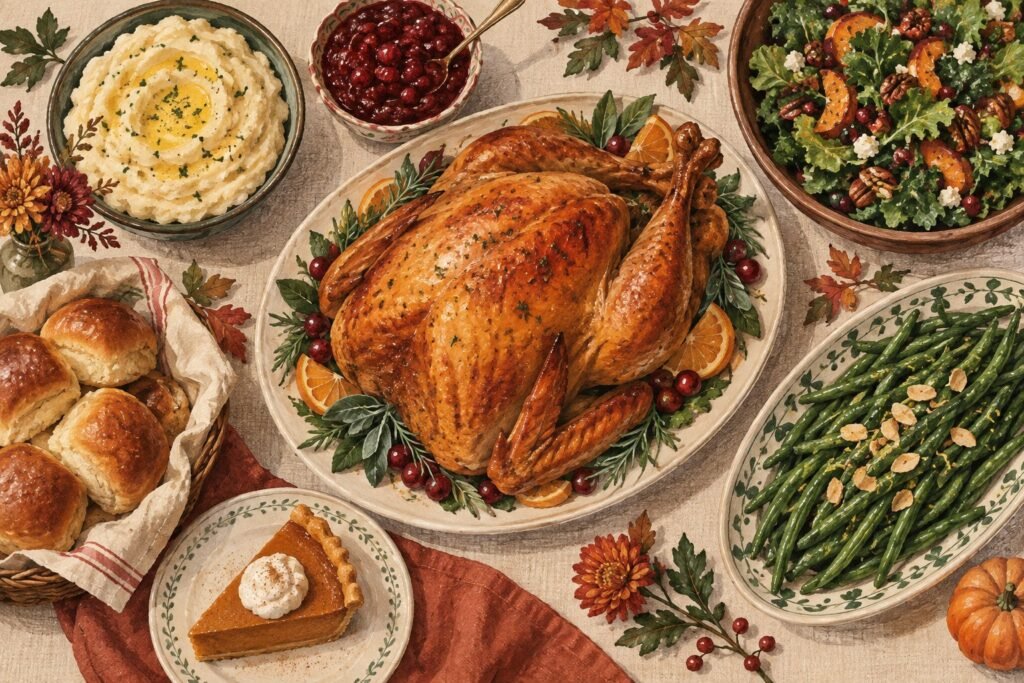
When someone leans in and wants the real picture, walk them through the day. Thanksgiving morning in America starts with the Macy’s Thanksgiving Day Parade in New York — giant balloons, marching bands, Broadway performances — playing on television while the turkey goes into the oven. The afternoon is cooking: turkey roasting for hours, sides multiplying across every available surface, pies cooling on racks. Early evening, everyone sits down — often fifteen or twenty people across generations — to a table that groans under roast turkey, stuffing, mashed potatoes, gravy, cranberry sauce, sweet potatoes, green beans, rolls, and pie. Many families go around the table with each person naming something they are thankful for.
After dinner: the couch, the NFL football triple-header (three professional games back to back, a tradition since the 1930s), pie at halftime, and the long food coma. The next day is Black Friday, the shopping extravaganza. The emotional core is worth stating explicitly: Thanksgiving is the least commercial major American holiday — no gifts, no cards, no religious obligations — just food, family, and gratitude. That is what makes it beloved, and it is usually the detail that lands hardest with non-American listeners. For the full historical background, see the first Thanksgiving story.
The History, Honestly Told
If someone asks where it comes from, give them the honest version — it is more interesting than the myth and earns you credibility.
The popular story: in 1621, the English Pilgrims of Plymouth Colony, having survived their first brutal year with the help of the Wampanoag people — notably Tisquantum (Squanto), who taught them to plant corn — shared a three-day harvest feast. That much is broadly true, though the event was not called Thanksgiving and the relationship it supposedly celebrated was far more complicated.
The honest additions: the peace between colonists and the Wampanoag was brief and transactional, followed by decades of conflict, dispossession, and disease that devastated Native nations. Many Native Americans today observe the fourth Thursday of November as a National Day of Mourning, honoring their ancestors and the ongoing struggle for survival — a solemn counterpoint held annually in Plymouth, Massachusetts since 1970. You do not need to deliver a lecture, but acknowledging this — “the history is complicated, and for Native Americans the day has a very different meaning” — is honest, respectful, and usually appreciated.
The modern holiday’s actual origin is cleaner: the writer and editor Sarah Josepha Hale campaigned for decades to make Thanksgiving national, and President Abraham Lincoln proclaimed it a national holiday in 1863, in the middle of the Civil War, as a day of national gratitude and healing. President Franklin D. Roosevelt later fixed the date to the fourth Thursday of November. So the Thanksgiving Americans celebrate is really a 19th-century invention with a 17th-century origin story — a useful framing when the history questions get detailed. For more, see why we eat turkey on Thanksgiving.
What Thanksgiving Is NOT
Clearing up misconceptions is half the job. Thanksgiving is not religious — it has no church service, no theological content, and is celebrated identically by Americans of every faith and none. There are no gifts — this surprises people from gift-heavy cultures; the meal is the gift. It is not like the Fourth of July — no fireworks, no patriotism pageantry, no public celebrations; it is an indoor, private, family holiday. It is not Christmas — though it opens the holiday season, the mood is autumnal gratitude, not winter festivity, and Americans do not generally eat turkey at Christmas (that is the British). And it is not a harvest festival in the agricultural sense anymore — few celebrants farm; it is a harvest festival the way a wedding is a fertility rite, in spirit and symbolism rather than practice.
Answering the Awkward Questions
“Isn’t Thanksgiving about… you know, the Indians?” — Be honest and brief: “The original story involves the Wampanoag people who helped the early colonists, but what followed was centuries of terrible treatment, and many Native Americans mourn rather than celebrate the day. Most Americans today treat it as a family and gratitude holiday while knowing the history is complicated.” Then move on — you are at a dinner party, not a seminar.
“Why Thursday? Why not the weekend?” — Historical accident layered with practicality: Lincoln’s proclamation set Thursday, FDR cemented it, and the Friday-after became a de facto holiday, creating the four-day weekend Americans now treat as sacred. Thursday dinner, Friday leftovers, weekend recovery — the rhythm is the point.
“Do you miss it?” — This one is personal, and honesty is disarming: “Yes, terribly, which is why I’m cooking a turkey in a Berlin apartment / inviting twelve people to my condo.” Expat vulnerability about homesickness is universally relatable — everyone has a holiday they miss.
“Can I come?” — Say yes. Thanksgiving is the most inclusive American holiday; the tradition of the extra chair, the orphan guest, the friend-of-a-friend is as old as the holiday. Your guest list just grew, and that is exactly right — the open table is the oldest Thanksgiving tradition there is.
Explaining It to Kids
Children — your own, growing up abroad, or local kids you are hosting — need the story at their level. The frame that works: “A long time ago, some people sailed across the ocean to a new land. Their first year was very hard, and the people who already lived there helped them grow food. When the harvest came, they had a big feast to say thank you — and we still have the feast every year to remember to be thankful.” For older kids, add the honest footnote about what happened next — children handle complexity better than adults expect, and the simplified myth does them no favors. Then make it tangible: the gratitude round, the cooking together, the pie. Kids remember doing, not hearing. If you are raising third-culture kids, our American expat Thanksgiving traditions guide explores how families keep the holiday meaningful across borders.
Explaining It at Work: Getting Thursday Off
The practical expat version of this guide: convincing a non-American boss that you need the fourth Thursday of November off. Do not assume they know — put it in writing, early (October), with context: “Thanksgiving is the biggest family holiday in the US — the equivalent of Christmas in terms of travel and family obligation. I’d like to take Thursday [and Friday] off.” Framing it against Christmas gives non-Americans an instant calibration of its weight. Offer to cover, suggest the swap, and note that you will be reachable for anything urgent — then actually cook, host, and be grateful. One more tip: invite colleagues to the Friendsgiving. Nothing explains Thanksgiving like experiencing it, and the colleague who has eaten your turkey will never again question the leave request.
Inviting Non-Americans: Setting Expectations
The explanation does not end when they accept the invitation — a few words beforehand make the evening better for everyone. Tell them: it is secular (no religious obligations), there are no gifts (bring wine or dessert if you like, but nothing is expected), the meal is the event (arrive hungry, expect hours), and the gratitude round is opt-in (going around the table is beloved by Americans and can feel exposing to reserved guests — make it light and voluntary). Warn them about portions — American Thanksgiving servings are generous, and that is the point — and about the pacing: grazing for hours, pie at 10 PM, leftovers pressed on them at midnight. The container of leftovers sent home with every guest is not an afterthought; it is one of the holiday’s sacraments.
The Harvest-Festival Bridge: Every Culture Has One
The single most effective explaining tool is the comparison: almost every culture has a harvest gratitude festival, and naming your listener’s version builds an instant bridge. Germany has Erntedankfest (see our Erntedankfest guide); Korea has Chuseok; China has the Mid-Autumn Festival; India has Pongal; Ghana has Homowo; Britain has its own harvest festival traditions; Brazil has the Dia de Ação de Graças. “It’s our version of your harvest festival — we just do it with turkey and football” is a sentence that has launched a thousand comfortable conversations. For the global tour, see Thanksgiving vs harvest festival around the world. The underlying point is worth making explicitly: gratitude for the harvest is one of humanity’s oldest impulses, and Thanksgiving is simply America’s dialect of a universal language.
The Gratitude Tradition: Explaining the Heart of It
If there is one element of Thanksgiving that puzzles non-Americans most, it is the gratitude practice itself — the going-around-the-table, the toasts, the explicit naming of thanks. In many cultures, gratitude is shown through action, not declared aloud; the American comfort with public emotional expression can read as performative. The way to explain it is through function: the gratitude round is a ritual technology, a structured moment that forces busy people to pause and notice their lives. It works precisely because it is slightly uncomfortable — the mild awkwardness is what makes it memorable.
It helps to note that gratitude rituals are universal, even if the forms differ. The Japanese practice of itadakimasu before meals, the Muslim alhamdulillah, the Jewish tradition of one hundred blessings a day, the simple grace before meals in Christian households — every culture has a technology for noticing good fortune. The Thanksgiving gratitude round is America’s loud, democratic version: everyone speaks, everyone listens, no hierarchy. Framed that way, it stops looking like an American eccentricity and starts looking like what it is — one culture’s answer to a human need. And for guests who dread it, the opt-in rule stands: “Share if you’d like, pass if you’d rather” keeps the ritual warm without making it mandatory.
“Does My Country Have Thanksgiving?” — The World Tour Answer
This question comes up constantly, and the answer is more interesting than most people expect. Canada has its own Thanksgiving on the second Monday of October, with a separate history. Liberia — founded by freed American slaves — celebrates Thanksgiving on the first Thursday of November, the only other country with the American-style holiday. Norfolk Island (Australia) observes it on the last Wednesday of November, a legacy of visiting American whaling ships. The Netherlands holds an annual Thanksgiving service in Leiden’s Pieterskerk for the American community, on the Pilgrims’ old ground. And Grenada marks October 25 as its Thanksgiving, commemorating the 1983 intervention.
Beyond those, nearly every culture has a harvest gratitude festival that serves as the local equivalent — which is why the “it’s our version of your harvest festival” framing works so reliably. The deeper point for your listener: Thanksgiving-the-American-holiday is specific, but thanksgiving-the-human-impulse is universal. You are not asking them to adopt your holiday; you are pointing out that they already have one, and inviting them to compare notes over pie.
Common Reactions and How to Read Them
After years of explaining Thanksgiving abroad, certain reactions recur — and knowing them in advance keeps you from misreading the room. Bemusement at the food: marshmallows on sweet potatoes, the sheer volume, the concept of “dinner at 4 PM followed by more dinner” — smile along; the food is objectively funny from the outside, and self-awareness is charming. Skepticism about the history: educated Europeans especially may know more about the colonial aftermath than you do — meet it with honesty rather than defensiveness; “yes, it’s complicated” is always the right answer. Envy: more common than you would think — people from cultures without a big secular family holiday often wish they had one, and the no-gifts-no-religion format looks liberating. The practical question (“but what do you do all day?”) — answer with the timeline: parade, cooking, feast, football, pie, coma. The ordinariness of it is the charm. And the invitation fish — “that sounds amazing” with meaningful eye contact — is exactly what it looks like. Invite them.
The One-Paragraph Written Version
Sometimes you need the explanation in writing — a message to a partner’s parents, a note to the office, a social media post for international friends. Here is a copy-paste version: “Thanksgiving (this Thursday) is America’s biggest family holiday — a secular harvest celebration where families gather for an enormous traditional dinner of roast turkey and all the trimmings, and everyone shares what they’re thankful for. No gifts, no religious service — just food, family, and gratitude. It’s the equivalent of Christmas in terms of how seriously Americans take it, which is why I’ll be cooking for twelve people and unreachable until the pie is done.” Adjust the last clause to taste. Having a written version ready saves you from composing it fresh every November, and it forwards well — send it to the group chat and let it do the explaining for you.
In Pictures: How to Explain Thanksgiving to Non-Americans
'So you just… eat turkey?' Explaining Thanksgiving abroad takes more than a menu description — it takes the story. Here's how to make it click.
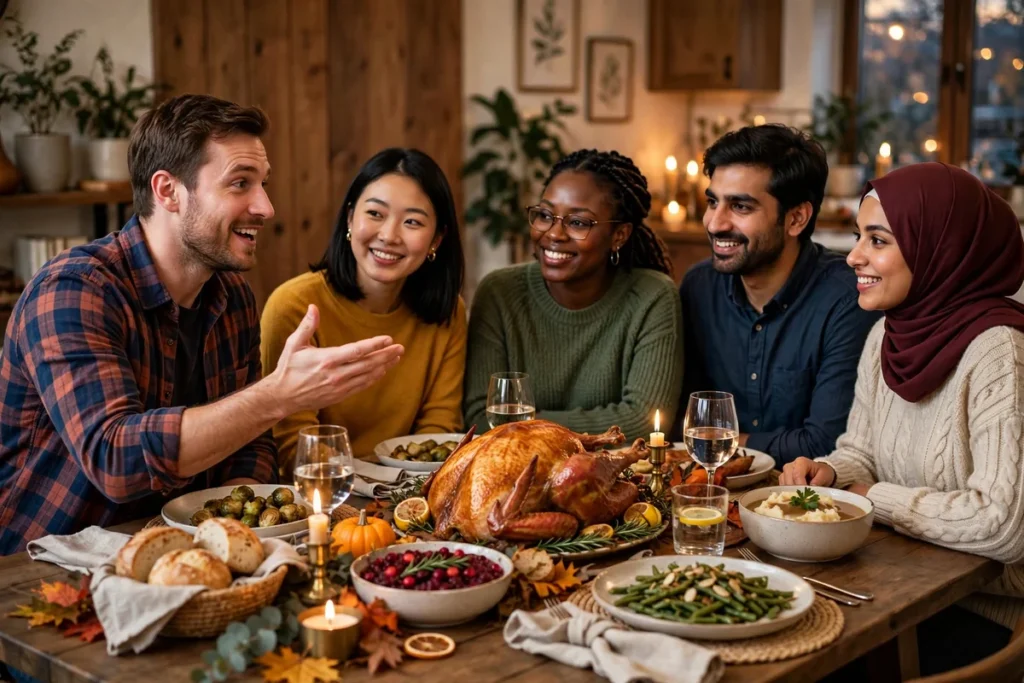
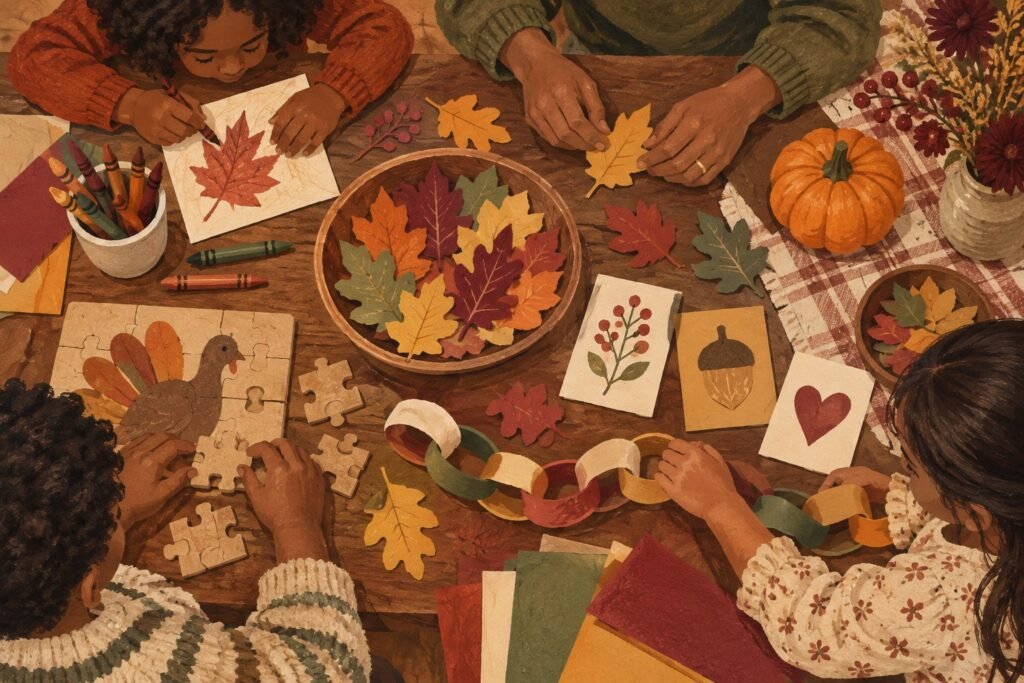
A diverse group of friends around a Thanksgiving table, one guest gesturing as they share the holiday's story.
Watch: How to Explain Thanksgiving to Non-Americans
What Europeans learn when they look past the stereotypes — the secret at the heart of American Thanksgiving.
At a Glance: How to Explain Thanksgiving to Non-Americans
A toolkit for making the holiday make sense abroad.
| Approach | What to say |
|---|---|
| The 30-second pitch | 'It's America's harvest festival — a day to gather, feast, and say what you're grateful for' |
| The harvest bridge | Almost every culture has a harvest celebration — start there, then explain America's version |
| The history (short) | 1621 feast, Lincoln made it national in 1863 — two sentences, no lecture |
| The food logic | Turkey = abundance, pie = harvest crops — it's a menu built from the autumn harvest |
| The gratitude ritual | Going around the table sharing thanks is the part foreigners remember most — lead with it |
| The invitation | The fastest explanation is an invitation — one dinner teaches more than any description |
Frequently Asked Questions
How do you explain Thanksgiving simply?
“It’s America’s harvest festival and biggest family holiday. On the fourth Thursday of November, families gather for a huge turkey dinner and say what they’re grateful for. It’s secular, there are no gifts, and the whole country cooks the same meal.” That covers it in thirty seconds.
Is Thanksgiving a religious holiday?
No. Thanksgiving has no religious content and is celebrated identically by Americans of every faith and none. It is a secular national holiday centered on food, family, and gratitude.
What is the real history of Thanksgiving?
The 1621 harvest feast at Plymouth — shared by English colonists and Wampanoag people — is the origin story, but the modern holiday was created by Abraham Lincoln’s 1863 proclamation during the Civil War. The history is complicated: what followed the first feast was centuries of conflict and dispossession, and many Native Americans observe the day as a National Day of Mourning.
Why do Americans eat turkey on Thanksgiving?
Tradition, scale, and symbolism: turkey was native to North America, large enough to feed a gathering, and became cemented as the centerpiece over the 19th century. See our full explainer on why we eat turkey on Thanksgiving.
How is Thanksgiving different from Christmas?
No gifts, no religious observance, no decorations arms race — just the meal. Thanksgiving is autumnal and food-focused; it opens the holiday season but has a completely different mood from Christmas.
What should I tell my boss to get Thanksgiving off?
Explain it early and calibrate: “Thanksgiving is America’s biggest family holiday — the equivalent of Christmas for travel and family obligation.” Request the Thursday (and Friday) in October, offer coverage, and invite colleagues to your Friendsgiving.
Do other countries celebrate Thanksgiving?
Canada (second Monday of October), Liberia (first Thursday of November), Norfolk Island, and Grenada all have their own Thanksgivings, and the Netherlands holds an annual service in Leiden. Most other cultures have a harvest gratitude festival that serves as the local equivalent — which makes “it’s our version of your harvest festival” the perfect explanation.
How do I explain the Native American history honestly?
Briefly and without defensiveness: the 1621 feast involved the Wampanoag people, but what followed was centuries of conflict and dispossession, and many Native Americans observe the day as a National Day of Mourning. Acknowledge it, then return to the family-and-gratitude present.
Conclusion
Knowing how to explain Thanksgiving to non Americans is really about translation — not of words but of feeling. The facts (fourth Thursday in November, turkey, stuffing, pie, gratitude) are easy; the harder part is conveying why a secular dinner carries the emotional weight of a sacred holiday, why grown adults cry at the table, why the whole country happily cooks the same meal on the same day. The harvest-festival bridge helps, the honest history earns respect, and the invitation does the rest — because Thanksgiving, explained at a table with a full plate in front of you, needs no further translation, in any language. It is the rare American export that improves in the telling: a holiday about gratitude, shared with people who have never heard of it, in a city far from home. That is not a lesser Thanksgiving. In many ways, it is the most Thanksgiving thing of all — the holiday doing beautifully what it was designed to do: gathering people around a shared table to notice, together, how much they have. Browse our Thanksgiving collection for more.