Ask a roomful of Americans abroad about their Thanksgivings, and the stories pour out: the turkey roasted in a toaster oven in Tokyo, the Friendsgiving of fourteen nationalities in Berlin, the video call propped on the gravy boat in Sydney, the morning service in a 600-year-old Leiden church where the Pilgrims once worshipped. American expat Thanksgiving traditions are not a lesser copy of the holiday back home — they are the holiday’s most creative chapter, a living laboratory where the essential rituals get stress-tested by distance, small kitchens, and foreign supermarkets, and come out changed in ways that make them, arguably, better. This is the story of how Americans keep Thanksgiving alive around the world: the orphan dinners, the invented rituals, the dishes that crossed oceans, and the second generation growing up with a holiday that belongs to two countries at once.
The Orphan’s Thanksgiving: Where Every Tradition Begins
Nearly every expat Thanksgiving tradition starts the same way: with a first year that is a little bit lonely. The newly arrived teacher in Seoul, the consultant in Frankfurt, the graduate student in Melbourne — all of them have a version of the story where November arrives, the city carries on as normal, and the homesickness hits like weather. Social media does not help: the feed fills with cousins’ tables and parade floats while you eat noodles alone.
And then, almost always, someone intervenes. A colleague who has been abroad longer. A neighbor from the expat forum. A church, a club, a chance conversation. “We’re doing Thanksgiving Saturday — come.” That invitation is the founding sacrament of expat Thanksgiving culture, and everyone who receives one remembers it. The orphan’s Thanksgiving — the gathering of the far-from-home, the newly arrived, the between-apartments — is not a consolation prize. Veterans will tell you it is often the warmest Thanksgiving of their lives, because everyone at the table chose to be there, and everyone knows exactly what it cost the others to show up. Years later, the orphans become the hosts, and the invitation gets passed forward. That chain of adoption is the oldest and most important American expat Thanksgiving tradition there is.
Friendsgiving: The Holiday’s Greatest Invention
The word “Friendsgiving” entered the American lexicon in the 2000s, but expats had been living it for decades before it had a name. The concept is simple: when family is an ocean away, friends become the family you choose for the holiday. Abroad, Friendsgiving is not the casual pre-Thanksgiving party it can be in the US — it is the main event, the whole holiday, carrying the full emotional weight.
The abroad Friendsgiving has its own evolved customs. The spreadsheet potluck: a shared document where dishes are claimed, not just offered, so the table balances — the veterans know that “bring whatever” produces four desserts and no starch. The turkey syndicate: two or three small households splitting the cost and the bird, or the host with the biggest oven roasting for the group. The open chair: every Friendsgiving keeps room for the last-minute orphan, because everyone was one once. The gratitude round, international edition: fourteen people from nine countries naming their thanks, which routinely reduces the table to tears — the emotional peak of the expat year. And the photo: the big-table picture, taken every year, which becomes the visual record of a chosen family scattered across the globe. If you are building your first one, our how to host Thanksgiving abroad playbook covers the logistics.
New Rituals from Far-Flung Tables
Distance does not just preserve traditions — it invents them. A tour of the expat world’s signature rituals:
The Leiden pilgrimage (Netherlands). The most historically resonant tradition in expat Thanksgiving: the morning train to Leiden for the Thanksgiving service in the Pieterskerk, the Pilgrims’ own church, then back to Amsterdam for dinner. Four centuries of continuity in a single day. See our how to celebrate Thanksgiving in Amsterdam guide for the full itinerary.
The tropical Thanksgiving (Singapore, Bangkok, Dubai). Air-conditioning at full blast, the turkey golden, the table set against a skyline or a pool — and, in the best versions, a deliberate embrace of the climate: cold desserts, lighter sides, the feast followed by a swim. The first year it feels wrong; by the third, the idea of a cold Thanksgiving feels like the strange one.
The summer Thanksgiving (Australia, New Zealand). Late November in 30-degree heat forced the most radical reinvention: barbecued spatchcock turkey, prawns alongside the bird, mango salad, pavlova for dessert. The purists resisted; the converts never looked back. Our Singapore guide and Sydney coverage explore the warm-weather holiday in depth.
The Glühwein Thanksgiving (Germany, Austria). Berlin’s expats worked out that Thanksgiving weekend flows directly into Christmas-market season — Thursday feast, Friday Glühwein at the Weihnachtsmarkt. Two holidays, one weekend, zero conflict. See how to celebrate Thanksgiving in Berlin.
The double Thanksgiving (Toronto, London, everywhere with Canadians). Celebrate the Canadian date in October with local friends, the American date in November with the expat circle — two turkeys, two tables, twice the gratitude. Nobody complains.
The embassy and club Thanksgiving. American Clubs, chambers of commerce, and Democrats Abroad chapters worldwide host holiday dinners that become institutions — the fixed point for expats who rotate through on two-year postings.
The Dishes That Crossed the Ocean
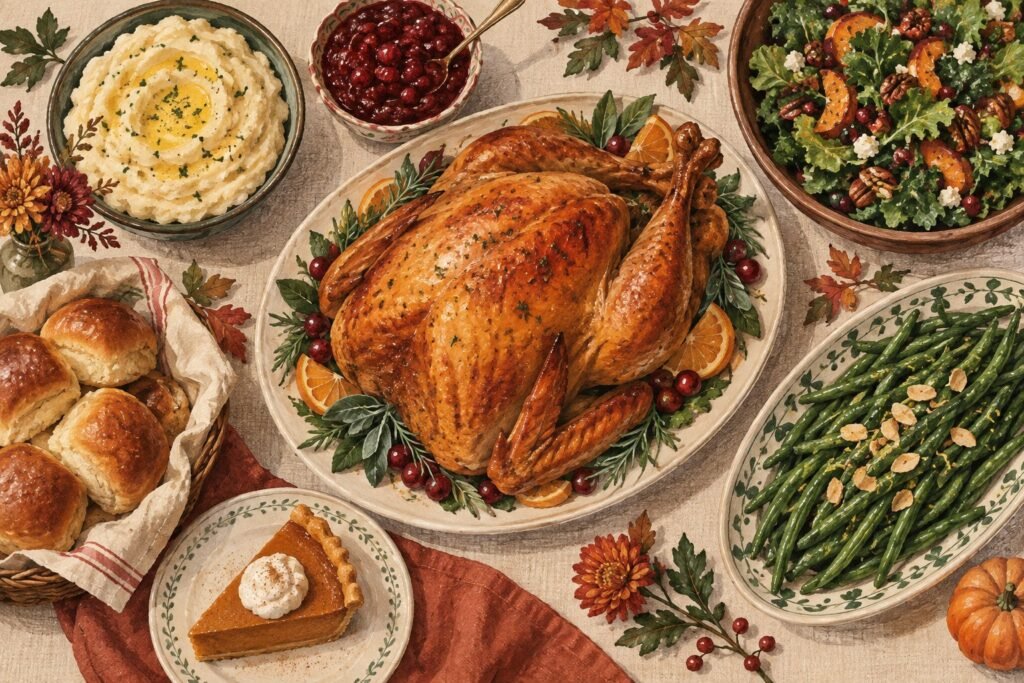
Expat tables develop a distinctive cuisine — the canon, adapted. The turkey survives everywhere (see our Thanksgiving ingredient substitutes abroad guide for the sourcing wars), but the sides tell the story of each posting. In Germany, Rotkohl (red cabbage) joins the table and never leaves. In the Netherlands, speculaas spice replaces pumpkin pie spice and nobody goes back. In France, the cheese course inserts itself between dinner and dessert and improves the pacing immeasurably. In Japan, kabocha makes the best pumpkin pie of your life. In the UK, the bread sauce and the roast potato traditions merge with the American spread into something greater than either. In Australia, the pavlova ends the meal and the argument about it ends there too.
The pattern is consistent: the first year, expats chase exact replication, importing cans at great expense. The third year, they cook with the local market and wonder why they ever did otherwise. The fifth year, they bring the hybrid dishes back to America for the family Thanksgiving — the speculaas pie, the lingonberry sauce, the barbecued turkey — and watch their relatives’ skepticism melt at first bite. The expat table is not a copy. It is a test kitchen, and the results get exported home.
Keeping the Thread: Calls, Care Packages, and Return Trips
Every expat Thanksgiving maintains a lifeline home, and the rituals around it are traditions in themselves. The scheduled call: the laptop at the end of the table during the toast, timed for the American family’s dinner, both sides briefed — short, emotional, essential. The care package exchange: the specific stuffing mix mailed from Ohio, the proper vanilla sent back from Madagascar via Paris — the parcels are love in cardboard. The menu coordination: families who cook “together” across time zones, texting photos of each course. The return trip: the expats who fly home for Thanksgiving every few years describe it as the most emotional travel they do — the childhood table, unchanged, hitting differently after years of building the holiday from scratch. And the reverse visit: parents and siblings who fly out for the expat Thanksgiving, experiencing the hybrid table — the Leiden morning, the tropical evening — and understanding, finally, what the abroad life actually feels like.
Passing It On: The Second Generation
The most poignant expat Thanksgiving tradition is the one being invented right now: raising children abroad with the holiday. Third-culture kids grow up with a Thanksgiving that is naturally, unselfconsciously multinational — the gratitude round in three languages, the table of fourteen nationalities, the turkey alongside dishes from six cuisines. For them, this is not an adapted Thanksgiving; it is simply Thanksgiving, the only kind they have ever known.
Parents develop their own rituals for the transmission: the annual telling of the family Thanksgiving stories, the video call with grandparents as a fixed ceremony, the “one dish from home” each child learns to cook, the big-table photo archive. The children, in turn, develop a relationship with America mediated through the holiday — Thanksgiving becomes their anchor to a country they may barely remember, the day the family is most American. And when those kids grow up and scatter further, they carry the portable version: the knowledge that Thanksgiving is not a place but a practice, buildable anywhere, with anyone, from whatever the market offers. That may be the expat tradition’s finest legacy.
The Traditions Expats Invented (That America Should Steal)
The traffic is not one-way. Years of abroad Thanksgivings have produced innovations worth repatriating. The gratitude jar: notes collected all November, read aloud at the table — deeper than the on-the-spot round. The poem tradition: borrowed from Dutch Sinterklaas, where each guest writes a short funny poem about another — the table’s comedy highlight. The Friendsgiving-first model: celebrating with friends the weekend before and family on the day, so nobody’s holiday depends on a single table. The morning-after walk: the European expat custom of the long post-feast walk (the British invented it, the expats perfected it) as a scheduled event, not an afterthought. The open invitation: the explicit, posted, newcomer-welcoming invite — American Thanksgivings back home could use more of it. The expat laboratory keeps producing; the homeland keeps importing. That exchange is the tradition working as designed.
What the Old Country Teaches: Reverse Culture Shock at the Table
There is a final tradition, quieter than the rest: the expat who goes home for Thanksgiving after years abroad and finds the American table strange. The abundance feels overwhelming after years of small-oven strategizing. The single-culture table feels narrow after years of fourteen nationalities. The canned pumpkin tastes… like a can, after years of roasted Hokkaido. This reverse culture shock is the clearest evidence of what the expat years do: they do not dilute the holiday, they deepen it. The returnee brings back the gratitude jar, the international guest list, the from-scratch everything, the knowledge that the feeling is portable. Home for the holidays, they are the ones who make it better — which is exactly what traditions are for: not preservation under glass, but living use, changed by every hand that carries them.
The Expat Thanksgiving Calendar: A Year in the Life
Expat Thanksgiving is not a day but a season, with its own annual rhythm that veterans recognize instantly. September: the first stirrings — a message in the group chat (“Thanksgiving this year?”), the mental inventory of who is still in town and who has rotated out. October: planning mode — the host emerges, the date gets set, the turkey sourcing begins, the import-shop reconnaissance. This is also when the nostalgia sharpens: the American supermarkets back home are stacking pumpkin displays, and the expat sees the photos. Early November: the sprint — orders placed, invitations out, the spreadsheet potluck filling up, the first “I just moved here, can I come?” message that makes the whole thing worthwhile. Thanksgiving week: the beautiful chaos — prep days, the Wednesday pie bake, the Thursday (or Saturday) feast, the photo, the leftovers. December: the afterglow — the photo shared, the thank-yous sent, the quiet satisfaction of having built it again, and the first idle thought: “next year, we should…” The cycle is the tradition. Expats who have done it five times can feel the year turn by it, the way farmers feel the seasons.
Thanksgiving in Unlikely Places
Some expat Thanksgivings happen far from any expat infrastructure, and those are the stories that get told for decades. The military families who roast turkeys on bases from Germany to Japan, where the commissary stocks the cans and the whole installation eats at the same hour. The oil workers and sailors who time their rotations to be home — or who celebrate on a rig, a ship, a remote site, with a turkey flown in frozen and a gratitude round over satellite phone. The researchers in Antarctica, who famously celebrate both American Thanksgiving and Midwinter with feasts that become legend. The Peace Corps volunteers who explain the holiday to their host villages and end up with a fusion feast nobody will forget. The cruise ship crews, the flight crews laying over in foreign cities, the students in towns with no American community at all, who cook for six in a dorm kitchen and start a tradition the university still talks about. The common thread: the holiday’s portability is its superpower. Give Americans a heat source, a bird (or a reasonable facsimile), and each other, and Thanksgiving happens — in a tent, on a ship, at the bottom of the world.
The Food That Tastes Like Home
Beneath the adaptation, every expat has the one dish that is non-negotiable — the taste that is Thanksgiving, the hill they will die on. For some it is the grandmother’s stuffing recipe, reconstructed from a phone call and three failed attempts. For others, the specific canned cranberry sauce with the ridges from the can — no fresh version accepted, the ridges are the point. The green bean casserole with the fried onions. The Parker House rolls. The pumpkin pie with exactly the right spice ratio, tested against childhood memory.
The care-package economy exists to serve these fixations: the annual parcel from home containing the stuffing mix, the fried onions, the pie spice, the marshmallows — items worth almost nothing in dollars and everything in meaning. Veteran expats learn to consolidate: one consolidated autumn parcel, timed for early November, carrying the irreplaceables for the whole friend group. And the beautiful irony is that the from-scratch converts — the ones who now roast Hokkaido and simmer lingonberries — still keep one canned, boxed, or bagged item on the table, the nostalgic anchor. The ridged cranberry sauce sits next to the artisanal gravy. Both are correct. Tradition is not purity; it is continuity, and the can with the ridges is somebody’s childhood.
Gratitude, Translated
The gratitude round — the expat Thanksgiving’s emotional center — changes character in translation, and the changes are revealing. In tables dominated by Americans, it runs long and tearful. Add British guests, and it gets wry and understated (“grateful for… central heating, honestly”). Add German guests, and it gets sincere but structured. Add Latin American guests, and it gets expansive and familial. Add Japanese guests, and the gratitude goes quiet and deep. The multinational gratitude round is not just a nice moment — it is a cross-cultural education in how different societies handle the emotion, and Americans at these tables consistently report that hearing gratitude in other cultural keys deepens their own practice.
Some tables evolve the format entirely: the gratitude jar filled all November and read aloud; the written notes placed at each setting; the toast that replaces the round; the walk after dinner where pairs share privately. The variations share a discovery: the form of the gratitude matters less than the pause — the deliberate stop in a busy expat life, taken together, to notice. That pause is the tradition’s core technology, and it works in every language. For guidance on explaining the practice to first-time guests, see our how to explain Thanksgiving to non-Americans.
In Pictures: American Expat Thanksgiving Traditions
Orphan's Thanksgivings, Friendsgivings, video calls home, and care packages of Stove Top — expats have reinvented the holiday from scratch. Here's how.
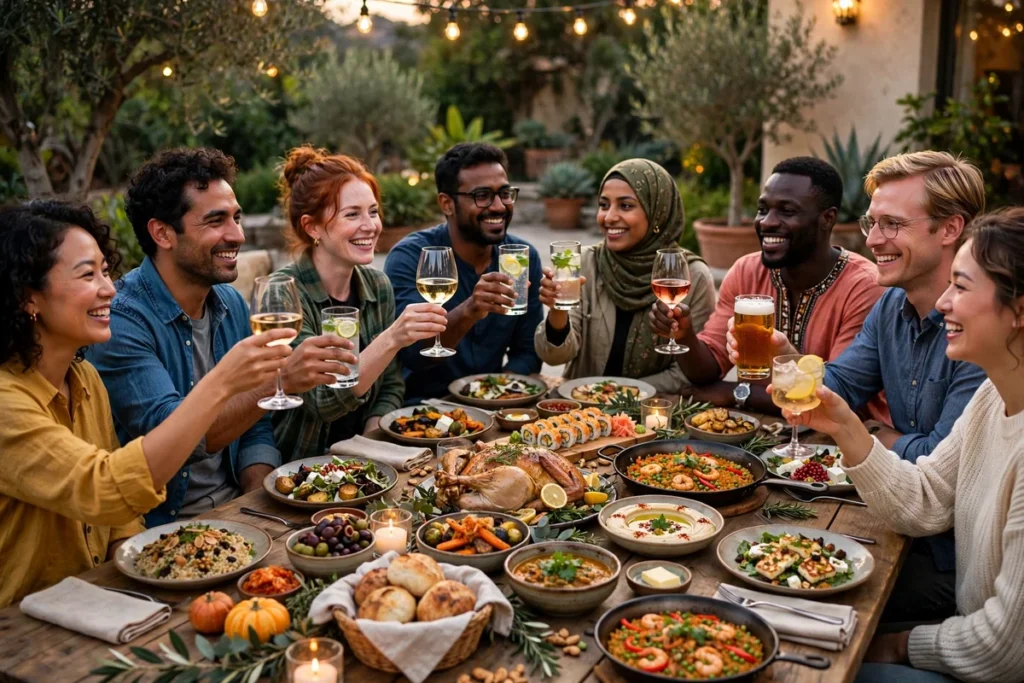
An expat Friendsgiving with a diverse group of friends toasting around a table full of Thanksgiving dishes.
Watch: American Expat Thanksgiving Traditions
What Thanksgiving looks like as an expat in the Philippines — the adaptations, the community, and the spirit that travels.
At a Glance: American Expat Thanksgiving Traditions
The traditions Americans build when home is an ocean away.
| Tradition | What it looks like |
|---|---|
| Orphan's Thanksgiving | Expats who can't get home gather — nobody cooks alone |
| Friendsgiving | The chosen-family feast, often the weekend before or after the real date |
| Video call home | A laptop at the table so grandparents can watch the chaos live |
| Care packages | Family ships the irreplaceable — fried onions, pumpkin spice, nostalgia |
| Local fusion | Host-country dishes join the table — the menu becomes a delicious hybrid |
| The gratitude round | Going around the table matters even more abroad — it's why everyone came |
Frequently Asked Questions
What are the most common American expat Thanksgiving traditions?
Friendsgiving potlucks with assigned dishes, the orphan’s table welcoming newcomers, video calls home during the toast, the annual big-table photo, and locally adapted menus — plus regional signatures like the Leiden Pieterskerk service, tropical Thanksgivings in Singapore, and summer barbecues in Australia.
What is Friendsgiving?
A Thanksgiving celebrated with friends instead of (or as well as) family. Abroad, it is the dominant format: a coordinated potluck where the turkey host roasts the bird, guests bring assigned sides, and the table mixes nationalities. It originated with Americans far from home and has since been adopted everywhere.
How do expats celebrate Thanksgiving with family back home?
Scheduled video calls during the toast, care package exchanges of hard-to-find ingredients, coordinated menus cooked across time zones, and return trips every few years — plus inviting family out to experience the expat version.
Do expat kids celebrate Thanksgiving?
Yes — and for third-culture kids, the multinational expat Thanksgiving is simply what the holiday is. Parents pass it on through stories, the grandparent video call, cooking traditions, and the annual photo archive.
What dishes do expats add to Thanksgiving?
Local signatures: Rotkohl in Germany, speculaas pie in the Netherlands, cheese courses in France, kabocha pie in Japan, pavlova in Australia, lingonberry sauce in Scandinavia. The hybrid dishes often get brought back to American tables.
How can I find an expat Thanksgiving as a newcomer?
Post in expat Facebook groups and on InterNations in early November, check Democrats Abroad and American Club calendars, and ask colleagues — the community is built around adopting newcomers at the holidays. See how to explain Thanksgiving to non-Americans for the cultural briefing to bring along.
Conclusion
American expat Thanksgiving traditions are the holiday’s proof of life — evidence that Thanksgiving was never really about the place, the oven, or the cans, but about the practice: gather people, cook abundantly, notice your blessings, feed everyone including the stranger. From the Pieterskerk in Leiden to a rooftop in Singapore, from a Berlin Altbau to a Sydney backyard, the tradition keeps doing what it has always done — making a home out of whoever is at the table. The orphans become hosts, the hosts become institutions, the children become carriers, and the dishes keep crossing oceans in both directions. If you are spending this November far from home, take heart: you are not missing Thanksgiving. You are making the version you will tell stories about for the rest of your life. For the practical side — sourcing, substituting, hosting — browse our Thanksgiving collection.