The turkey is the undisputed king of the Thanksgiving table — a bird so central to the holiday that the day is sometimes nicknamed “Turkey Day.” But why do we eat turkey on thanksgiving? The answer is more surprising than most people expect. The Pilgrims almost certainly did not serve roast turkey at the famous 1621 feast, the bird’s path to the table runs through English pie traditions and a determined magazine editor, and the most famous turkey story of all — that Benjamin Franklin wanted it as America’s national bird — is mostly a myth. The real story of Thanksgiving turkey is a 400-year tale of ecology, economics, literature, and one woman’s relentless campaign to define what an American feast should look like.
The Short Answer
We eat turkey on Thanksgiving because wild turkeys were abundant in colonial New England, because the bird was already an established centerpiece for English celebratory feasts, and — decisively — because nineteenth-century tastemakers, led by Sarah Josepha Hale, chose it as the symbol of the American Thanksgiving dinner and promoted it relentlessly in print. When Abraham Lincoln made Thanksgiving a national holiday in 1863, the turkey was already the expected main dish in the minds of millions of readers. Tradition did the rest.
What Was on the Table in 1621: The First Feast
Let’s start with the feast that supposedly started it all. In the autumn of 1621, the surviving Pilgrims of Plymouth Colony and about ninety Wampanoag guests shared a three-day harvest celebration. Our main source is a brief letter written by Pilgrim Edward Winslow, who described fowling expeditions that brought in wild birds, the Wampanoag bringing five deer, and a general abundance of the harvest.
Here is what historians agree was almost certainly not on the table: roast turkey as we know it, mashed potatoes, cranberry sauce, pumpkin pie, or sweet potatoes. The colonists had no ovens for baking pies, their sugar supplies were nearly exhausted, and potatoes had not yet been widely introduced to North America. The menu was more likely venison, wild waterfowl (ducks and geese, which Winslow’s “fowl” probably meant), corn, squash, shellfish, and fish. Wild turkeys may well have been among the birds eaten — they were native and plentiful in New England — but there is no record of a great roasted turkey presiding over the feast. The 1621 menu was a practical harvest meal, not a ceremonial one.
Why the Myth Persisted
The image of the Pilgrims carving a golden turkey comes not from 1621 but from the nineteenth century, when writers and artists retrofitted the first Thanksgiving with the customs of their own time. Sarah Josepha Hale, in her 1827 novel Northwood, described a Thanksgiving dinner with roast turkey at its head — and because her book reached an enormous audience, her fictional menu became, in the popular mind, the Pilgrims’ menu. Later generations of textbook illustrators completed the job. The turkey at the first Thanksgiving is less a historical fact than a nineteenth-century editorial decision that hardened into myth.
How the Turkey Won Colonial America
Long before Thanksgiving was a national holiday, the turkey was already auditioning for the role of America’s celebration bird. Wild turkeys (Meleagris gallopavo) were native to North America and spectacularly abundant when Europeans arrived — early accounts describe flocks darkening the skies of the eastern woodlands. For colonists, turkey was practical: a single bird could feed a large family, it was cheaper than raising geese, and it was available for the hunting.
Just as important was the English tradition the colonists brought with them. In Tudor and Stuart England, large roasted birds were the centerpiece of Christmas and harvest feasts — goose was the classic, but turkey, introduced to England from the Americas in the 1500s, was already a fashionable alternative for the wealthy. A whole roasted turkey “sticking out of a pie” was a familiar sight in English cookery books. The colonists who could afford celebratory meals naturally reached for the biggest, most impressive bird available, and in New England that bird was the wild turkey.
The Economics of the Centerpiece
Food historians point to a simple, powerful logic: the centerpiece of a feast must be impressive. As one historian of American foodways has noted, chicken or pork would not do for a major celebratory meal — by the nineteenth century, those meats were everyday fare. A turkey, especially a large one, was elaborate, colorful, and dramatic: it let the cook show off and gave the table a visual anchor. Turkeys were also economical for big gatherings — one bird feeds many — and they were well suited to the large-family, community-scale feasting that Thanksgiving demanded. The turkey won not by decree but by fitting the job description better than any competitor.
Sarah Hale’s Decisive Role: Inventing the Menu
The single most important figure in the turkey’s rise is Sarah Josepha Hale. Her 1827 novel Northwood did not just mention turkey — it staged it. An entire chapter describes a New England Thanksgiving feast with a roasted turkey at the head of the table, “sending forth rich odors of savory stuffing,” surrounded by plum puddings and pies “of every description known in Yankee land.” For readers across the country, many of whom had never seen a New England Thanksgiving, Hale’s fictional dinner became the template for the real thing.
But Hale did not stop at fiction. As editor of Godey’s Lady’s Book, she spent decades publishing Thanksgiving menus, recipes, and table-setting advice, with roast turkey invariably at the center. She printed instructions for roasting, for stuffing, for gravy — standardizing the dish across a continent. By the time Lincoln proclaimed the national holiday in 1863, millions of American women had been cooking Hale’s Thanksgiving for years. The turkey was not chosen by the Pilgrims or decreed by a president; it was marketed, menu by menu, into inevitability.
The Lincoln Connection
There is a pleasing coda to this story: Abraham Lincoln himself loved roast turkey. Contemporary accounts describe turkey as a fixture of White House holiday meals during his presidency, and the bird’s association with the new national holiday was sealed by the president’s own table. When the nation’s first family served turkey on the first national Thanksgiving, the custom gained the ultimate endorsement. Tradition, once established at the top, filtered down through every level of American society.
The Franklin Story: Did He Really Want a Turkey for America’s Symbol?
No Thanksgiving turkey discussion is complete without the Benjamin Franklin story — and no version of it you have heard is quite right. The tale goes that Franklin wanted the turkey, not the bald eagle, as America’s national bird. Here is what actually happened.
On January 26, 1784, Franklin wrote a private letter from Paris to his daughter, Sarah Bache, commenting on the design of the Great Seal of the United States. He complained that the eagle depicted looked more like a turkey, and added — with his characteristic wit — that he was “not displeased” by the resemblance, since the turkey was “in comparison a much more respectable bird, and withal a true original native of America,” while the bald eagle was a bird of “bad moral character” that stole its living from other birds. Franklin praised the turkey as “a bird of courage” that “would not hesitate to attack a grenadier of the British Guards.”
It is a delightful letter, and Franklin clearly admired the turkey. But he never seriously proposed it as the national symbol, never campaigned for it, and never raised the idea publicly. The story grew in the telling — boosted, historians note, by a famous 1962 New Yorker cover showing a turkey in the eagle’s place — until a private joke became a national myth. The truth is better than the myth: Franklin’s real contribution to Thanksgiving turkey lore is that he articulated, a century early, exactly why Americans would love the bird — native, courageous, and unmistakably their own.
For more on the holiday’s founding narrative, see the true story of the first Thanksgiving and who the Pilgrims really were.
Why Turkey Beat Goose, Chicken, and Venison
The turkey had serious competitors. Consider the alternatives: goose was the traditional English Christmas bird, rich and flavorful but expensive to raise and greasy to cook. Chicken was affordable but too small and too ordinary — a Tuesday dinner, not a feast centerpiece. Venison was the actual meat of the 1621 feast, but by the nineteenth century, wild deer were scarce near settled areas and farmed venison was impractical. Duck was delicious but small. Each rival failed at least one test of the ideal Thanksgiving centerpiece.
The turkey passed them all. Size: one bird feeds a crowd, making it economical for the large family gatherings Thanksgiving demands. Availability: wild turkeys were abundant, and domestic turkey farming scaled easily. Affordability: turkey was cheaper per pound than goose and far more practical than venison. Drama: a big, golden-brown bird carried to the table is a showpiece — it announces “feast” in a way no platter of chicken parts can. Neutrality: turkey’s mild flavor pairs with everything from oyster stuffing to cranberry sauce, making it a versatile canvas for regional traditions. No other bird combined all five advantages.
The Name Game: Why “Turkey”?
Here’s a bonus etymology: the bird is called “turkey” because of a centuries-old case of mistaken identity. When Europeans first encountered guineafowl imported through Turkish and Ottoman traders, they called them “turkey cocks.” When the larger American bird arrived in England in the 1500s, English traders applied the same familiar name. The American turkey has nothing to do with Turkey the country — it’s a linguistic fossil of early global trade. (In a delightful mirror image, Turks call the bird hindi, “from India,” because they made the same kind of geographic error in reverse.)
The Modern Turkey Tradition
Today, the Thanksgiving turkey is an institution with its own infrastructure. The National Turkey Federation reports that the overwhelming majority of Americans serve turkey on Thanksgiving — surveys have put the figure around 88%. The average bird weighs about 16 pounds. Minnesota leads the nation in turkey production, and the Butterball Turkey Talk-Line — operating since 1981 — fields hundreds of thousands of calls, chats, and video sessions from anxious cooks each November.
The traditions keep evolving. The presidential turkey pardon, made annual by George H. W. Bush in 1989, is now a beloved White House ritual. Deep-fried turkey, popularized in the South, has its devotees and its fire-department warnings. Spatchcocking, dry-brining, and sous-vide techniques compete with grandmother’s recipe. Vegetarian and vegan households serve tofurky, stuffed squash, or mushroom Wellington. And a growing number of cooks are rediscovering heritage breeds — slower-growing, more flavorful birds that taste like turkey did a century ago.
What hasn’t changed is the bird’s symbolic job: to sit at the center of the table, golden and abundant, and say without words what the holiday is about. However you cook it — or whether you serve it at all — the turkey earned its place through four centuries of practicality, promotion, and one editor’s unshakeable vision of what an American feast should look like.
In Pictures: Why We Eat Turkey on Thanksgiving
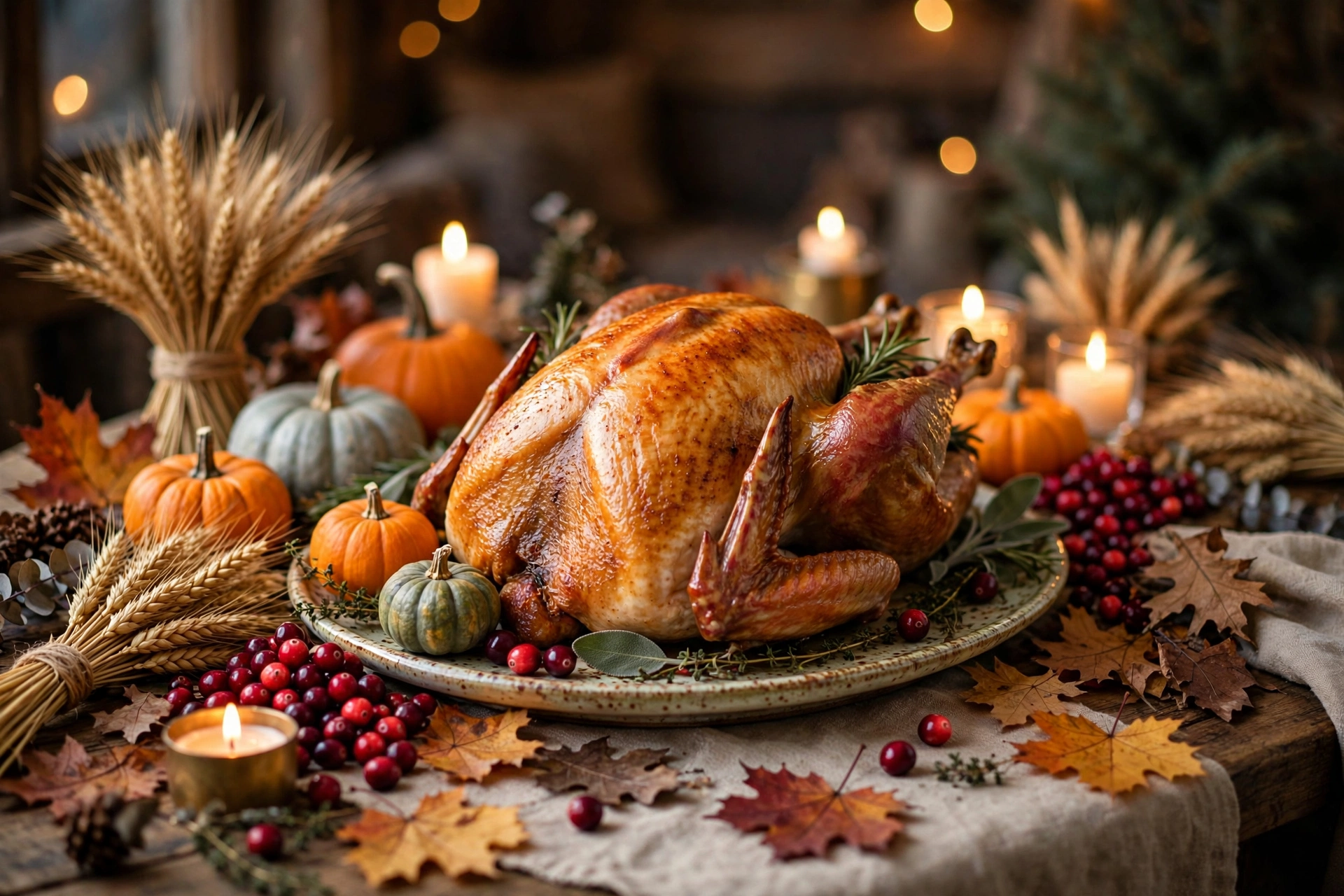
The turkey wasn't inevitable — it beat out goose, duck, and even eagle (in Franklin's famous musing) to become the centerpiece. Here's the bird that won the holiday.

A golden roasted turkey on a carving board surrounded by rosemary, cranberries, and roasted vegetables.
Watch: Why We Eat Turkey on Thanksgiving
The real story of how turkey became Thanksgiving's symbol — separating the myths from what actually put the bird on the table.
At a Glance: Why We Eat Turkey on Thanksgiving
The milestones that made turkey synonymous with the holiday.
| Fact | Detail |
|---|---|
| A practical choice | Wild turkeys were plentiful in New England and big enough to feed a crowd — no refrigeration needed before the feast |
| Franklin's letter | In a 1784 letter, Benjamin Franklin called the turkey 'a much more respectable bird' than the bald eagle — about the national emblem, not the menu |
| Hale's recipes | Sarah Josepha Hale published roast turkey recipes that helped standardize the Thanksgiving menu in the 1800s |
| Dickens' influence | 'A Christmas Carol' (1843) made turkey the aspirational holiday bird on both sides of the Atlantic |
| Scale today | Around 46 million turkeys are eaten each Thanksgiving in the United States, per the National Turkey Federation |
| The pardoning | The presidential turkey pardon became an annual White House tradition in 1989 under George H. W. Bush |
Frequently Asked Questions
Why do we eat turkey on Thanksgiving?
Wild turkeys were abundant in colonial America, the bird was already an English celebratory centerpiece, and nineteenth-century tastemakers — led by Sarah Josepha Hale’s menus and recipes — established roast turkey as the expected Thanksgiving main dish. Its size, affordability, and visual drama made it ideal for large family feasts.
Did the Pilgrims eat turkey at the first Thanksgiving?
Probably not as the centerpiece. The 1621 feast likely featured venison (the Wampanoag brought five deer), wild waterfowl such as ducks and geese, corn, squash, and shellfish. Wild turkey may have been among the birds eaten, but there is no record of a roasted turkey presiding over the meal.
Did Benjamin Franklin want the turkey as the national bird?
Not seriously. In a private 1784 letter to his daughter, Franklin joked that the eagle on the Great Seal looked like a turkey and praised the turkey as “a true original native of America” and “a bird of courage.” He never proposed it publicly or campaigned for it — the story grew in the retelling.
What role did Sarah Josepha Hale play in the turkey tradition?
A decisive one. Her 1827 novel Northwood featured a roast turkey at the Thanksgiving table, and as editor of Godey’s Lady’s Book she published turkey-centered Thanksgiving menus and recipes for decades, standardizing the dish across America before the holiday was even national.
How many Americans eat turkey on Thanksgiving?
The National Turkey Federation’s surveys have found that roughly 88% of Americans serve turkey on Thanksgiving, making it by far the dominant choice. The average Thanksgiving turkey weighs about 16 pounds.
What are the alternatives to turkey?
Popular alternatives include ham, roast goose or duck, prime rib, vegetarian options like stuffed squash or mushroom Wellington, and plant-based roasts. In other countries’ Thanksgivings, chicken, salmon, and local dishes often take the turkey’s place.
Conclusion
We eat turkey on Thanksgiving because a wild American bird met an English feast tradition, was championed by a determined editor, was endorsed by a wartime president, and proved — year after year, table after table — that nothing says “feast” quite like a golden bird big enough to feed the whole family. The Pilgrims may not have served it, and Franklin may not have nominated it, but Sarah Hale imagined it, Lincoln’s America adopted it, and four centuries of cooks have confirmed the choice. This November, when the turkey comes out of the oven, you’ll know exactly how it got there.
Related reading: Sarah Josepha Hale, the Mother of Thanksgiving, what the Pilgrims actually ate, who the Pilgrims were, and more Thanksgiving guides.
From Farm to Table: The Turkey Industry
The Thanksgiving turkey doesn’t just appear — it’s the product of one of America’s most specialized agricultural industries. Modern turkey farming is concentrated in the Upper Midwest and Southeast, with Minnesota leading the nation in production. The birds raised for Thanksgiving are broad-breasted whites, bred over decades for maximum breast meat and rapid growth: a bird that took six months to reach market weight in the 1930s now gets there in about four.
The industry’s calendar revolves around the fourth Thursday of November. Hatcheries time their poults so that birds reach ideal weight — typically 14 to 24 pounds — in mid-November. Processing plants run at full capacity in the weeks before the holiday, and the frozen-turkey supply chain is one of the marvels of American food logistics: millions of birds, processed, frozen, and distributed to every supermarket in the country in time for a single day’s dinners.
The Butterball Story
No brand is more synonymous with Thanksgiving turkey than Butterball, introduced in 1954 and now the best-selling turkey brand in America. Butterball’s innovation was consistency: a branded, quality-graded bird that took the guesswork out of buying. The company’s Turkey Talk-Line, launched in 1981 with a handful of home economists, has become a cultural institution — answering hundreds of thousands of questions each November by phone, chat, email, and now video call. The most common questions year after year: how to thaw, how long to cook, and whether the turkey is done. (Answer: use a meat thermometer; 165°F in the thickest part of the thigh.)
Cooking the Bird: A Brief History of Methods
How Americans cook their turkey has evolved as much as the bird itself. The nineteenth-century standard was open-hearth or wood-stove roasting, basted for hours — the method Sarah Hale’s readers used. The twentieth century brought the electric oven and the pop-up timer, standardizing the roast. Then came the challengers.
Deep-frying, popularized in Louisiana’s Cajun country and spread nationally in the 1990s and 2000s, produces exceptionally moist meat and crisp skin in under an hour — along with annual fire-department warnings about fryer safety. Spatchcocking (butterflying the bird flat) has won converts among food writers for its even cooking and shorter roasting time. Dry-brining — salting the bird a day or two ahead — has largely replaced wet brining among serious cooks for its crisp-skin results. Smoking gives the turkey a barbecue character beloved in the South and Midwest. And the sous-vide turkey breast, cooked precisely in a water bath, represents the high-tech frontier.
Through every method, the goal is the same one colonial cooks pursued: a bird impressive enough to anchor the feast and generous enough to feed everyone at the table — with leftovers for the legendary day-after sandwiches.
Frequently Asked Questions (Continued)
How big is the average Thanksgiving turkey?
The average Thanksgiving turkey weighs about 16 pounds, which typically serves 10 to 12 people with leftovers. Birds range from 10-pound hens to 24-pound-plus toms for large gatherings.
What is the presidential turkey pardon?
Each November, the U.S. president ceremonially “pardons” a live turkey, sparing it from the dinner table. Presidents had spared turkeys sporadically for decades, but George H. W. Bush made it an official annual tradition in 1989. The pardoned birds typically retire to farms or agricultural universities.
Is deep-fried turkey safe?
Deep-fried turkey is delicious but requires strict safety precautions: fry outdoors away from structures, never use a frozen or partially frozen bird (ice causes explosive oil overflow), keep a fire extinguisher nearby, and lower the turkey into the oil slowly. Fire departments respond to fryer fires every Thanksgiving.
The Day-After Sandwich: A Coda
No account of the Thanksgiving turkey is complete without its second act: the leftovers. The day-after turkey sandwich — cold turkey, stuffing, cranberry sauce, a smear of gravy or mayo, on a soft roll — has achieved a cultural status nearly equal to the dinner itself. Some families plan for it deliberately, roasting a larger bird than the feast requires. Chefs have built careers on elevating it; food writers rank the best constructions; and more than one cook has confessed that the sandwich is what they’re really looking forward to.
The leftover ritual is the turkey tradition’s final proof of fitness: no other centerpiece generates a second beloved meal. The goose is too small, the ham too salty, the roast too lean. Only the turkey — big, mild, versatile — stretches across two days of celebration. It feeds the feast and then feeds the memory of the feast. Four centuries after the first colonists hunted wild birds in the New England woods, the turkey is still doing exactly the job it was hired for.